
Introduction
HR Tech and Benefits Administration teams often discover Workato's limitations the hard way — a payroll sync that loops through 10,000 employee records counts every iteration as a separate billable task. Actions that run successfully inside a failed job still count. The costs compound fast, and the complexity compounds faster.
As integration needs grow more specialized across the 60+ HRIS, payroll, and benefits systems that modern HR Tech stacks depend on, teams are actively searching for alternatives. Some need a cheaper general-purpose tool. Others need something purpose-built for their domain entirely.
This guide covers the leading Workato alternatives for 2026 — general-purpose iPaaS tools, unified API platforms, and purpose-built HR Tech infrastructure — with honest assessments of where each fits and who each is actually built for.
TL;DR
- Workato is a capable but expensive general-purpose iPaaS with task-based pricing that can spike sharply at scale
- Best for enterprise API management: MuleSoft
- Best for hybrid cloud/on-premise: Boomi
- Best for lightweight automation: Zapier or Make
- Best for HR Tech and Benefits Administration: Bindbee — a purpose-built unified API purpose-built for HRIS, payroll, and benefits data
- Evaluate alternatives on pricing transparency, connector depth, and maintenance ownership
What Is Workato and Why Look for Alternatives?
Workato is a cloud-based iPaaS (Integration Platform as a Service) that lets teams automate workflows between SaaS apps using a low-code "recipe" builder. It's popular for sales, marketing, and operational automation — connecting tools like Salesforce, Slack, and NetSuite with minimal engineering overhead.
For many teams, though, that simplicity has limits. Here's where Workato tends to break down.
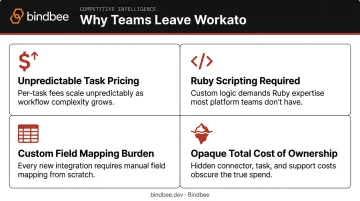
The Four Reasons Teams Start Looking Elsewhere
1. Task-based pricing escalates unpredictably Every connector action counts as a task — including actions inside loops, and actions that run successfully inside a failed job. A recipe that loops through employee records and hits an error midway still charges for every action that completed. Repeat-while loops have a 50,000-iteration defensive cap, but by then the billing damage is done.
2. Advanced customization requires Ruby Workato's Ruby snippets connector runs on Ruby 2.7 with 256 MB memory and a 30-second timeout. Complex transformations push business users out and pull developers in — defeating the low-code value proposition.
3. Generic data models require custom mapping work Workato wasn't built for HR data complexity. Teams connecting HRIS and payroll systems must build and maintain custom field mappings for every system — Workday fields differ from BambooHR fields, which differ again from ADP fields. That work compounds as the customer base grows.
4. Opaque total cost of ownership Entry-level pricing looks manageable. Add connector volume, retries, dev/test executions, and premium connectors, and the real number looks very different.
What to Look for in a Workato Alternative
Before shortlisting platforms, pin down what actually matters for your use case. Three criteria consistently separate good fits from expensive regrets:
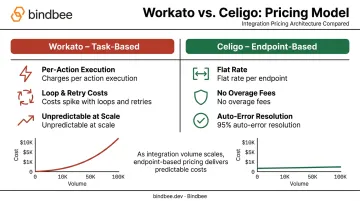
Pricing transparency Understand exactly how costs scale. Task-based models (Workato, Make) charge per action execution. Endpoint-based models (Celigo) charge a flat rate regardless of volume. Outcome-based pricing ties cost to measurable results. Know which model matches your usage pattern before committing.
Connector depth vs. connector count A platform claiming 1,000+ connectors means little if those connectors require manual field mapping, break on API updates, or cover only the top-level data objects. Ask who maintains connectors when upstream systems change — the vendor or your team.
Low-code usability vs. technical depth Strong platforms let business users build simple flows while giving engineers room for custom data transformations when requirements grow. Platforms that require scripting for anything beyond basic triggers will create bottlenecks as needs grow.
Top Workato Alternatives for 2026
These alternatives were selected based on pricing transparency, connector depth, ease of use, scalability, and fit for HR Tech, Benefits Administration, and adjacent SaaS teams.
Bindbee
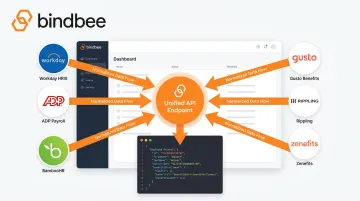
Bindbee is a unified API platform built specifically for HR Tech, Benefits Administration, payroll, and InsurTech companies. Rather than a general-purpose workflow builder, it provides a single API that connects to 65+ HRIS, payroll, benefits, and carrier systems — normalizing all data into benefits-first data models so engineering teams never have to write custom field mappings.
The practical difference from Workato is structural. With Workato, your team builds and maintains integration logic for each HRIS system. With Bindbee, you integrate once against their unified API and instantly support every HR system your customers use.
When ADP or Workday updates their API, Bindbee absorbs the change — your code doesn't touch it.
Customers like Phin went live in 48 hours instead of 10+ weeks compared to native integration timelines. Healthee's team reported HRIS integration dropping from 2+ months to minutes, enabling same-day customer go-lives. Giftpack's VP of Engineering put it directly: "With the Unified API, I can integrate once and instantly support many platforms without dealing with each provider's quirks."
Key differentiators include:
- Benefits-first data models with Employee Benefits, Employer Benefits, and Dependent Benefits as distinct schemas
- Magic Link authentication — employers connect their HRIS in under 10 minutes, no IT involvement required
- Automatic incremental syncs every few hours with webhook notifications on completion
- SFTP-to-API Bridge for legacy systems that export batch files rather than API calls
- Carrier integrations including benefits enrollment sync, dependent data, and contribution mapping
- SOC 2 Type II, ISO 27001, HIPAA-compliant, GDPR-ready
| Attribute | Details |
|---|---|
| Best For | HR Tech, Benefits Administration, Payroll Platforms, InsurTech, and TPAs needing normalized HRIS/benefits data across 60+ systems |
| Key Features | Unified API for 65+ systems, benefits-first data models, zero-maintenance connectors, Magic Link auth, webhooks, SFTP-to-API Bridge, custom fields |
| Pricing | Contact Bindbee; setup in less than 1 day vs. 4–8 weeks for native API builds |
MuleSoft (Anypoint Platform)
MuleSoft, owned by Salesforce, is built around an API-led connectivity model used by large enterprises managing complex, multi-system architectures. It's the platform of choice for organizations that need deep API governance, lifecycle management, and advanced data transformation at scale.
DataWeave — MuleSoft's proprietary transformation language — handles complex data mapping that would require scripting in other platforms. Anypoint API Governance provides organization-wide dashboards for conformance tracking. Deployment flexibility is genuine: MuleSoft supports CloudHub 2.0, hybrid deployments, Private Cloud Edition, and Anypoint Runtime Fabric.
The tradeoff: MuleSoft requires dedicated integration developers or expensive consulting to operate effectively. A Forrester Total Economic Impact study found $12.3M in benefits and $2.3M in costs over three years for a composite enterprise — meaningful ROI, but only if you have the team to extract it.
| Attribute | Details |
|---|---|
| Best For | Large enterprises with dedicated integration teams, Salesforce-heavy architectures, strict API governance requirements |
| Key Features | API-led connectivity, DataWeave transformation, hybrid deployment, API Governance, Flex Gateway, Intelligent Document Processing |
| Pricing | Custom enterprise pricing; contact MuleSoft for a quote |
Boomi
Boomi uses lightweight runtime engines called "Atoms" that deploy in the cloud or on-premise, making it genuinely useful for enterprises with mixed infrastructure — modern SaaS plus legacy on-prem systems sitting side by side.
The platform covers application integration, API management, master data management, and B2B/EDI in one place. Boomi's AI mapping tool, Boomi Suggest, uses a crowd-sourced database of 26M+ data maps to recommend field mappings with confidence scores — useful for accelerating complex data transformation work.
Entry pricing starts at $99/month plus usage, making Boomi the most accessible enterprise iPaaS on this list for smaller teams evaluating enterprise iPaaS. Advanced use cases still require scripting, and the interface has a learning curve, but the hybrid deployment flexibility is a genuine differentiator.
| Attribute | Details |
|---|---|
| Best For | Mid-to-large enterprises with hybrid cloud and on-premise infrastructure, MDM and EDI requirements |
| Key Features | 1,500+ connector APIs, hybrid Atom deployment, Master Data Hub, API management, AI-powered field mapping, event streams |
| Pricing | Pay-as-you-go from $99/month; enterprise tiers available |
Celigo
Celigo's clearest differentiator from Workato is pricing. Where Workato charges per task execution, Celigo charges a flat rate based on endpoints — no overage fees, no surprises when a sync runs more often than expected. Enterprise editions include unlimited endpoints.
The platform's AI-driven error management is genuinely useful: Celigo automatically resolves over 95% of errors each month, retrying intermittent failures up to four times over a 7.5-hour window. For teams tired of babysitting integration error queues, that's a meaningful operational improvement.
Celigo has native support for HR and PeopleOps workflows — benefits administration, employee onboarding, and HRIS automation are documented solutions, not just theoretical use cases. It's a strong fit for mid-market companies that need predictable pricing and solid HR system coverage without going full enterprise iPaaS.
| Attribute | Details |
|---|---|
| Best For | Fast-growing companies and enterprises needing end-to-end business process automation across ERP, CRM, HR, and e-commerce |
| Key Features | 1,000+ prebuilt integrations, AI error management (95% auto-resolution), reusable components, API management, EDI support, endpoint-based pricing |
| Pricing | Custom pricing based on endpoints; contact Celigo |
Tray.ai
Tray.ai targets technical teams and SaaS product teams that need both a visual workflow builder and deep API-level customization. Its Merlin Agent Builder enables no-code AI agent development with enterprise guardrails, while the Agent Gateway for MCP provides governance for approved tools with policies, versioning, and compliance controls.
The embedded integration capability — supporting 700+ connectors that SaaS teams can white-label directly into their products — makes Tray.ai particularly relevant for software vendors building customer-facing integrations. Pricing isn't publicly listed; Tray.ai directs buyers to contact sales.
| Attribute | Details |
|---|---|
| Best For | Technical automation teams and SaaS product teams needing flexible API customization and embedded integration |
| Key Features | Visual builder + API connectivity, Merlin AI agent builder, Agent Gateway for MCP governance, 700+ integrations, embedded integration support, SOC 2 and GDPR compliance |
| Pricing | Contact Tray.ai for pricing |
Zapier
Zapier connects 8,000+ apps through simple trigger-action workflows. For small businesses, startups, and individual contributors who need fast automation between popular SaaS tools, nothing is easier to get started with — paid plans begin at $19.99/month and the free tier is genuinely useful.
The hard limits: Zapier doesn't support two-way syncing and isn't designed for high-volume, data-heavy workflows. For HR/benefits integration with bidirectional data requirements, it's the wrong tool.
| Attribute | Details |
|---|---|
| Best For | Small businesses and individual users needing simple, one-way automation between popular SaaS apps |
| Key Features | 8,000+ app integrations, trigger-action Zap builder, multi-step Zaps, prebuilt templates, AI workflow builder |
| Pricing | Free tier available; paid plans from $19.99/month |
Make (formerly Integromat)
Make's visual scenario builder shows exactly how data flows between apps — a flowchart approach that's more transparent than simple trigger-action tools and more accessible than enterprise iPaaS platforms. At $12/month for the Core plan, it's among the most affordable options for moderate-volume automation.
The 3,000+ connectors cover most popular SaaS tools, and the conditional logic capabilities give technically inclined users real flexibility. High-volume enterprise use cases are where Make reaches its ceiling — it's purpose-built for SMBs and growth teams, not mission-critical data pipelines.
| Attribute | Details |
|---|---|
| Best For | SMBs and technically savvy business users needing flexible, visual workflow automation at a low price |
| Key Features | Visual scenario builder, advanced routing and conditional logic, 3,000+ app connectors, AI agents, embedded capabilities |
| Pricing | Free tier available; Core plan from $12/month |
How We Chose These Workato Alternatives
Evaluating iPaaS alternatives means looking past marketing claims — a few factors consistently separate tools that scale cleanly from ones that quietly create engineering debt.
Evaluation criteria:
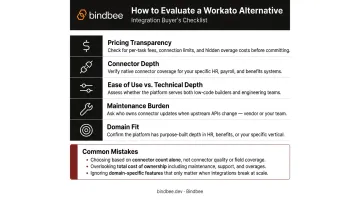
- Pricing transparency — flat-rate or endpoint-based pricing vs. task-based models where costs compound unpredictably at scale
- Connector depth — quality and maintenance model of connectors, not raw count
- Ease of use vs. technical depth — does the platform serve both business users and engineers, or just one?
- Maintenance burden — vendor-maintained connectors vs. ongoing engineering overhead on your team
- Domain fit — general-purpose coverage vs. purpose-built depth for specific industries
Common mistakes when evaluating alternatives:
- Counting connectors without checking who maintains them when upstream APIs change
- Choosing a general-purpose iPaaS when a purpose-built solution exists for the domain
- Comparing only entry-level pricing without accounting for task volume, retries, and premium connector costs at realistic usage
Conclusion
There's no universal winner here. The right platform depends on your architecture and use case:
- MuleSoft suits large enterprises with dedicated integration teams and complex API governance needs
- Boomi fits hybrid cloud architectures
- Celigo offers the most predictable pricing for mid-market automation
- Zapier and Make serve lighter, lower-volume workflows well
For HR Tech, Benefits Administration, and payroll companies, the decision looks different. If most of your Workato recipes sync HRIS data, pull benefits enrollment records, or manage census data across employer connections, you're using a general-purpose tool to solve a domain-specific problem.
That mismatch has a cost: engineering hours spent on connector maintenance, unpredictable billing, and integrations that need rebuilding every time an upstream system changes.
Bindbee was built for exactly this use case. One integration covers 60+ HRIS and payroll systems, with zero connector maintenance and benefits-first data models — eligibility logic, dependent tracking, COBRA events, EDI 834 generation — that general-purpose iPaaS platforms don't include. If your integration roadmap is HR/benefits-driven, it's worth asking whether you need a horizontal iPaaS at all.
Request a Bindbee demo to see how quickly your team can ship HRIS coverage without building or maintaining a single connector.
Frequently Asked Questions
What is the best alternative to Workato for HR Tech companies?
General-purpose iPaaS tools like Workato require HR Tech teams to build custom field mappings for every HRIS system they connect to — and maintain those mappings every time an upstream API changes. Purpose-built unified APIs like Bindbee normalize data across 65+ systems out of the box, eliminating that build-and-maintain cycle entirely.
Is there a free or low-cost alternative to Workato?
Zapier's free tier and Make's Core plan (from $12/month) are the most accessible low-cost options. Both work well for simple, low-volume SaaS automation but aren't suited for complex data integration, bidirectional sync, or enterprise-grade compliance requirements.
How does Workato pricing compare to its alternatives?
Workato charges per task execution — every action counts, including actions inside loops and failed jobs, which creates unpredictable costs at volume. Celigo uses endpoint-based flat-rate pricing with no overage fees; Make charges per module action (credits). Bindbee uses custom enterprise pricing not tied to execution volume.
Can Workato alternatives handle HRIS and payroll integrations?
General-purpose iPaaS tools can connect to HRIS systems, but they don't understand benefits-specific data structures — fields like dependent relationships, benefit class assignments, or ACA eligibility rules require custom handling. Bindbee's data models cover those fields natively across 65+ systems, so HR Tech and benefits platforms don't have to build that logic themselves.
Is MuleSoft better than Workato for enterprise integrations?
MuleSoft fits enterprises that need deep API governance, DataWeave-based data transformation, and dedicated integration developer teams. Workato is easier for business users running departmental SaaS automation without developer involvement. If you're managing platform-level APIs across the organization, MuleSoft; if you need workflow automation without an integration team, Workato.
What should I consider when switching from Workato to an alternative?
Map your existing integrations and their complexity before evaluating replacements. Calculate total cost of ownership — not just entry-level pricing — by factoring in task volume, retries, and premium connectors. Then decide whether a general-purpose iPaaS or a domain-specific tool fits your use case better.