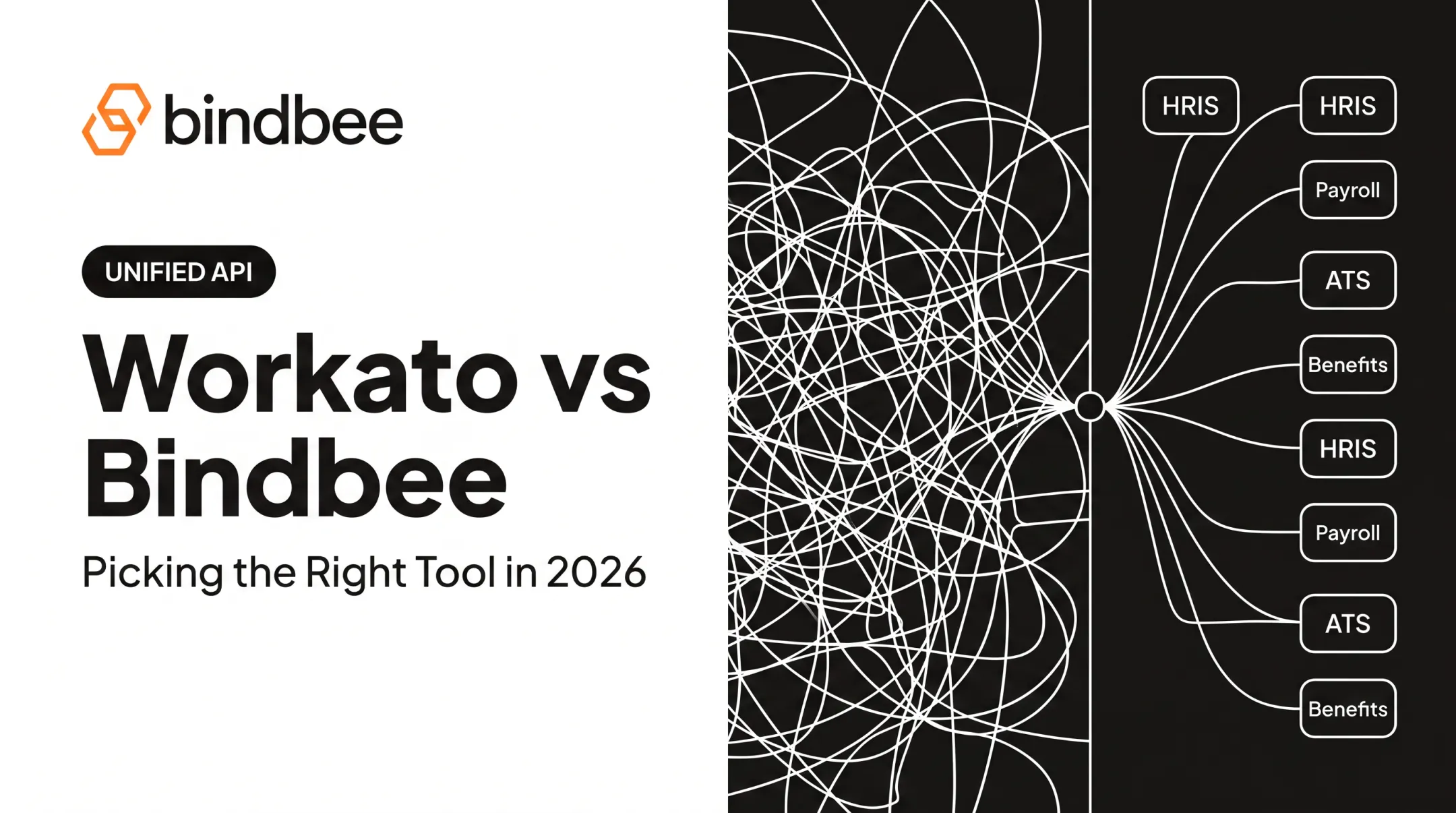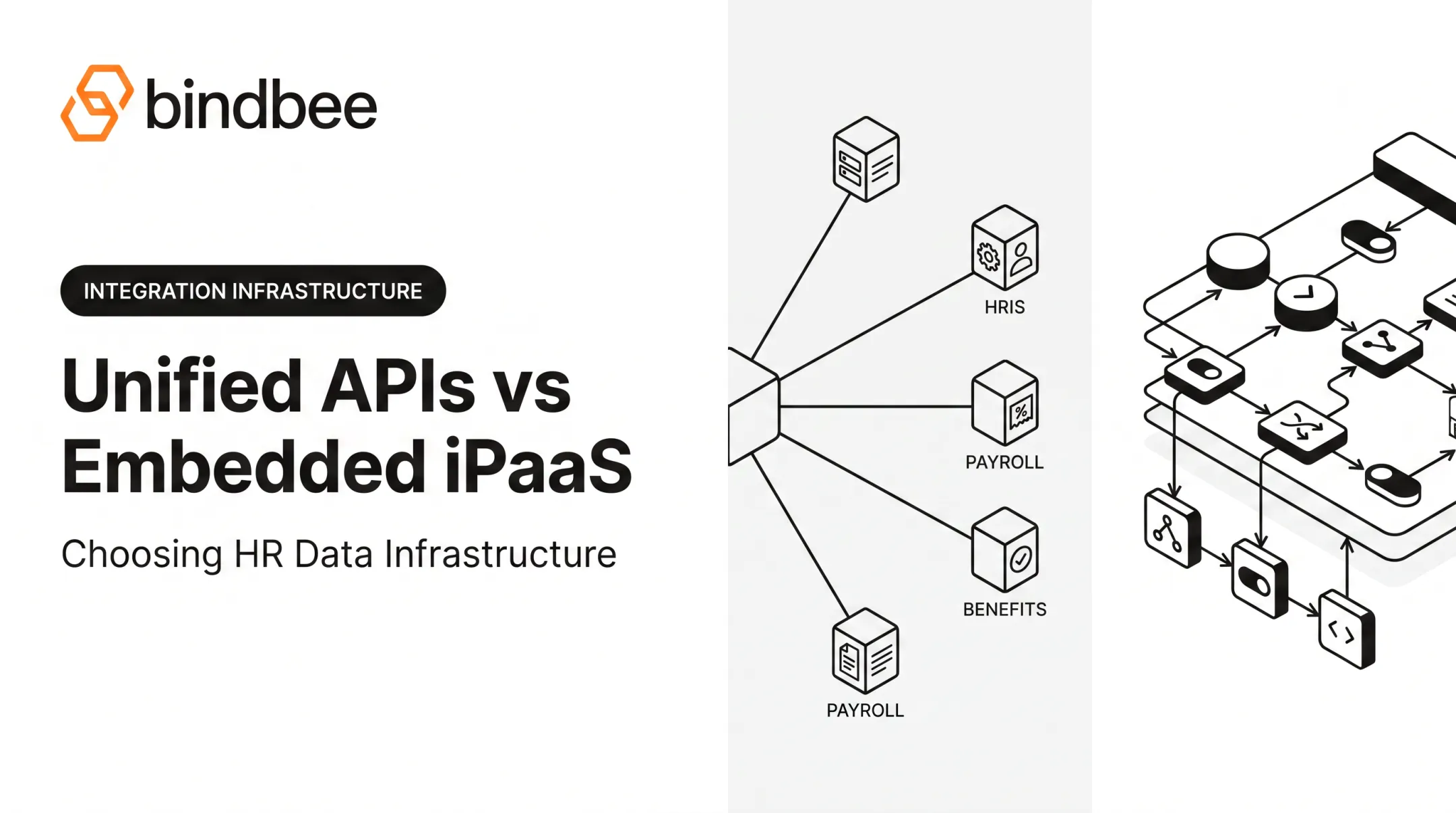

Get this decision wrong and the fallout shows up fast: slower onboarding, dirty data, engineering teams stuck maintaining connectors instead of shipping product. Choosing right protects customer trust in a category where accurate benefits data isn't optional.
This article breaks down cost, architecture, and use-case fit so HR tech leaders can make the call with confidence.
TL;DR
- Workato is a general-purpose enterprise iPaaS built for cross-department workflow automation.
- Bindbee is a purpose-built unified API for HR, payroll, and benefits data with benefits-first models.
- Workato needs custom recipes per HR system; Bindbee ships pre-normalized data across 60+ HR systems from day one.
- Global iPaaS revenue hit $8.5 billion in 2024, up 23.4% year-over-year, according to Gartner.
- Choose Workato for broad automation beyond HR; choose Bindbee if HR/benefits data is your core product.
Workato vs Bindbee: Quick Comparison
| Dimension | Workato | Bindbee |
|---|---|---|
| Cost | Usage-based (platform + usage fees), sales-led; Vendr median ~$64,544/year ($25K–$500K+) | Per-active-connection pricing via custom Order Form; $12,000 minimum annual commitment |
| Setup Time | Weeks of recipe-building per connector | Under 1 day via Magic Link authentication |
| Data Model | Generic; custom field mapping required per recipe | Benefits-first: Employee, Employer Benefits, Dependent Benefits models |
| Maintenance | Ongoing recipe upkeep as APIs change | Zero-maintenance, automatic incremental syncs |
| Ideal User | IT/ops teams needing cross-departmental automation | HR tech, benefits administration, payroll, and insurtech platforms |
Workato's pricing is well-documented through third-party transaction data; Bindbee's rates are custom per Order Form. The structural difference matters more than the exact numbers: one is a metered automation platform, the other a flat per-connection integration layer with unlimited API calls and no overage fees.

What is Workato?
Workato is an enterprise iPaaS that connects apps and workflows into "recipes" spanning IT, finance, sales, and HR. It's positioned for ops-led automation across an entire organization, not just one department.
Core strengths:
- Massive app catalog covering thousands of SaaS tools, databases, and ERPs
- Governance and API management features suited to enterprise IT
- A common data model that lets integrations use canonical structures instead of app-specific formats
The limitation for HR tech buyers: Workato has no HR-specific data models. Every HRIS, payroll, or benefits connector has to be custom-built and mapped field by field. That's manageable if HR is one automation among many. It becomes a real bottleneck if HR/benefits data is your product.
Use Cases of Workato in HR Tech
Workato fits companies that need HR automation running alongside finance, sales, and IT workflows in one shared platform. Common patterns include:
- Routing new-hire data between an ATS and Slack
- Triggering onboarding tasks across departments when someone joins
Workato's own research found that 56% of IT executives said their organizations automated PTO requests and approvals, and 43% automated application provisioning. That points to solid coverage of cross-functional HR workflows.
One G2 reviewer at a 1,000+ employee company noted production automations were live roughly two months after implementation. That's a single data point, not a guaranteed timeline, but it reflects the reality: Workato deployments take real setup time because every connector is custom.

What is Bindbee?
Bindbee is a unified API built for employment data. It normalizes 60+ HRIS, payroll, benefits, and carrier systems — including Workday, ADP, BambooHR, Gusto, and Rippling — behind one integration.
Core benefits:
- Benefits-first data models: Employee, Employer Benefits, and Dependent Benefits
- Real-time eligibility updates and complete dependent data
- Enrollment sync tied directly to onboarding speed
- QLE webhooks for marriage, divorce, new babies, job loss, terminations, and hours reductions, including COBRA-triggering events
SFTP-to-API Bridge and Legacy Systems
Not every HRIS has a modern API. Bindbee's SFTP-to-API Bridge takes file drops (CSV, XML, fixed-width) from legacy systems and converts them into standardized JSON on the same unified endpoints.
That matters for benefits data stuck in older systems that only export on a schedule. Without a bridge, teams stay trapped in manual CSV cycles.
Use Cases of Bindbee in HR Tech
Bindbee fits benefits administration platforms, payroll platforms, TPAs, and insurtech products that need employment data as a core product layer.
- Benefits tech: Healthee, Pasito, Clever Benefits, Budgie Health
- Employee engagement: Phin
- Immigration services: Alma (60+ HRIS and ATS integrations)
Phin's case study is often cited for these results after adopting Bindbee:
- 76% faster onboarding for new customers
- 94% improvement in time-to-value
- $115,000+ in annual development savings

Workato vs Bindbee: Which Is Better for HR Tech?
Which platform fits depends on the problem you're solving—not on a generic feature scorecard.
- Pick Workato if HR integration is a small slice of a larger automation strategy that spans finance, sales, and IT operations.
- Pick Bindbee if your product depends on accurate, real-time HR and benefits data as its core value proposition.
A benefits administration platform trying to onboard employers faster shouldn't be spending engineering cycles building Workday connectors from scratch. An enterprise IT team automating cross-departmental workflows doesn't need benefits-specific data models. Choose based on whether employment data is your product's foundation or just one workflow among many.
Real World Example: Why HR Tech Platforms Choose Bindbee
Healthee's engineering team faced a familiar problem: collecting census data from a new employer meant weeks of back-and-forth, and building a custom integration for each HRIS took more than two months per employer. That's not sustainable when your growth depends on onboarding employers quickly.
Rising maintenance costs and slow onboarding pushed the switch to a unified API. After adopting Bindbee, employers could connect their HRIS in minutes, and Healthee went live the same day.
The trigger that pushed many platforms to switch:
- Custom connectors take months to build and require ongoing maintenance as source APIs change
- Engineering time gets consumed by integration plumbing instead of core product features
- Slow onboarding directly limits how fast the business can grow
Cypherworx saw the same pattern. After replacing CSV and SFTP-based processes with Bindbee, the team saved over 400 hours of engineering time (about five months of capacity) and cut customer onboarding from 24 days to a few hours.

HR tech companies scale faster when a specialized provider owns integration infrastructure instead of the product team rebuilding it in-house. If your team is still writing custom HRIS connectors, a unified API built for HR and benefits data can take that work off your plate.
Conclusion
Workato is a strong choice for IT-led organizations that need broad automation spanning many departments, with HR as just one piece of the puzzle. It offers governance, a large app catalog, and flexibility, at the cost of custom recipe-building and ongoing maintenance for every HRIS or payroll connector.
Bindbee fits a narrower, deeper need: HR tech and benefits platforms that require employment data to stay accurate, current, and normalized without months of engineering work.
Choose based on the job to be done:
- Workato if IT needs cross-department automation and can own recipe building and connector upkeep
- Bindbee if your product needs embedded HRIS, payroll, and benefits data coverage with far less integration maintenance
For HR tech teams, that usually means faster employer onboarding, engineering time returned to the core product, and eligibility data that stays current without manual cleanup.
Frequently Asked Questions
What are the top alternatives to Workato for automation?
General iPaaS alternatives include Make, Zapier, n8n, Boomi, and Tray.ai. Bindbee is a specialized unified API for HR, payroll, and benefits data—not a general automation platform.
Is Bindbee a replacement for Workato?
No. Bindbee is not a general automation platform; it's a unified API focused on employment data. Many HR tech companies use it alongside Workato, reserving Workato for broader cross-functional workflows.
How long does it take to integrate HR systems with Bindbee vs Workato?
Bindbee connections typically go live in under a day via Magic Link authentication. Workato integrations take weeks, since each HRIS or payroll connector requires custom recipe-building.
Does Workato offer HR-specific data models like Bindbee?
No. Workato uses a generic common data model requiring custom field mapping for every connector. Bindbee ships benefits-first data models (Employee, Employer Benefits, Dependent Benefits) out of the box.
Which is more cost-effective for HR tech startups: Workato or Bindbee?
Workato's sales-led, usage-based pricing can range from $25K to $500K+ annually and scales unpredictably. Bindbee uses per-connection pricing starting at a $12,000 annual minimum, which reduces engineering and maintenance overhead.
Is Bindbee compliant with data security standards like Workato?
Yes. Bindbee holds SOC 2 Type II and ISO 27001 certifications, is GDPR-ready, and offers HIPAA-compliant BAAs on Pro and Enterprise plans. Data is encrypted with TLS 1.3 in transit and AES-256 at rest.