
The problem isn't a lack of data. It's that disconnected systems force manual reconciliation, breed stale records, and make timely decisions harder than they should be.
This guide breaks down the measurable benefits of healthcare data integration for clinical workflows, benefits administration, compliance posture, and operational costs, with specific data to back each one up.
Key Takeaways
- Healthcare data integration connects clinical, administrative, and benefits data into a single source of truth for eligibility, enrollment, and claims
- Core benefits are operational: fewer claim denials, lower admin costs, reduced eligibility errors, and stronger compliance
- Without integration, siloed data produces duplicate records, coverage gaps, and bottlenecks that block scale
- Realizing that value depends on consistent standards (HL7, FHIR, EDI X12) and real-time data sync
- For benefits and HR tech platforms, integration infrastructure is what separates a 3-month enterprise deal from a 3-day one
What Is Data Integration in Healthcare?
Healthcare data integration is the process of connecting and consolidating health-related data from multiple systems (clinical, administrative, benefits, and financial) into a unified format that supports timely decisions.
The scope is broader than most people assume. It extends well beyond EHRs and lab systems. The administrative and benefits layer adds its own set of systems: employer benefits platforms, insurance carriers, HRIS systems, third-party administrators, and pharmacy networks. All of these manage member eligibility, enrollment, and coverage.
Clinical vs. Administrative Integration
These two layers serve different purposes but depend on each other:
| Layer | Systems Involved | Data Types |
|---|---|---|
| Clinical | EHRs, labs, imaging, pharmacy | Diagnoses, prescriptions, treatment history |
| Administrative | HRIS, benefits platforms, carriers, TPAs | Eligibility, enrollment, coverage, dependent data |
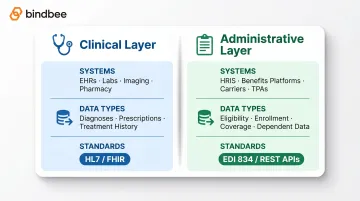
Which layer you're integrating determines which standards apply, and that changes the entire technical approach.
A benefits platform like those powered by Bindbee's unified API operates strictly in the administrative layer, syncing employee eligibility, dependent data, and enrollment information across HRIS and carrier systems. That's a fundamentally different challenge than connecting clinical records across hospital networks, requiring EDI 834 and REST APIs rather than FHIR or HL7.
Data integration is enabling infrastructure. It lets providers, benefits administrators, and payers act on accurate, current information, reducing errors, improving care coordination, and cutting the overhead of manual data reconciliation.
Key Benefits of Data Integration in Healthcare
Benefit 1: Improved Patient and Member Outcomes Through Complete Data Visibility
Integrated data gives clinicians and benefits administrators a complete, real-time view of a patient or member's information (medical history, current coverage, eligibility status, active prescriptions, and dependent relationships) without manual lookups across disconnected systems.
In benefits administration specifically, this means a care coordinator or benefits platform can confirm insurance coverage before a procedure, verify a dependent's eligibility for a plan election, or identify a coverage gap before it becomes a claim denial.
Why stale data is expensive:
KFF data shows insurers rejected 19% of in-network claims for ACA exchange plans in 2024. That's roughly 49 million claims denied in a single year. Eligibility verification failures alone rejected approximately 13.5% of medical claims. Reworking a denied claim costs between $25 and $181 per claim, and 35–60% of denied claims are never resubmitted, meaning those represent permanent revenue losses.
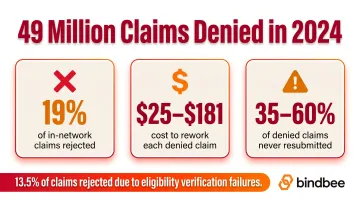
Stale eligibility data in an HRIS creates a mismatch at the carrier, which generates a denial, which costs money to rework, if it gets reworked at all.
KPIs this benefit influences:
- Claim denial rates and eligibility-related rejection rates
- Time-to-diagnosis and first-contact resolution for benefits inquiries
- Medication error rates (clinical settings)
- Member satisfaction and benefits engagement scores
When the impact is highest:
The benefit compounds in high-complexity environments: multi-specialty care networks, large employer health plans, and any setting where the same member interacts with multiple systems (an HR platform, a benefits platform, and a carrier) that don't automatically share updates.
For benefits platforms, real-time eligibility sync is where this translates most directly. ThrivePass, for example, uses Bindbee's webhook-driven data sync to catch coverage violations before contributions post, cutting HSA/FSA audit cycles from six weeks to under one week by receiving real-time eligibility signals rather than waiting for monthly batch files.
Benefit 2: Operational Efficiency and Cost Reduction
Healthcare data integration eliminates the manual, repetitive workflows that consume administrative resources. Data entry, eligibility verification, enrollment reconciliation, claims pre-processing, and compliance reporting all become faster and more accurate when driven by unified data pipelines.
Administrative spending accounts for 15–30% of total U.S. healthcare spending, with at least half deemed wasteful, representing roughly $285 billion to $570 billion annually. The 2025 CAQH Index reported that U.S. healthcare avoided $258 billion in administrative costs through electronic transactions in 2024. A further $21 billion in annual savings remains unrealized from still-manual processes.
Manual transactions cost health plans an average of $2 more and providers $4 more per transaction than electronic equivalents. For eligibility verification specifically, the per-transaction gap is $4.29.
What This Looks Like in Benefits Operations
Automated data flows between HRIS, benefits platforms, and carriers mean that when an employee is hired, terminated, or has a qualifying life event, downstream systems update automatically, removing the lag and errors that come from manual re-entry or batch file transfers.
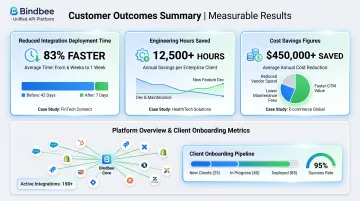
Bindbee's unified API, which connects 65+ HR and benefits systems, shows how this plays out concretely:
- Healthee reduced integration deployment time from 8–12 weeks to 24–48 hours, cutting client onboarding time by 82% and saving $150,000+ annually in development costs
- Newfront achieved a 90% reduction in engineering time on integrations, saving $800,000+ annually and enabling 3x faster enterprise client onboarding
- Clever Benefits deployed 65+ integrations at once instead of building them one-by-one over 2–3 weeks each
Metrics this moves:
- Employer onboarding time and integration setup time
- Data sync latency (hours vs. weeks)
- Administrative labor hours and error rates in eligibility files
- Engineering hours redirected to core product development
When the impact compounds:
Operational efficiency gains scale with complexity. The higher the volume of employer groups, carriers, or data sources managed, the greater the drag from manual processes, and the higher the return from standardized integration infrastructure.
Benefit 3: Regulatory Compliance and Risk Reduction
Healthcare data (clinical records and employee benefits information alike) is subject to strict regulatory frameworks. HIPAA mandates secure handling, access controls, audit trails, and breach notification for Protected Health Information (PHI). For benefits platforms managing large employer groups, compliance is continuous, not a one-time implementation task.
The cost of getting it wrong:
The average healthcare data breach cost $7.42 million in 2025, and healthcare has been the most expensive industry for breaches for 14 consecutive years. The breach identification and containment lifecycle in healthcare averages 279 days, five weeks longer than the global mean, largely because fragmented data environments delay detection.
HIPAA civil monetary penalties reach up to $2,190,294 per violation in cases of willful neglect.
How Integration Supports Compliance
A well-designed integration layer centralizes data governance rather than leaving each system to manage compliance independently. That means:
- Access controls applied consistently across all connected systems
- Full data lineage showing where data originated and how it moved
- Real-time breach detection instead of discovering incidents weeks later
- Automated audit trail generation for PHI disclosures
Bindbee maintains HIPAA compliance, SOC 2 Type II, and ISO 27001 certifications as core infrastructure requirements, not add-ons. The platform commits to breach notification within 72 hours of discovery, with documented disclosures of PHI as required by HIPAA Rules.
For benefits platforms, this means inheriting compliance controls across 65+ integrations rather than building and certifying each one independently.
Why this matters for go-to-market:
That compliance posture increasingly determines whether a deal closes. SOC 2 report issuance has grown from roughly 10,000 to an estimated 15,000–20,000 annually, reflecting a market-wide shift where enterprise procurement teams require SOC 2 Type II and ISO 27001 alignment as contractual prerequisites, not optional certifications. For benefits tech companies, compliance posture is increasingly a sales requirement, not just a legal one.
KPIs this benefit influences:
- Compliance audit pass rates and open findings count
- Breach incident frequency and time to detect unauthorized access
- Time spent on manual compliance reporting
What Happens When Healthcare Data Integration Is Missing
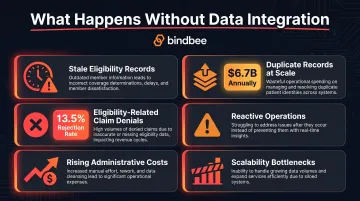
Fragmented data environments create compounding problems across every layer of operations:
- Stale eligibility and enrollment records. Decisions made on outdated information lead to claim denials, coverage gaps, and treatment errors
- Duplicate records at scale. Patient identification errors cost the U.S. healthcare system over $6.7 billion annually, with duplicate rates of 10–30% across organizations and an average resolution cost of ~$1,950 per duplicate record
- Eligibility-related claim denials. Approximately 13.5% of medical claims rejected due to eligibility verification failures, with initial denial rates climbing to 11.8% in 2024
- Reactive operations. Without unified data, missed prior authorizations, incorrect dependent coverage, and compliance gaps surface after the fact rather than being caught in real time
- Rising administrative costs. Manual processes don't scale; as member volumes grow, the cost of maintaining disconnected integrations increases disproportionately
- Scalability bottlenecks. Each new employer group or carrier connection requires custom development without standardized infrastructure, capping growth velocity for benefits platforms and TPAs
Bindbee customers describe exactly this before standardizing their integration layer:
- Pasito received partial data sets that required manual intervention to resolve gaps before each sync cycle
- Newfront saw maintenance burden grow exponentially with client volume, with engineers decoding API documentation across dozens of HRIS platforms instead of shipping product features
For platforms without a unified integration layer, this is the baseline, not the exception.
How to Get the Most Value from Healthcare Data Integration
Integration delivers measurable value when it's governed consistently, not built as a one-off connection. These principles separate high-performing integrations from ones that gradually drift back toward the problems they were meant to solve:
Adopt recognized interoperability standards. FHIR, HL7, and EDI X12 exist because custom transformation logic for every data source is unsustainable. The CMS Interoperability and Prior Authorization Final Rule sets January 2027 compliance requirements for FHIR-based exchange. Organizations should be building FHIR-ready integration layers now, well ahead of that deadline.
Treat monitoring as ongoing work, not a post-launch task. Real-time sync notifications, automated quality checks, and webhook-driven alerts for life events (new hires, terminations, dependent changes) keep integrated data current. Bindbee's webhook system fires instant notifications on employment status changes or sync errors, so teams catch issues in hours rather than discovering them in a monthly audit.
Build operational workflows around the data. Integration handles the data movement, but it only creates value if teams know what to do when discrepancies are detected, eligibility files fail to sync, or compliance anomalies are flagged. Establish escalation paths and cross-functional alignment before those events happen. Scrambling to define ownership mid-incident is avoidable.
Verify standards compliance for your specific data layer. For benefits and HR tech platforms, EDI 834 generation and REST API connectivity cover most use cases. For clinical data exchange, HL7 and FHIR are the relevant standards. The right standard depends on which layer of the ecosystem you're operating in.
Conclusion
Healthcare data integration delivers control and consistency across operations. Its real value is in ensuring every decision across the care and benefits ecosystem is grounded in accurate, current data.
When integration is treated as ongoing infrastructure, not a one-time project, platforms grow without rebuilding every time they add a new system, employer group, or carrier. Organizations that skip that investment face the same manual reconciliation, eligibility errors, and compliance gaps at greater scale and cost.
For benefits platforms, HR tech companies, and digital health platforms, integration is the operational foundation. Build it right, and the platform scales. Build it as an afterthought, and every growth milestone becomes a rebuild.
Frequently Asked Questions
What is data integration in healthcare?
Healthcare data integration is the process of unifying data from multiple systems (EHRs, benefits platforms, HRIS, insurance carriers) into a coherent, accessible view. It enables accurate, timely decisions across both clinical and administrative workflows without manual lookups or reconciliation across disconnected sources.
What is the difference between EDI and HL7?
EDI (Electronic Data Interchange) is a general-purpose format for exchanging structured business documents (claims, eligibility files, enrollment transactions) widely used by payers, clearinghouses, and TPAs. HL7 is a clinical messaging standard for exchanging patient health information between healthcare IT systems. The distinction is functional: EDI handles administrative transactions, HL7 handles clinical data exchange.
How does HIE differ from EHR?
An EHR (Electronic Health Record) is a system used by a single healthcare organization to store and manage patient clinical data. A Health Information Exchange (HIE) is the infrastructure and network that allows different organizations to share that data securely across organizational boundaries. EHRs are the source systems; HIEs are the mechanism for interoperability between them.
What are the main benefits of data integration in healthcare?
The core operational benefits include:
- Improved patient and member outcomes through complete data visibility
- Reduced administrative costs through automated workflows
- Lower rates of eligibility errors and claim denials
- Stronger HIPAA compliance through centralized data governance
How does healthcare data integration support HIPAA compliance?
Integrated data environments make it easier to enforce consistent access controls, maintain audit trails, and monitor for unauthorized data access across all connected systems. Siloed environments leave compliance management to each individual system, creating gaps, inconsistencies, and detection delays that increase breach risk and HIPAA penalty exposure.
What role do APIs play in healthcare data integration?
APIs enable real-time, standardized data exchange between systems, replacing slow batch file transfers with automated, bidirectional data flows. Modern standards like FHIR use RESTful APIs built specifically for healthcare interoperability. In benefits administration, unified APIs like Bindbee's abstract 65+ HRIS and carrier systems behind a single connection. Platforms build once and instantly support all of them, rather than maintaining a separate integration for each system.