
Introduction
Every HR Tech and benefits platform faces the same uncomfortable reality: serving customers means connecting to dozens of HRIS, payroll, and carrier systems. Every one of those connection points becomes a potential liability when SOC 2 auditors start asking questions.
The problem isn't just technical complexity. Each native integration creates its own:
- Authentication flow and credential set
- Vendor risk assessment and security review
- Access control policy and audit trail
Multiply that across Workday, ADP, BambooHR, Gusto, Rippling, and dozens more. Your SOC 2 audit surface expands with every deal you close.
The IBM 2024 Cost of a Data Breach Report puts the average breach cost at $4.88 million, with organizations handling health and benefits data averaging $9.77 million. Platforms processing employee benefits, health plan enrollments, and compensation data sit squarely in that risk zone.
A unified API restructures how SOC 2 compliance is achieved: dozens of vendor relationships, credential sets, and data flows collapse into a single auditable pipeline.
Key Takeaways
- Every native HRIS integration introduces a separate vendor, credential set, and data flow. Each one SOC 2 auditors must assess on its own
- A unified API collapses that sprawl into a single vendor relationship, a single authentication layer, and one auditable data pipeline
- This directly maps to SOC 2 criteria: CC6 (access controls), CC9 (vendor risk), Availability, Confidentiality, and Privacy
- The right unified API partner holds its own SOC 2 Type II certification, transferring significant compliance burden off your team
- Bindbee connects 65+ HRIS, payroll, and carrier systems with SOC 2 Type II, ISO 27001, and HIPAA compliance included natively
Why SOC 2 Compliance Is Uniquely Complex for HR Tech Platforms
The Data You Handle Is Among the Most Sensitive
Benefits platforms don't just process generic business data. They handle:
- Employment records and compensation details
- Health plan elections and coverage tiers
- Dependent relationships and beneficiary data
- COBRA qualifying events and eligibility determinations
- ACA hour validations and benefit class assignments
This category of PII sits at the intersection of employment law, healthcare privacy, and financial data. Attackers target it specifically, and auditors scrutinize it accordingly. The Verizon 2025 Data Breach Investigations Report found that personal data was compromised in 50% of SMB breaches, and stolen credentials were the initial access vector in 22% of all breaches.
The Integration Sprawl Problem
A mid-market benefits platform typically needs to connect to a wide range of HRIS and payroll systems: Workday, ADP, BambooHR, Gusto, Rippling, Paychex, UKG, SAP SuccessFactors, and many more across different employer sizes and regions.
Each native integration means:
- A separate authentication flow (OAuth, API key, SFTP)
- A distinct credential set to manage and rotate
- An independent vendor risk assessment under SOC 2 CC9
- Separate access control documentation for CC6
- Its own change management history for CC8
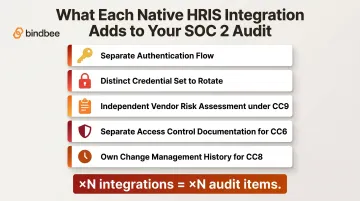
Add ten new HRIS connectors to support an enterprise sales push, and you've added ten new vendor assessments to your next audit cycle. The compliance burden scales exactly as fast as your integration count.
Evidence Collection Becomes Unsustainable
When employee data flows through multiple custom-built connectors, your security team must trace every data path, access log, and configuration change across every system, and do it for every audit cycle. Schellman, a CPA firm issuing 2,000+ SOC reports annually, requires organizations to analyze key service providers at least once per year. With 20+ native integrations, that's 20+ annual reviews.
Credential sprawl makes this worse. As 1Password's research on unmanaged credential sprawl documents, the uncontrolled growth of API keys, OAuth tokens, and developer secrets stored across environments implicates SOC 2 CC6.1 logical access controls, turning fragmented integrations into a recurring source of audit findings.
What Is a Unified API Platform?
A unified API is a single integration layer that normalizes and aggregates data from multiple third-party systems through one standardized endpoint. The model is simple: authenticate once, write your integration code once, and receive normalized data back from any connected provider.
For HR Tech and benefits platforms, this means building one integration to the unified API, which then handles all underlying connections to Workday, ADP, BambooHR, Gusto, Rippling, UKG, and the 65+ other HRIS and payroll systems your customers use.
Key Architectural Elements
| Element | What It Means for Compliance |
|---|---|
| Single authentication layer | One credential set to document and control |
| Normalized data models | Consistent data handling regardless of source system |
| Centralized connector maintenance | Upstream API changes handled by the vendor, not you |
| One vendor relationship | One sub-processor to assess under CC9 |
The unified API vendor takes responsibility for maintaining integrations and upholding security standards across all connected systems. That vendor relationship consolidates into a single sub-processor. If your platform supports 30+ HRIS systems natively, your SOC 2 auditors review one vendor assessment instead of thirty.
How Unified APIs Transform SOC 2 Compliance Management
Consolidating the Third-Party Risk Surface
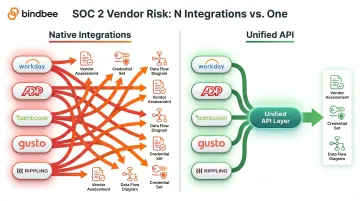
SOC 2's CC9 (Risk Mitigation) requires organizations to assess and manage risks from every vendor and subservice organization that touches customer data. With native integrations, each HRIS or payroll system is a separate subservice relationship requiring independent annual review.
A unified API converts that N-to-1. Your auditors review one vendor risk assessment, examine one set of data flow diagrams, and evaluate one sub-processor agreement, regardless of how many underlying systems that vendor connects to. For teams already stretched across engineering, compliance, and security functions, that consolidation alone can shorten audit prep by days.
Streamlining Evidence Collection
Fragmented integrations create fragmented audit trails. When data flows through custom connectors built against individual HRIS APIs, your security team must pull access logs from each system separately and reconstruct a coherent picture of what data moved where and when.
A unified API creates a consistent, auditable pipeline. Every data ingestion event passes through one gateway, producing standardized logs and sync histories in one place. Instead of chasing logs across systems, you point auditors to a single source of truth.
Bindbee's platform provides centralized integration visibility with searchable logs, issue tracking, and sync status across all connections, without requiring teams to dig through code or contact individual system vendors for their access records.
Simplifying Access Control Documentation
Native integrations require managing separate credentials for each connected system: OAuth tokens, API keys, SFTP passwords. Under SOC 2 CC6.1, every credential set must be documented, access-controlled, and monitored. At scale, that's dozens of line items in your audit evidence package.
Bindbee's Magic Link authentication centralizes this entirely. The component handles OAuth flows, API key management, and SFTP credentials for all 65+ connected systems behind a single endpoint. Customer credentials never touch the platform's servers. The audit evidence package shrinks from dozens of credential records to one.
Enabling Continuous Compliance
The traditional SOC 2 approach is to scramble to collect evidence before an audit window. The result is what's increasingly called "compliance theater." One CISO who reviewed 50+ SOC 2 reports in a single year found that every report passed, yet none meaningfully influenced vendor decisions.
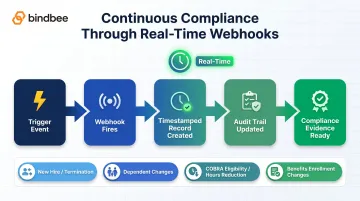
Continuous compliance requires continuous data trails. Bindbee's webhook system fires in real time when critical HR events occur:
- New hire and termination events with timestamped records
- Dependent changes and beneficiary updates
- Hours reductions triggering COBRA eligibility
- Benefits enrollment and plan selection changes
Each event produces an operational record of what your platform actually did, not a retroactive documentation exercise.
Reducing Configuration Drift Risk
Every native integration is a surface where misconfiguration creates compliance gaps. Common examples:
- Deprecated API keys with overly broad permissions that were never scoped down
- Schema changes in a new HRIS version that silently break data mapping
- OAuth tokens not rotated after a personnel change
Bindbee absorbs connector maintenance centrally. When Workday releases an API update or ADP changes an authentication method, Bindbee's engineering team handles it. Customers continue using the same unified API endpoints with no integration code changes required. The configuration drift risk that generates recurring SOC 2 findings simply doesn't accumulate.
Unified APIs and the Five SOC 2 Trust Service Criteria
SOC 2 is structured around five Trust Service Criteria. Here's how a unified API architecture maps directly to each:
Security (CC6–CC9)
Centralizing authentication to one endpoint reduces the attack surface and simplifies CC6 access control documentation. CC8 change management becomes cleaner because connector updates are handled by one vendor with defined release processes. CC9 vendor risk drops from many assessments to one.
Confidentiality
Benefits-first data models with field-level scoping enforce a minimal data exposure principle: the platform receives only the specific fields it needs (enrollment elections, dependent relationships, coverage tiers) rather than broad raw HR exports.
Auditors look for this kind of scoping as a confidentiality control. Bindbee's architecture lets customers define exactly which models and fields to sync, supporting this requirement directly.
Availability
Unified APIs with automatic incremental syncs, built-in retry logic, and uptime SLAs support consistent data accessibility. Bindbee caches synced data during third-party system outages and retries failed syncs automatically, unlike fragile custom connectors that break silently when upstream APIs change.
Processing Integrity
Normalized data models ensure records from any connected HRIS arrive in a consistent, validated format. The AICPA defines Processing Integrity as completeness, validity, accuracy, and timeliness of system processing. Standardized normalization across all sources makes it demonstrable that data transformations don't corrupt, duplicate, or drop records.
Privacy
Consistent treatment of PII regardless of source system supports privacy controls. When every connected HRIS feeds through the same normalized pipeline with the same field scoping rules, your data handling practices are uniform, rather than varying by connector based on how individual HRIS vendors structure their exports.
What to Look For in a SOC 2-Certified Unified API Partner
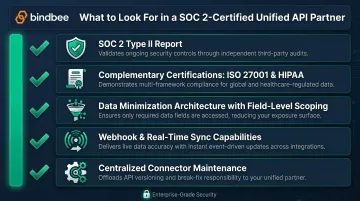
Choosing a unified API partner is itself a SOC 2 vendor risk decision. Here's what actually matters:
The Provider's Own SOC 2 Type II Report
This is non-negotiable. Your auditors will review your sub-processor's report as part of assessing your vendor risk controls. SOC 2 Type II means the provider's controls have been tested for operational effectiveness over a sustained period (typically 6–12 months), not just assessed for design at a single point in time. Confirm the provider undergoes annual audits and can share their report under NDA.
Complementary Certifications
ISO 27001 and HIPAA compliance alongside SOC 2 indicate a mature security program rather than minimum-viable compliance. Benefits platforms processing health plan enrollment data often qualify as HIPAA business associates, making HIPAA coverage in your infrastructure stack a hard requirement, not a nice-to-have.
Data Minimization Architecture
Does the provider store raw HR data, or operate with a minimal-footprint approach? Providers with field-level scoping, where you define exactly which data models and fields are returned, reduce what must be protected and documented in your own audit. Also confirm the provider has a formal GDPR-aligned data retention policy.
Webhook and Real-Time Sync Capabilities
These are what enable continuous compliance posture rather than point-in-time snapshots. Real-time event notifications for hires, terminations, and dependent changes create the ongoing operational audit trail that makes SOC 2 evidence collection straightforward.
Centralized Connector Maintenance
Verify that the vendor absorbs upstream API changes centrally. If your team must track HRIS versioning and authentication changes across any connectors, configuration drift risk remains your problem.
Bindbee is built around all five of these criteria. It holds SOC 2 Type II, ISO 27001, and HIPAA compliance as core infrastructure requirements, with Magic Link authentication for centralized credential management, field-level scoping across benefits-first data models, and automatic incremental syncs with webhooks for continuous compliance posture.
With 65+ HRIS, payroll, and carrier systems connected through a single API, Bindbee is designed specifically for the compliance requirements of benefits platforms and HR Tech companies. Security documentation and RFP response packages are available on request.
Frequently Asked Questions
What are SOC 2 compliance requirements?
SOC 2 requires effective controls across five Trust Service Criteria: Security (mandatory), Availability, Processing Integrity, Confidentiality, and Privacy. The criteria you include depend on your service commitments, and compliance is verified by a licensed CPA firm authorized by the AICPA.
How do you get SOC 2 Type II compliance?
Start by scoping your systems and applicable Trust Service Criteria, then complete a readiness assessment and implement controls. After operating those controls for an observation period (typically 3–12 months), a licensed CPA firm conducts the formal audit.
How often is SOC 2 compliance required?
SOC 2 is not a one-time certification. Type II reports cover a specific observation period, and organizations typically renew annually to maintain a current, valid report. Customers and enterprise partners generally expect to see a report issued within the past 12 months.
Who issues SOC 2 compliance?
Licensed CPA firms authorized by the AICPA issue SOC 2 reports. No government body grants a central "certificate"—the auditing firm's signed report is the compliance attestation.
What is a unified API platform?
A unified API is a single integration layer that normalizes and routes data from multiple third-party systems—such as HRIS, payroll, and benefits platforms—through one standardized interface. Instead of maintaining separate point-to-point integrations for each system, organizations connect once and the unified API handles everything underneath.