
Many engineering teams struggle with a specific, expensive problem: building and maintaining native integrations with 60+ HRIS, payroll, and benefits systems. Every carrier has a different data format. Every HRIS vendor ships breaking API changes without warning. That drains engineering resources that should be going toward the actual product, and it slows down customer onboarding at exactly the moment a deal is closing.
This guide breaks down what software integration solutions actually are, the main types you'll encounter, the real benefits (and where vendor claims need a skeptical eye), and how unified APIs like Bindbee solve this specifically for benefits administration, HR tech, and insurtech platforms.
Key Takeaways
- Software integration connects systems so employee and benefits data flows automatically—no manual CSV uploads
- iPaaS, embedded iPaaS, and unified APIs are the three categories that matter most for HR tech builders
- Native HRIS integrations take 4-8 weeks per system; unified APIs cut that to hours or days
- Bindbee cut Newfront’s integration builds from 8-12 weeks to 48-hour deployments
What Are Software Integration Solutions?
Software integration is the process of connecting separate applications so they share data and function as one cohesive system, rather than a collection of silos that require manual syncing.
Three building blocks make this possible:
- APIs — the rules that let software talk to software instead of humans clicking through screens
- Middleware — the connective layer that handles communication between distributed applications
- Service-Oriented Architecture (SOA) — independent services exposing business capabilities that can be swapped or updated without breaking the whole system
Integration Strategies Compared
Teams generally pick from four approaches:
- Point-to-point — direct connections between two systems (fast to build, painful to scale)
- Hub-and-spoke — a central hub routes data between multiple systems
- Common data format — everything gets normalized into a shared schema before use
- Unified API — one interface abstracts dozens of underlying systems entirely

Any of those four can work in a simple SaaS stack. HR tech and benefits platforms face a harder version of the same problem: data models are fragmented and inconsistent across 60+ HRIS, payroll, and carrier systems.
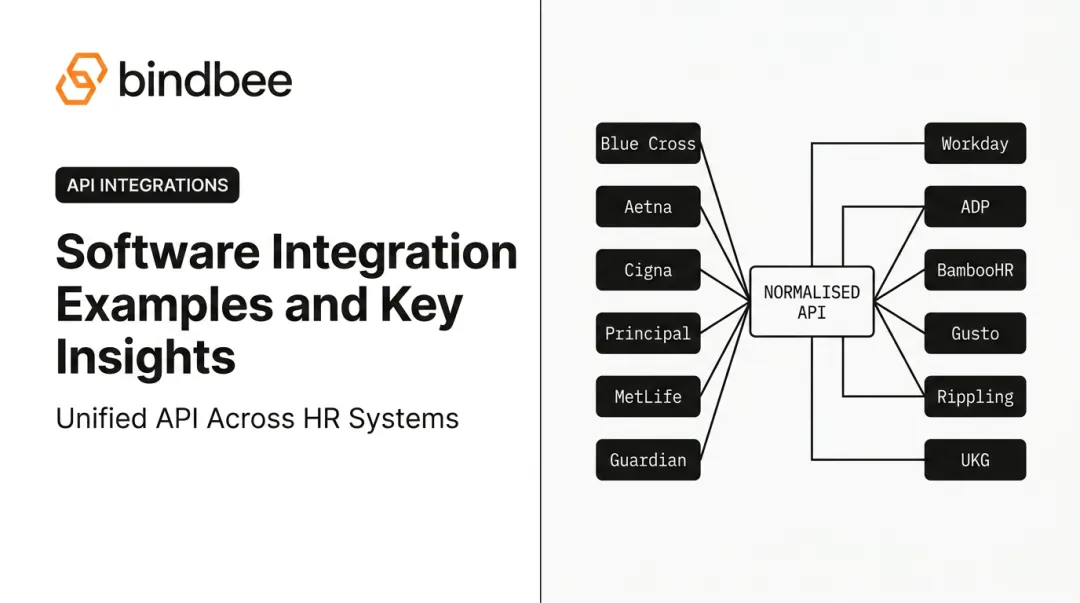
Workday structures employment data differently than BambooHR. ADP's payroll fields don't map cleanly to Gusto's. A benefits platform trying to support all of them ends up writing—and maintaining—dozens of one-off transformation scripts.
Demand for this kind of integration coverage is climbing fast. Merge's 2026 industry survey found a 103% year-over-year increase in companies offering 10+ integrations, with 66% of B2B SaaS companies planning to use a unified API for AI-agent integrations. That's a signal worth paying attention to, even though it's vendor-sponsored research.
Types and Examples of Software Integration Solutions
Different integration problems call for different architectures. Here's how they break down:
| Type | What It Does | HR/Benefits Use Case |
|---|---|---|
| Enterprise Application Integration (EAI) | Automates exchange between enterprise apps | Connecting CRM, ERP, and HR systems for unified workflows |
| Data integration (ETL/ELT) | Consolidates data into a warehouse | Reporting and analytics across HR data sources |
| Embedded/unified API | Pre-built connectors instead of custom builds | One API connecting to 60+ HRIS systems |
| EDI and B2B integration | Standardized document exchange | Carrier enrollment files (X12 834 transactions) |

Real-World Example: Benefits Eligibility Sync
Instead of writing separate connectors for Workday, ADP, and BambooHR, a benefits administration platform can use a unified API to sync employee eligibility, dependent data, and enrollment elections in real time. Bindbee's customer ThrivePass used this model to cut both onboarding and coverage-audit cycles from 6 weeks to under 1 week, catching eligibility violations before contributions post.
SFTP-to-API Bridges for Legacy Systems
Not every HR system has a modern REST API. Some only export flat files. That constraint is common for insurtech and TPA platforms working with older carrier or benefits systems.
An SFTP-to-API bridge solves this by:
- Automatically processing SFTP file drops (CSV, XML, fixed-width formats)
- Converting them into standardized JSON
- Validating and enriching records before they hit downstream systems
- Exposing the result through the same endpoints used for direct API integrations
Newfront, an insurtech platform, used exactly this pattern to aggregate HRIS and benefits data that only existed in flat-file exports.
Key Benefits of Software Integration Solutions
Software integration solutions pay off across speed, data quality, engineering cost, and customer experience. For HR Tech and benefits platforms, the gains show up in both delivery timelines and the deals those timelines unlock.
Faster Time-to-Value
Native HRIS integrations commonly take 4-8 weeks per system (Workday alone can run 8-12 weeks due to configuration complexity). Unified APIs compress that dramatically. Newfront went from 8-12 weeks to 48 hours. Healthee saw the same drop, plus an 82% faster client-onboarding process.
Data Accuracy and Consistency
Speed only holds if the data stays trustworthy. Real-time syncs and normalized data models prevent siloed, stale records. Instead of building transformation logic per vendor, teams work against one schema covering Employee, Compensation, Benefits, and Dependent data — whether the source is Workday, ADP, or a regional payroll system.
Engineering Bandwidth Recovery
This is where the numbers get concrete:
- Newfront: 90% reduction in engineering time on integration builds, $800,000+ in annual savings
- Healthee: $150,000+ in annual development and technical-resource savings
- Upduo: 15 engineering hours saved per week, $80,000 annually
- Budgie Health: 5 engineer-months saved, 90% reduction in integration-management overhead

Improved Customer Experience
Recovered engineering time shows up for customers too. Fewer broken connectors mean fewer support tickets, and faster onboarding lets sales close enterprise deals that require broad HRIS coverage without waiting on custom build cycles.
Cost Savings — With a Caveat
Vendor pages often cite dollar-for-dollar comparisons of custom builds versus managed layers. Treat generic industry-wide cost claims cautiously — there isn't a solid independent benchmark for this. Individual customer outcomes are better documented, like Compport's $150,000+ annual savings and 74% faster onboarding after moving off custom integrations.
Scalability and Compliance
As platforms add customer connections, security risk compounds. Look for:
- SOC 2 Type II
- ISO 27001
- HIPAA compliance
- GDPR readiness
These aren't universal legal requirements for every vendor, but they matter enormously once you're handling PHI or benefits data at scale.
Best Integration Platforms and Middleware to Consider
Not all integration tools solve the same problem. Match the tool to the job:
- General iPaaS (Zapier, Workato, MuleSoft): broad app-to-app automation across departments, not built for deep employment-data normalization
- Data integration/ETL (Fivetran, Airbyte): analytics pipelines feeding a warehouse, not real-time operational syncs
- Embedded iPaaS (Prismatic, Paragon): customer-facing integrations built into a SaaS product's UI
- Vertical unified APIs (Bindbee): purpose-built for HR, payroll, and benefits data specifically
Bindbee's approach separates benefits data into three distinct models: Employee Benefits, Employer Benefits, and Dependent Benefits. Those models cover coverage tiers, deduction codes, and dependent relationships.
Generic HR data models force benefits platforms to derive enrollment logic from raw employee records. For a TPA or benefits admin platform, that distinction determines whether carrier submissions and contribution reconciliation work correctly.
What Is a System Integrator Company?
A system integrator (SI) is a company that designs, builds, and manages connections between disparate software systems on a client's behalf. It's a services model, not a software product.
How this differs from platforms and unified APIs:
| Model | What You're Buying | Best Fit |
|---|---|---|
| System integrator | Expertise, architecture, project delivery | Complex migrations, unusual legacy systems |
| Self-serve platform | Reusable software you configure yourself | Repeatable connectivity needs |
| Unified API | Infrastructure-as-a-service, pre-normalized | Ongoing product integration at scale |

Some vendors blend these models. Bindbee, for example, offers self-serve connections via Magic Link for its 60+ standard integrations, but also builds custom connectors on demand (typically a 7–10 day cycle) for regional HRIS platforms or legacy systems outside the standard catalog.
It also handles migrations off competing unified APIs like Merge.dev or Finch, with parallel syncing and field-mapping translation to avoid downtime.
How to Choose the Right Software Integration Solution
Before signing anything, run through this checklist:
- Connector breadth — Does it support the specific HRIS, payroll, and carrier systems your customers actually use, not just the popular ones?
- Data model consistency — Does it normalize data, or just pass through raw, inconsistent formats from each provider?
- Security credentials — SOC 2 Type II, ISO 27001, and HIPAA matter for employee and benefits data—ask for certificate scope, not just the logo.
- Total cost of ownership — Factor in engineering maintenance time, not just the subscription line item.
- Real-time sync and life-event triggers — If you're building HR or benefits products, you need webhooks for new hires, terminations, and dependent changes.
Bindbee fires a webhook when an employee is marked terminated with an INACTIVE status. Downstream platforms can end coverage on the correct date and trigger COBRA notice generation automatically—event-driven sync that keeps you aligned with compliance deadlines.
Frequently Asked Questions
What are software integration solutions?
They're tools, platforms, or services that connect disparate systems so data flows automatically instead of through manual exports and uploads. That spans enterprise middleware, embedded APIs, and unified API layers.
What are some examples of software integration solutions and use cases?
Common types include Enterprise Application Integration (EAI), data integration/ETL, embedded or unified APIs, and EDI. A benefits platform syncing eligibility and enrollment data across 60+ HRIS systems via one API is a real-world unified API use case.
What are the best integration platforms and middleware technologies?
The right fit depends on your use case. Main categories include general iPaaS (Zapier, Workato), data integration tools (Fivetran, Airbyte), embedded iPaaS (Prismatic, Paragon), and vertical unified APIs for industries like HR and benefits.
What is a system integrator company?
A system integrator is a services partner that designs and implements multi-vendor integrations for a client. This differs from integration software or unified APIs, which are self-serve products you configure and maintain.
How is a unified API different from a traditional iPaaS?
A unified API normalizes data models for one specific vertical, like HR or benefits, so every provider returns consistent fields. Traditional iPaaS tools connect general-purpose apps across departments without that industry-specific normalization.
How long does it typically take to implement a software integration solution?
Native API builds for individual HRIS systems commonly take 4-8 weeks, with Workday running 8-12 weeks. Unified API and managed solutions, like Bindbee, typically bring that down to hours or a single day.