
That fragmentation creates a compounding problem. Every new integration you need to support is weeks of engineering work. Every connected system uses different data formats, authentication methods, and API conventions. And benefits data — dependents, enrollment elections, effective dates — adds complexity that generic integration tooling was never designed to handle.
According to Sapient Insights' 2024-2025 HR Systems Survey, enterprise organizations average 55 HR system integrations. The scope of what customers expect your product to connect with is not shrinking.
This article covers 11 of the most common integration challenges HR Tech teams face, what causes each one, and practical ways to address them.
Key Takeaways
- Most integration failures trace back to fragmented vendor ecosystems and inconsistent data models — not engineering errors
- Benefits data (dependents, elections, effective dates) requires purpose-built data models, not generic employee records
- Real-time sync is now a baseline expectation for onboarding, terminations, and eligibility changes
- In-house integration maintenance consumes disproportionate engineering bandwidth over time
- One unified API compresses months of integration work into days — and eliminates maintenance costs entirely
What Are Integration Challenges?
Integration challenges are the technical and operational obstacles that arise when connecting software systems to share data. In HR Tech, they're magnified by two factors: the sheer number of systems in the market, and the sensitivity of what flows between them.
HR data sits at the intersection of compliance requirements (HIPAA, GDPR, SOC 2) and operational urgency — a delayed termination sync isn't just a data quality issue, it's a benefits liability.
They surface across every phase of an integration's life:
- Initial setup — authentication, field mapping, data model alignment
- Ongoing sync — frequency, incremental updates, error handling
- Maintenance — API version changes, deprecated endpoints, broken tokens
- Compliance — audit logging, encryption, data residency
Ignoring them means delayed product launches, frustrated customers, and engineering time sunk into plumbing instead of product. The 11 challenges below break down exactly where things go wrong — and what to do about it.
11 Common Integration Challenges in HR Tech and How to Overcome Them
Most HR Tech teams encounter several of these simultaneously. The specific symptoms differ by system, but the root patterns repeat across the ecosystem.
Challenge 1: Fragmented and Inconsistent HRIS Ecosystem
The HR Tech market includes over 1,500 technology solutions across 22 HR tech segments, according to Sapient Insights. Each HRIS uses its own API design, authentication method, and data structure. Building and maintaining a native integration with each one is impossible to maintain at scale without a dedicated team.
The result: Engineering roadmaps get consumed by connector work instead of product differentiation.
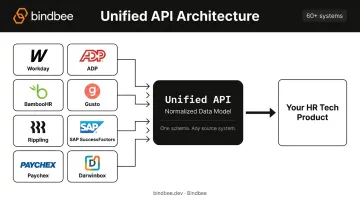
Solution: Adopt a unified API strategy that normalizes data across all connected systems into a single, consistent data model. Bindbee's unified API, for example, abstracts 60+ HRIS and payroll systems — including Workday, ADP, BambooHR, Gusto, Rippling, and SAP SuccessFactors — behind one normalized REST API. A customer using Darwinbox in India and another using Paychex in the US return data in the same schema. No additional code changes required.
Challenge 2: Data Format and Schema Inconsistencies
The same concept can be represented a dozen different ways across systems. Employment status might be ACTIVE/INACTIVE, 1/0, Full Time/Part Time, or a free-text label depending on the HRIS. Without normalization at the integration layer, downstream systems receive inconsistent data and break silently.
Solution: Implement schema normalization before data reaches your application. Every field — employment status, employment type, job level — should map to a consistent enumeration regardless of source. Bindbee handles this by translating provider-specific field names into a unified field set. Filtering by employment_status=INACTIVE works identically whether the source system is Nmbrs, SAP SuccessFactors, or BambooHR.
Document field-level mapping for each source system as well. When a new system produces unexpected values, a known schema gives you a clean audit trail.
Challenge 3: Slow Integration Setup and Long Time-to-Value
Every new HRIS integration your product needs to support takes meaningful engineering time to build natively — and that timeline multiplies fast when enterprise customers run dozens of different systems. As Forrester notes, the first 90 days post-sale are critical for value realization and renewal decisions. Long integration timelines eat directly into that window.
The compounding problem: A product supporting 15 different HRIS systems natively is carrying 15 separate maintenance obligations — each with their own versioning, auth changes, and deprecation cycles.
Solution: Use pre-built integration infrastructure that eliminates per-system build time. Bindbee's Magic Link authentication lets end customers connect their HRIS in under 10 minutes, with initial data sync starting immediately. Teams that previously estimated 10+ weeks to build natively reported going live in 48 hours using Bindbee's unified API. The Phin team documented this outcome directly.
Challenge 4: Legacy Systems and File-Based Data Exports
A significant portion of enterprise HRIS and benefits carrier systems don't expose modern REST APIs. They rely on SFTP-based file exports — CSV, EDI 834, fixed-width formats. The CAQH CORE 834 infrastructure rule actually mandates batch processing support for benefits enrollment transactions, and CMS FFE exchange uses batch file transfer for 834 enrollment — real-time is optional, not standard.
For teams expecting API-based access to carrier data, that's a fundamental connectivity gap.
Solution: Deploy an SFTP-to-API bridge layer that ingests file-based data and exposes it through a consistent API interface. Near-real-time access to legacy system data becomes possible without requiring those systems to modernize. Bindbee supports SFTP-based integration for systems like ADP Workforce Now where batch file exchange remains the operational norm.
Challenge 5: Batch Processing vs. Real-Time Sync Requirements
Many HR workflows can't tolerate the delays that batch integrations introduce:
- New hire provisioning — benefits eligibility must be set before day one
- Termination offboarding — coverage must terminate immediately to avoid liability
- Dependent changes — qualifying life events trigger enrollment windows with hard deadlines
Traditional scheduled batch pulls — running daily, weekly, or on fixed cycles — mean critical changes sit undetected between runs. The CAQH CORE standard allows batch responses up to the third business day. For compliance-sensitive workflows, that's unacceptable latency.
Solution: Build event-driven sync with webhooks as the default mechanism. Bindbee runs automatic incremental syncs after initial data load and fires webhook notifications when new data is available — eliminating the need to poll. Changes in source HRIS records propagate in near-real-time rather than accumulating until the next batch window.
Challenge 6: Benefits Data Complexity
Benefits data doesn't fit in a standard employee record. Dependent relationships, coverage elections, plan types, employer contribution amounts, and effective dates are structurally distinct from core workforce data — and most generic integration tools treat them as afterthoughts.
The result: enrollment workflows lose critical details in transit, dependent coverage syncs incompletely, and reconciliation becomes a manual nightmare.
Solution: Use integration platforms with purpose-built benefits data models. Bindbee separates benefits data into three distinct objects:
| Model | What It Captures |
|---|---|
| Employee Benefits | Individual enrollment — plan type, coverage tier, employee & employer contributions, effective dates |
| Employer Benefits | Plan catalog — all plans the employer offers, coverage tiers, provider details |
| Dependent Benefits | Dependent-to-plan mapping — which dependents are covered under which plans |
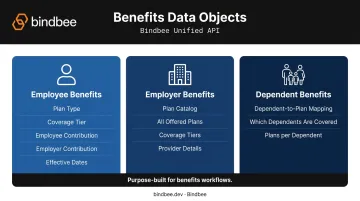
Newfront, the modern InsurTech platform, uses all three of Bindbee's benefits-related models together to power AI-driven benefits optimization across enterprise clients — use cases that collapse entirely with generic employee data models.
Challenge 7: Security, Compliance, and Data Privacy
HR and benefits data is subject to HIPAA, GDPR, SOC 2, and ISO 27001 requirements. Every integration point introduces an additional attack surface. According to IBM's 2025 Cost of a Data Breach Report, the average breach cost in the US is $10.22M, with healthcare as the most expensive industry at $7.42M per incident.
Any infrastructure handling dependent health data or benefit elections may qualify as a HIPAA business associate — meaning the compliance obligation extends to the integration layer, not just the application.
Solution: Work only with integration infrastructure that carries verifiable third-party certifications:
- SOC 2 Type II: requires an independent CPA audit over 6-12 months; cannot be self-attested
- ISO 27001: requires certification by an accredited body
- HIPAA compliance: critical for any PHI flowing through benefits workflows
- GDPR readiness: required for EU employee or dependent data
Bindbee holds all four, with SOC 2 Type II and ISO 27001 being third-party audited by nature. All data is encrypted in transit via TLS 1.2+.
Challenge 8: Integration Maintenance Burden and Engineering Bandwidth
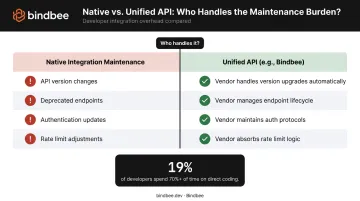
A live integration is not a finished integration. API providers change endpoints, deprecate fields, update authentication requirements, and adjust rate limits — often without advance notice. Without a team dedicated to tracking these changes, integrations break quietly and customers discover the problem through missing data.
Most engineering teams underestimate this ongoing commitment. The JetBrains 2024 State of Developer Ecosystem survey found only 19% of developers spend more than 70% of their time on direct coding work — the rest goes to understanding systems, debugging, and maintenance.
Solution: Shift maintenance responsibility off your engineering team entirely. Bindbee manages API version changes, authentication updates, and rate limiting internally across all 60+ connected systems. When Darwinbox updates its endpoints or UKG Pro changes authentication behavior, Bindbee absorbs that change — your integration stays stable. As Giftpack's VP of Engineering noted: "I can integrate once and instantly support many platforms without dealing with each provider's quirks."
Challenge 9: Custom Fields and Non-Standard Data Structures
Many HRIS customers configure fields that fall outside standard data models — cost centers, custom employee attributes, non-standard benefit codes. Integrations that can't surface these fields force customers into workarounds or push them toward abandoning the integration.
Solution: Build custom field support directly into the integration layer. Bindbee allows developers to pass include_custom_fields=true in API requests, which surfaces provider-specific custom fields alongside the normalized standard model in a consistent custom_fields object. Provider-specific field names are preserved, so customers don't lose their custom data structure — they just access it through a standardized interface.
Cypherworx's Senior Developer confirmed this matters in practice: Bindbee's "functionality lets us add support for new systems without any code change" — including systems with non-standard field configurations.
Challenge 10: Monitoring, Error Detection, and Broken Sync Recovery
Integration failures are often silent. A sync stops working because of an expired token, a rate limit breach, or a schema change — and teams only find out when a customer reports missing data. By that point, the gap may span hours or days.
Solution: Instrument every integration with end-to-end observability from day one:
- Sync status dashboards showing which connections are healthy — no engineering involvement required
- Webhook-based alerts that fire automatically when sync errors occur
- Automatic retry logic so failed syncs recover without manual intervention
- Data caching during outages, keeping previously synced records available when upstream systems go down
Bindbee provides all four. Teams can also trigger manual syncs via API or dashboard when immediate data refresh is needed.
Challenge 11: Vendor Lock-In and Scalability Constraints
Teams that build native integrations or adopt a single vendor's proprietary integration format face an uncomfortable reality as they scale: migrating away becomes expensive. Integration logic, field mappings, and customer connections are all tied to the vendor's ecosystem.
Solution: Prioritize integration infrastructure built on open standards and API-first design. The HR Open Standards Consortium, founded in 1999, exists specifically to reduce lock-in through voluntary, consensus-based HR data standards — because the problem is structural, not incidental.
Bindbee's unified API returns the same normalized schema regardless of which underlying HRIS is connected. When an end customer migrates from Recruitee to Greenhouse, zero code changes are required on the developer's side. Field mappings written against Bindbee's schema remain valid across the entire 60+ system library.
Root Causes: Why Integration Challenges Keep Recurring
Three compounding factors drive most recurring integration problems:
The HR Tech ecosystem was never designed for interoperability. Each HRIS evolved independently with proprietary data models. HR Open Standards has been working on voluntary interoperability specifications since 1999 — the fact that fragmentation persists four decades later reflects how entrenched proprietary formats are.
Integration work is consistently underestimated as a one-time cost. It's an ongoing operational commitment with maintenance, versioning, and compliance dimensions that compound over time. Sapient Insights found 29% of enterprise organizations planned to switch payroll solutions — which means integration churn is a persistent operational reality, not a one-time project.
Benefits-specific data needs are chronically underserved by generic tooling. Most integration platforms weren't built with dependent coverage, enrollment elections, or life event triggers in mind. Benefits teams end up patching generic tools to handle data structures they were never designed for.
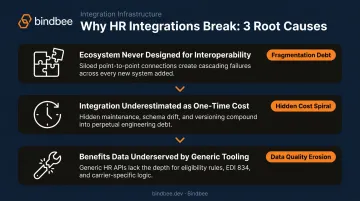
The consistent thread across all three: each problem gets harder to fix the longer it's left unaddressed. Maintenance debt accumulates, vendor churn compounds, and patched tooling breaks under edge cases that purpose-built infrastructure handles by default.
Best Practices to Prevent Integration Challenges
Getting integrations right upfront is far less costly than fixing them after your customers are live. These three practices address the root causes of the most common integration failures.
Unified data model first. Standardize how employee, employer, and benefits data is structured across all integrations before onboarding your first system. Retrofitting a data model after five systems are live is significantly more disruptive than getting it right upfront.
Real-time by default. Build integration pipelines with webhooks and event-driven triggers from day one. Reserve batch processing for bulk historical loads only — retrofitting for real-time requirements later costs significantly more than building it correctly the first time.
Observability as a core feature. Instrument every integration with sync status visibility, automated failure alerts, and audit logging before go-live. Assign clear ownership for monitoring and define response SLAs for each error category — not after a customer reports missing data.
Frequently Asked Questions
What are the three types of integrations?
The three main types are point-to-point (direct connections between two systems), hub-and-spoke (all systems connect through a central broker), and unified API (a single normalized layer connecting many systems at once). For HR Tech products supporting dozens of HRIS systems, unified API is the only approach that scales without engineering costs growing linearly with each new connection.
How do you overcome integration challenges?
Four practices make the biggest difference:
- Standardize your data model before writing the first line of integration code
- Use pre-built or unified API infrastructure rather than native connections from scratch
- Implement event-driven sync with webhook notifications instead of polling
- Treat integration maintenance as an ongoing function with defined ownership
The most common mistake is assuming the initial build is the end of the work.
What makes HRIS integration more complex than other software integrations?
HRIS systems have highly variable data models — every vendor structures employee and benefits data differently. The data is subject to strict compliance requirements (HIPAA, SOC 2, GDPR). And benefits-specific objects like dependent coverage elections and life event triggers have no equivalents in generic integration frameworks, requiring purpose-built data models.
How long does it typically take to build a native HRIS integration?
Building natively against a single HRIS platform's API requires significant engineering investment per system. Organizations supporting 10+ systems face cumulative build time that stretches across quarters. Unified API platforms like Bindbee cut new system connections to under a day, with end-customer authentication via Magic Link taking under 10 minutes.
What compliance standards should HR data integrations meet?
SOC 2 Type II, ISO 27001, HIPAA, and GDPR are the key standards for HR and benefits data. Any infrastructure handling employee PII, health benefit elections, or dependent data should hold third-party verified certifications — not self-attestation.