
Introduction
Before the Affordable Care Act, young adults faced a coverage cliff. Most lost health insurance at 18 or the moment they graduated college, leaving them uninsured during years when they were building careers, starting families, and navigating real health decisions.
The ACA's dependent coverage provision changed that. Under Section 2714, any health plan offering dependent coverage must extend it to adult children until age 26. No conditions attached. No student requirement. No residency test. No exception for married dependents.
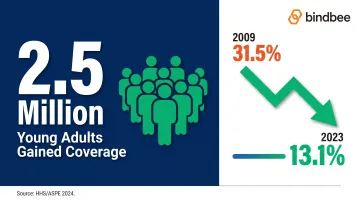
According to HHS/ASPE's October 2024 report, approximately 2.5 million young adults gained health insurance as a direct result of this provision. The uninsured rate for ages 19-25 dropped from 31.5% in 2009 to 13.1% in 2023. More than halved in a little over a decade.
For HR teams, benefits administrators, and the platforms that serve them, getting dependent coverage right isn't just a compliance checkbox. It's where enrollment errors, missed qualifying events, and termination timing failures tend to surface first.
Key Takeaways
- The ACA requires plans with dependent coverage to include adult children through age 26, regardless of student status, marital status, residency, or other coverage access.
- Both fully-insured and self-insured employer plans must comply with the federal age-26 rule.
- State extensions beyond age 26 apply only to fully-insured plans.
- Job-based plans typically end coverage on the 26th birthday; Marketplace plans continue through December 31 of that year.
- Seven states extend dependent coverage to ages 29–31, but only for fully-insured plans written in those states.
- Turning 26 triggers a Special Enrollment Period: 30 days for employer plans, 60 days for Marketplace plans, and 60 days to elect COBRA.
The ACA Under-26 Rule: What It Is and Who Qualifies
The Statutory Basis
ACA Section 2714 is codified across three federal frameworks: the Public Health Service Act (42 U.S.C. § 300gg-14), ERISA Section 715, and IRC Section 9815. Together, they require any health plan or insurer offering dependent coverage to make that coverage available until a child's 26th birthday.
The rule covers biological children, adopted children, stepchildren, and foster children. Plans cannot condition eligibility on any factor other than the parent-child relationship and the dependent being under 26.
None of the following factors disqualify a dependent:
- Being married
- Not being enrolled as a student
- Living independently or out of state
- Not being claimed as a tax dependent
- Having access to their own employer's health plan
One boundary: the rule does not extend to the dependent's own spouse or children. A grandchild does not gain eligibility through this provision.
The rule is clear on who qualifies. But the timing of when coverage actually ends varies by plan type.
When Coverage Ends
The cutoff depends on plan type:
| Plan Type | Coverage End Date |
|---|---|
| Job-based (employer) plan | On or around the 26th birthday (varies by plan terms) |
| Marketplace plan | December 31 of the year the dependent turns 26 |
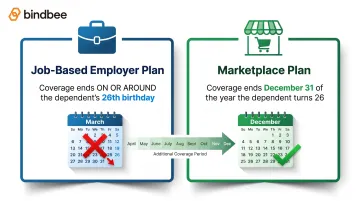
This timing difference matters. A dependent who turns 26 in February on an employer plan loses coverage in February. The same person on a Marketplace plan stays covered through year-end. Benefits administrators managing both plan types should track these calendars separately. The gap between February and December can mean months of unexpected coverage gaps or eligibility overlap.
How to Enroll a Dependent Under 26 on a Health Plan
Enrollment follows standard plan windows: annual Open Enrollment or a qualifying Special Enrollment Period (SEP). Here's how the process works in practice.
Step 1: Confirm Plan Eligibility
The parent should verify that their specific plan offers dependent coverage and check for any documentation requirements. Most plans do cover dependents, but confirm plan-specific enrollment windows before submitting.
One important note: when the ACA under-26 rule first took effect (for plan years beginning September 23, 2010), employers were required to offer a 30-day enrollment opportunity for dependents previously denied coverage under old rules. This was a one-time transitional window.
Step 2: Submit Enrollment
- Job-based plans: Contact HR or the benefits department during Open Enrollment, or within 30 days of a qualifying event (such as the dependent losing other coverage).
- Marketplace plans: A dependent can be added if the parent claims them as a tax dependent. If the parent pays full cost without a premium tax credit, tax-dependent status is not required.
Step 3: Verify Coverage Terms and Costs
The ACA prohibits charging dependents under 26 more than similarly situated individuals on the plan. Cost-sharing and benefit packages must be equivalent.
On the tax side, IRS Notice 2010-38 confirms that the employer-paid portion of a dependent's premium is excluded from the employee's gross income through the end of the taxable year in which the child turns 26 (under IRC Sections 105(b) and 106). The employee-paid share can also be paid pre-tax through a Section 125 cafeteria plan.
Managing these compliance requirements at scale introduces a separate operational challenge: keeping dependent data accurate across dozens of employer systems simultaneously. Bindbee's Dependent Benefits data model normalizes dependent relationship data, coverage elections, and effective dates across 65+ HRIS systems, so platforms like Newfront and Healthee can run compliant enrollment workflows through a single API rather than building separate connections for each employer's system.
What Plans Must Comply: Employer, Marketplace, and Self-Insured
Plan Type Coverage at a Glance
| Plan Type | Must Comply? | Notes |
|---|---|---|
| Fully-insured group health plans (small and large) | Yes | Subject to both federal and state rules |
| Self-insured ERISA plans | Yes (federal rule only) | Exempt from state insurance mandates |
| Individual market / Marketplace plans | Yes | Including off-Marketplace plans |
| Grandfathered group health plans | Yes | One of the few ACA provisions grandfathered plans must follow |
| Retiree-only plans | Generally exempt | Not treated as group health plans for ACA market reforms |
| Medicare | No | Eligibility is individually determined; no dependent coverage parallel exists |
The Self-Insured ERISA Distinction
Self-insured employer plans are governed by ERISA federal law, not state insurance mandates. This means state-enacted extensions beyond age 26 do not apply to self-insured plans unless the plan sponsor voluntarily adopts them.
This matters because self-insured plans cover a large share of the workforce at mid-size and large employers. An HR team in New Jersey managing a self-insured plan cannot assume New Jersey's age-31 extension applies to their employees. It doesn't.
Medicare and Dependents
Medicare does not follow the ACA dependent coverage model. Eligibility is individually determined based on each person's own earnings record or qualifying condition. There is no mechanism for a dependent to remain on a parent's Medicare coverage.
This creates a practical gap that benefits platforms and HR teams need to flag: when a parent transitions from employer coverage to Medicare, a dependent under 26 loses coverage entirely. That transition is a qualifying event triggering a special enrollment period, not an automatic continuation.
State Law Variations and Extended Coverage Beyond Age 26
The federal age-26 rule is a floor. Seven states have raised that floor, but only for fully-insured plans written in that state.
States with Extended Dependent Coverage
| State | Max Age | Key Conditions |
|---|---|---|
| Florida | 30 | Unmarried; no dependents; student or lives with parent; no other coverage |
| Illinois | 30 | Unmarried military veterans specifically |
| Nebraska | 30 | Unmarried; no other health insurance; state resident or full-time student |
| New Jersey | 31 | Unmarried; no dependents; NJ resident or full-time student |
| New York | 30 | Unmarried; works or resides in NY; ineligible for own employer coverage |
| Pennsylvania | 30 | Unmarried; no dependents or insurance; resident or full-time student |
| South Dakota | 29 | Full-time student requirement |
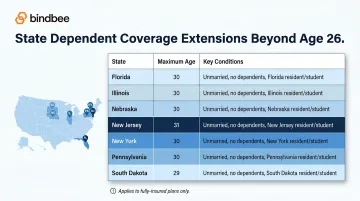
Source: Investopedia, January 2026
New Jersey as a Case Study
New Jersey's law (P.L. 2005, c. 375, predating the ACA) allows eligible dependents to remain on a parent's fully-insured group plan through age 31. Conditions include being unmarried, having no dependents, and being either a New Jersey resident or a full-time student at an accredited institution. Self-funded plans, governed by ERISA, are exempt, meaning many large employers aren't covered by this state rule at all.
The Multi-State Compliance Problem
For employers with workers in multiple states, the relevant rule is determined by where the fully-insured plan is written, not where the employee works. A company headquartered in Texas but with employees in New Jersey faces different coverage obligations depending on how each plan is structured and where it's issued. Benefits teams need to audit plan issuance location for each state, not just employee headcount, to know which extended-age rules apply.
What Happens When a Dependent Turns 26?
The Aging-Out Timeline
Coverage ends, and the clock starts immediately:
| Coverage Option | Window to Enroll | Duration |
|---|---|---|
| Marketplace SEP | 60 days from loss of coverage | Annual renewal |
| Own employer plan | 30 days from losing dependent status | Ongoing |
| COBRA continuation | 60 days to elect after notice | Up to 36 months |
| Medicaid/CHIP | Year-round if income qualifies | Ongoing |
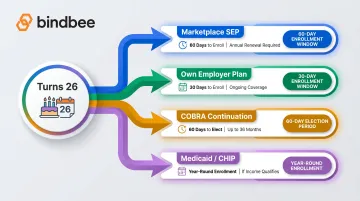
Aging off a parent's plan qualifies as a "loss of minimum essential coverage," which triggers Special Enrollment Period rights across all three pathways above.
COBRA as a Bridge
If the parent's employer has 20 or more employees, the dependent can elect COBRA continuation coverage for up to 36 months. The catch: the dependent pays the full premium plus an administrative fee of up to 2%. COBRA works well as a short-term bridge, particularly when the dependent has ongoing care needs and wants continuity of providers. Long term, it's rarely cost-effective compared to a Marketplace plan with income-based tax credits.
Avoiding a Coverage Gap
The transition requires proactive planning. Key steps:
- Contact the employer's HR department at least 30 days before turning 26 to understand the exact coverage end date
- Compare options: employer plan (if available), Marketplace plan, Medicaid, or spouse's plan
- Elect COBRA only if needed as a bridge, not as a permanent solution
At the platform level, these same age-out events create an operational challenge at scale. Bindbee's webhook system detects dependent aging-out events in real time, automatically triggering COBRA notifications, coverage termination workflows, and enrollment data updates before the next reconciliation cycle runs. ThrivePass cut benefits admin onboarding from 6 weeks to under a week by automating this type of event-driven workflow.
Common Misconceptions About Under-26 Dependent Coverage
Myth: The dependent must be a full-time student
This is a holdover from pre-ACA rules that Section 2714 specifically reversed. The ACA explicitly prohibits plans from conditioning eligibility on student enrollment. A 24-year-old who dropped out and works full-time qualifies just as much as one enrolled in graduate school.
Myth: The child must be claimed as a tax dependent
For job-based plans, tax-dependent status is irrelevant. The ACA's coverage right is based on the parent-child relationship and age alone. The one exception: Marketplace plans where the parent receives a premium tax credit. Parents paying full cost without a subsidy can add the child regardless of how taxes are filed.
Myth: Having their own employer coverage disqualifies them
Grandfathered group plans could initially exclude dependents with access to their own employer coverage, but that exception expired for plan years beginning January 1, 2014. No plan today can legally deny coverage to an under-26 dependent on those grounds, even if the dependent has their own job-based option available.
Quick reference: what the ACA actually requires:
- No student enrollment requirement
- No tax-dependent status requirement (for job-based plans)
- No exclusion based on access to other employer coverage
- Eligibility based solely on parent-child relationship and age under 26
Frequently Asked Questions
How is a dependent child defined under the Affordable Care Act?
Under the ACA, a "dependent child" is a biological child, adopted child, stepchild, or foster child of the plan enrollee who is under age 26. Financial dependency, co-residence, student status, and marital status are all irrelevant to eligibility.
Can I add my 25-year-old son to my health insurance?
Yes. A 25-year-old qualifies as an eligible dependent on a parent's job-based or Marketplace plan under the ACA. Request enrollment during your plan's Open Enrollment Period or within 30 days of a qualifying Special Enrollment Period event.
Can I get Obamacare if I am a dependent?
If your parent has a Marketplace plan, you can generally be included if they claim you as a tax dependent, or if they pay full cost without a premium tax credit. You can also apply for your own separate Marketplace plan or Medicaid if you don't qualify for inclusion on the parent's plan.
Can I claim a child on the ACA if I don't claim them on my tax return?
For employer-sponsored plans, yes. The ACA coverage right depends only on the family relationship and age, not tax-filing status. For Marketplace plans, tax-dependent status is required when the parent claims a premium tax credit, but parents paying full cost can include the child regardless.
How do I determine if someone qualifies for under-26 dependent coverage?
Two criteria: a qualifying parent-child relationship (biological, adopted, stepchild, or foster child) and the dependent being under age 26. No student status, income, or residency test applies.
What are my options after aging off a parent's plan at 26?
Your main pathways are: enroll in your own employer's plan within 30 days, elect COBRA for up to 36 months, enroll in a Marketplace plan within 60 days, or apply for Medicaid if income qualifies. Aging out triggers a Special Enrollment Period, so none of these options close on you.