
Introduction
GDPR fines aren't theoretical. As of early 2026, European supervisory authorities have imposed over €6 billion in cumulative penalties across nearly 2,900 individual enforcement actions. Regulators are no longer focused exclusively on Big Tech. Mid-size SaaS companies and non-EU providers are increasingly in scope.
Beyond regulatory risk, GDPR has become a procurement blocker. Enterprise buyers treat a signed DPA and documented compliance evidence as prerequisites, not negotiating items. Fail to produce them, and deals stall or disappear entirely.
SaaS companies face a compliance surface area that traditional businesses never encounter:
- Multi-tenant architectures with shared data boundaries
- Dozens of sub-processors, each requiring due diligence
- Customer data flowing across cloud regions and jurisdictions
- Operating simultaneously as both a data controller and a data processor
This guide covers what you actually need to know — from determining your obligations and structuring your roles, to implementing technical safeguards and managing DPAs at scale.
Key Takeaways
- GDPR applies to any SaaS company processing EU personal data, regardless of where the company is incorporated
- SaaS platforms almost always operate as both a controller (own CRM, HR, marketing data) and a processor (customer data inside the product)
- Core requirements: lawful basis for every processing activity, data subject rights within 30 days, Article 30 records, and 72-hour breach reporting
- Technical safeguards (encryption, access controls, audit logging, retention automation) require documented evidence, not just implementation
- Signed DPAs with every vendor touching personal data are non-negotiable: cloud providers, analytics tools, and sub-processors included
Does GDPR Apply to Your SaaS Company?
The short answer: if you process EU personal data, yes. Regardless of where your company is headquartered or where your servers sit.
The Extraterritorial Scope
GDPR Article 3(2) applies to non-EU entities when processing relates to:
- Offering goods or services to EU residents (even free-tier products)
- Monitoring behavior of EU residents, including through analytics, cookies, or behavioral tracking
The EDPB Guidelines 3/2018 clarify that simply having an accessible website isn't enough to trigger scope — intent matters. Using EU-specific languages, currencies, or domain names, or actively targeting EU customers, are indicators that pull you in.
That scope extends to processors too. If you process data on behalf of a controller who targets EU individuals, GDPR applies to you even without a direct relationship with EU end-users.
What Counts as Personal Data in SaaS
Many B2B SaaS companies assume they're exempt because they serve businesses rather than individuals. Wrong. Under Article 4(1), any information relating to an identifiable individual counts — which in a SaaS context includes:
- IP addresses, device identifiers, and session cookies
- User activity records and behavioral analytics data
- Support ticket content referencing individuals
- Professional email addresses and direct phone numbers in B2B CRM systems
- Employee records, health plan elections, compensation data, and dependent information in HR Tech and benefits platforms
For HR Tech and benefits platforms, that last category triggers Article 9 — GDPR's special category provisions for health and employment data, which carry stricter processing requirements and explicit consent obligations.
Controller vs. Processor: Understanding Your Role
Getting this distinction wrong creates structural compliance failures: the wrong DPA format, wrong lawful basis, and a broken data subject rights workflow.
The Core Definitions
- Data controller (Article 4(7)): determines the purposes and means of processing — the "why" and "how"
- Data processor (Article 4(8)): processes data on behalf of and under instruction from the controller
Controllers bear primary liability. But processors face direct enforcement under Articles 82 and 83. They cannot rely on the controller relationship as a shield against fines or compensation claims.
The Dual-Role Reality for SaaS
Most SaaS platforms operate in both roles simultaneously, and the EDPB Guidelines 07/2020 are explicit: the determination depends on factual circumstances, not what your contract says.
| Processing Activity | Typical Role |
|---|---|
| Customer billing and subscription management | Controller |
| Internal marketing and CRM data | Controller |
| Platform security monitoring and fraud detection | Controller (legitimate interests basis) |
| Customer data managed inside the product | Processor |
| EU employee records flowing through an HR API | Processor (or sub-processor) |
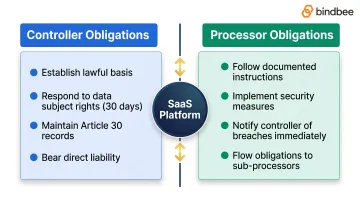
Controller obligations include:
- Establishing a lawful basis for each processing activity
- Responding to data subject rights requests within 30 days
- Maintaining Article 30 records of processing activities
- Bearing direct liability when something goes wrong
Processor obligations include:
- Processing only per documented controller instructions
- Implementing appropriate security measures
- Notifying controllers of breaches without undue delay (so they can meet their 72-hour deadline)
- Flowing GDPR obligations down to any sub-processors engaged
The sub-processor question is where HR Tech and benefits platforms face particular complexity. Every HRIS, payroll system, carrier integration, or benefits platform connected through an API layer constitutes a sub-processor relationship that requires contractual coverage.
Core GDPR Requirements SaaS Companies Must Address
Lawful Basis for Processing
Article 6 provides six lawful bases. For SaaS, three are most relevant:
- Contract performance — core service delivery: account creation, authentication, billing
- Legitimate interests — security monitoring, fraud detection, product improvement (requires a documented balancing test)
- Consent — optional features like marketing emails or analytics cookies
One common audit failure: using a single blanket basis across all processing activities. Each distinct processing purpose requires its own mapped basis. Regulators check this specifically. "Insufficient legal basis for data processing" is the single largest fine category in the enforcement record, accounting for nearly €3 billion in cumulative penalties.
Data Subject Rights
GDPR grants individuals eight rights. The operational implications for SaaS are significant:
- Access: produce a full data export within 30 days
- Erasure: deletion must cascade to backups, logs, and third-party services, not just primary databases
- Portability: structured, machine-readable format
- Rectification: updates must propagate across all storage locations
- Restriction and objection: requires processing controls at the system level
In multi-tenant SaaS environments, fulfilling these requests manually is not viable at any meaningful scale. Automated discovery and fulfillment tooling is operationally necessary.
Breach Notification Procedures
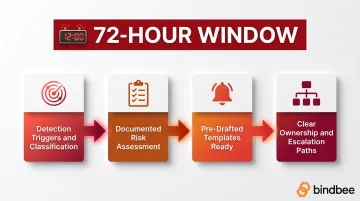
Article 33 requires controllers to notify the relevant supervisory authority within 72 hours of becoming aware of a breach that poses a risk to individuals. High-risk breaches also require notification to affected individuals.
As a processor, you must notify your controller customers "without undue delay", meaning immediately, to preserve their notification window.
Your incident response plan needs, at minimum:
- Detection triggers and classification criteria
- A documented risk assessment process
- Pre-drafted notification templates
- Clear escalation paths and ownership
Records of Processing Activities (Article 30)
Article 30 records are the first document regulators request during any investigation. Breach notification obligations make this especially consequential. If your records aren't current when an incident hits, you lose time you don't have.
Each record must cover:
- Processing purposes
- Categories of data and data subjects
- Recipients and sub-processors
- International transfer mechanisms
- Retention periods and security measures
SaaS companies operating in both controller and processor roles must maintain separate records for each role. Keep them current and producible quickly. Regulators won't accept a document last touched during the initial compliance project.
Technical and Organizational Measures
Article 32 requires documented technical and organizational measures appropriate to the risk. Regulators expect evidence, not just assertions.
Encryption
Encryption at rest and in transit is both a security measure and a regulatory liability reducer. Under Article 34(3)(a), if breached data was rendered unintelligible through encryption, the obligation to notify affected individuals individually may be waived — a concrete financial incentive beyond the baseline security benefit.
Industry practice for SaaS aligns with AES-256 for data at rest and TLS for data in transit across all service-to-service communication, API calls, and database connections. For multi-tenant environments, customer-specific encryption key management strengthens data segregation.
Access Controls and Authentication
Effective access control for GDPR purposes requires:
- Role-based access enforcing least privilege: no user or process should access beyond what their function requires
- Multi-factor authentication for admin accounts and production systems
- Periodic access reviews to prevent privilege creep
- Audit trails for all access provisioning changes
For HR Tech and benefits platforms, access controls carry extra weight: employee compensation, health plan elections, and dependent data all warrant stricter access tiers than general business data.
Audit Logging and Multi-Tenant Data Isolation
Every interaction with personal data (who accessed it, when, from where, and what action was taken) needs to be captured in tamper-resistant logs stored separately from production systems. Logs serve dual purposes: compliance evidence during audits and a security tool for detecting anomalous access.
For multi-tenant SaaS, preventing unauthorized access between customer tenants requires:
- Database-level segregation (tenant IDs, schema separation, or dedicated databases depending on risk)
- Application-layer validation enforcing tenant context on every query
- Network segmentation between tenant environments
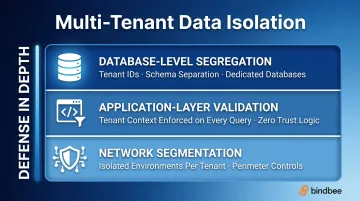
Document your isolation architecture. Expect this to appear in every enterprise security questionnaire your prospects send. It's one of the most scrutinized items in procurement reviews.
Data Retention Automation
Build automated retention schedules that flag data nearing expiry and delete it cleanly, including from backups and caches. Manual deletion workflows fail under volume and create direct GDPR exposure.
For HR Tech platforms, define distinct retention periods by data category: active employee records, terminated employee records, and benefits enrollment history all carry different requirements.
Managing Data Processing Agreements and Sub-Processors at Scale
What a Compliant DPA Must Contain
Under Article 28(3), a DPA must specify:
- Subject matter, duration, nature, and purpose of processing
- Categories of data and data subjects
- Processing instructions and the limits on processor discretion
- Security measures (referencing certifications like SOC 2 or ISO 27001)
- Sub-processor rules including notification timelines and approval processes
- Data subject rights assistance obligations
- Breach notification timelines aligned to the 72-hour requirement
- International transfer mechanisms (SCCs or adequacy decisions)
Having a DPA template that isn't actually signed is a compliance gap that surfaces regularly in audits. Every customer whose data you process needs an executed agreement.
Bindbee, for example, publishes its Data Processing Addendum publicly and executes it with customers as part of its standard terms. The DPA covers SCCs for EU-to-US transfers under Module 2 (controller-to-processor), a published sub-processor list with 30-day advance notice of changes, breach notification procedures, and data subject rights assistance.
These are the structural elements enterprise procurement teams check first. Having them documented in a publicly accessible DPA shortens security review cycles considerably.
Sub-Processor Chain Management
Map every third-party service that touches personal data: cloud infrastructure, monitoring tools, analytics providers, ticketing systems. For each sub-processor:
- Conduct vendor due diligence: review certifications, security policies, and compliance reports
- Execute a sub-processor agreement that flows down GDPR obligations
- Maintain a published, up-to-date sub-processor list
Approximately 84% of enterprise organizations require SOC 2 or equivalent compliance from SaaS vendors — and they're checking this list. HR data is a particularly sensitive category, so prioritize sub-processors with formal compliance certifications.
Bindbee holds SOC 2 Type II, ISO 27001, and GDPR-Ready status, which reduces the compliance overhead of onboarding it as a sub-processor for HRIS and payroll integrations.
International Transfers and SCCs
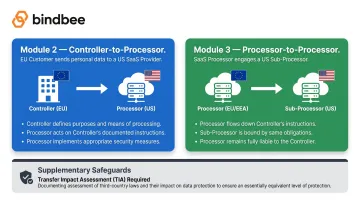
Most US-based SaaS companies processing EU data rely on Standard Contractual Clauses as their primary transfer mechanism. Module selection matters:
| Module | Scenario |
|---|---|
| Module 2 (Controller-to-Processor) | EU customer sends data to US SaaS provider |
| Module 3 (Processor-to-Processor) | SaaS processor engages a US sub-processor |
The EU-US Data Privacy Framework (DPF), which entered into force on July 10, 2023, provides an adequacy pathway for certified US organizations. Given the history of Safe Harbor and Privacy Shield being invalidated, maintaining SCCs as a fallback alongside DPF certification is the safer, more defensible approach.
Where SCCs are used, conduct a Transfer Impact Assessment evaluating whether the destination country's laws compromise the protections SCCs provide, and apply supplementary safeguards where destination-country laws fall short of GDPR standards.
Your GDPR Implementation Roadmap
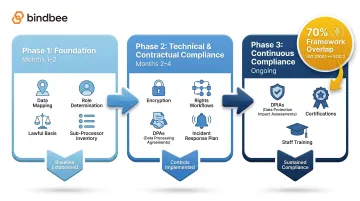
Phase 1: Foundation (Months 1–2)
- Conduct a data mapping exercise covering every personal data flow
- Determine controller vs. processor role for each processing activity
- Establish lawful bases for each processing purpose
- Inventory all sub-processors and identify gaps in DPA coverage
This baseline is what regulators ask to see first. Everything else builds on it.
Phase 2: Technical and Contractual Compliance (Months 2–4)
- Audit or implement encryption, access controls, audit logging, and retention automation
- Execute DPAs with all customers and sub-processors
- Build internal workflows for data subject rights requests within the 30-day window
- Establish a documented incident response plan with 72-hour notification procedures
Phase 3: Continuous Compliance and Commercial Leverage (Ongoing)
Without ongoing maintenance, Phase 1 and Phase 2 work degrades fast. Vendor lists change, features ship, and staff turns over. Keep the program current with these activities:
- Schedule DPIA reviews for new features involving high-risk processing
- Update sub-processor lists as the vendor landscape changes
- Conduct regular staff training
- Pursue ISO 27001 and SOC 2 certification. 70% of requirements overlap across these frameworks, meaning the implementation effort is largely shared
A readily available DPA, a published sub-processor list, and recognized security certifications aren't just compliance outputs. They're sales assets. Enterprise deals routinely stall at security review and procurement sign-off when this documentation isn't ready. Having it on hand before a prospect asks removes that friction entirely.
Frequently Asked Questions
Is GDPR compliance mandatory in the USA?
GDPR is not a US domestic legal requirement. However, any US-based SaaS company that processes personal data of EU residents (through EU customers, EU end-users, or EU employee data flowing through integrations) is legally subject to GDPR regardless of US headquarters. Non-compliance exposes the company to EU regulatory enforcement and significant fines.
Can you transfer data to the US under GDPR?
Yes, transfers from the EU to the US are permitted but require an approved legal mechanism. Standard Contractual Clauses (SCCs) are the most common approach; the EU-US Data Privacy Framework provides an adequacy pathway for certified US organizations. Without one of these mechanisms, transferring EU personal data to US systems is a GDPR violation.
What is a GDPR compliant platform?
A GDPR compliant platform covers three areas: technical safeguards (encryption, access controls, audit logging, data deletion), legal frameworks (signed DPAs, sub-processor agreements, SCCs), and operational processes (data subject rights fulfillment, breach notification, records of processing). Certifications like ISO 27001 and SOC 2 Type II independently verify these controls are in place.
What is the difference between a data controller and data processor for SaaS?
A data controller determines why and how personal data is processed; a data processor acts on the controller's instructions. Most SaaS companies are both — a controller for internal data (HR, billing, marketing) and a processor for personal data their customers manage inside the product.
What are the penalties for GDPR non-compliance for SaaS companies?
GDPR fines are tiered: less severe infringements reach up to €10 million or 2% of global annual revenue; the most serious violations carry fines up to €20 million or 4% of global annual revenue, whichever is higher. Beyond the financial penalties, non-compliance triggers deal delays, customer churn, and reputational damage.
Do SaaS companies need a Data Processing Agreement with all vendors?
Yes. A signed DPA is required with every vendor that processes personal data on your behalf — cloud infrastructure providers, analytics platforms, customer support tools, email marketing services, and any integration or API providers handling personal data. Operating without these agreements is a direct GDPR violation that exposes both parties to regulatory action.