
With the average cost of a data breach reaching $4.44 million in 2025 (and healthcare breaches averaging $7.42 million), enterprise procurement teams aren't taking chances on unvetted vendors.
This guide covers what makes ISO 27001 certification distinct in a SaaS context, how to scope and execute it efficiently, what it costs, and how to turn the certificate into a genuine sales asset.
Key Takeaways
- ISO 27001:2022 has 93 Annex A controls across 4 themes; SaaS companies can scope narrowly around their product and cloud infrastructure to reduce time and cost
- The 2022 revision added cloud-specific controls (A.5.23) and mandatory secure coding practices (A.8.28), making it significantly more relevant for cloud-native companies than ISO 27001:2013
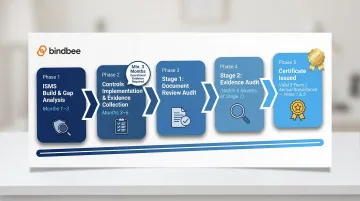
- Certification takes 6–12 months for a SaaS startup; the ISMS must show at least 3 months of operational evidence before the Stage 2 audit
- ISO 27001 controls map directly onto SOC 2, GDPR, and HIPAA. Pursue multiple frameworks together and cross-map to cut duplicative work
- First-year costs typically range from $20,000–$55,000 USD for a 20–100 person SaaS company
What Makes ISO 27001 Certification Unique for SaaS Companies
ISO 27001 was originally written for any type of organization. The 2022 revision changed that dynamic for cloud-native companies. It introduced controls that directly address how SaaS businesses actually operate.
The 2022 Revision: Built for Cloud
ISO 27001:2022 restructured Annex A from 114 controls across 14 domains to 93 controls across 4 themes: Organizational (37), People (8), Physical (14), and Technological (34). The revision added 11 entirely new controls. For SaaS companies, the critical ones are:
| Control | What It Requires |
|---|---|
| A.5.23 | Document shared responsibility with cloud providers; define exit strategies |
| A.8.9 | Govern infrastructure-as-code and configuration management |
| A.8.28 | Establish secure coding principles within development processes |
| A.8.10 | Manage data deletion across multi-tenant environments |
| A.8.16 | Implement logging and observability across cloud workloads |
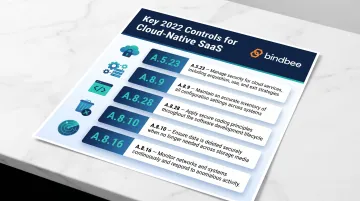
A.5.23 represents the biggest shift for cloud-dependent SaaS companies. SaaS companies using AWS, GCP, or Azure must formally document the shared responsibility boundary, specifying which security controls the cloud provider owns versus what the SaaS company must manage (IAM configurations, VPC architecture, encryption settings, application-layer access). Auditors expect this boundary to be explicit, not implied.
That foundation in cloud-specific controls sets the stage for a more specific challenge SaaS teams encounter: multi-tenancy.
Multi-Tenancy as a Specific Risk Area
When customers share infrastructure, the ISO 27001 risk assessment process requires explicitly modeling data segregation. Auditors focus on three controls in particular:
- A.8.3: Information access restriction
- A.8.5: Privileged access management
- A.8.24: Use of cryptography
More than 31% of cloud breaches stem from misconfiguration and manual errors, with 82% of those misconfigurations caused by human error. Multi-tenant data segregation controls should be a top priority during scoping.
Bindbee addresses this directly in its multi-tenant architecture: customer data is logically isolated on AWS using separate authentication contexts, least-privilege access controls, and TLS encryption for all data in transit. Auditors look for implemented controls backed by evidence, not just documented policies. This architecture satisfies both requirements.
Solving for multi-tenancy secures your data layer. But for SaaS companies, the development pipeline is an equally exposed surface.
Developers Are the Primary Security Surface
A.8.25 (Secure Development Lifecycle) and A.8.28 (Secure Coding) require documented policies for code review, change management, and security testing. For SaaS companies, these aren't optional bureaucracy. They're the core of what auditors look for. A polished access control policy won't save you if there's no evidence that security validation happens before code ships.
In HR Tech and Benefits SaaS specifically, the stakes are higher. These platforms handle compensation data, benefits elections, dependent records, and health-related information, the kind of data that makes enterprise buyers run thorough vendor audits. Bindbee holds both ISO 27001 and SOC 2 Type II certifications, meeting the same security bar its customers must clear when large employers review their vendor stack.
Defining Your ISMS Scope as a SaaS Company
Scope is the most consequential early decision. Get it wrong and you either spend twice as long on certification or create audit failure risks.
What to Include vs. Exclude
For an initial certification, a focused scope covering your core SaaS product and cloud infrastructure is the right starting point:
Include:
- Production cloud accounts where customer data is processed
- Customer-facing APIs and backend services
- CI/CD pipelines and engineering/DevOps workflows
- Third-party integrations that touch customer data (payment processors, identity providers, sub-processors)
- Key internal tools used by teams with production access
Exclude (initially):
- Internal HR and people management tools
- Marketing systems with no access to customer data
- Administrative functions outside the product delivery chain
One caveat: excluding elements requires explicit justification and can create audit complications if the excluded system later touches in-scope data. Scope expands in later certification cycles. Start narrow, document your reasoning, and revisit at renewal.
Handling Supplier Risk Within Scope
Controls A.5.19–A.5.22 require documented supplier agreements and security assessments for every external service that processes customer data. For a typical SaaS company, this means your payment processor, identity provider, cloud infrastructure provider, and any embedded integration partners.
Working with already-certified sub-processors cuts the assessment workload considerably. Bindbee, for instance, holds ISO 27001 and SOC 2 Type II certifications and provides a pre-packaged documentation set: a sub-processor list, Data Processing Addendum, and security documentation auditors can review directly. For Benefits SaaS companies using Bindbee to connect to HRIS and carrier systems, that means supplier assessments for those connections require far less back-and-forth to complete.
The ISO 27001 Certification Process: Step by Step
Step 1: Gap Analysis and Risk Assessment
Map your current security controls against all 93 Annex A controls. Score each identified risk by likelihood × impact across your key data assets: customer databases, admin panels, API configurations, third-party integrations. The output is a prioritized remediation list and the foundation for your Statement of Applicability.
Step 2: Build Core ISMS Documentation
Two documents are mandatory and will be the first things your auditor reviews:
- Statement of Applicability (SoA): Documents which controls are implemented, which are excluded, and the justification for each exclusion
- Risk Treatment Plan: Maps each identified risk to a specific control implementation or a documented accept decision
Step 3: Implement Controls and Policies
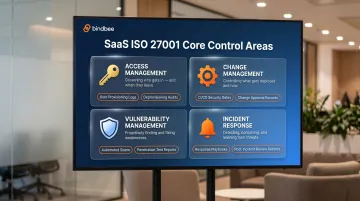
Auditors don't read policies. They sample evidence that controls ran yesterday. The four areas most scrutinized for SaaS companies:
- Access management: User provisioning/deprovisioning logs, quarterly access reviews
- Change management: Security review gates in CI/CD, rollback procedures
- Vulnerability management: Scheduled scans, patch timelines, penetration test results
- Incident response: Documented playbooks, post-incident review records
Step 4: Employee Training and Internal Audit
Role-based training must be logged with completion records. Engineering, DevOps, and customer support each need separate training tracks reflecting their actual risk exposure.
Once training cycles are complete, the internal audit (Clause 9.2) can begin, and this is the most commonly under-resourced step. External auditors verify that at least one complete internal audit cycle has been performed. Shortcut it and you'll almost certainly face Stage 2 delays.
Step 5: Stage 1 and Stage 2 Certification Audit
Each stage has a distinct focus:
- Stage 1: Document review. The auditor assesses whether ISMS documentation meets the standard and issues a readiness report with any gaps to address
- Stage 2: Evidence review. The auditor samples actual evidence: log files, change tickets, training records, vendor assessment documentation
Stage 2 must occur within 6 months of Stage 1, and your ISMS must show at least 3 months of operational evidence before Stage 2. The certificate is valid for 3 years, with mandatory annual surveillance audits in years 1 and 2.
Timeline and Cost: What SaaS Companies Should Expect
Timeline by Approach
| Scenario | Timeline |
|---|---|
| SaaS startup with compliance automation | 6–12 months |
| Mid-market SaaS, manual approach | 12–18 months |
| Stage 1 + Stage 2 audit window | Up to 6 months |
Whether you hit 6 months or 18 months largely depends on one decision: automated or manual evidence collection. Compliance automation platforms (Vanta, Drata, Sprinto, Secureframe) integrate with your cloud infrastructure and pull evidence continuously from AWS CloudTrail, GitHub, Okta, and similar sources, mapping it directly to Annex A controls. That eliminates the single biggest time sink in the process.
Cost Breakdown for a 20–100 Person SaaS Company
| Component | Notes |
|---|---|
| Gap analysis / consulting | Varies by current security maturity |
| Compliance automation platform | Annual subscription; pricing varies by vendor and company size |
| Stage 1 + Stage 2 audit fees | Set by accredited certification body based on scope and audit days |
| Total first-year estimate | $20,000–$55,000 USD |
Once certified, the ongoing costs drop. Annual surveillance audits run well below the initial certification spend. And when automation is integrated into CI/CD workflows, evidence collection becomes continuous. There's no pre-audit scramble to pull everything together at once.
Common ISO 27001 Challenges for SaaS Teams
Control Drift in Fast-Moving Codebases
Teams shipping multiple deploys per week can inadvertently introduce vulnerabilities between audits. The fix: integrate continuous compliance monitoring into CI/CD pipelines and make security review a mandatory gate in the deployment process, not a post-deploy check.
Scattered Evidence Across Tools
Compliance evidence lives across AWS CloudTrail, GitHub, Okta, Jira, and HR systems. Manual collection can consume hundreds of hours per audit cycle. Automation tooling that maps collected evidence directly to Annex A controls turns this from a quarterly fire drill into a continuous background process.
Operationalizing Controls, Not Just Writing Policies
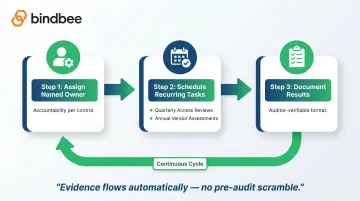
Auditors want evidence that controls actually run: access reviews completed on schedule, vendor risk assessments documented, incident logs maintained. Three actions make this concrete:
- Assign a named process owner to each control
- Schedule recurring tasks (quarterly access reviews, annual vendor assessments)
- Document results in a format auditors can verify
When each control has an accountable owner and a documented cadence, your ISMS produces evidence automatically, rather than requiring a scramble before every audit.
Weak Internal Audits
A rushed or incomplete internal audit lets fixable gaps reach Stage 2, where a certification body finds them instead of you. Treat the internal audit as a rehearsal for the certification audit. Run checklists against every applicable Annex A control, document findings, and produce corrective action plans before the certification body arrives.
ISO 27001 as a Business Asset
Accelerating Enterprise Sales
Enterprise procurement teams increasingly require security validation before contract signature. For HR Tech and Benefits SaaS companies, where buyers are sharing employee health data, compensation information, and dependent records with vendors, ISO 27001 certification often transitions from "preferred" to "required" during vendor evaluation.
The practical impact shows up in a few ways:
- Security questionnaires get shorter or disappear when you can point to a certificate and published documentation
- RFP responses reference the certificate instead of requiring lengthy security appendices
- European and enterprise buyers recognize ISO 27001 specifically. Enterprise buyers worldwide recognize it in a way that SOC 2, primarily a North American standard, isn't
Activating Certification as a Sales Tool
Three moves turn your certificate into a sales asset:
- Publish a Trust Center with your ISO 27001 certificate, scope statement, and security documentation, enabling self-service review for buyers and cutting procurement back-and-forth
- Stack it with SOC 2 Type II if you hold it: the control overlap means the incremental work for ISO 27001 is lower than starting from scratch, and the two programs reinforce each other
- Segment by market: ISO 27001 for European and enterprise buyers, SOC 2 for North American customers. Both audiences get a framework they already recognize
The Regulatory Tailwind
That market recognition is now backed by regulation. The EU's NIS2 Directive sets risk management requirements for essential and important entities and references ISO 27001 as a relevant standard for demonstrating compliance with Article 21 obligations. SaaS companies selling to banks, healthcare organizations, or utilities in Europe face growing pressure to hold certification as part of vendor onboarding.
For HR Tech and Insurtech, sectors processing financial, health, and workforce data across regulated industries, that pressure compounds fast. A vendor that can't produce an ISO 27001 certificate during European enterprise due diligence is increasingly disqualified before the commercial conversation begins.
Frequently Asked Questions
What is the ISO standard for SaaS?
ISO 27001 is the primary internationally recognized information security standard for SaaS companies, covering the design and operation of an ISMS. The 2022 revision added cloud-specific controls (A.5.23, A.8.28) that make it directly applicable to cloud-native architectures, with companies selecting which of the 93 Annex A controls apply through their Statement of Applicability.
Is Google Cloud Platform ISO 27001 certified?
Yes, GCP, AWS, and Azure all hold ISO 27001 certifications, but these cover the providers' own infrastructure only. Under the Shared Responsibility Model, a SaaS company must independently certify its own ISMS, covering application-layer controls, IAM configurations, and data handling practices built on top of those platforms.
How long does ISO 27001 certification take for a SaaS company?
Typically 6–12 months for a SaaS startup using compliance automation tooling, or 12–18 months via a manual approach. Company size, scope complexity, and auditor availability are the main variables. The ISMS also needs at least 3 months of operational evidence before the Stage 2 audit begins.
What is the difference between ISO 27001 and SOC 2 for SaaS companies?
ISO 27001 is a certifiable international standard for an ISMS issued by accredited certification bodies; SOC 2 is a US-originated audit report against AICPA Trust Service Criteria. Controls overlap significantly, and many SaaS companies pursue both: ISO 27001 for European and enterprise buyers, SOC 2 for North American customers.
Does ISO 27001 certification expire?
The certificate is valid for 3 years, with mandatory annual surveillance audits in years 1 and 2. At the end of the 3-year cycle, a full recertification audit is required to renew. Annual surveillance audits cost less than the initial certification.
How much does ISO 27001 certification cost for a SaaS startup?
Total first-year costs for a 20–100 person SaaS company typically fall between $20,000–$55,000 USD, covering gap analysis and consulting, a compliance automation platform, and Stage 1 + Stage 2 audit fees from an accredited body. Using automation tooling is the fastest way to cut both cost and time-to-certification.