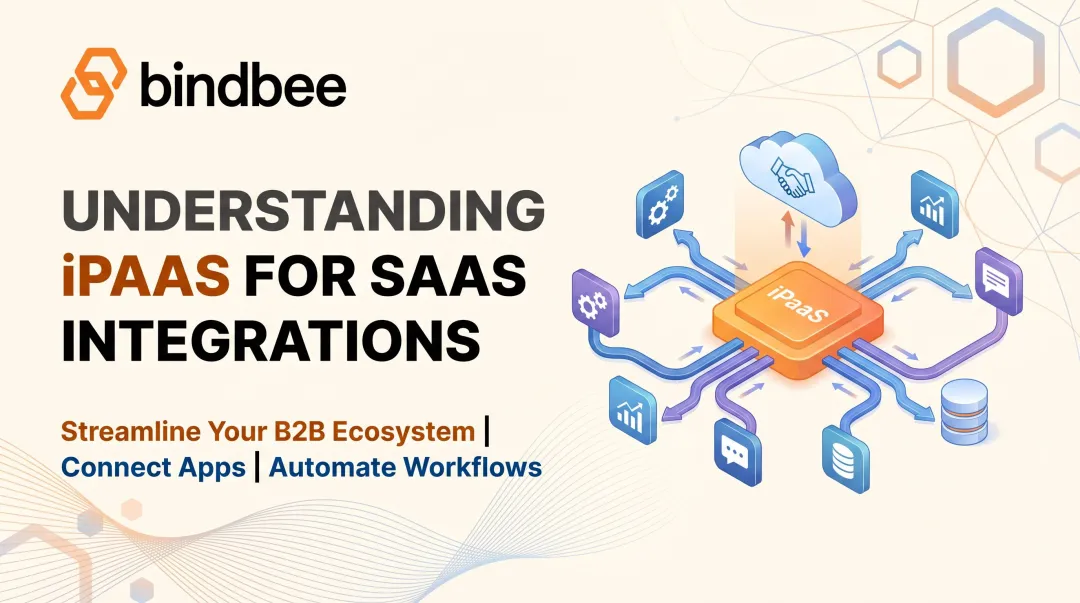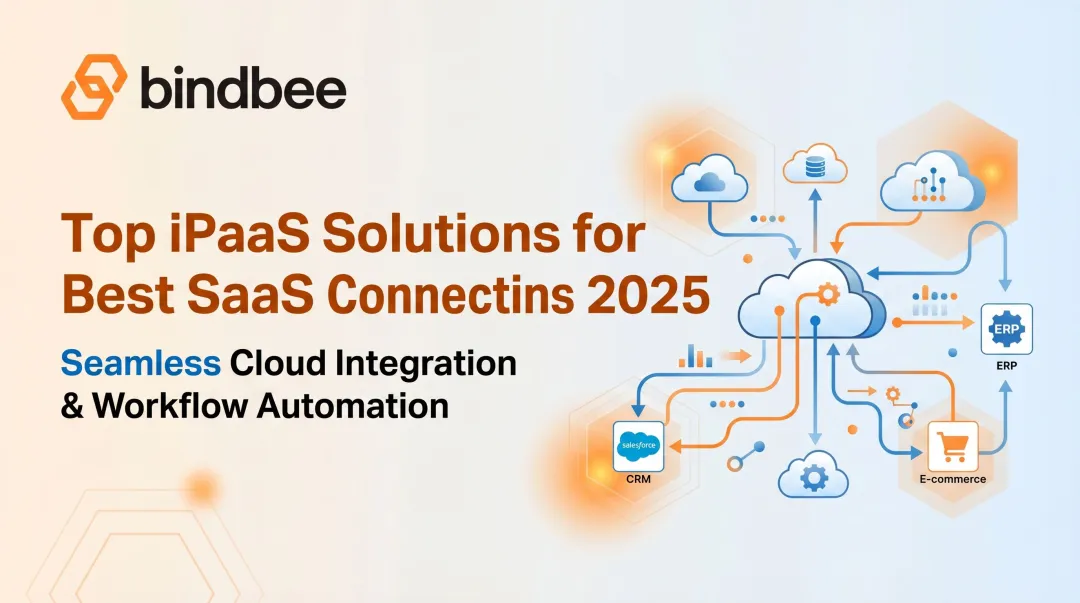

In-product integrations aren't the same as internal automations. They need to support multiple customer accounts, separate credentials per tenant, different permission levels, custom schemas, and a setup flow a non-technical customer can complete alone.
This article compares unified APIs, embedded iPaaS tools, and developer-focused integration infrastructure — five platforms, evaluated on integration depth, security, observability, and long-term maintenance burden.
Key Takeaways
- Match the platform to your need: normalized data, provider-specific depth, embedded workflows, or full code control
- Bindbee fits HR Tech, payroll, and benefits SaaS that need employment data through one API
- Evaluate field coverage, sync behavior, and error recovery, not just connector counts
- Run a proof of concept with real customer configurations before committing to any platform
Overview of In-Product Integrations in the SaaS Market
An in-product integration is a customer-facing connection: your user links their external system (say, their HRIS) to your product, and data flows or actions trigger from inside your app — not through a background script only your team can see.
Three categories dominate this space:
- Unified APIs — one normalized API covering a category like HRIS, payroll, CRM, or accounting
- Embedded iPaaS — customer-facing workflows, connectors, and integration management built into your product's UI
- Deep or code-first infrastructure — developer-owned integration logic that preserves provider-specific fields and operations instead of flattening everything into a common schema
Why does this category matter so much right now? In G2's 2023 report, 82% of 1,704 B2B software buyers said integration with their existing tools was an important purchase factor. That's a lot of deals riding on whether your product connects to what a customer already runs.

Faster onboarding, lower maintenance overhead, and a genuine product differentiator — that's the payoff when it's done right. The five platforms below aren't interchangeable. Each solves a different version of the integration problem.
Best Platforms for In-Product Integrations SaaS
Before ranking anything, we looked at usability for the end customer, system coverage, API and data depth, authentication model, sync behavior, observability, security posture, and the engineering effort required to launch and maintain each connection.
Bindbee
Bindbee is built specifically for HR Tech, benefits administration, payroll, and employee-engagement platforms that need employment and benefits data through a single, normalized API, not a generic "connect anything" tool.
Its differentiators are narrow but deep:
- Normalized data across 60+ HR, payroll, ATS, and carrier systems, including Workday, ADP, BambooHR, Gusto, Rippling, and UKG
- Benefits-first data models with Employee, Employer, and Dependent Benefits as distinct objects (eligibility windows, coverage tiers, beneficiaries, effective dates)
- Automatic incremental syncs plus webhooks for life events like new hires, terminations, and dependent changes
- An SFTP-to-API bridge that ingests legacy CSV, XML, and fixed-width file exports and serves them through the same endpoints as direct integrations
- Magic Link authentication, letting customers connect an HRIS in three clicks without ever sharing credentials with Bindbee
- Custom field support at both the connector and organization level for provider-specific edge cases
| Attribute | Details |
|---|---|
| Best use case | HR Tech, benefits admin, payroll, and insurtech platforms |
| Integration model | Unified API with benefits-first data models |
| Key capabilities | Eligibility intelligence, COBRA detection, census sync, SFTP-to-API bridge |
| Security credentials | SOC 2 Type II, ISO 27001, HIPAA compliant, GDPR ready |
| Implementation note | Setup in under a day versus 4–8 weeks building native APIs in-house |
Newfront, one of Bindbee's customers, used the platform to reach 50+ HR and benefits systems through one integration point, with consistent error handling whether data arrived via REST API or a daily SFTP drop.
The trade-off is honest: Bindbee goes deep in HR and benefits, not wide across unrelated categories. If your product also needs CRM or ticketing connections, you'll want to pair it with (or compare it against) a more horizontal platform.
Merge
Merge targets SaaS products that need broad category coverage: HRIS, recruiting, accounting, CRM, ticketing, and file storage, all behind one unified API per category.
Its common data model reduces provider-specific implementation work, but you'll still need to validate supported objects, write operations, custom-field handling, and authentication methods for your specific use case.
| Attribute | Details |
|---|---|
| Supported categories | HRIS, ATS, accounting, CRM, ticketing, file storage |
| Common-model coverage | Standard fields mapped; Remote Data exposes raw provider payloads |
| Customization | Field mapping; authenticated passthrough available on Professional/Enterprise only |
| Sync & observability | Highest-frequency or daily sync; webhooks for linked-account and data changes |
| Security | SOC 2 Type II, ISO 27001 |
| Pricing | Three free linked accounts, then $650/month for up to 10, $65 per additional account |
Cledara, a Merge customer, says it built more than 40 HRIS and accounting integrations in a couple of weeks and attributed part of a roughly 3x quarter-over-quarter new-business increase to the integrations — though that growth wasn't exclusively tied to Merge.
Before committing, confirm webhook behavior, API rate limits, and whether your needed custom fields actually flow through the common model or require passthrough calls.
Paragon
Paragon is an embedded iPaaS: customer-facing workflows, a branded setup portal, and managed sync, rather than a flat normalized API.
It combines prebuilt connectors (130+ advertised) with an embeddable Connect Portal where customers authenticate and configure integrations themselves. A visual workflow builder lets you chain triggers, API requests, and JavaScript functions.
| Attribute | Details |
|---|---|
| Embedded components | Connect Portal, Integration SDK, Connected Users Dashboard |
| Workflow flexibility | Visual builder with triggers, actions, and code steps |
| Connector coverage | 130+ prebuilt, plus custom connectors |
| Sync options | Managed Sync with 1-minute to 24-hour incremental overrides; polling fallback at one request per minute |
| Deployment | Multi-tenant cloud (US or EU), VPC self-hosting, forward deployment |
| Security | SOC 2 Type II; ISO 27001 listed as "coming soon," not yet certified |
Test how workflows are versioned, updated per customer, and debugged when a third-party API call fails — that's where embedded iPaaS tools either shine or create new support tickets. Paragon fits workflow-heavy products better than ones that just need a clean, normalized vertical API.
Nango
Nango is the developer-first choice: you own the integration logic and data models, while Nango manages authentication, retries, rate limits, webhooks, and logs.
- Supports 1,000+ external APIs for authentication and raw connectivity, not 1,000 fully built product integrations
- Teams write TypeScript functions for syncs, actions, and webhook processing
- Open-source under the Elastic License, with managed cloud, BYOC, or limited free self-hosting
| Attribute | Details |
|---|---|
| Code ownership | Integration logic lives in your repo, deployed via CI/CD |
| Authentication | OAuth 2.0, OAuth 1.0a, API keys, basic auth, custom schemes |
| Sync & webhooks | Provider webhooks plus polling reconciliation; functions can run every 30 seconds |
| Deployment | Managed cloud, enterprise self-hosting, or free hobby self-hosting |
| Security | SOC 2 Type II (ISO 27001 not listed on its trust center) |
| Pricing | Free tier, $50/month pay-as-you-go, custom Enterprise |
Talkbase, a Nango customer, doubled its integration count and shipped three custom integrations in its first month on the platform. That speed comes with a catch: you're responsible for building, testing, and maintaining the parts that aren't prebuilt. Nango fits engineering teams that want control more than a fully managed, no-code experience.
Workato Embedded
Workato Embedded targets larger SaaS organizations that want to hand customers broad workflow automation: not just data sync, but full recipe-based logic they can run (or you can manage centrally) inside your product.
| Attribute | Details |
|---|---|
| Connector ecosystem | 1,000+ connectors across prebuilt, universal, and community categories |
| Workflow complexity | Recipes manageable per customer workspace via Embedded API |
| Customer administration | Embedded Admin Console for managing customers, connections, and recipe success rates |
| Deployment | White Label and Fully Embedded UI options with theme customization |
| Security | SOC 2 Type II, ISO 27001 |
| Commercial structure | Custom quote model; no public fixed pricing |
Mitratech, a Workato Embedded customer, grew its integrated customer count from 2 to 300 within its first year.
Before choosing this route, decide whether your product needs customer-authored workflows or centrally governed recipes. That decision drives implementation complexity and ongoing admin overhead. Workato Embedded tends to suit larger teams with governance requirements and enterprise budget, not early-stage products shipping their first integration.

How We Chose the Best In-Product Integration Platforms
This evaluation prioritized production readiness over marketing claims or raw connector counts. Here's what we actually checked:
- Integration depth: required objects, relationships, custom fields, read/write operations, pagination, rate-limit handling, and provider-specific endpoints
- End-user experience: tested against at least two customer account types with different schemas and permissions, documenting how much setup needed engineering help
- Sync behavior: distinguishing live reads, native webhooks, polling, scheduled syncs, incremental updates, and historical backfills
- Operational resilience: searchable logs, retries, failed-event recovery, alerting, and visibility into individual customer connections
- Security and commercial fit: certifications, encryption, credential handling, data retention, tenant isolation, and pricing structure

SOC 2 and ISO 27001 measure different things. AICPA's SOC criteria cover security, availability, processing integrity, confidentiality, and privacy, while ISO 27001:2022 certifies an information security management system.
A vendor mentioning HIPAA or GDPR in passing isn't the same as holding either certification. Check the documentation, not the marketing page.
For broader market context, Gartner's Magic Quadrant evaluates 18 iPaaS vendors on ability to execute and completeness of vision (useful background, though it doesn't rank these five platforms directly against each other).
Conclusion
There's no single "best" platform here: only the one that matches your integration category, required data depth, customer configuration model, and engineering capacity. A huge connector catalog means nothing if the three systems your customers actually use aren't deeply supported.
Before you sign anything, run a proof of concept:
- Authenticate a real customer account
- Map fields against your actual schema
- Trigger a bidirectional update
- Force a failed operation and watch how recovery works
- Test a second account with a different schema or permission set
For HR Tech and benefits-focused products specifically, put Bindbee's unified API, benefits-first data models, and SOC 2/ISO 27001 credentials on your shortlist, particularly if your customers run a mix of modern and legacy employment systems that need to show up as one clean data stream.
Frequently Asked Questions
What are product integrations?
Product integrations are customer-facing connections that let users link external systems — like an HRIS or CRM — to a SaaS product. They exchange data, trigger actions, or automate workflows directly inside the application.
What are types of integrations?
Common types include unified APIs, embedded iPaaS, direct or deep provider integrations, workflow automation, webhook-based events, and file-based or SFTP integrations for legacy systems.
What are examples of integration?
Examples include syncing an HRIS with a benefits platform, sending payroll data to an employee-finance app, connecting a CRM to a customer-success tool, or embedding a configurable workflow builder inside a SaaS product.
What is the difference between a unified API and an embedded iPaaS?
A unified API abstracts multiple providers in one category behind a single normalized interface. An embedded iPaaS focuses more on customer-facing workflows, connector management, and configurable integration experiences.
How do I choose an in-product integration platform?
Compare target-system coverage, data depth, customer onboarding experience, authentication methods, sync freshness, bidirectional writes, observability, security credentials, and pricing structure — not just the number of listed connectors.
What should I test before launching customer-facing integrations?
Test multiple customer schemas, custom fields, permission levels, failed writes and retries, webhook or polling behavior, historical syncs, credential revocation, and whether your support team has visibility into connection health.