
Introduction
Every HR Tech platform faces the same painful reality: each new enterprise customer runs a different payroll system. One uses ADP, the next uses Workday, the third uses BambooHR — and every one of those connections starts as a custom engineering project. Multiply that across dozens of customers and the math gets ugly fast.
According to Sapient Insights' 2024–2025 HR Systems Survey, enterprises now average 11.1 HR systems, with mid-market firms running 7.1. Meanwhile, the average organization used 26 HR modules in 2024, up from just 10 in 2020. Each system has its own schema, its own auth model, its own quirks.
This guide covers the API integration best practices that matter most in this environment. The context is specific to HR Tech, benefits administration, and payroll platforms — where a failed sync isn't just a data problem. It can delay benefits enrollment, miscalculate payroll, or expose protected health information.
What Is API Integration and Why Is It Especially Complex in HR Tech?
API integration connects two or more systems so data flows programmatically between them — eliminating manual CSV exports, data reconciliation, and the lag that comes with them. The mechanics are simple enough. What makes HR Tech uniquely difficult is the data model underneath.
The Multi-System Problem
A "complete" employee record rarely lives in one place. Compensation data lives in payroll. Benefits enrollments live in the carrier or benefits admin platform. Time-off balances live in the time-and-attendance system.
Getting an accurate picture of a single employee can require pulling from three or four separate endpoints — each with different field names, relationship types, and update frequencies.
The numbers reflect this fragmentation:
- 26% of organizations report a disjointed or fragmented employee experience
- Only 17% say their primary HR service-delivery applications always meet business needs
Both figures point to the same root cause: integration gaps.
Why the Stakes Are Higher Here
In most SaaS categories, a broken API integration means stale data or a missing dashboard metric. In HR Tech, the consequences are more concrete:
- A missed termination event leaves a former employee active in benefits systems
- A delayed enrollment sync causes someone to miss open enrollment
- A miscalculated deduction creates payroll errors that affect take-home pay
The 2021 UKG/Kronos ransomware outage caused hundreds or thousands of workers to miss overtime and holiday pay, with some employees at institutions like the University of Utah waiting months for corrections. When payroll breaks, the people waiting on those corrections aren't abstract users — they're employees who missed rent.
Security and Authentication Best Practices
Authentication vs. Authorization
Authentication confirms identity. Authorization defines what an authenticated identity can actually do. The distinction matters because the failure mode in HR Tech is almost always the same: over-permissioned API keys.
If a benefits platform requests read access to an HRIS but gets granted full read permissions across all employee data — including compensation, dependents, and health information — a compromised key exposes far more than the application ever needed. Least-privilege access isn't optional here.
OAuth 2.0 and Credential Security
OAuth 2.0 is the preferred standard for user-delegated access in HR integrations. Short-lived access tokens limit the exposure window if a token is intercepted. Refresh token flows handle re-authentication without re-exposing credentials. This matters when the systems on the other end store compensation data, medical plan elections, and dependent information.
Credential management is where teams most commonly cut corners. GitGuardian's 2025 State of Secrets Sprawl report found 23,770,171 new secrets exposed in public GitHub commits in 2024 — a 25% year-over-year increase — and 70% of secrets leaked in 2022 were still valid as of 2024.
Non-negotiable credential practices:
- Never hardcode API keys or secrets in source code
- Store all credentials in environment variable stores or secrets management services
- Rotate keys on a defined schedule and immediately after any team member offboarding
- Scope API keys to the minimum permissions the integration actually requires
Compliance Certifications That Apply
HR integrations touch three distinct regulatory regimes depending on data type:
| Standard | Applies When | What It Covers |
|---|---|---|
| HIPAA | Health and benefits data | Safeguards for ePHI: access controls, audit logs, transmission security |
| GDPR | EU employee data | Lawful processing, data minimization, individual rights |
| SOC 2 Type II | Any sensitive data handling | Audited security controls over a sustained period |
| ISO 27001 | Enterprise security posture | Information security management system |
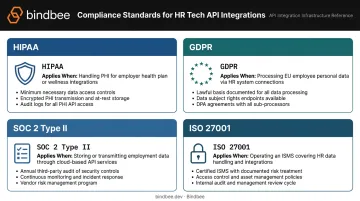
Choosing integration infrastructure that already holds these certifications removes a significant compliance burden. Bindbee carries SOC 2 Type II certification and HIPAA compliance, meaning the underlying data pipeline has been independently audited — platforms building on top of it don't need to recertify the infrastructure layer themselves.
Certifications cover the infrastructure layer, but transport and input security are still your responsibility. Enforce HTTPS/TLS for all API communication, and implement input validation on any data ingested from external HRIS endpoints — systems you don't control can send malformed or malicious payloads.
Error Handling, Rate Limiting, and Building Resilience
Why HR Integrations Demand Deterministic Failure Handling
A failed social media post can be retried silently. A failed benefits enrollment sync during open enrollment cannot. A missed termination event has downstream consequences across payroll, access provisioning, and carrier notifications. Integrations in this domain must detect failures, surface them, and recover from them in ways the system can reason about.
Structured Error Responses
Consistent error schemas make cross-system debugging tractable. When you're integrating with a dozen HRIS providers simultaneously, each with different failure modes, a standardized error format matters: HTTP status code plus a machine-readable JSON body with an error code and actionable message. That combination is what separates a 15-minute fix from a 3-hour debugging session.
A useful pattern:
{
  "error_code": "RATE_LIMIT_EXCEEDED",
  "message": "ADP API rate limit reached. Retry after 60 seconds.",
  "retry_after": 60
}
Rate Limit Handling in Practice
Most HRIS providers expose rate limit information in response headers. Reading X-RateLimit-Remaining and Retry-After headers is standard practice. When limits are approaching:
- Implement exponential backoff with jitter — not immediate retries that compound the problem
- Use request queues that degrade gracefully rather than flooding provider endpoints
- Distribute sync schedules across time windows when syncing multiple employers simultaneously
For platforms managing this at scale, Bindbee handles rate limiting internally across all 60+ connected systems — caching synced data and managing retries automatically, so application code never interacts with upstream throttling directly.
The Circuit Breaker Pattern
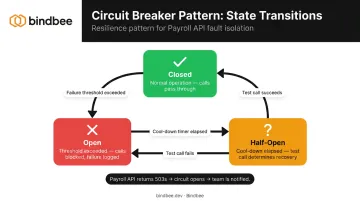
When an external HRIS or benefits carrier API fails repeatedly, a circuit breaker prevents cascading failures by temporarily halting outbound calls to that service. As described by Martin Fowler, circuit breakers move through three states:
- Closed — normal operation, calls pass through
- Open — threshold exceeded, calls are blocked and the failure is logged
- Half-Open — after a cool-down period, a test call determines whether to reclose
Concrete scenario: A payroll API returns 503s during open enrollment. An integration without resilience patterns silently fails — enrollments don't sync, no one gets notified.
Add retry logic, a circuit breaker, and a fallback notification, and the failure surfaces immediately. The employer knows. The enrollment team intervenes before anyone misses a deadline. That outcome requires intentional architecture: structured error contracts, backoff policies, and circuit state management built in from the start — not patched in after the first production incident.
Data Normalization, Versioning, and Real-Time Sync
Standardizing Data Across Systems
The normalization problem in HR Tech is genuinely hard. Different platforms represent identical concepts differently. Employment status in Workday isn't labeled the same as in BambooHR. Dependent relationship types vary. Pay frequency labels don't match. A raw API response from one system looks nothing like a raw response from another.
Without a normalized data model, every downstream consumer reimplements the same transformation logic. That's expensive the first time and a maintenance liability every time a provider updates their schema.
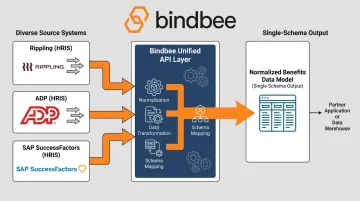
The architectural solution is a unified API layer — a normalization layer that sits between the raw provider APIs and the consuming application. Instead of writing a custom parser for Workday and another for BambooHR, the application works with one consistent schema regardless of the underlying system.
Bindbee is one example of this in practice — normalizing data across 60+ HR systems through a single API with purpose-built models for benefits data:
- Employee Benefits: individual enrollment data including plan type, coverage tier, and employee/employer contribution splits
- Employer Benefits: the full plan catalog an employer offers, including plan metadata and eligibility rules
- Dependent Benefits: which plans cover each dependent, their relationship type, and effective dates
These models return the same field names and structures whether the source system is Rippling, ADP Workforce Now, or SAP SuccessFactors.
API Versioning Strategy
Breaking changes to an API surface are unavoidable over time. How you manage them determines whether customers can trust your platform for the multi-year contracts common in HR Tech.
Versioning best practices:
- Use path-based versioning (
/v1/,/v2/) for breaking changes - Maintain backward compatibility within a major version
- Publish deprecation timelines well before enforcement — HR Tech customers often can't migrate integrations overnight
- Ship migration guides alongside change logs, not after the fact
Google's API design guidelines are a useful reference for versioning discipline.
Real-Time Sync via Webhooks
Polling creates stale data windows. For most life events in HR, stale data has consequences:
- A new hire needs day-one system access — polling might miss this by hours
- A termination needs immediate deprovisioning across benefits, identity, and other systems
- Nudge Security found that manual offboarding takes an average of 5 hours per employee to deprovision access, and 70% of organizations reported business disruption or security incidents from ineffective offboarding
Webhooks push data the moment an event occurs. For time-sensitive HR events, this isn't a nice-to-have — it's the difference between deprovisioning an employee on their last day versus leaving access active for weeks. Bindbee delivers webhooks for connector sync completions, employee data changes, and sync errors, so downstream platforms don't need to poll for state changes.
Monitoring, Documentation, and Long-Term Maintenance
Observability Across Multi-System Pipelines
A single employee sync in HR Tech can touch several services — the HRIS, the payroll system, the benefits carrier, an identity provider. When something breaks, you need to know where.
The three foundational observability signals, drawn from Google's SRE principles:
- Metrics — latency, error rates, throughput per integration
- Logs — structured, machine-readable event records with correlation IDs that tie a request across services
- Traces — end-to-end request journeys that show exactly where in a multi-hop flow a failure occurred
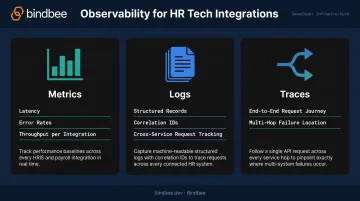
Correlation IDs are particularly valuable for HR integrations. When an enrollment event fails, a correlation ID that follows the request from the HRIS webhook through the normalization layer through the carrier notification gives you a complete audit trail — not just a stack trace.
Postman's 2025 State of the API Report found 17% of organizations use no monitoring tools. In HR Tech, that's not a gap — it's a liability.
Documentation and Maintenance Burden
Integration documentation that lives outside the codebase goes stale fast. What to keep current, in the same repository as the code:
- Endpoint specs and authentication flows
- Data field mappings between the normalized schema and each source system
- Error code glossaries
- Version change logs with migration guides
Keeping that documentation current is only part of the problem. The deeper question is a build-vs-buy one: every native HRIS integration a team builds is one they also own permanently.
Every time ADP updates their API or Workday changes an endpoint, every team that built a native integration absorbs that change. One Bindbee customer cut a project that previously required 6 engineers for 6 months down to 1 engineer for 1 week by eliminating native integration builds — a result consistent with what engineering teams broadly report when moving to a unified API layer.
API Integration Best Practices in Action: HR Tech Examples
Example 1: Benefits Platform Onboarding an ADP Employer
A benefits administration platform needs to onboard a new employer running ADP Workforce Now. Without a unified API, that means tackling each of these problems from scratch:
- Understanding ADP's authentication model
- Mapping ADP's payroll data structures to the platform's schema
- Building retry logic for ADP's rate limits
- Maintaining all of it indefinitely
With a unified API layer, that story changes significantly:
- The employer authenticates via an embedded connection flow (Bindbee's Magic Link takes under 10 minutes)
- An initial employee roster sync completes in minutes, normalized to consistent field names
- Subsequent incremental syncs run automatically — no polling required
- Webhook notifications fire when enrollment-relevant changes occur
- Rate limiting and retries are handled at the infrastructure layer, invisible to the benefits platform
Healthee, which manages 90,000+ employee profiles across 60+ HRIS systems, reports that custom integrations previously took 2+ months each. After switching to a unified API approach, employers connect in minutes and go live the same day.
Example 2: Termination Event Workflow
Termination workflows are where integration architecture directly affects compliance and security — not just operationally, but legally.
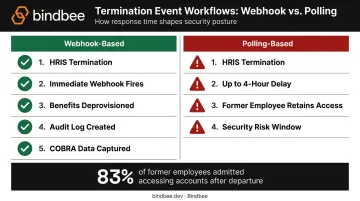
Well-architected (webhook-based):
- Employee is terminated in the HRIS
- Webhook fires immediately with employment status change and termination date
- Benefits platform receives the event, triggers deprovisioning across carriers, identity providers, and downstream systems
- Each step is logged with a shared correlation ID for audit purposes
- COBRA qualifying event data is captured and surfaced to the relevant platform
Polling-based alternative:
- The polling interval is 4 hours
- Termination may go undetected for up to 4 hours
- During that window, the former employee retains active benefits access and system credentials
- Beyond Identity research found 83% of former employees admitted accessing accounts from previous employers after departure
Common Integration Failure Patterns to Avoid
| Failure Pattern | Corrective Practice |
|---|---|
| Silent failures with no alerting | Structured error responses + webhook failure notifications |
| Over-permissioned API keys | Least-privilege scoping + regular credential rotation |
| Missing retry logic on transient errors | Exponential backoff + circuit breaker pattern |
| Hardcoded field mappings | Normalized data models that absorb upstream schema changes |
| Building native integrations one by one | Unified API layer that handles normalization centrally |
Frequently Asked Questions
What is the difference between API integration and native integration?
Native integration means direct, point-to-point connections built and maintained in-house for each system. API integration uses a standardized interface instead. A unified API layer goes further: one integration gives you access to dozens of systems through a single consistent interface.
How do you handle rate limits when integrating with multiple HRIS platforms simultaneously?
Read rate limit headers (X-RateLimit-Remaining, Retry-After) from each provider and implement per-provider request queues with exponential backoff. Distribute sync schedules across time windows rather than hitting all providers simultaneously. At scale, delegating rate limit management to a unified API layer that handles it internally is the more practical approach.
What security and compliance standards should HR Tech API integrations meet?
The key standards for HR Tech API integrations are:
- HIPAA — health and benefits data
- SOC 2 Type II — audited security controls
- ISO 27001 — information security management
- GDPR — any EU employee data
These apply to both the integration infrastructure and the data it transmits.
When should I use webhooks instead of polling for HRIS data sync?
Webhooks are the right choice for time-sensitive events — new hires, terminations, dependent changes, enrollment events — where data latency has real downstream consequences. Polling works for periodic bulk reconciliation where near-real-time accuracy isn't required.
How do you normalize employee data from different HRIS systems?
Normalization maps each system's proprietary field names, values, and data types to a canonical schema. At any meaningful scale, this belongs in a unified API layer. Handling it per-integration means every new system adds another set of custom transformation logic to build and maintain.
What is the biggest mistake teams make when building HR Tech API integrations?
Building native integrations one by one. The first looks manageable. By the tenth, you have a permanent maintenance burden: every provider API change, authentication update, and schema revision becomes your engineering team's problem to absorb.