
It matters more than ever. Guardian's 2023 Workplace Benefits Study found that 20% of employers had access to platforms using APIs, up four times from just 5% four years earlier, and two in three employers now say real-time connectivity is a priority when picking HR technology. Yet legacy carriers and payroll systems haven't disappeared. This article breaks down when SFTP still wins, when API is non-negotiable, and why most platforms end up needing both.
Key Takeaways
- SFTP is secure, batch-based file transfer: still the standard for legacy carriers and bulk data
- API enables real-time, bidirectional sync, critical for eligibility, deductions, and life events
- Most HR tech platforms need both, since employer clients run mixed tech stacks
- Pick the method that matches your data freshness needs and the systems your customers already run
SFTP vs API: Quick Comparison
| Factor | SFTP | API |
|---|---|---|
| Data Timing | Batch (hourly, daily, weekly) | Real-time or near real-time |
| Setup & Maintenance | Simple setup, low ongoing lift | Higher build effort, requires auth & webhook handling |
| Security & Compliance | Strong encryption (SSH), audit-friendly for EDI 834 | Requires TLS/OAuth management, granular access control |
| Data Interaction | One-directional, file-based | Bidirectional, event-driven |
| Best Fit | Legacy carriers, bulk census imports | Eligibility updates, enrollment sync, lifecycle events |

What is SFTP Integration?
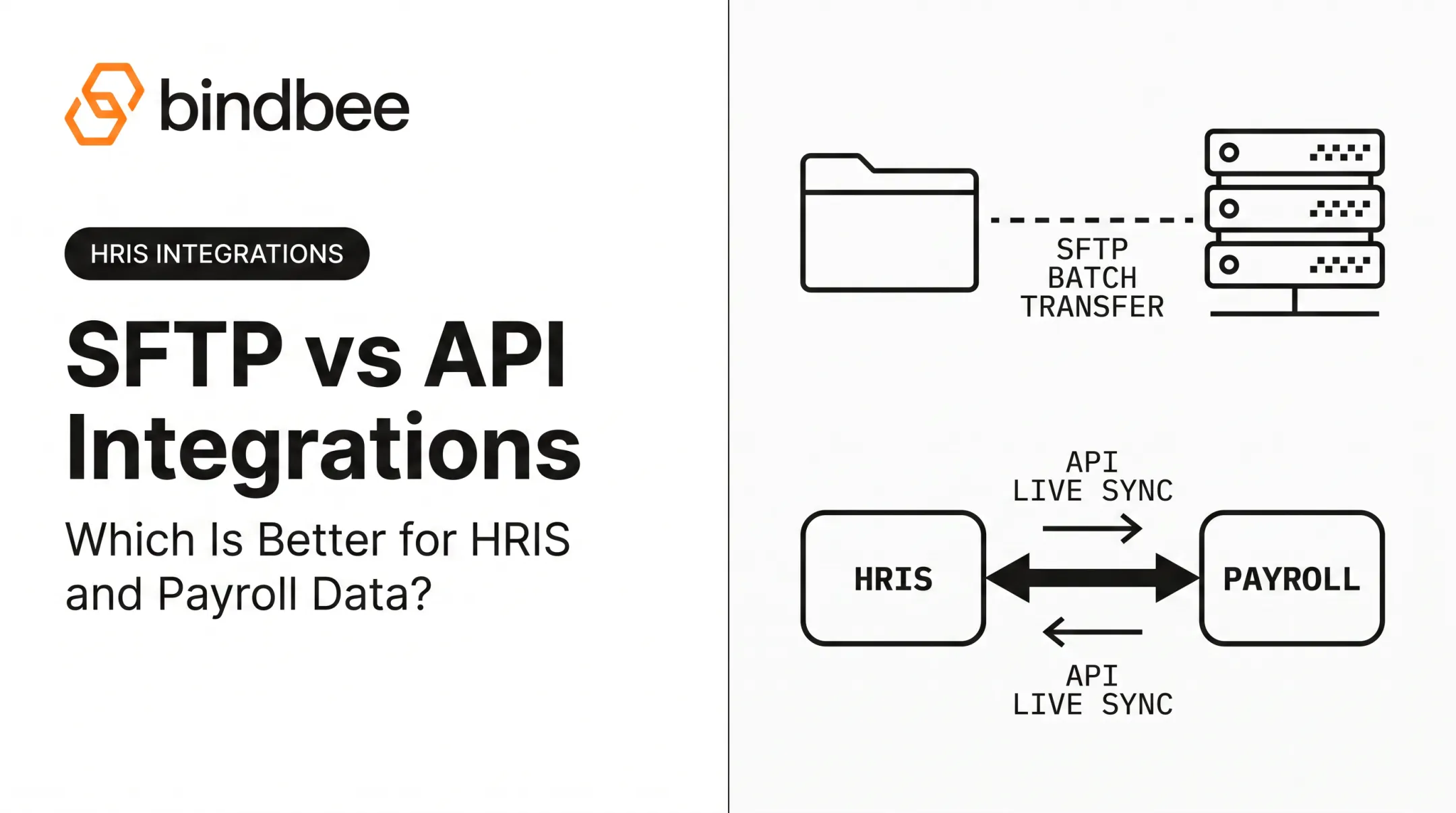
SFTP (Secure File Transfer Protocol) moves encrypted files between systems in batches rather than live, continuous streams. It's why so many benefits carriers, insurance systems, and legacy payroll platforms still run on it decades after APIs became mainstream.
Why it persists:
- Strong encryption over SSH, satisfying HIPAA's technical safeguard requirements under 45 CFR 164.312(e)(1)
- Simple, reliable for large historical data dumps
- Built-in audit trails that compliance teams appreciate
- No ongoing API maintenance burden
Files typically arrive as CSV, XML, or fixed-width formats, with transfer intervals ranging from hourly to weekly.
The ASC X12N 834 transaction, the HIPAA standard for benefit enrollment, still runs largely in batch mode. Carrier guides from Florida Blue and Blue Cross Blue Shield of Rhode Island both confirm SFTP over SSH as an active connectivity option for enrollment files, with BCBSRI processing in batch mode only.
Use Cases of SFTP
SFTP fits naturally into:
- Legacy benefits carrier feeds for TPAs and insurers that never built modern APIs
- Bulk census imports that onboard an entire employer's workforce in one pass
- Historical data migrations moving years of payroll or enrollment records at once
CAQH's Index reported more than 510 million ASC X12N 834 transactions in a single year, showing how much benefits enrollment still runs on batch file exchange rather than live APIs.

What is API Integration?
API integration exchanges data programmatically, through HTTP requests, webhooks, and structured JSON payloads, instead of dropping files on a schedule. Instead of waiting for tonight's batch, a terminated employee's benefits eligibility updates the moment HR processes the change.
Core benefits:
- Instant eligibility updates instead of week-long lag
- Bidirectional sync (read and write, not just read)
- Event-driven triggers for new hires, terminations, and qualifying life events
Common implementations include REST APIs, webhooks (like ADP's Event API, which monitors a message queue and pushes notifications), and unified APIs that normalize data across dozens of systems at once.
Use Cases of API Integration
API integration fits best where timing and accuracy directly affect the employee experience:
- Real-time payroll deduction updates — new benefit elections flow straight into payroll
- Benefits enrollment sync — plan selections and effective dates stay current across systems
- COBRA event detection — qualifying events trigger notices automatically
- Dependent data changes — marriage, birth, or divorce updates propagate instantly

Modern HRIS platforms like Rippling offer REST APIs for read/write access, while older enterprise systems require a much heavier lift. According to a Guardian vendor one-pager, eligibility updates can move from weeks to minutes and save up to 11 hours per month.
SFTP vs API: What is Better for HR Tech Platforms?
There's no single right answer here. The real question is what you're weighing:
- Data freshness requirements — does a one-day-old eligibility file cause real problems, or is next-day fine?
- System availability — does the employer's HRIS or carrier even expose an API?
- Engineering bandwidth — can your team maintain custom integrations for dozens of systems?
- Scalability — will you need to onboard hundreds of employer clients with mixed tech stacks?
Decision guide:
- SFTP: Legacy carriers with no API option, and real-time updates aren't core to the workflow
- API: Eligibility accuracy, bidirectional writes, or event-driven triggers (terminations, life events) are core to your product
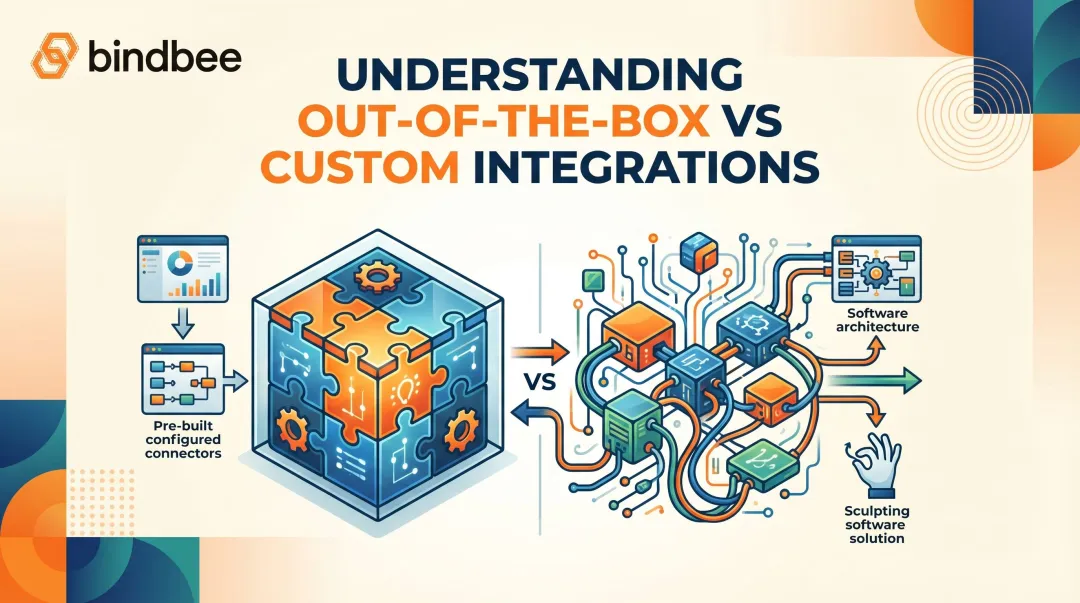
In practice, most benefits and HR tech platforms need both. Employer clients don't standardize on one system — some run modern HRIS with full API access, others still export CSV files from decades-old TPA platforms.
That mix is why a single normalized interface matters. Bindbee's unified API connects to 60+ HRIS, payroll, and benefits systems—including an SFTP-to-API bridge that ingests legacy file drops (CSV, XML, fixed-width), parses and validates them, and serves the results through the same endpoints as direct API connections.
Downstream, your product sees one consistent data stream whether the source pushed a file or a webhook.
The practical impact: native API integrations typically take 4-8 weeks per system to build and maintain. Bindbee's setup runs under a day for most connections, since authentication, normalization, and sync logic are already built.

Real-World Example: Data Integration in Practice
Cypherworx, an LMS platform, ran its HRIS connections through a manual CSV and SFTP process that took 24 days per customer onboarding. Every new client meant re-parsing files, mapping fields by hand, and troubleshooting format mismatches.
After switching to Bindbee's unified API:
- Onboarding time dropped from 24 days to a few hours
- Saved roughly 5 months of engineering time (over 400 hours) that would have gone into native HRIS integrations
- Documented more than $150,000 in total savings in the case study

The trigger was straightforward: manual file processing didn't scale as customer count grew. Every new HRIS meant another one-off integration to maintain.
Takeaway: platforms scaling across many employer clients benefit most from abstracting away SFTP and API differences entirely, rather than building separate handling logic for each.
Want to see how Bindbee handles both connection types under one unified API? Book a demo to walk through it with our team.
Conclusion
There's no universal winner between SFTP and API. SFTP still fits legacy, batch-oriented, compliance-heavy workflows, particularly carrier enrollment feeds bound by EDI 834 standards. API fits real-time, bidirectional needs like eligibility checks and payroll deduction updates.
The right choice depends entirely on what systems sit in your employer clients' tech stack.
For HR tech and benefits platforms scaling across dozens or hundreds of employer clients, the practical answer is usually both. A unified integration layer removes the burden of building and maintaining separate connections for every system type. Bindbee provides that layer across 60+ HRIS, payroll, benefits, and carrier systems, including an SFTP-to-API bridge so file-based carrier feeds and real-time APIs can coexist without separate custom builds.
Frequently Asked Questions
Is SFTP free to use?
SFTP itself is a free, open protocol with no licensing cost. Businesses typically pay for hosting, servers, SFTP client tools, and the engineering time needed to maintain file-processing pipelines.
What is the difference between SFTP and REST API?
SFTP transfers encrypted files in batches over SSH, on a set schedule. REST API exchanges data in real time through HTTP requests and structured JSON responses, enabling instant reads and writes.
Which is better, API or SFTP?
It depends on the use case. API wins for real-time, bidirectional needs like eligibility and enrollment sync. SFTP remains the practical choice for legacy systems and bulk batch transfers.
Is SFTP used anymore?
Yes. SFTP remains widely used in benefits carriers, insurance systems, and legacy payroll platforms, even as API adoption grows. Many carriers still process EDI 834 enrollment files exclusively in batch mode.
Is SFTP an API?
No. SFTP is a file transfer protocol, not an API. Both can move data between systems, but SFTP handles batch files while APIs enable structured, real-time requests and responses.
How does Bindbee handle both SFTP and API integrations?
Bindbee's unified API connects to 60+ systems through both direct API connections and an SFTP-to-API bridge. The bridge normalizes legacy file exports into the same standardized format used across all integrations, so your product sees one consistent data stream.