
Introduction
HR Tech and benefits platforms are under real pressure. Most companies now run their workforce data across multiple disconnected systems—HRIS, payroll, benefits administration, carrier portals—and the cost of keeping those systems in sync manually is no longer invisible. It shows up in delayed onboarding, eligibility errors, compliance gaps, and deals lost to competitors who already have the integrations prospects need.
Aptitude Research's 2025 HR Technology report found that 1 in 2 companies cite integration with existing systems as their top frustration with HR technology—across more than 5,000 HR leaders surveyed. That's not a niche complaint. It's the single biggest friction point in the market.
"API integration" gets mentioned often as the solution—but what it actually changes in engineering workload, customer retention, and revenue is rarely spelled out. What follows covers nine concrete operational benefits, specific to how HR Tech and benefits platforms build, sell, and scale.
TL;DR
- API integration connects software systems so data moves automatically—no manual exports, no re-entry, no reconciliation lag
- Nine benefits covered: automation, real-time data, faster onboarding, lower maintenance costs, less engineering overhead, and scalable growth
- HR Tech and benefits platforms that skip proper integration face data silos, eligibility errors, and a ceiling on growth
- Maximum value comes from maintaining integration as a live capability — syncing, monitoring, and expanding as your customer base grows
What Is API Integration?
API integration is the process of connecting two or more software systems via their APIs so data and functions move between them automatically, without manual steps. IBM defines it as using application programming interfaces to connect enterprise software applications and workflows for data and service exchange.
It applies in two primary contexts:
- Internal integration — connecting tools your organization uses (an HRIS syncing to a payroll system, for example)
- External integration — connecting your product to the third-party systems your customers already use (a benefits platform pulling live eligibility data from a customer's Workday instance)
The connection is a means to an end. What actually matters is what it enables: real-time data availability, automated workflows, and less friction for every team that touches that data.
9 Key Benefits of API Integration
Each benefit below reflects a measurable operational or business outcome. The value is most visible not in the connection itself, but in what it eliminates—manual work, data gaps, slow onboarding, and maintenance debt.
Benefit 1: Real-Time Data Access Across Connected Systems
Without integration, data is siloed. HR teams manually export files, reformat them, re-enter them in another system, and by the time that data lands, it's already outdated. When an employee changes their dependent coverage, or a new hire clears their waiting period, that update needs to propagate across HRIS, payroll, and carrier systems fast—or errors follow.
API integration enables continuous, automatic data sync: a record updated in one system reflects in connected systems in near real-time, without human action.
Why this matters in HR and benefits specifically:
Gartner research puts the average cost of poor data quality at $12.9 million per year for organizations. In benefits administration, the consequences are concrete: Mercer reports that 3% to 10% of plan members may be ineligible during dependent eligibility audits—a direct consequence of stale or unsynced data.
KPIs directly affected:
- Data accuracy rates across systems
- Eligibility error rates in carrier submissions
- Time-to-action on life events (new hire, termination, dependent change)
- Audit compliance scores
Real-time sync is most critical during open enrollment, mass onboarding, and carrier file submissions—periods where a single outdated record can cascade into coverage gaps, incorrect deductions, or compliance findings.
Benefit 2: End-to-End Workflow Automation
API integration is the prerequisite for automation. Multi-step workflows—new hire triggers benefits enrollment, which triggers carrier notification, which updates payroll deductions—only work when systems can communicate programmatically. Without that connection, each step requires a human touchpoint.
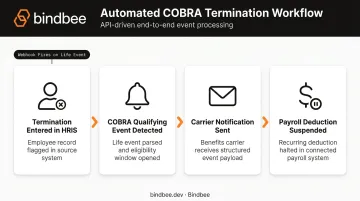
Event-driven API connections, such as webhooks that fire on life events like new hires, terminations, or dependent changes, enable these workflows to execute without manual intervention. A termination entered in the HRIS can automatically trigger COBRA qualifying event detection, carrier notification, and payroll deduction suspension.
The scale of the opportunity:
McKinsey's HR automation analysis found 56% of typical hire-to-retire tasks could be automated with current technologies and limited process changes. The CAQH 2023 Index found that electronic eligibility verification saves 16 minutes per transaction compared to manual processing.
KPIs directly affected:
- Time-to-complete for onboarding workflows
- Manual touchpoints per employee lifecycle event
- Error rates in benefits enrollment
- HR staff time spent on data entry
Automation delivers the highest ROI at scale. Organizations processing hundreds of new hires monthly, or administering benefits for thousands of employees, see compounding gains that one-at-a-time manual processing simply cannot match.
Benefit 3: Scalability Without Rebuilding Infrastructure
As organizations grow—adding new employers, new HRIS systems, new product lines—API-based architecture lets each new connection layer in without rearchitecting existing workflows. APIs provide a standardized interface regardless of what's running underneath.
The alternative is point-to-point custom integrations: a web of brittle connections that breaks when any one upstream system updates its schema, authentication method, or API version. Each new system added multiplies the maintenance surface area.
What this looks like in practice:
A benefits platform using a unified API layer can support a customer on Workday today and a customer on BambooHR tomorrow, through the same integration, with no additional code. Bindbee's unified API normalizes data from 60+ HRIS, payroll, and benefits systems into a single interface. Giftpack's VP of Engineering put it directly: "With the Unified API, I can integrate once and instantly support many platforms without dealing with each provider's quirks."
MuleSoft's 2024 Connectivity Benchmark Report found that IT teams spend 37% of their time designing, building, and testing custom integrations, time better spent on core product development.
KPIs directly affected:
- Time-to-market for new integrations
- Engineering hours per integration
- Number of supported HRIS systems per developer
- Customer onboarding speed
Benefit 4: Reduced Human Errors and Improved Data Accuracy
Manual data transfer is error-prone by design. Copying employee records, re-entering enrollment selections, reconciling payroll deductions across systems—each step introduces risk. In HR and benefits contexts, even small errors carry real consequences.
The cost of errors at scale:
EY's 2022 HR Processing Risk and Cost Survey quantified this: average payroll accuracy across surveyed companies was 80.15%, with remediation costing an average of $291 per error. Specific errors run higher: failing to enroll a new employee in payroll on time costs an average of $635; health savings plan setup errors average $6,800 per incident.
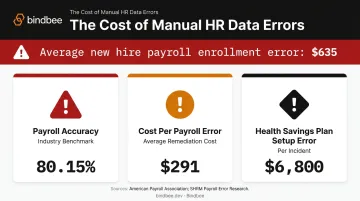
API integration removes the manual steps where errors are introduced. Data moves from source to destination in a structured, validated format—no transcription, no format mismatches, no opportunity for a copy-paste mistake to generate a downstream cascade.
KPIs directly affected:
- Error rates in carrier file submissions
- Chargeback rates from trading partners
- Audit findings related to data discrepancies
- Time spent on error correction
Benefit 5: Faster Customer Onboarding and Time-to-Value
For B2B SaaS platforms, the time it takes to connect a new customer's existing HR or payroll system affects whether that customer activates before they churn. Amplitude's research found that users who don't experience value early are significantly more likely to drop off—with as many as 91% of new users potentially disengaging in the first week.
When integration setup takes weeks of back-and-forth IT coordination, customers never reach the point of seeing live data and automations in action. Pre-built connectors and unified API layers change this equation directly.
Healthee's Head of Operations described the shift after implementing Bindbee: employers now connect their HRIS "in minutes instead of weeks of manual data collection, with same-day go-live instead of 2+ month custom integration cycles." Compport reduced integration deployment time from 8 weeks to 48 hours and achieved 74% faster client onboarding.
KPIs directly affected:
- Customer time-to-activate
- Implementation hours per customer
- Onboarding satisfaction scores
- Early churn rates linked to slow integration setup
Benefit 6: Built-In Support for Security and Compliance Requirements
When sensitive HR and benefits data—employee PII, dependent information, health plan details—moves through manual exports, email attachments, or unencrypted FTP transfers, the exposure risk is structural. No manual process can meet the security posture that regulated HR data requires.
API integration through compliant, audited platforms ensures data flows through authenticated, encrypted channels. For HR Tech operating with protected health information, this isn't optional.
The relevant compliance standards:
| Standard | What It Requires |
|---|---|
| HIPAA | Administrative, physical, and technical safeguards for ePHI; applies to covered entities and business associates |
| SOC 2 | AICPA Trust Services Criteria covering security, availability, processing integrity, confidentiality, and privacy |
| ISO/IEC 27001 | Requirements for establishing, implementing, and maintaining an information security management system |
| GDPR Article 32 | Appropriate technical and organizational security measures including encryption and pseudonymization |
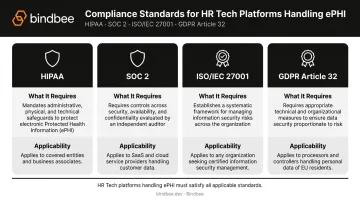
The breach landscape reinforces the stakes. HHS OCR received 663 large breach notifications involving unsecured protected health information in 2024 alone. Bindbee is SOC 2 Type II certified, HIPAA compliant, and GDPR-ready—meaning customers building on that infrastructure inherit those compliance postures rather than having to establish them independently.
KPIs directly affected:
- Compliance audit pass rates
- Data breach incident frequency
- Vendor security assessment outcomes
- Time to satisfy customer security reviews
Benefit 7: Higher Developer Productivity and Faster Product Iteration
When engineering teams maintain custom, file-based, or handcrafted webhook integrations, a significant portion of their capacity disappears into plumbing rather than product. MuleSoft's 2025 Connectivity Benchmark found that 39% of developer time goes to designing, building, and testing custom integrations.
That's time not spent on core features, customer-facing improvements, or roadmap work. And it compounds: every new integration built in-house adds another maintenance track.
Reusable API connectors and standardized data models reduce both the build burden and the ongoing cognitive overhead. CypherWorx's Senior Developer described the practical outcome of switching to Bindbee: "Functionality lets us add support for new systems without any code change."
KPIs directly affected:
- Engineering hours recovered per quarter
- Sprint velocity on core product features
- Time-to-ship new integrations
Benefit 8: Improved Customer Experience and Retention
HR administrators and benefits managers notice the difference between a product that pulls their live data automatically and one that requires manual uploads or periodic CSV imports. The former reduces administrative burden; the latter adds it.
API-powered features—real-time eligibility updates, automatic enrollment syncing, dependent change notifications—directly reduce the work on the end user's side. That reduction shows up in retention data. Aptitude Research found that 38% of companies rank integration capability as a vendor-selection criterion, and 72% of organizations that reduced HR tech investment did so because they couldn't demonstrate measurable ROI.
A product that integrates cleanly with the systems customers already use demonstrates ROI faster and with less friction than one that doesn't.
KPIs directly affected:
- NPS scores
- Feature adoption rates for integration-dependent features
- Renewal rates among customers with active integrations
- Support ticket volume related to data discrepancies
Benefit 9: Lower Long-Term Integration Maintenance Costs
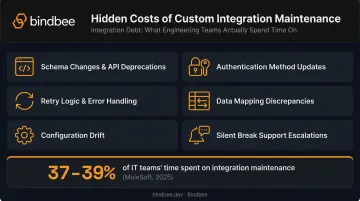
Custom-coded, point-to-point integrations carry a hidden recurring cost: every time a connected system updates its API version, changes its authentication method, or modifies its data schema, someone has to fix the integration. That maintenance work never ends.
The cost drivers accumulate and none appear on a project plan when the integration is first built:
- Schema changes and API version deprecations
- Authentication method updates
- Retry logic and error handling edge cases
- Data mapping discrepancies across systems
- Customer-specific configuration drift
- Support escalations when something silently breaks
A unified API model shifts this burden away from the product team. Bindbee absorbs maintenance for all upstream provider changes—when Workday deprecates an API version or ADP updates its authentication flow, Bindbee's team handles the update internally. Customers' code continues working unchanged.
MuleSoft's data puts this in perspective: IT teams spend 37–39% of their time on integration maintenance. For teams managing connections to dozens of HRIS and payroll systems, that's a significant share of engineering capacity tied up in keeping existing integrations alive—not building the next feature.
KPIs directly affected:
- Annual engineering hours spent on integration maintenance
- Integration-related incident frequency
- Cost per connected system over a 24-month horizon
What Happens When API Integration Is Missing
Running HR and benefits workflows without integration means relying on scheduled file exports, manual reconciliation, and email threads to move data between systems. Every handoff adds latency. Every manual step is a new opportunity for error — and accountability gaps multiply fast.
The consequences compound over time:
- Inconsistent eligibility data across HRIS, payroll, and carrier systems leads to coverage errors and compliance findings
- Rising error correction costs as teams spend increasing time reconciling discrepancies instead of improving the product
- Inability to scale — each new employer or HRIS connection demands manual setup that eats into engineering capacity and slows deal velocity
- Reactive firefighting replaces proactive administration — teams discover data problems when customers complain, not before
The cost of not integrating is often invisible at first. But every quarter without a solution adds another layer of manual process, another custom workaround, and more technical debt that makes the eventual fix harder to justify and slower to ship.
How to Get the Most Value from API Integration
API integration delivers compounding returns when treated as a managed capability, not a one-time technical project. Three practical conditions under which it delivers maximum value:
- Data flows are reviewed regularly for drift or schema changes — upstream systems update without notice, and integrations that worked last quarter may silently degrade
- Integration events trigger alerts so teams catch failures before customers do, not after
- Integration insights inform product decisions — knowing which HRIS systems your customers use most should directly influence which connections to invest in next
For HR Tech and benefits platforms managing connections to dozens of systems, handling each connection independently — monitoring uptime, versioning, schema changes, re-authentication — becomes a full-time operational burden with no direct product value.
A purpose-built unified API layer centralizes that overhead, keeping integrations current, compliant, and high-performing without requiring dedicated engineering time for each connector.
The integrations that generate lasting value are built for how systems change over time — not just for how they work on day one.
Frequently Asked Questions
What is API integration and how does it work?
API integration is the process of connecting software systems via their APIs so data moves automatically between them. One system makes a call to another system's API endpoint, receives structured data back, and uses it—no manual intervention required.
What is the difference between API integration and a unified API?
Individual API integration connects one system to another, one at a time. A unified API normalizes data from many systems—such as 60+ HRIS and payroll platforms—into a single consistent interface, so a product team builds once and gains access to all connected systems rather than maintaining each integration separately.
How do APIs specifically help HR Tech and benefits platforms?
APIs handle the structured data exchange that manual processes can't reliably deliver between HRIS, payroll, and benefits systems. Key capabilities include:
- Real-time employee eligibility sync
- Benefits enrollment data transfer
- Dependent management and beneficiary updates
- Carrier file automation
- Life event webhooks (new hire, termination, dependent change)
How long does it take to set up API integrations?
Setup time varies: building a native API integration from scratch typically requires weeks of engineering work, while using a pre-built unified API layer can reduce that to under a day—with end users completing authentication via tools like Bindbee's Magic Link in under 10 minutes.
What are the risks of not having API integration in a benefits or HR Tech product?
The main risks: manual data errors leading to eligibility or enrollment mistakes, inability to scale onboarding without proportional headcount increases, compliance exposure from unsecured data transfers, and customer churn from a slow or unreliable data experience.
How do APIs support compliance in HR and benefits data management?
Platforms certified under SOC 2 Type II, HIPAA, ISO 27001, and GDPR ensure sensitive employee and health data flows through authenticated, encrypted, and auditable channels. That directly replaces insecure manual methods like email file transfers or unencrypted exports.