
Introduction
The average enterprise runs 106 SaaS applications, and most of them don't talk to each other. For HR Tech platforms, benefits administrators, and payroll providers, that fragmentation has real costs: lost deals when prospects demand HRIS coverage you don't have, delayed onboarding, and engineering cycles consumed by integration maintenance instead of core product work.
B2B integration tools have matured well past basic API connectors. Modern platforms handle authentication, data normalization, compliance, real-time sync, and legacy file-based connectivity, freeing engineering teams to focus on the features that actually move their product forward.
The challenge is choosing the right category of tool. A unified API built for HR Tech looks nothing like an enterprise iPaaS designed for internal IT automation, and picking the wrong one creates more technical debt than it solves.
This guide covers 12 tools across three categories — unified APIs, embedded iPaaS, and enterprise iPaaS — with honest tradeoffs so you can match the tool to your actual architecture and customer requirements.
TL;DR
- B2B integration tools connect business applications, automate data exchange, and eliminate manual workflows between organizations and software systems.
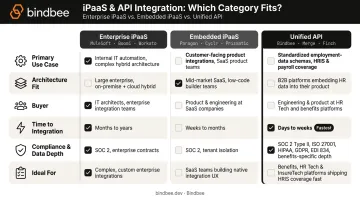
- The market splits into unified APIs (standardized schemas, broad category coverage), embedded iPaaS (flexible product integrations for SaaS teams), and enterprise iPaaS (internal IT automation at scale).
- For HR Tech, benefits, and payroll platforms, vertical-specific unified APIs like Bindbee cover employment data models horizontal platforms miss.
- The 12 tools below cover distinct use cases — pick by category fit, not just feature count.
What Is B2B Integration?
B2B integration is the automated exchange of data and business documents between organizations or software systems, eliminating manual data entry, disconnected file transfers, and siloed workflows in favor of programmatic, real-time connections.
Modern enterprises rely on it to connect internal systems (HRIS, ERP, CRM, payroll) with external partner systems (carriers, brokers, benefits providers, TPAs).
Both EDI-based and API-based approaches remain in active use. According to IBM, 85% of supply chain transactions are still managed through EDI, even as API adoption accelerates — which is why mature integration platforms need to handle both without forcing teams to choose.
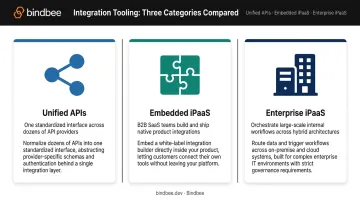
The tools in this list fall into three distinct categories:
- Unified APIs — normalize dozens of underlying APIs into one standardized interface
- Embedded iPaaS — let B2B SaaS teams build and ship native product integrations faster
- Enterprise iPaaS — orchestrate large-scale internal workflows across complex hybrid architectures
12 Best B2B Integration Tools for Modern Enterprises in 2026
These tools were selected based on integration depth, enterprise readiness, security posture, ease of implementation, and fit for modern B2B SaaS and enterprise workflows. The list spans three categories: specialized unified APIs (Bindbee, Merge, Finch, Kombo), enterprise iPaaS platforms (MuleSoft, Boomi, Workato), and embedded iPaaS for SaaS teams (Paragon, Ampersand, Nango, Cyclr, Prismatic).
Bindbee
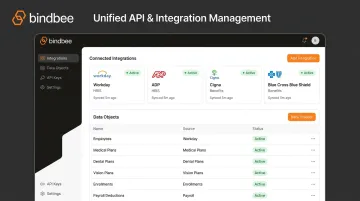
Bindbee is a unified API purpose-built for HR Tech, Benefits Administration, and payroll platforms. It normalizes data across 65+ HRIS, payroll, ATS, benefits, and carrier systems through a single API endpoint — with a benefits-first data model that treats Employee Benefits, Employer Benefits, and Dependent Benefits as distinct objects.
What separates Bindbee from horizontal unified APIs is architectural depth. The three-tier benefits model covers the full picture:
- Employer Benefits — the plan catalog an employer makes available (plan names, providers, coverage tiers)
- Employee Benefits — individual enrollment data (plan selection, contribution amounts, effective dates, coverage tier)
- Dependent Benefits — the linking layer connecting specific dependents to specific enrolled plans
Other standout features include a Magic Link authentication component that lets employers connect their HR system in under 10 minutes without IT involvement, an SFTP-to-API Bridge for legacy carrier systems that only export flat files, and real-time webhooks for life events including new hires, terminations, and dependent changes.
Setup time runs under one day versus the 4–8 weeks typically required to build native API integrations. Customers including Newfront, Clever Benefits, Budgie Health, and Healthee report meaningful engineering bandwidth recovered for core product work. Newfront specifically noted that what previously took six engineers six months now takes one engineer one week.
| Key Features | Benefits-first data models, unified API for 65+ systems, SFTP-to-API Bridge, Magic Link auth, life event webhooks, automatic incremental syncs, custom fields support |
| Security & Compliance | SOC 2 Type II, ISO 27001, HIPAA Compliant, GDPR Ready |
| Best For | HR Tech platforms, Benefits Administration, Payroll platforms, Insurtechs, TPAs |
Merge
Merge provides pre-built unified APIs across HRIS, ATS, CRM, Accounting, Ticketing, File Storage, Knowledge Base, and Chat — connecting to 240+ third-party systems through normalized data models.
It's a strong fit for B2B SaaS companies that need broad multi-category coverage from one vendor. Automated issue detection, an observability dashboard, and Field Mapping for custom fields round out a mature platform.
The trade-off is cost structure at scale. Merge's Launch plan includes 3 free production Linked Accounts, then $650/month for up to 10 total, with $65 per additional Linked Account beyond that. Sync frequency is also fixed rather than real-time on lower tiers.
| Key Features | 240+ integrations across 8 categories, automated issue detection, Field Mapping, observability dashboard |
| Pricing | Launch: $650/month for up to 10 Linked Accounts, $65/additional account; Professional and Enterprise: custom |
| Best For | B2B SaaS companies needing broad multi-category integration with standardized schemas |
Finch
Finch is a unified API focused exclusively on employment data, connecting HR, benefits, and fintech applications to 250+ HRIS and payroll providers — including legacy platforms like ADP and Paychex.
Its differentiation is depth in payroll data: multi-state taxes, garnishments, deductions, benefits enrollment, and two years of historical payroll data included on initial sync. For fintech lending platforms and benefits companies where payroll data quality is critical, that depth matters.
The single-category specialization means Finch must be supplemented for non-HRIS use cases. Starter pricing begins at $65/month per connection for up to 15 connections and 24 providers; Pro and Premier unlock all 250+ providers.
| Key Features | 250+ HRIS/payroll integrations, payroll run data, benefits deductions, employment verification, audit logs |
| Security & Compliance | SOC 2 Type II, GDPR |
| Best For | Fintech lending platforms, HR Tech, and benefits companies needing standardized employment and payroll data |
Kombo
Kombo is a unified API platform specializing in HRIS, ATS, and Payroll integrations with 250+ connectors, notable strength in European markets (Personio, Factorial, Teamtailor), and support for write operations back to HR systems.
Mock integrations for testing and a clean connect flow via Kombo Connect make developer experience a priority. Pricing uses a fixed annual platform fee plus a variable per-customer fee — no charges by API call or data volume.
The key limitation is sync behavior: Kombo mirrors source-system data at regular intervals via Full and Delta Syncs, with near-real-time updates available only for tools that support upstream webhooks. Organizations with strict data sovereignty requirements should note that Kombo stores customer data in its own infrastructure rather than supporting bring-your-own-cloud deployment.
| Key Features | 250+ HRIS/ATS/Payroll integrations, write operations, European coverage, Kombo Connect OAuth flow |
| Sync Behavior | Polling-based (interval syncs); near-real-time for webhook-supporting tools |
| Best For | European HR Tech and talent acquisition platforms, B2B fintech needing employment data write-back |
MuleSoft Anypoint
MuleSoft Anypoint Platform is Salesforce's enterprise-grade iPaaS offering full API lifecycle management, hybrid cloud/on-premises connectivity, and hundreds of certified connectors covering SAP, Oracle, Workday, and Salesforce — with Gartner Magic Quadrant Leader recognition for 10 consecutive years.
The API-led connectivity model and centralized governance make it a natural fit for large enterprises with complex hybrid architectures and existing Salesforce ecosystem investment. Pricing is contact-only; expect enterprise contract terms. Mid-market and startup teams will find the cost and implementation complexity difficult to justify.
| Key Features | API lifecycle management, Anypoint Studio IDE, hybrid deployment, governance and SLAs, pre-built connectors for SAP/Oracle/Workday |
| Pricing | Enterprise contracts; contact Salesforce for pricing |
| Best For | Large enterprises with complex hybrid integration needs and existing Salesforce ecosystem investment |
Boomi
Boomi AtomSphere is a long-standing iPaaS leader — named a Gartner Magic Quadrant Leader for 12 consecutive years — specializing in connecting cloud applications with on-premises and legacy infrastructure. Its unified platform handles EDI/B2B, API management, MDM, MFT, and workflow automation.
With 1,000+ pre-built connectors and cloud, on-premises, or hybrid deployment options, Boomi excels for enterprises undergoing digital transformation with significant legacy system footprints. Pricing is subscription-based with pay-as-you-go options; teams building customer-facing embedded integrations will need to look elsewhere.
| Key Features | AtomSphere platform, cloud/on-prem/hybrid deployment, EDI and B2B connectivity, legacy system connectors (SAP, Oracle EBS) |
| Pricing | Subscription and pay-as-you-go; contact Boomi for pricing |
| Best For | Enterprises connecting legacy systems with modern cloud apps, digital transformation programs |
Workato
Workato is an enterprise iPaaS with pre-built connectors for thousands of SaaS applications, databases, and ERP systems — backed by Gartner Magic Quadrant Leader recognition for eight consecutive years and the furthest right for vision in 2026.
Its recipe-based low-code automation engine, Workbot (conversational integrations via Slack and Teams), and extensive governance features including RBAC make it well suited for enterprise IT teams automating internal workflows. Security coverage is comprehensive: SOC 2 Type II, ISO 27001, HIPAA, PCI-DSS Level 1, and more. Pricing is flexible and not publicly listed. The platform is designed for internal IT automation — not for embedding customer-facing integrations into a product.
| Key Features | Thousands of connectors, recipe-based automation, Workbot, RBAC, SOC 2 Type II, ISO 27001, HIPAA, deployment pipelines |
| Pricing | Flexible pricing; contact Workato |
| Best For | Enterprise IT teams automating internal workflows and cross-system business process orchestration |
Paragon
Paragon is an embedded iPaaS built specifically for B2B SaaS engineering teams. Its visual workflow builder, authentication management, and integration catalog UI — along with 130+ pre-built connectors — let teams ship native product integrations faster without the overhead of building from scratch.
Access to underlying third-party APIs (not limited to pre-built actions), a custom connector builder, and a white-labeled Connect Portal give engineering teams flexibility. The Paragon framework (integrations-as-code with Git sync) supports CI/CD workflows for teams that prefer code over visual builders. Pricing is usage-based by Connected Users.
| Key Features | Workflow builder, custom connector builder, Connect Portal, webhooks, scheduler triggers, headless option, embedded SDK |
| Developer Experience | SDK-based implementation, Paragon code framework for Git/CI-CD, step-level observability and logging |
| Best For | B2B SaaS engineering teams building and managing customer-facing native integrations at scale |
Ampersand
Ampersand is a declarative integration platform for building deep product integrations across CRM, Sales, Revenue, Marketing, Accounting, and Support systems. A YAML-based framework gives developers full control over data models, field mappings, and sync logic.
Bidirectional syncs, custom field mapping per customer, bulk write support for voluminous data, and an observability dashboard with automated issue detection make Ampersand a good fit where CRM and GTM integrations are core to the product. Pricing is usage-based by data delivered: free up to 2 GB and 5 production customers; $999/month for the Catalyst plan (up to 25 customers and 2 GB/month).
| Key Features | YAML declarative framework, 250+ integrations across 15 categories, dynamic field mapping, bidirectional sync, observability dashboard, AI SDK and MCP server |
| Pricing | Free tier (2 GB, 5 customers); Catalyst $999/month (25 customers); Accelerate and Enterprise: custom |
| Best For | B2B SaaS companies where CRM, GTM, and revenue integrations are core to the product experience |
Nango
Nango is an open-source, code-first platform supporting 800+ APIs across 30 categories, letting engineering teams build custom unified APIs with full control over data models and integration logic .
The community-expandable open-source connector catalog, native support for AI tool calling and MCP servers, and a free tier (10 API Auth connections, 100K sync records, 100K proxy requests) make it accessible for early-stage teams. Starter plans begin at $50/month. Building custom integrations typically requires 2–4 weeks of mapping work per integration — the platform prioritizes breadth over depth by design.
| Key Features | 800+ APIs, 3,000+ templates, open-source connectors, AI/MCP support, custom unified API building |
| Pricing | Free; Starter from $50/month; Growth from $500/month; Enterprise: custom |
| Best For | Engineering teams that want to build their own unified API layer with broad coverage and code-level control |
Cyclr
Cyclr is an embedded iPaaS designed for B2B SaaS companies to deliver native integrations directly within their own applications, using a low-code drag-and-drop workflow builder and a library of 600+ pre-built API connectors.
White-labeled integration delivery (customers never leave the host product), multi-tenant architecture purpose-built for SaaS, and a Connector Creation Toolkit for custom connectors make Cyclr particularly well-suited for SaaS product teams wanting to offer a branded integration marketplace without deep engineering investment. Pricing is connector and API-call based: 10 connectors included, $100 per additional connector per month. G2 rating: 4.7/5 from 77 reviews.
| Key Features | 600+ pre-built connectors, multi-tenant architecture, low-code builder, white-label UI, Connector Creation Toolkit, dashboard and reporting |
| Pricing | 10 connectors included; $100/connector/month additional; 5M API calls included |
| Best For | B2B SaaS companies delivering branded native integrations to end-users without dedicated integration engineering teams |
Prismatic
Prismatic is an embedded iPaaS with a component-based integration builder supporting both low-code (for CS/support teams) and SDK-based development (for engineers), with a white-labeled integration marketplace that embeds natively into the host product.
The dual-development approach — where customer success teams can deploy integrations without engineering involvement — is the clearest differentiator. Automated retry logic, monitoring and alerting, and CI/CD support via CLI and API round out a mature platform. G2 rating: 4.8/5 from 232 reviews. Pricing has Scale and Enterprise tiers; contact Prismatic for current rates.
| Key Features | Component-based builder, low-code + SDK dual approach, white-labeled marketplace, SSO, automated retry, CI/CD deployment |
| Pricing | Scale and Enterprise tiers; contact Prismatic for pricing |
| Best For | Software teams building integration marketplaces where non-engineers need to configure and deploy integrations for customers |
How We Chose the Best B2B Integration Tools
Selecting a B2B integration tool on connector count alone is the most common mistake buyers make. A platform with 500+ connectors but shallow data models, polling-only syncs, and no compliance certifications will create more problems than it solves as your customer base scales.
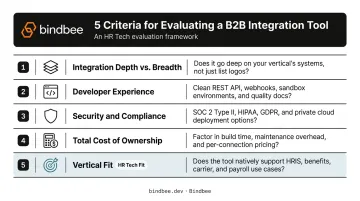
Core Evaluation Criteria
1. Integration depth vs. breadth Does the tool support custom fields, bidirectional sync, and complex transformations — or does it normalize data so aggressively that important fields are dropped?
2. Developer experience Key indicators include:
- SDK quality and documentation completeness
- Observability tooling and error visibility in production
- Release management and how fast new integrations ship and debug
3. Security and compliance
- SOC 2 Type II — data security controls
- ISO 27001 — information security management
- HIPAA — required for health and benefits data
- GDPR — required for European customer data
4. Total cost of ownership Per-connection pricing scales poorly. Usage-based and flat-fee models are easier to forecast at volume. Factor in engineering maintenance load too — every native integration requires ongoing upkeep for API version changes, auth updates, and new data requirements.
5. Vertical fit Horizontal platforms handle generic use cases well. Vertical-specific platforms deliver purpose-built data models that horizontal tools cannot replicate. For HR Tech and benefits, that distinction matters most: enrollment elections, dependent coverage, plan selections, and life events don't map cleanly to generic data objects.
For HR Tech and Benefits Platforms Specifically
Buyers in this space should prioritize tools that support:
- Benefits-specific data objects (dependent coverage, enrollment elections, plan selections)
- SFTP/file-based connectivity for carrier and broker systems that don't have REST APIs
- Life-event webhooks for new hires, terminations, and qualifying events
- Enterprise compliance certifications covering HIPAA and SOC 2 Type II
Most horizontal unified APIs and enterprise iPaaS platforms fail on at least two of those four criteria. That narrows the real contender list quickly.
Conclusion
No single B2B integration tool is the right answer for every team. Enterprises managing internal IT workflows have fundamentally different requirements than product teams embedding integrations in customer-facing SaaS — and both differ from HR Tech platforms that need benefits-aware data models and carrier connectivity.
Before signing a contract, push vendors beyond the demo. Test actual sync latency under load. Ask what happens when an upstream API version changes. Find out how the platform handles custom fields and legacy SFTP-based systems. Connector count is a starting point, not a decision criterion.
For teams that have worked through that checklist — HR Tech companies, Benefits Administration platforms, and payroll providers needing to connect 60+ HRIS, payroll, and carrier systems without building or maintaining integrations in-house — Bindbee is built for exactly this. Setup takes under one day, data models cover Employee, Employer, and Dependent Benefits as distinct objects, and compliance covers SOC 2 Type II, ISO 27001, HIPAA, and GDPR.
Frequently Asked Questions
What is B2B integration?
B2B integration is the automated exchange of data and business documents between organizations or software systems — replacing manual workflows with API-driven or EDI-based connections. It enables partner collaboration and scalable data exchange without human intervention at each step.
What are examples of integration tools?
Common categories include unified APIs (Merge, Finch, Bindbee), embedded iPaaS (Paragon, Cyclr, Prismatic), declarative platforms (Ampersand), and enterprise iPaaS (MuleSoft, Workato, Boomi). The right type depends on whether you're building product integrations for customers or automating internal IT workflows.
What is the difference between an iPaaS and a unified API?
An iPaaS provides workflow-based orchestration for connecting applications — primarily used for internal IT automation. A unified API normalizes multiple underlying APIs into a single standardized interface, built for B2B SaaS companies shipping product integrations to their customers. If you're shipping integrations as a product feature, a unified API is almost always the right starting point.
How do I choose the right B2B integration tool for my HR Tech company?
Prioritize tools with benefits-specific data models, support for 50+ HRIS and payroll systems, real-time webhooks for life events, SFTP-to-API bridges for legacy carriers, and HIPAA/SOC 2 Type II compliance. Horizontal platforms that treat employee data as a generic object will require significant custom work to handle benefits use cases properly.
What security standards should a B2B integration tool support?
At minimum, look for SOC 2 Type II, ISO 27001, GDPR readiness, and HIPAA compliance. Tools handling employee PII or benefits data face the highest scrutiny — confirm certifications are current and that audit reports are available on request.
Can B2B integration tools connect legacy systems that don't have modern APIs?
Yes — platforms that support SFTP-to-API bridges, EDI translation layers, or managed file transfer protocols can handle legacy systems. This matters most in HR Tech and benefits, where many carriers still exchange data via flat files. Verify this capability before committing to any tool for carrier integrations.