
The tool category you choose matters more than most teams realize. General-purpose iPaaS platforms like Boomi and MuleSoft excel at horizontal workflow automation across CRM, ERP, and finance systems. Purpose-built unified APIs like Bindbee are designed for a different problem: normalized employment data at scale, with benefits-specific data models built in.
This article evaluates 11 application integration solutions across system coverage, data depth, setup speed, and HR Tech suitability — so engineering and product teams can shortlist the right fit without wasting months on the wrong architecture.
Key Takeaways
- Application integration eliminates manual data transfers between independent software systems through automated data exchange.
- General iPaaS platforms (Boomi, MuleSoft, Workato) are strong for cross-functional workflow automation — not HR data normalization.
- Purpose-built unified APIs (Bindbee, Finch, Merge) deliver production-ready HR data faster, with pre-normalized models for benefits, dependents, and payroll.
- For HR Tech buyers, evaluate on: HRIS coverage breadth, benefits data depth, write-back support, and integration maintenance ownership.
- Bindbee covers 60+ HRIS and payroll systems with same-day setup, making it the fastest path to production for benefits-specific integrations in 2026.
What Is Application Integration?
Application integration is the process of connecting independently built software systems so they can exchange data and trigger workflows automatically — without manual intervention or custom code written per vendor.
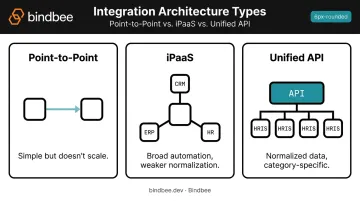
Three architectural approaches dominate the market:
- Point-to-point integration — One direct connection between two systems. Simple to build, but doesn't scale. Each new system requires a new custom build.
- iPaaS (Integration Platform as a Service) — Cloud-based platforms with broad connector libraries for automating workflows across CRM, ERP, HR, and other business systems. Strong for horizontal automation; weaker for vertical data normalization.
- Unified APIs — Pre-normalized data models across a specific category of systems (such as HR Tech). One API integration gives access to dozens of source systems with consistent data structure.
The market reflects genuine demand. According to Grand View Research, the application integration market was valued at $15.9 billion in 2023 and is projected to reach $55.2 billion by 2030 at a 19.8% CAGR. Okta's 2025 Businesses at Work report found the average company now uses 101 apps. MuleSoft reports that only 27% of those applications are actually connected.
For HR Tech and benefits platforms, that 73% connectivity gap has a direct cost: manual data syncs, failed enrollments, and integrations that block enterprise deals. The 11 solutions below cover the architectures and vendors most worth evaluating for teams building in or adjacent to HR Tech in 2026 — selected for category fit, deployment model, and depth in employment data.
Top 11 Application Integration Solutions to Watch in 2026
Tools are evaluated on integration coverage, HR data depth, setup time, maintenance model, and security — not brand recognition.
1. Bindbee — Best for HR Data Integration
Bindbee is a unified employment data API purpose-built for HR Tech, benefits administration, payroll platforms, and insurtech. It normalizes employee, dependent, compensation, deduction, and time-off data through a single API endpoint.
Coverage spans 60+ HRIS and payroll systems — enterprise platforms like Workday, ADP Workforce Now, SAP SuccessFactors, and UKG, as well as SMB tools like Gusto, Rippling, and BambooHR.
The benefits-first data architecture sets Bindbee apart from general unified APIs. Most unified APIs offer a generic employee data model. Bindbee structures benefits data as three separate normalized objects:
- Benefit model — individual employee enrollment data (plan name, coverage tier, employee/employer contribution, effective dates)
- Employer Benefit model — the full catalog of benefit plans an employer offers
- Dependent Benefit model — links specific dependents to the benefit plans covering them
This separation matters for benefits administration platforms. A generic employee record doesn't tell you which dependent is enrolled in which plan, or what the employer's contribution split looks like by tier. Bindbee's models do.
Additional differentiators include:
- Magic Link authentication — Employers complete HRIS connection setup in 10–30 minutes without IT involvement, no OAuth configuration required
- SFTP-to-API Bridge — Connects legacy systems that export batch files rather than live APIs
- Zero maintenance model — Bindbee absorbs all API versioning, schema changes, and auth updates internally; customers never write remediation code
- Automatic incremental syncs with webhook notifications when data changes
- Custom field support — Accessible via
include_custom_fields=trueparameter for employer-specific data points outside standard models
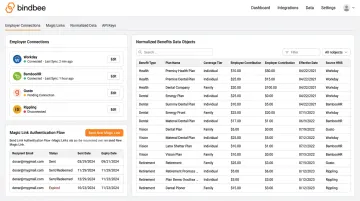
Healthee's Head of Operations reported that HRIS integration time dropped from 8–12 weeks to 24–48 hours after adopting Bindbee. Budgie Health's engineering team had all 30 HR and payroll integrations operational by day 4. Papershift reduced deployment time from 90 days to under 24 hours.
Security certifications include SOC 2 Type II, ISO 27001, HIPAA compliance, and GDPR readiness.
| Attribute | Details |
|---|---|
| Best For | HR Tech SaaS, benefits platforms, 401(k) providers, TPAs, and insurtech needing normalized employment data with read support across diverse HRIS environments |
| Key Features | 60+ HRIS/payroll integrations, benefits-first data models, Magic Link onboarding, webhook notifications, custom field support, zero maintenance model |
| Pricing | Available on request via bindbee.dev/book-demo |
2. MuleSoft Anypoint Platform
MuleSoft is an enterprise-grade iPaaS and API management platform owned by Salesforce, widely deployed in large organizations connecting complex multi-system architectures across cloud, on-premise, and hybrid environments. Its strength is breadth — supporting hundreds of certified connectors alongside full API lifecycle management.
The tradeoff is implementation complexity. A Forrester Total Economic Impact study commissioned by MuleSoft reports implementation periods of 2 to 10 months for enterprise deployments, with developer onboarding taking up to two weeks. Total implementation, training, and management costs for the composite organization reached $595,000 over three years.
MuleSoft is best suited for enterprises with dedicated integration teams and complex infrastructure requirements — not HR Tech startups or mid-market SaaS companies that need production-ready employer connections in days.
3. Boomi
Boomi is a low-code iPaaS with 1,000+ prebuilt connectors and an approachable visual interface, well-suited for mid-market to enterprise teams managing general business process integration across CRM, ERP, and HR systems.
Where it falls short for HR Tech product teams is data normalization depth. Boomi connects to HRIS systems but does not normalize benefits-specific objects like dependent coverage, enrollment elections, or deduction schedules. Operations teams automating internal workflows will find it capable. Benefits platforms needing production-grade eligibility data will hit its ceiling quickly.
4. Workato
Workato is an enterprise automation and embedded iPaaS platform supporting both internal workflow automation and customer-facing integration scenarios through its embedded product. With 1,200+ pre-built connectors and a business-user-friendly interface, it handles cross-functional automation well.
The limitation for HR Tech: Workato does not normalize HR data objects natively. Building consistent employee, benefits, or dependent data pipelines requires custom recipe-building per integration — which brings back the same engineering burden that unified APIs are meant to eliminate. It's a strong choice for automating processes around HR systems, not for extracting normalized employment data from them.
5. Zapier
Zapier is a no-code trigger-action automation tool targeting SMBs and non-technical users, with 9,000+ app connections for simple point-to-point workflows. For lightweight internal automation — syncing form submissions, triggering email sequences, updating spreadsheets — it's genuinely useful.
It is not designed for enterprise-grade HR data integration. Zapier lacks real-time sync, robust error handling, and the data depth required for benefits administration or payroll use cases. G2 reviews consistently flag cost escalation at scale and difficulty troubleshooting complex multi-step workflows. Treat it as automation infrastructure for business users, not as integration infrastructure for product teams.
6. Merge
Merge is a unified API platform covering 7+ integration categories — HRIS, ATS, CRM, Accounting, Ticketing, and more — with Common Models for normalized data and an Integrations Management dashboard. Its HRIS Common Models include Benefits, Dependents, Employee payroll runs, Employer benefits, Pay groups, and Payroll runs.
The tradeoff is horizontal scope. Merge serves a broad market across multiple software categories, which means its HR data models cover general employment data well. Platforms needing deeper benefits specificity — granular deduction schedules, dependent enrollment linkage, or benefits-carrier connectivity — may find Merge's HRIS layer sufficient for some use cases but thinner than purpose-built alternatives.
7. Finch
Finch is a unified API for HRIS and payroll, providing access to 250+ employment integrations with a focus on payroll data access for retirement, benefits, and compensation platforms. Its benefits page supports health benefits platform use cases including roster sync, enrollment, and deductions automation.
Two practical limitations to note:
- Sync frequency — Automated connections sync every 24 hours; assisted connections every 7 days. No continuous sync.
- Scope — Limited to HRIS and payroll. Platforms needing ATS, benefits carrier, or benefits admin connectivity must look elsewhere.
8. Celigo
Celigo is a business application integration platform with prebuilt integration templates, particularly strong for ERP and e-commerce workflows involving NetSuite, Shopify, and Salesforce. It does publish a benefits administration automation page, but its documentation does not include pre-normalized HRIS/benefits Common Models comparable to unified API providers.
Operations and finance teams automating order-to-cash or lead-to-invoice workflows are the right fit. HR Tech product builders will find limited HR-specific data infrastructure here.
9. SnapLogic
SnapLogic is a low-code iPaaS distinguished by its visual "Snap" connector library (1,000+ pre-built connectors) and AI-assisted integration design, supporting both technical and non-technical users building workflows across cloud and on-premise systems. Current positioning emphasizes agentic integration and AI-connected workflows.
Like other general iPaaS tools, SnapLogic has no pre-normalized HR data models for benefits or payroll. It suits enterprise data pipeline projects spanning multiple departments — not HR Tech teams needing production-ready employment data normalization.
10. Jitterbit
Jitterbit is a flexible, AI-infused low-code iPaaS with pre-built connectors, an API management layer, and significant customization capabilities. Its differentiation versus MuleSoft or TIBCO is developer flexibility and competitive pricing — and it claims 50–80% faster integration delivery using reusable recipes and templates.
Jitterbit does publish HR-focused content covering onboarding, payroll, and benefits workflows, but its documentation does not include a pre-normalized HR data layer. It requires technical expertise to configure and maintain, making it more appropriate for IT developers managing broad enterprise integration than for HR Tech product teams needing benefits data infrastructure.
11. Tray Embedded
Tray Embedded is an embedded iPaaS solution that enables SaaS companies to white-label Tray.io's integration platform inside their own product, with 700+ connectors and customizable branding. For SaaS teams that want customers to configure integrations inside their product UI, it provides a reasonable starting point.
The scaling limitation is real: Tray Embedded builds one integration at a time, making it difficult to efficiently scale to dozens of customer-facing connections. Troubleshooting also requires significant manual engineering effort. Gartner Peer Insights reviews note that the UI has a meaningful learning curve. Teams with complex multi-HRIS environments will encounter friction as connection volume grows.
How We Chose These Application Integration Solutions
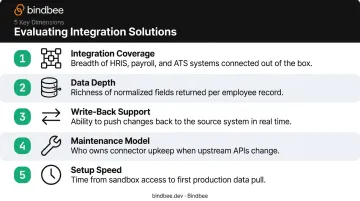
Tools were evaluated across five dimensions:
- Integration coverage — How many HR, payroll, ATS, and benefits systems are supported
- Data depth — Whether normalized data models exist for HR-specific objects (dependents, benefits elections, deduction schedules)
- Write-back support — Whether the platform allows pushing data back to source systems
- Maintenance model — Who is responsible when vendor APIs change
- Setup speed — Time from decision to first live employer connection
The Mistake Most Buyers Make
Teams frequently select general iPaaS platforms based on connector count, then discover months later that building normalized HR data pipelines still requires months of custom engineering. A connector to Workday is not the same as a normalized data model for benefits enrollment across 65 HRIS systems. One gets you authenticated; the other gets you to production.
According to Postman's 2025 State of the API Report, 69% of developers already spend 10+ hours per week on API-related tasks. Selecting the wrong integration architecture compounds that burden — every new HRIS vendor, every API update, every schema change becomes an engineering ticket.
Why Architecture Type Matters More Than Connector Count
For HR Tech and benefits platforms, the right question is: does this platform normalize benefits, dependent, and payroll data consistently across all connected systems — not just how many apps it connects?
General iPaaS platforms require custom data mapping per integration. A platform connecting 20 HRIS systems still maintains 20 separate mapping configurations. When Workday deprecates an endpoint or ADP changes its auth flow, those configurations break individually — each one an engineering ticket.
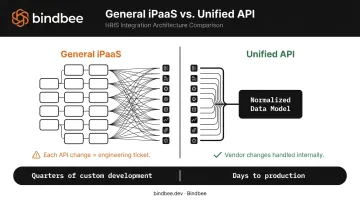
Purpose-built unified APIs handle that differently. Bindbee, for example, manages API version updates, schema changes, and authentication internally. Customers call the same endpoints and receive the same normalized data models regardless of what changes upstream. That's the operational difference between days to production and quarters of custom development.
Conclusion
Application integration in 2026 spans a wide range — from horizontal enterprise automation platforms to purpose-built employment data APIs. The tools are not interchangeable. Each category solves a different problem for a different buyer.
For HR Tech and benefits platforms, evaluation criteria should go beyond connector count. Three factors determine real engineering cost and onboarding speed — not the size of a connector library:
- Data normalization quality across HR-specific objects like benefits elections, dependents, and pay groups
- Maintenance ownership — who absorbs the work when vendor APIs change
- Time-to-live for new employer connections in production
If your product needs normalized employment data across 60+ HRIS and payroll systems, book a demo with Bindbee to see how integration timelines compress from weeks to hours.
Frequently Asked Questions
What is application integration?
Application integration connects independently built software systems so they can exchange data and trigger workflows automatically — without manual data entry or file transfers. It eliminates information silos across an organization's or product's tech stack by creating automated data pipelines between systems.
What is an example of application integration?
A benefits administration platform integrating with an employer's HRIS (such as Workday or ADP) to automatically sync employee eligibility data, enrollment elections, and dependent information — so benefits teams always have current records without manual spreadsheet uploads or SFTP file transfers.
What are integration solutions?
Integration solutions are software platforms or services that enable different applications to share data automatically. They range from iPaaS platforms (like Boomi or Workato) that automate general business workflows, to unified APIs (like Bindbee) that provide pre-normalized data models for a specific software category like HR and benefits.
What is the difference between iPaaS and a unified API?
iPaaS platforms offer broad workflow automation across many app categories but require custom data mapping per integration. Unified APIs provide pre-normalized data models for a specific category (such as HRIS or payroll). This means faster deployment and consistent data structure across all connected systems — no rebuilding mapping logic for each new vendor.
What should HR Tech companies look for in an application integration solution?
Key factors to evaluate:
- Breadth of HRIS and payroll system coverage
- Depth of HR-specific data models (benefits, dependents, and deductions)
- Write-back support for pushing data back to source systems
- Who owns API maintenance when vendors push updates
- Time-to-live for a new employer connection in production
How long does it take to implement an application integration solution?
It depends on the approach. Native API integrations typically take 4–8 weeks per system; general iPaaS platforms range from days to weeks based on data complexity. Purpose-built unified APIs like Bindbee get a first employer connection live in 24–48 hours, with most deployments complete within one week of contract signing.