
Universal API management emerged as the answer to that mess. It's the practice of applying one consistent set of governance, security, and visibility standards across every API a company owns, regardless of protocol or hosting location.
HR tech, benefits administration, and payroll platforms feel a specific version of this pain. They're not just managing internal APIs, they're trying to connect to 60+ third-party systems like Workday, ADP, and BambooHR, each with its own data model and quirks. This article covers both sides: what universal API management means for internal governance, and what the related "unified API" concept means for external integration.
Key Takeaways
- Universal API management applies full lifecycle governance to every API, regardless of protocol or environment
- Fixes API sprawl: inconsistent standards, poor visibility, and security gaps
- HR tech and benefits platforms typically need a unified API instead, integrating 60+ systems through one interface
- A unified API can cut integration time from weeks to hours and remove ongoing connector maintenance
What Is Universal API Management?
Universal API management is the practice of applying consistent discovery, governance, security, and control to every API in an organization, no matter its protocol (REST, GraphQL, AsyncAPI) or where it's hosted. It treats internal APIs, partner APIs, and legacy APIs as one governed portfolio instead of a patchwork of disconnected systems.
The problem it solves is API sprawl: uncoordinated API growth that leaves teams with poor visibility, inconsistent documentation, and security gaps.
This isn't theoretical. In a 2025 Salt Security survey of 206 API managers, 99% of respondents encountered an API security issue in the prior 12 months. Among Salt's own customer traffic data, 98% of attack attempts targeted external-facing APIs.
Visibility is getting worse, not better. Akamai found that the share of security teams with a full API inventory dropped from 40% in 2023 to just 27% in 2024.

Why the gap widened:
- Microservices architectures multiplied the number of independently deployed APIs
- Hybrid cloud adoption scattered APIs across multiple hosting environments
- Multiple protocols (REST, GraphQL, gRPC, AsyncAPI) each need different tooling
- Traditional "full lifecycle API management," built for a simpler world of monolithic REST APIs, couldn't keep pace
Universal API management is not the same thing as a "unified" or "universal" API product. The former governs your own APIs. The latter, covered later in this article, aggregates other companies' APIs into a single interface. They share a name but solve different problems.
Core Pillars of Universal API Management
Universal Visibility and Discovery
You can't govern what you can't see. Universal API management starts with a single catalog or repository where teams document every API—internal or external—and make it reusable. Without this, teams rebuild the same integrations repeatedly because nobody knew a similar API already existed.
Consistent Governance and Security
Centralized gateways and policies apply the same compliance checks to every API, no matter where it lives. This typically maps to established frameworks:
- SOC 2 — examines controls around security, availability, and confidentiality
- ISO/IEC 27001 — defines requirements for an information security management system, adaptable to organization size
NIST's SP 800-228 (published June 2025) formalizes this further, covering risk analysis across API development and runtime stages.
Architectural and Environmental Flexibility
A universal approach works across monolithic, microservice, and event-driven APIs alike—whether they run in the cloud, on-prem, or hybrid. The governance layer stays consistent even when the underlying architecture doesn't.
Cross-Functional Engagement
Developers, architects, and API product managers all pull from the same source of truth. That shared catalog speeds up builds for engineering, gives architects a clear security picture, and lets product managers monetize or retire APIs with full visibility.
Universal API Management vs. Unified APIs: What's the Difference?
These two terms sound alike, but they solve different problems—especially in HR tech.
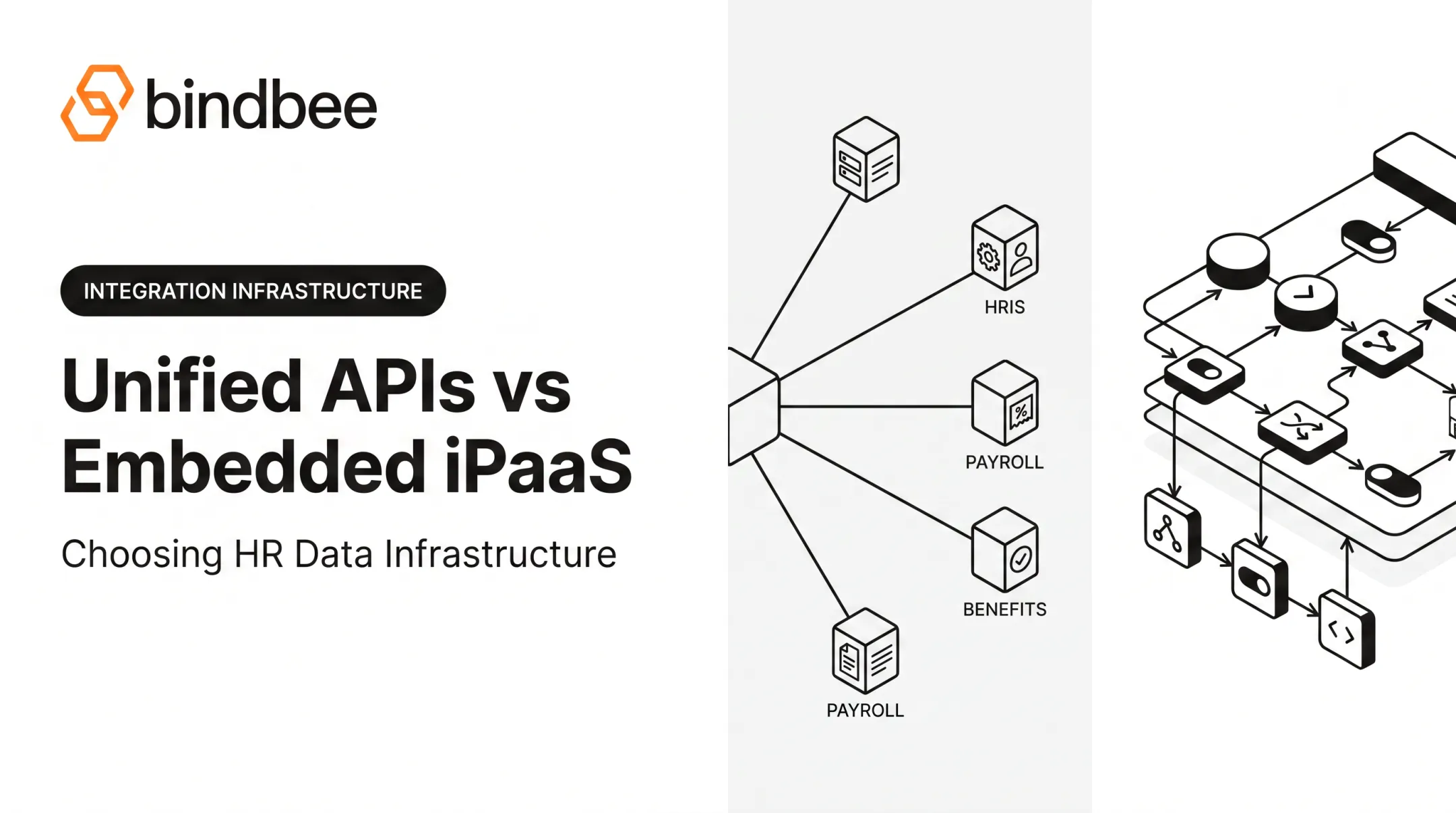
Universal API management governs an organization's own API portfolio. A unified API is a third-party product that aggregates many external APIs into one standardized interface.
If you're building a benefits platform, you almost certainly need a unified API.
Instead of writing separate integration code for Workday's API, ADP's API, and BambooHR's API, each with its own authentication, data model, and quirks, a unified API abstracts all three (and dozens more) into one standardized model. You write the integration once.
| Dimension | Universal API Management | Unified API |
|---|---|---|
| Governs | Your own API portfolio | Third-party systems you connect to |
| Solves | Sprawl, security gaps, inconsistent policy | Duplicate integration work |
| Used by | Platform/security teams | Engineering teams building integrations |

Why This Matters for HR Tech and Benefits Platforms
Building native integrations with 60+ HRIS and payroll systems is brutal. Every system update, every schema change, every new carrier format becomes a maintenance ticket. Engineering teams end up reconciling dozens of inconsistent data models instead of building product features.
A benefits-first unified API approach flips this. Instead of forcing your team to normalize Workday's eligibility fields against ADP's, the API layer does it for you, mapping everything into consistent models for employee benefits, employer plan configuration, and dependent coverage.
This is the exact problem Bindbee was built to solve. It provides a single API for 60+ HR, payroll, and benefits carrier systems, with data models purpose-built for eligibility, enrollment, and dependent coverage rather than generic HR records.
Documented customer results include:
- Newfront cut integration deployment from 12 weeks to 48 hours and saved over $800,000 annually in development resources
- Healthee, a Benefits Tech platform, reduced deployment from 8–12 weeks to 24–48 hours, with client onboarding 82% faster
- Phin, an HR Tech platform, cut onboarding time 76% and improved time-to-value by 94%
- ThrivePass dropped onboarding from 6 weeks to under 1 week using real-time webhooks

Real-time syncing matters here too. When an employee is marked terminated with an effective date, a webhook fires immediately. Downstream benefits, COBRA, and payroll systems can then trigger coverage end dates and required notices without waiting on batch files or manual polling. That speed isn't cosmetic. COBRA notices are legally required within 14 days of a qualifying event.
How to Choose the Right Approach for Your Organization
Start by asking what problem you actually have:
- Internal sprawl? You need a universal API management platform to govern your own portfolio.
- External integration coverage? You need a unified API platform to connect with dozens of outside systems.
Most HR Tech and benefits companies land squarely in the second category. From there, evaluate vendors on:
- Data model depth — does it handle specialized cases like dependent relationships and benefits enrollment, or just generic employee records?
- Security certifications — look for SOC 2 Type II, ISO 27001, and HIPAA readiness at minimum.
- Setup time — a well-built unified API should take under a day to implement, versus 4–8 weeks for a native integration built from scratch.
Those last two points aren't marginal details. They're usually the difference between shipping an integration this sprint or shipping it next quarter.
Frequently Asked Questions
What does API stand for?
API stands for Application Programming Interface, a set of rules that lets software systems communicate and exchange data with each other.
Can I get an API for free?
Many providers offer free tiers or sandbox access for testing. Production-grade unified APIs for HR and benefits data typically involve paid plans based on usage or number of connections.
What is the difference between an API gateway and universal API management?
A gateway is one component that handles traffic control and security. Universal API management is the broader practice covering the full lifecycle, including discovery, governance, and cross-team engagement.
How long does it take to implement a unified API integration?
A unified API integration can often go live in under a day. Building the same coverage through native integrations typically takes 4–8 weeks per system.
Is universal API management only for large enterprises?
Enterprises pioneered the concept, but growing HR tech and benefits platforms need it too as they scale integrations across more customer systems.