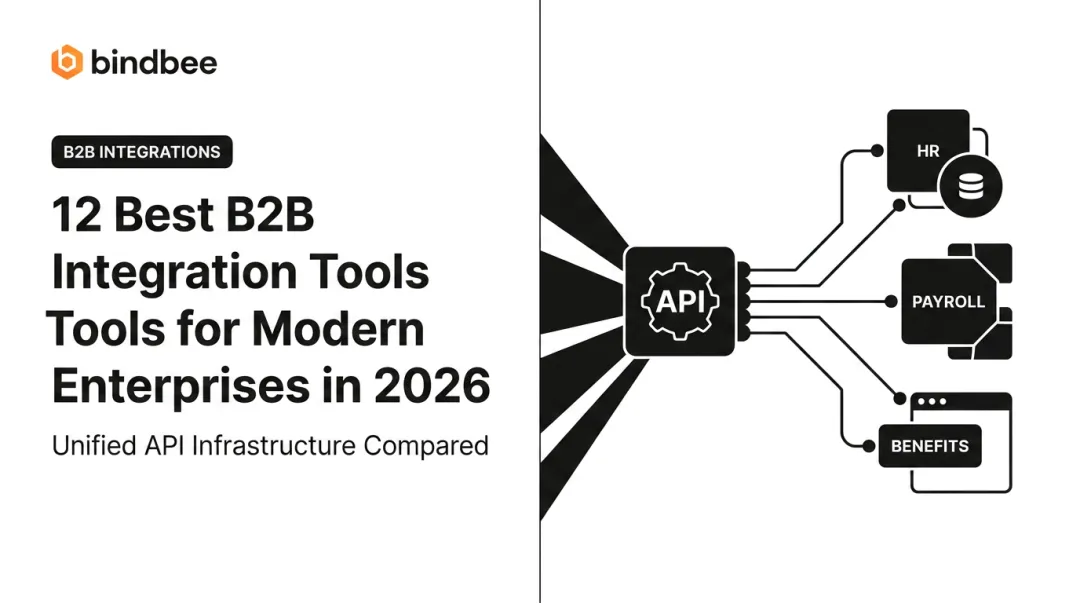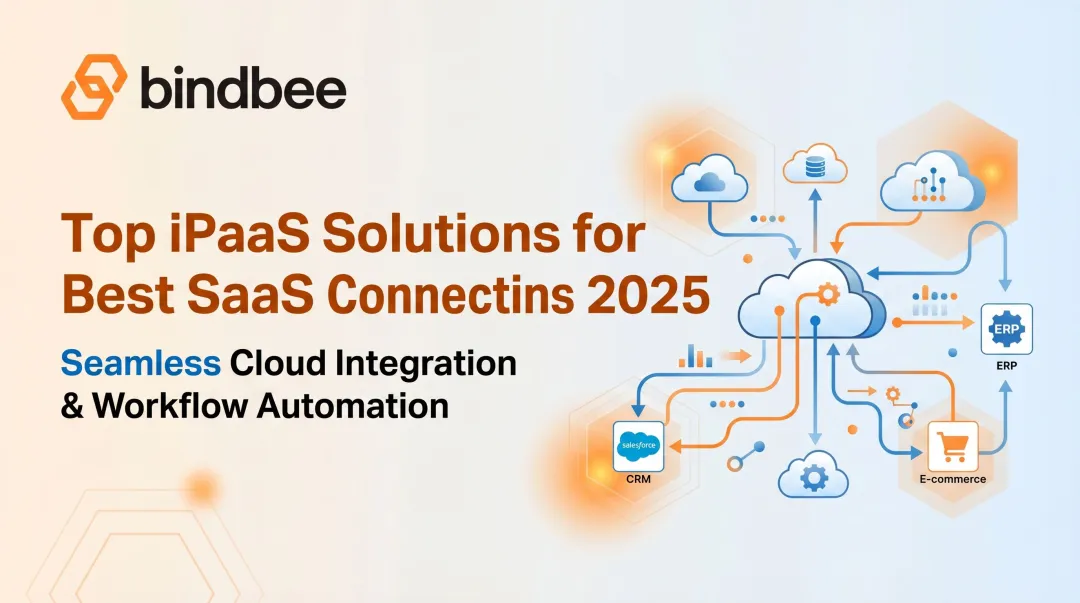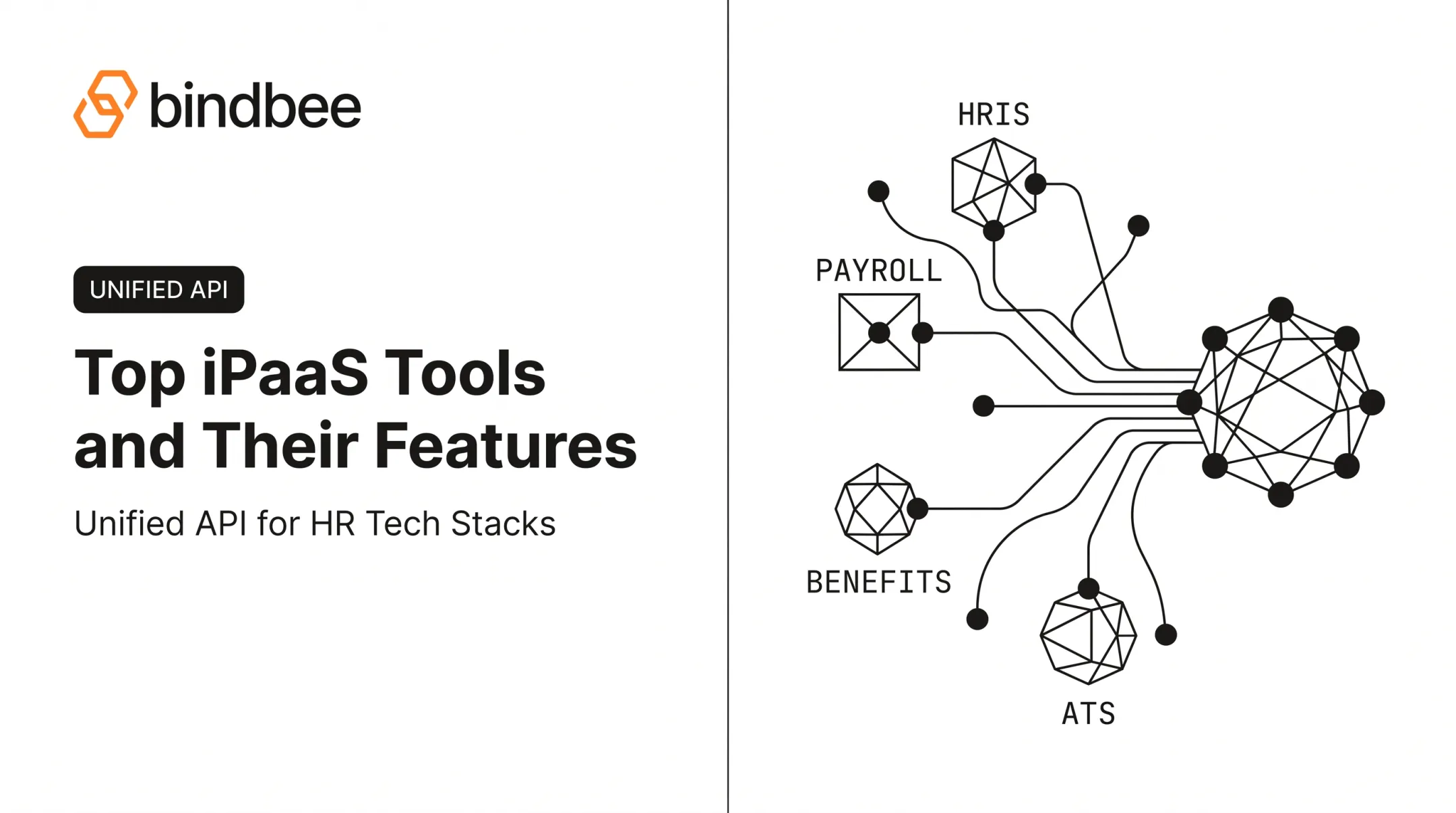

Integration platforms have quietly become the backbone that lets enterprises move fast without duct-taping systems together. They cut engineering overhead, reduce data silos, and shrink the time between "we need this system connected" and "it's live."
The same benchmark found that 80% of IT leaders cite data integration as their biggest obstacle, and 95% struggle to weave AI into existing workflows. Picking the wrong platform doesn't just slow you down. It compounds technical debt for years.
This guide breaks down the top enterprise integration platforms for 2026, plus where general-purpose tools fall short for specialized domains like HR and benefits data.
Key Takeaways
- Enterprise integration platforms (iPaaS) connect apps, data, and workflows across hybrid cloud and on-prem environments
- Worldwide iPaaS revenue hit $8.5 billion in 2024, up 23.4% year-over-year, per Gartner
- Selection hinges on connector breadth, API management maturity, security certifications, and hybrid deployment support
- MuleSoft, Boomi, Informatica, Workato, SnapLogic, and Celigo lead the general enterprise market
- Vertical-specific data (like HR and benefits) often needs purpose-built unified APIs, not generic connectors
Overview of Integration Platforms for Enterprise Needs
Point-to-point integration does not scale. Every new system multiplies the connections you maintain, and each one becomes a maintenance liability.
An enterprise integration platform—often called iPaaS or a hybrid integration platform—is vendor-managed cloud infrastructure that connects internal and external applications, data sources, and services. Gartner describes it as tooling for data-consistency, multistep process, and composite-service integrations without custom point-to-point connectors.
These platforms centralize:
- API management
- Data synchronization
- Workflow automation
That control plane spans cloud, on-prem, and hybrid environments.
This guide ranks the top enterprise integration platforms for 2026 on connectivity, scalability, security, and market presence.
Top Enterprise Integration Platforms for 2026
Selection criteria for this list: connector breadth, API management depth, hybrid deployment support, compliance certifications, and proven enterprise scalability.
MuleSoft Anypoint Platform
MuleSoft, now part of Salesforce, centers on API-led connectivity. Anypoint Exchange hosts reusable connectors for third-party APIs, databases, and standard protocols.
It stands out for full API lifecycle management and deep hybrid/on-premise support, which large enterprises with legacy ERP footprints still rely on heavily. The July 2025 release added natural-language creation of MCP servers and connector setup, pushing it further into AI-assisted integration.
| Aspect | Details |
|---|---|
| Core Capabilities | API management, ESB, hybrid integration |
| Best For | Large enterprises needing extensive API governance |
| Pricing | Custom, request-based |

Boomi
Boomi AtomSphere offers 1,000+ prebuilt connectors spanning CRM, ERP, cloud storage, and messaging systems. It's built for teams that want drag-and-drop simplicity without sacrificing governance.
It pairs intelligent recommendations and EDI support with strong controls for complex hybrid ecosystems. Its July 2025 release added an Excel Connector and enhanced branch-and-merge controls for parallel integration workflows.
| Aspect | Details |
|---|---|
| Core Capabilities | Drag-and-drop integration, API management, data quality |
| Best For | Enterprises scaling hybrid cloud integration |
| Pricing | Pay-as-you-go starts at $99/month plus usage; enterprise plans are custom |
Informatica Intelligent Data Management Cloud
Informatica built its reputation on master data management, and its Intelligent Data Management Cloud (IDMC) pairs that strength with integration and governance. It's the platform enterprises reach for when data lineage and quality matter as much as connectivity.
Its CLAIRE AI engine drives recommendations across pipelines, and its July 2025 release added GenAI connectors for platforms like Databricks Mosaic AI and Snowflake Cortex AI.
| Aspect | Details |
|---|---|
| Core Capabilities | ETL, ELT, MDM, data governance |
| Best For | Large enterprises needing comprehensive data management |
| Pricing | Consumption-based via Informatica Processing Units (IPUs); quote required |
Workato
Workato takes a no-code approach, using AI-driven "recipes" that let business users automate workflows without engineering support. Documentation lists over 1,000 connectors across app, data, and legacy/on-premises categories.
It's a favorite for DevOps and ticketing use cases where speed matters more than deep API governance. Workato was named a Leader in the 2025 Forrester Wave for iPaaS, which evaluated 10 vendors across adoption, strategy, and capabilities.
| Aspect | Details |
|---|---|
| Core Capabilities | Workflow automation, bi-directional sync |
| Best For | Enterprises automating cross-app workflows with minimal coding |
| Pricing | Custom, based on apps and automation volume |
SnapLogic Intelligent Integration Platform
SnapLogic leans on its Iris AI engine and 1,000+ prebuilt Snaps to handle legacy modernization alongside standard integration work. Its Self-Service Legacy Integration Modernization (SLIM) tooling targets enterprises still running decades-old systems.
Self-service pipeline building cuts central-IT bottlenecks when teams need new connections quickly.
| Aspect | Details |
|---|---|
| Core Capabilities | ETL, ELT, real-time processing, legacy modernization |
| Best For | Enterprises modernizing legacy systems alongside new integrations |
| Pricing | Package-based (Essential, Professional, Enterprise); custom quote |
Celigo
Celigo's Integrator.io focuses on prebuilt SaaS-to-SaaS flows, particularly around NetSuite and Salesforce. Its AI-powered error management dashboard flags integration failures before they cascade into bigger problems.
Flat-rate pricing based on endpoints and flows (not transaction volume) makes cost more predictable than usage-based competitors.
| Aspect | Details |
|---|---|
| Core Capabilities | iPaaS, error management, prebuilt SaaS connectors |
| Best For | Businesses automating processes between cloud applications |
| Pricing | Flat-rate, based on endpoints and flows |

Vertical-Specific Integration Needs: Where General iPaaS Platforms Fall Short
General-purpose iPaaS platforms excel at broad connectivity. They weren't built for deep, normalized data modeling in specialized domains like HR, payroll, and employee benefits.
A generic connector can technically hit a benefits carrier's API. What it usually can't do out of the box is understand:
- Dependent relationships (spouse, child, domestic partner) tied to coverage elections
- Benefits eligibility logic, including waiting periods and ACA hour thresholds
- COBRA qualifying events like terminations or hours reductions
- EDI 834 file generation for carrier enrollment
This is why HR tech, benefits administration, and insurtech companies increasingly turn to purpose-built unified APIs instead of stretching generic connectors to fit.
Bindbee is one example—a unified API purpose-built for employment data. It offers:
- Benefits-first data models: Employee Benefits, Employer Benefits, and Dependent Benefits
- Coverage across 60+ HR, payroll, and carrier systems, including Workday, ADP, Gusto, Rippling, and UKG
- SOC 2 Type II and ISO 27001 certification, with HIPAA-compliant and GDPR-ready infrastructure
Benefits platforms like ThrivePass used Bindbee's real-time webhooks to cut new-hire onboarding from six weeks to under one week. Healthee cut integration deployment to 24–48 hours—an 82% reduction in onboarding time.

Purpose-built unified APIs sit alongside enterprise iPaaS as a complementary layer in the domains where generic connectors run out of depth.
How We Chose the Best Enterprise Integration Platforms
Many buyers pick an integration platform based on brand recognition alone, then discover the connector they actually need doesn't exist or requires heavy custom development. That mistake gets expensive fast.
Our evaluation weighed:
- Connector library breadth — not just count, but depth of prebuilt logic per connector
- API management maturity — lifecycle governance, versioning, and monitoring
- Security certifications — SOC 2, ISO 27001, HIPAA where relevant
- Scalability — hybrid and on-prem support alongside cloud-native architecture
- Total cost of ownership — tied to actual business outcomes, not just license price
Gartner's 2026 Magic Quadrant for iPaaS evaluated 18 vendors on Ability to Execute and Completeness of Vision. Forrester's Q3 2025 Wave scored 10 vendors across adoption, strategy, and roadmap. Both frameworks show that connector count alone is a poor proxy for fit.
Conclusion
The right integration platform matches technical capability to your operational goals. Before you commit, dig into connector reliability, ongoing maintenance costs, and how the platform scales as your application count grows.
For general enterprise connectivity, MuleSoft, Boomi, Informatica, Workato, SnapLogic, and Celigo each bring distinct strengths. For HR tech, benefits, and payroll data, a purpose-built unified API like Bindbee can complement your broader iPaaS stack—covering employment and benefits data models that generic connectors were never built to handle.
Frequently Asked Questions
What is an enterprise integration platform?
An enterprise integration platform is middleware that connects applications, data, and systems across hybrid environments. It automates workflows and enables secure data sharing without manual point-to-point connections.
What is the difference between iPaaS and an ESB?
ESB is a traditional, heavyweight, on-premises middleware architecture. iPaaS is the cloud-native, vendor-managed evolution designed for SaaS, APIs, and hybrid deployments.
How much do enterprise integration platforms cost?
Pricing varies widely: mid-market tools like Boomi start around $99/month plus usage, while full enterprise deployments often reach tens of thousands annually. Most vendors require a custom quote.
How long does it take to implement an enterprise integration platform?
Simple connector setups can take days. Full enterprise iPaaS rollouts with governance, security review, and custom connectors typically take several months.
What security certifications should enterprise integration platforms have?
Look for SOC 2 Type II, ISO 27001, GDPR readiness, and HIPAA compliance where employee or health data is involved. These signal mature controls around access, encryption, and data handling.
Can enterprise integration platforms handle industry-specific data like HR or benefits?
General iPaaS tools can technically connect to HR or benefits APIs, but they lack domain-specific data models. Specialized platforms like Bindbee handle nuanced logic, such as COBRA qualifying event detection, with far less custom engineering.