
EDI and APIs solve the same broad problem: moving data between systems. They go about it very differently. EDI was built around standardized business documents exchanged between trading partners, while APIs expose data or functionality through defined software interfaces.
That makes "EDI vs API" less of a contest than it first appears. The right choice depends on what the systems on either side support, the transaction you need to complete, how quickly data needs to move, and how much integration infrastructure your team wants to maintain.
The distinction becomes especially important in HR Tech and employee benefits. A benefits platform may pull employee data from modern HRIS systems through an API, receive census data from another system over SFTP, and send enrollment information to a health plan using an EDI 834. The integration architecture has to accommodate all three without turning every new customer into another custom engineering project.
Key Takeaways
EDI and APIs are integration methods, not direct substitutes in every workflow. EDI is built around standardized business messages; APIs expose application data and operations through defined interfaces.
EDI does not automatically mean "slow," and API does not automatically mean "real-time." Data freshness depends on the implementation, source system, polling schedule, event support, and processing model.
Trading-partner requirements often decide the technology. If a carrier, HRIS, payroll provider, or other partner exposes only one supported path, your architecture has to work with it.
Many modern integration environments need both. APIs can coexist with EDI, SFTP, and other file-based connections behind the same internal data layer.
At scale, normalization becomes as important as connectivity. Connecting to 20 systems is only useful if your product can work consistently with the data coming from them.
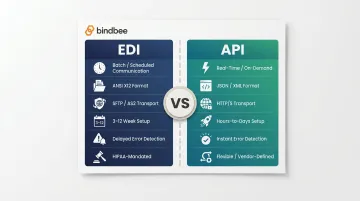
EDI vs API: Quick Comparison
| Factor | EDI | API |
|---|---|---|
| Primary purpose | Exchange standardized business documents between organizations | Expose application data or functionality |
| Common formats | X12, UN/EDIFACT and other structured standards | Often JSON or XML |
| Transport | Can use AS2, SFTP, VANs and other channels | Commonly HTTP/S |
| Interaction model | Often asynchronous or store-and-forward | Can be request-response, asynchronous or event-driven |
| Standardization | Strong document and message standards | Usually defined by the API provider |
| Typical setup work | Mapping, partner specifications, testing and acknowledgements | Authentication, endpoints, scopes, schemas and rate limits |
| Error handling | Functional/transaction acknowledgements and partner-specific workflows | HTTP responses, application errors, logs and callbacks/webhooks |
| Common strength | Structured B2B transactions across established trading networks | Flexible access to application data and operations |
| Common challenge | Partner-specific implementation requirements | Every provider can expose a different API contract |
The biggest mistake is reducing the comparison to "EDI is batch and APIs are real-time." Both can support different processing patterns. Even an API-based integration may retrieve data on a schedule rather than continuously.
What Is EDI?
Electronic Data Interchange (EDI) is the computer-to-computer exchange of structured business information using an agreed standard. Instead of one company inventing its own format for an invoice, enrollment record, purchase order, or other transaction, trading partners can exchange data according to a shared specification.
Organizations such as X12 develop and maintain EDI standards used across healthcare, insurance, transportation, finance, supply chain, and other industries. Internationally, UN/EDIFACT provides another widely established EDI standard.
How EDI Works
A simplified EDI workflow looks like this:
Business data → EDI mapping → standardized message → transport → receiving partner → validation and processing
The transport layer is worth separating from EDI itself.
SFTP, for example, is a method for securely transferring files. It is not an EDI standard. An organization may transfer an X12 document over SFTP, but it can just as easily transfer a CSV file over SFTP that is not EDI at all.
The same distinction applies to AS2 and value-added networks. They move information; EDI defines the structured business message being exchanged.
Common EDI Standards and Transactions
EDI is used far beyond healthcare. X12 alone maintains hundreds of transaction standards covering different business processes.
For benefits teams, one of the most relevant examples is the X12 834 Benefit Enrollment and Maintenance transaction. X12 defines the 834 for communicating benefit enrollment information between a plan sponsor and payer, potentially through a third-party administrator or insurance carrier.
For HIPAA-covered electronic enrollment and disenrollment transactions, HHS adopted ASC X12N 834 as the standard. That makes the 834 particularly important to benefits platforms working with health plans and other covered entities.
Advantages of EDI
EDI's biggest advantage is standardization between organizations. The receiving organization knows what type of business document is being sent and how its information should be represented.
That makes EDI useful for:
- repeatable, structured B2B transactions;
- established trading-partner networks;
- industries with mature transaction standards;
- high-volume document exchange; and
- workflows where a partner already requires a particular EDI transaction.
EDI also replaces many manual document-exchange processes with machine-readable transactions.
Limitations of EDI
A standard does not eliminate implementation work.
Trading partners often have their own implementation guides, required fields, validation rules, schedules, and operational processes. Mapping and testing still have to account for those requirements.
Adding another carrier or partner can therefore mean another implementation cycle even when both organizations technically use the same EDI transaction.
For product teams, that partner-by-partner work is often the bigger issue than the EDI syntax itself.
What Is an API?
An Application Programming Interface (API) defines how one software system can request data or actions from another.
A common web API exposes endpoints that another application calls over HTTP/S. A request might retrieve an employee record, create an object, update a deduction, or trigger another supported operation. The provider defines what endpoints exist, how authentication works, what data they return, and which actions are allowed.
REST APIs commonly use JSON, but API is a broader concept than REST.
How API Integration Works
A basic web API flow looks like:
Application → authenticated request → endpoint → provider processes request → response
For HTTP-based APIs, the response can use standardized HTTP status codes alongside provider-specific error messages.
Some APIs also expose webhooks or similar event mechanisms. Instead of repeatedly asking whether something has changed, the receiving application can be notified when a supported event occurs.
Advantages of APIs
APIs work well when applications need more granular interaction than exchanging complete business documents.
Depending on what the provider exposes, an API can support:
- retrieving specific records;
- creating or updating data;
- querying smaller subsets of information;
- interactive product experiences;
- event-driven workflows; and
- programmatic error handling.
Developers also work directly with the provider's software interface rather than converting every interaction into a standardized business document.
Limitations of APIs
The flexibility comes with a tradeoff: every provider can design its API differently.
Connect Workday, ADP, BambooHR, UKG, and another HR system directly and you may encounter different:
- authentication flows;
- schemas;
- pagination models;
- rate limits;
- permissions;
- endpoints;
- webhook capabilities;
- write operations; and
- versioning policies.
An API therefore does not eliminate integration maintenance. It changes what your team has to maintain.
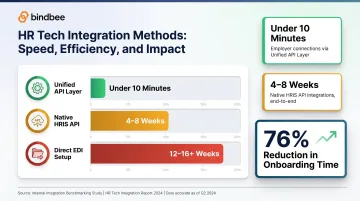
If supporting many HR or payroll systems is part of your product, this is where a unified API can change the architecture: provider-specific interfaces are mapped behind one normalized contract instead of becoming separate branches in your application.
EDI vs API: What Are the Key Differences?
The meaningful differences go beyond file versus endpoint.
Data Structure and Standardization
EDI starts with an agreed business-message standard. An X12 transaction has a defined purpose and structure that participating organizations implement.
APIs are generally provider-specific. Two payroll platforms may both expose employee data through APIs while naming, structuring, and relating those records differently.
That makes APIs flexible, but it shifts more normalization responsibility to whoever consumes them.
Communication and Data Freshness
EDI is frequently implemented through scheduled or asynchronous exchanges, particularly when files move between trading partners. But that is an implementation pattern, not a definition of EDI.
Likewise, an API endpoint being available does not mean your application receives every upstream change instantly.
A provider may impose rate limits. A middleware layer may poll periodically. A unified API may synchronize on a configured schedule. Some systems support webhooks for particular events and not others.
For example, Bindbee's Workday integration explicitly notes that data is synchronized periodically rather than continuously in real time, with webhooks notifying the application when synchronized data becomes available.
The better question is therefore:
How fresh does this workflow need to be, and what does the source system actually support?
Implementation and Onboarding
EDI implementations tend to involve mapping, trading-partner requirements, file validation, connectivity setup, acknowledgements, testing, and certification or approval processes where applicable.
API implementations involve a different set of tasks: authentication, endpoint integration, field mapping, pagination, rate-limit handling, permissions, retries, error handling, and version management.
Neither model is automatically easy.
Error Handling and Observability
API errors can often be surfaced directly through HTTP responses or provider-defined error payloads. Asynchronous API operations may require additional status endpoints, callbacks, or webhook handling.
EDI commonly uses acknowledgements and partner-specific reconciliation processes.
In both cases, production reliability depends on observability: your team needs to know which connection failed, which records were affected, whether a retry succeeded, and what the customer needs to do next.
Maintenance
EDI mappings and partner rules change. APIs change too.
An API provider can add versions, modify endpoints, adjust permissions, change authentication requirements, or introduce new rate limits. A trading partner can update an EDI implementation guide or validation rule.
At small scale, maintaining these differences may be manageable. At 20, 40, or 60 customer-facing integrations, maintenance becomes its own engineering function.
When Should You Use EDI vs API?
Use EDI when:
- your trading partner requires a specific EDI transaction;
- you participate in an established EDI network;
- standardized business-document exchange is central to the workflow;
- existing operational infrastructure already depends on EDI; or
- regulatory or industry requirements make a specific standard relevant.
Use an API when:
- the provider exposes the data or operation you need through an API;
- your product needs granular reads or writes;
- interactive application workflows matter;
- you need programmatic access to selected objects rather than entire documents; or
- the API supports the event or update pattern your product requires.
Use both when different parts of your ecosystem support different integration methods.
That last scenario is common in HR Tech and benefits.
Can EDI and APIs Work Together?
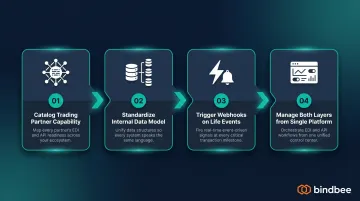
Yes. A mature integration architecture does not have to expose every upstream difference to the rest of your product.
Consider two sources:
SFTP/file source → ingestion and mapping → normalized data model → application
API source → connector and mapping → normalized data model → application
The upstream mechanics differ, but the application can consume the same internal representation.
The same principle can work in the opposite direction. Your product may operate on a normalized enrollment model internally, then translate the required data into an EDI transaction for one destination and an API request for another.
That abstraction is valuable because partner diversity stops dictating your entire application architecture.
EDI vs API in HR Tech and Employee Benefits
HR and benefits platforms are a good example of why the theoretical "EDI versus API" debate breaks down in production.
Employer systems themselves are fragmented. Bindbee's current integration directory includes API-based connections, SFTP-based connections, and systems where both connection methods are available.
A platform serving many employers therefore cannot assume every customer will provide workforce data the same way.
Employer and HRIS Connectivity
Modern HRIS and payroll systems may expose APIs for employee, employment, compensation, payroll, benefits, time-off, or other data. Native HRIS API integrations are common, though not every customer configuration uses them.
Other systems or customer configurations still rely on scheduled reports and SFTP.
The product consuming that data usually does not care whether a person's employment record originated in an API response or a file. It cares that the fields are complete, correctly mapped, and presented consistently.
This is why normalization becomes critical as integration coverage grows.
Benefits and Carrier Connectivity
Benefits platforms have an additional layer of complexity.
They may need employee census data, dependents, benefit elections, contribution information, payroll deductions, eligibility-related fields, and enrollment changes.
Carrier-side workflows can introduce EDI alongside those HRIS and payroll connections. The X12 834 is the clearest example: it provides a standardized enrollment and maintenance transaction for communication between sponsors and payers.
So the architecture may involve API-based HRIS ingestion on one side and an EDI enrollment transaction on another.
The Hard Part Is Often Normalization
Connectivity gets the data through the door. It does not make different source systems agree.
One HRIS may model dependents, benefits, deductions, employment status, or custom fields differently from another. If every connector hands your application a provider-specific structure, your product still needs conditional logic for each provider.
For HR Tech and benefits companies, the more scalable pattern is a normalization layer that maps those systems into a consistent employment-data model.
Bindbee's employee benefits infrastructure, for example, separates Employee Benefits, Employer Benefits, and Dependent Benefits instead of reducing the integration to a generic employee object.
How Bindbee Handles Mixed API and File-Based Integrations
Bindbee is built around the problem that HR Tech and benefits companies rarely control what integration method their customers' systems use.
Through one unified integration platform, Bindbee currently provides 67+ customer-facing HRIS, payroll, ATS, and benefits integrations. The connector catalog includes API-based integrations as well as SFTP-based sources.
The important part is what happens after connection: Bindbee normalizes employment data into consistent models so the consuming product does not need a completely different internal schema for each source system.
The platform also supports capabilities such as custom fields, data scoping, webhooks, operational logs, and read/write functionality where the underlying connector supports the required operation. Connector capabilities vary, so read/write support should always be evaluated against the specific system and data model rather than assumed universally.
This architecture has practical consequences. In Bindbee's ThrivePass case study, ThrivePass replaced custom file specifications and provider-specific transformation logic with a standardized integration layer across its HRIS footprint.
Carrier connectivity extends the model further. Bindbee currently lists Carrier Integrations as BETA, including automated EDI 834 generation, carrier API connectivity where available, and member-ID synchronization.
In other words, the objective is not to declare API the winner over EDI. It is to keep the upstream integration method from becoming your product team's problem every time a new employer or partner arrives.
EDI vs API: How to Choose the Right Integration Approach
Before choosing an architecture, answer these questions in order:
- What does the partner actually support? Start with reality, not your preferred technology.
- What data or transaction do you need? Employee records, enrollment, deductions, payroll data, and eligibility workflows have different requirements.
- How fresh must the data be? Define an actual acceptable interval rather than defaulting to "real-time."
- Do you need reads, writes, or both? Verify capabilities at the connector or endpoint level.
- What normalization is required? Connectivity without consistent data may only move the problem downstream.
- How will you detect and resolve failures? Logging, sync status, acknowledgements, retry behavior, and customer-facing errors all matter.
- Who owns maintenance? Every direct integration creates an ongoing operational obligation.
- What happens when you add the next 20 systems? An architecture that works for three integrations can become technical debt at thirty.
EDI and APIs both have a place in modern integration infrastructure. The better architecture is the one that fits the source and destination systems while keeping those differences from leaking throughout your product. For HR Tech and benefits teams facing a mix of APIs, SFTP feeds, provider-specific schemas, and carrier workflows, that often means normalizing the complexity behind one integration layer. Book a demo with Bindbee to see how one unified API can give your product access to 67+ employment-system integrations without building and maintaining every connector yourself.
Frequently Asked Questions
What is the main difference between EDI and API?
EDI is a method for exchanging structured business information according to agreed standards such as X12 or UN/EDIFACT. An API is a software interface through which one application can request data or actions from another.
EDI typically emphasizes standardized business transactions between trading partners, while APIs expose provider-defined application capabilities.
Is API replacing EDI?
Not universally.
APIs have become important for application connectivity, but EDI remains embedded in many established B2B and regulated workflows. In U.S. healthcare, for example, HHS has adopted specific X12 transaction standards for electronic transactions conducted by HIPAA-covered entities.
Many businesses therefore use EDI and APIs together rather than replacing one wholesale with the other.
Is EDI an API?
No.
EDI defines structured electronic business-message exchange between organizations. An API defines an interface that software can use to interact with another application or service.
They can participate in the same workflow, but they are different integration concepts.
Can EDI and APIs work together?
Yes. An integration layer can ingest an EDI or file-based transaction, map the information into a normalized internal schema, and expose it through an API.
The reverse is also possible: application data can be retrieved or created through APIs and transformed into an EDI transaction required by a downstream trading partner.
Is SFTP the same as EDI?
No.
SFTP is a secure file-transfer protocol. EDI concerns the standardized structure and exchange of business information.
An EDI document can be sent over SFTP, but a CSV file sent through SFTP is not automatically EDI.
Is an API always real-time?
No.
An API may allow a system to request data immediately, but that does not guarantee the underlying information is continuously synchronized. Integrations may poll providers on a schedule, process updates asynchronously, encounter provider rate limits, or depend on whether the source offers event notifications.
Always evaluate actual sync behavior rather than assuming "API" means instant data.
Which is better for HRIS and benefits integrations: EDI or API?
It depends on the systems and workflow.
APIs are useful when an HRIS or payroll provider exposes the objects and operations your product needs. EDI may be required for specific standardized transactions or trading partners, including some carrier enrollment workflows.
For platforms serving many employers, the stronger architecture is usually one that can accommodate API and file/EDI-based connectivity while normalizing the resulting data for the benefits platform.