
According to the Sapient Insights Group's annual HR Systems Survey, organizations use an average of 16.4 HR-specific applications. Each one is a potential integration problem. When those systems don't talk to each other, data stays siloed, teams resort to manual exports, and payroll errors become a matter of when, not if.
The license fee is just the entry cost. The real spend, often the larger spend, is building and maintaining the connections between systems. Yet most startup budgets treat integration as a line item footnote rather than an ongoing operational cost.
This guide covers realistic integration cost ranges by startup stage, the four factors that drive those costs up, a full one-time vs. recurring cost breakdown, and the budgeting mistakes that consistently blindside growing companies.
Key Takeaways
- HR tech stack integration costs range from under $1,000/year for seed-stage automation to $50,000–$150,000+ annually for multi-system enterprise environments
- The biggest cost drivers: number of connected systems, build vs. buy approach, and ongoing engineering maintenance
- Recurring maintenance costs typically exceed the initial build cost within 18–24 months
- Licensing fees are only part of the picture: at scale, engineering opportunity cost routinely outweighs them
What Does HR Tech Stack Integration Actually Cost?
Integration costs don't follow a clean per-user pricing model. They depend on three variables: the approach you choose (build, buy, or unified API), how many systems need connecting, and how much engineering time those connections require over time.
When these costs are misunderstood, startups tend to hit one of three failure modes:
- Budget exhaustion mid-build: underestimated scope, integration half-done
- Unmaintainable point-to-point spaghetti: six direct connections that each break independently
- Surprise API costs: a vendor pushes a breaking change, and the integration is down until someone fixes it
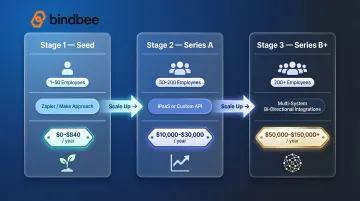
Here's what realistic costs look like across startup stages.
| Stage | Headcount | Typical Approach | Annual Cost Range |
|---|---|---|---|
| Seed | 1–50 | Zapier / Make between 2–3 tools (HRIS + payroll, HRIS + Slack) | $0–$840 |
| Series A | 50–200 | iPaaS (Workato, Tray.ai) or initial custom API work across 4–6 systems | $10,000–$30,000 |
| Series B+ | 200+ | Multi-system bi-directional integrations with dedicated engineering maintenance | $50,000–$150,000+ |
Seed Stage (1–50 Employees)
No custom API work is required at this stage. Zapier's Starter plan ($20/month) or Make's Core plan ($9/month for 10,000 operations) covers most connective tissue between 2–3 tools. The right question isn't "how do I build this?" It's "which two systems actually need to talk right now?"
This approach makes sense as long as you're still evaluating your HR tools and prioritizing speed over scalability.
Series A (50–200 Employees)
Once a People Ops function forms, manual exports break down fast. Connecting HRIS, payroll, ATS, benefits, and onboarding across 4–6 systems typically means either an iPaaS platform or direct API work. Workato starts around $10,000/year; Tray.ai runs $25,000–$30,000/year. Custom API builds add $2,000–$15,000 per integration depending on complexity.
Series B+ (200+ Employees)
At this scale, HR data errors carry real consequences. A missed payroll deduction or stale benefits eligibility record creates downstream legal exposure. Expect multi-system, bi-directional integrations with real-time sync requirements and dedicated engineering maintenance. The total annual cost of a single API integration, factoring in engineering time, maintenance, and partnership fees, can reach $50,000–$150,000 per year.
Key Factors That Drive HR Tech Stack Integration Costs
Four compounding factors shape what integration actually costs. Understanding each one helps avoid both over-engineering and underbuilding.
Number and Complexity of Connected Systems
Each additional tool (ATS, LMS, payroll, benefits, time tracking) adds a new integration surface. Costs don't scale linearly. Connecting six systems isn't three times the cost of connecting two, because data models, authentication schemes, and error handling logic multiply across every pairing.
A practical example: connecting your HRIS to payroll is a single data flow. Add benefits and ATS, and now you're managing four potential failure points, different field naming conventions across vendors, and separate authentication tokens to maintain.
Build vs. Buy Decision
This is where most startups make their most expensive mistake. In-house builds look cheap upfront. You're "just" using engineering capacity you already have. But building a single native integration typically takes 4–8 weeks according to Gartner benchmarks, and that's before you account for the maintenance that follows every time a vendor updates their API.
Engineers typically spend roughly 150 hours building a single integration and an additional 300 hours per year on maintenance and troubleshooting. At a median software developer salary of $133,080 (BLS, May 2024), that's roughly $9,600 to build one integration, plus ~$19,200 per year just to keep it running.
Data Volume and Sync Frequency
The gap between real-time and batch sync isn't just architectural. It's a cost multiplier. Real-time requires always-on connections, streaming error handling, and infrastructure that propagates mistakes instantly across every connected system.
For benefits-sensitive data (health plan eligibility, dependent information, COBRA qualifying events), real-time sync isn't optional. A 30-day lag between a termination and a benefits system update isn't just inconvenient. It's a compliance liability.
Compliance and Security Requirements
Integrations handling HIPAA-relevant benefits data, PII, or multi-state payroll compliance require:
- Encryption at rest and in transit
- Audit logging for data access
- Data residency controls (especially for EU employees)
- SOC 2 alignment across your integration layer
These requirements add meaningful engineering scope to any custom integration project. That's also why many Series B+ companies find their homegrown integration layer can't pass a customer security questionnaire, and have to rebuild from scratch.
Full Cost Breakdown: One-Time vs. Recurring Integration Expenses
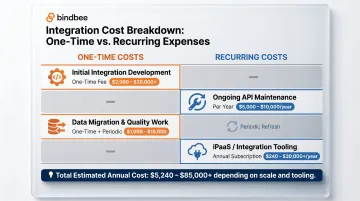
The total cost of integration goes well beyond an initial development sprint. Recurring costs often exceed the initial build cost within 18–24 months.
| Cost Category | Type | Typical Range |
|---|---|---|
| Initial integration development | One-time | $2,000–$30,000+ per integration |
| Ongoing API maintenance | Recurring | $5,000–$10,000/year per integration |
| Data migration and quality work | One-time + periodic | $1,000–$15,000 depending on data volume |
| iPaaS / integration tooling | Recurring | $240–$30,000+/year |
Initial Integration Development
Covers scoping, API authentication, data mapping, and the initial build. A simple integration between two common HR systems (say, BambooHR and a payroll platform) typically requires 40–80 engineering hours for the build, with complex integrations exceeding 100 hours. At a loaded engineering cost of $72/hour, that's $2,900–$7,200 for the build alone, before testing, deployment, or documentation.
Ongoing Maintenance and API Management
APIs change constantly, and the maintenance bill reflects it. Workday pushes quarterly updates that can break integrations. BambooHR deprecates endpoints with roughly six months' notice. 87.3% of API versions introducing breaking changes provide no deprecation information in the preceding version.
Annual maintenance cost per integration typically runs $5,000–$10,000, representing 15–20% of the initial development cost. Multiply that across six integrations, and you're looking at $30,000–$60,000/year just to keep existing connections working.
Integration Tooling and Licensing
For iPaaS platforms, annual costs range significantly:
- Zapier (Starter): ~$240/year
- Workato: ~$10,000+/year
- Tray.ai: ~$25,000–$30,000/year
These fees scale with connector count or data volume, so costs compound as your HR stack expands.
A unified API approach changes this math. Bindbee's model normalizes data across 60+ HRIS, payroll, and benefits systems through one connection, replacing per-connector fees and eliminating the maintenance overhead that drives recurring costs up. Flat-fee per-connection pricing means costs stay predictable regardless of API call volume or sync frequency.
Build vs. Buy: Choosing Your Integration Approach
Three main paths exist for connecting an HR tech stack. The right choice depends on three factors: how many systems need connecting, how fast the team needs to move, and how much engineering capacity can realistically go toward non-product work.
In-House Native Integrations
Cost structure: Engineering hours upfront (40–150+ hours per integration) plus ongoing maintenance for each connected system.
When it makes sense: 1–2 integrations, full control requirements, available engineering bandwidth.
Where it breaks down: At 4+ integrations, the maintenance burden becomes a significant drag. Each vendor API update requires engineering attention. Customers who switched to Bindbee from homegrown integrations consistently report that custom integrations were consuming 2–3 weeks of engineering time per system, with Healthee reporting 2+ months per integration before switching.
iPaaS / Middleware Tools
Cost model: Subscription + configuration + per-connector fees. Reduces initial build time but still requires ongoing management. Doesn't solve the underlying problem of differing data models across HR vendors. You normalize data yourself or live with inconsistency.
Best for: Series A companies that need faster setup than custom builds but aren't yet connecting enough systems to justify a unified API.
Unified API Platforms
A unified API provides a single integration layer that normalizes data across multiple systems. Instead of building 10 separate integrations, you build one.
Bindbee connects to 60+ HRIS, payroll, ATS, benefits, and carrier systems through one API. Setup takes under a day. Most customers complete initial authentication in under 10 minutes via the Magic Link component, versus 4–8 weeks for native builds. When a vendor like Workday or ADP pushes an API change, Bindbee handles it with no action required from the customer's engineering team.
The ROI case is documented across multiple platforms:
- Newfront saved $800,000+ annually and cut engineering time on integrations by 90%
- Cypherworx saved $150,000 and recovered 5 man-months of engineering time
For HR tech and benefits platforms connecting to dozens of employer HRIS instances, the math favors a unified API approach well before the 3–4 integration mark.
Budgeting for HR Tech Stack Integrations: What Startups Usually Get Wrong
Mistake 1: Treating Integration as a One-Time Project
The most common budgeting error. Startups allocate for the initial build and nothing else. But every API update, schema change, or vendor deprecation becomes an unbudgeted engineering task. The maintenance never stops.
Budget integration as an ongoing operational expense. A realistic recurring allocation is $5,000–$10,000 per custom integration per year, or the annual fee for a managed platform.
Mistake 2: Underestimating Tool Count Growth
Startups often start with 2–3 HR tools and assume that's stable. It rarely is. The numbers tell the story:
| Company Size | Avg. SaaS Apps |
|---|---|
| 1–99 employees | ~30 |
| 100–999 employees | ~113 |
That's nearly a 4x jump through Series A and B, and the HR stack scales with it.
Designing for 3 integrations when you'll need 8 within 18 months forces expensive rewrites of integration architecture at the worst possible time.
Map the HR systems you'll need over a 24-month horizon (not just what's running today) and design the integration layer to handle that growth from the start.
Mistake 3: Ignoring Engineering Opportunity Cost
Every sprint spent building or maintaining HR integrations is a sprint not spent on the core product. For HR tech and benefits platforms, this trade-off is especially costly. When engineering salaries are fully loaded, a single in-house integration can cost $50,000–$150,000 in the first year including build, maintenance, and troubleshooting time.
Run a 2-year TCO comparison before committing to an in-house build. Calculate:
- Engineering hours to build × loaded hourly rate
- Estimated annual maintenance hours × loaded hourly rate × number of integrations
- Compare against the annual cost of a managed integration platform
- Factor in what those engineering hours could produce if redirected to product
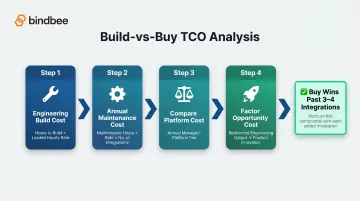
Past 3–4 integrations, the buy option wins on cost, usually sooner than teams expect.
Frequently Asked Questions
What is an HR tech stack?
An HR tech stack is the collection of software tools a company uses to manage people operations, typically an HRIS, payroll system, ATS, benefits administration platform, and time-tracking tools. The cost and complexity of connecting these tools is often as significant as the tools themselves.
How much does it cost to implement an HRIS system?
HRIS software licenses typically run $6–$25 per employee per month depending on the platform (Gusto starts at $6/employee; BambooHR runs $10–$25/employee). Implementation adds a separate layer. Setup, data migration, and integration work typically push total first-year costs several thousand to tens of thousands of dollars beyond the license fee alone.
What is the difference between HR software cost and HR integration cost?
HR software cost is the subscription or license fee to use a tool. Integration cost is the engineering work required to connect that tool to other systems so data flows reliably between them. For growing startups, integration costs frequently exceed software costs over a 2-year horizon when maintenance is factored in.
Should startups build or buy HR integrations?
Building makes sense for startups with very few integrations (1–2) and available engineering capacity. Beyond that threshold, especially when connecting to 3–4 or more HR or payroll systems, buying through an iPaaS or unified API platform ships faster and costs less to maintain over time.
What is the best HR tool for startups?
It depends on stage. Early-stage companies often start with all-in-one platforms like Gusto or BambooHR. Faster-growing startups prioritize platforms with strong API availability and integration flexibility, since the ability to connect cleanly to a broader HR tech stack matters more as headcount and system complexity grow.