

Understanding API Integration Cost: Factors and Estimation
Summarise the blog with AI
Did you ever try estimating the real cost of an API integration and end up with a number far higher than expected?
Most teams underestimate integration costs because they only count the initial build. The real cost includes ongoing maintenance, version updates, error handling, monitoring, and the engineering time pulled away from core product work every time a vendor changes their API.
This guide breaks down what API integration actually costs, where the hidden costs accumulate, and how to evaluate build vs. buy decisions accurately.
The Full Cost of an API Integration
Initial Build
A single HRIS integration with proper error handling, authentication, data mapping, and testing typically takes 4–8 weeks of senior engineering time. At a fully-loaded engineering cost of $150–200K per year, that's $25–65K per integration just to build it.
Ongoing Maintenance
APIs change. Vendors update schemas, deprecate endpoints, and release new versions. For every active integration, expect 1–2 weeks of engineering time per year just to keep it working. Across 15 integrations, that's 15–30 weeks annually — nearly a full engineering year.
Monitoring and Error Handling
Integrations fail silently. Without proper monitoring, you find out about broken syncs from customers, not dashboards. Building and maintaining that monitoring infrastructure adds cost beyond the connector itself.
Opportunity Cost
Every sprint spent on integration maintenance is a sprint not spent on product features. For HR Tech companies, this is often the largest hidden cost — the features not built, the deals not closed, the roadmap not shipped.
Build vs. Buy: The Real Math
For 15 HRIS integrations:
- Build: 12–18 months to build, $200K–$500K per year to maintain, 2–3 engineers dedicated to integration work
- Buy (unified API): Weeks to go live, predictable subscription cost, zero internal maintenance overhead
The break-even point is usually reached before the third integration. After that, every integration you don't build in-house is net savings.
How Bindbee Changes the Cost Equation
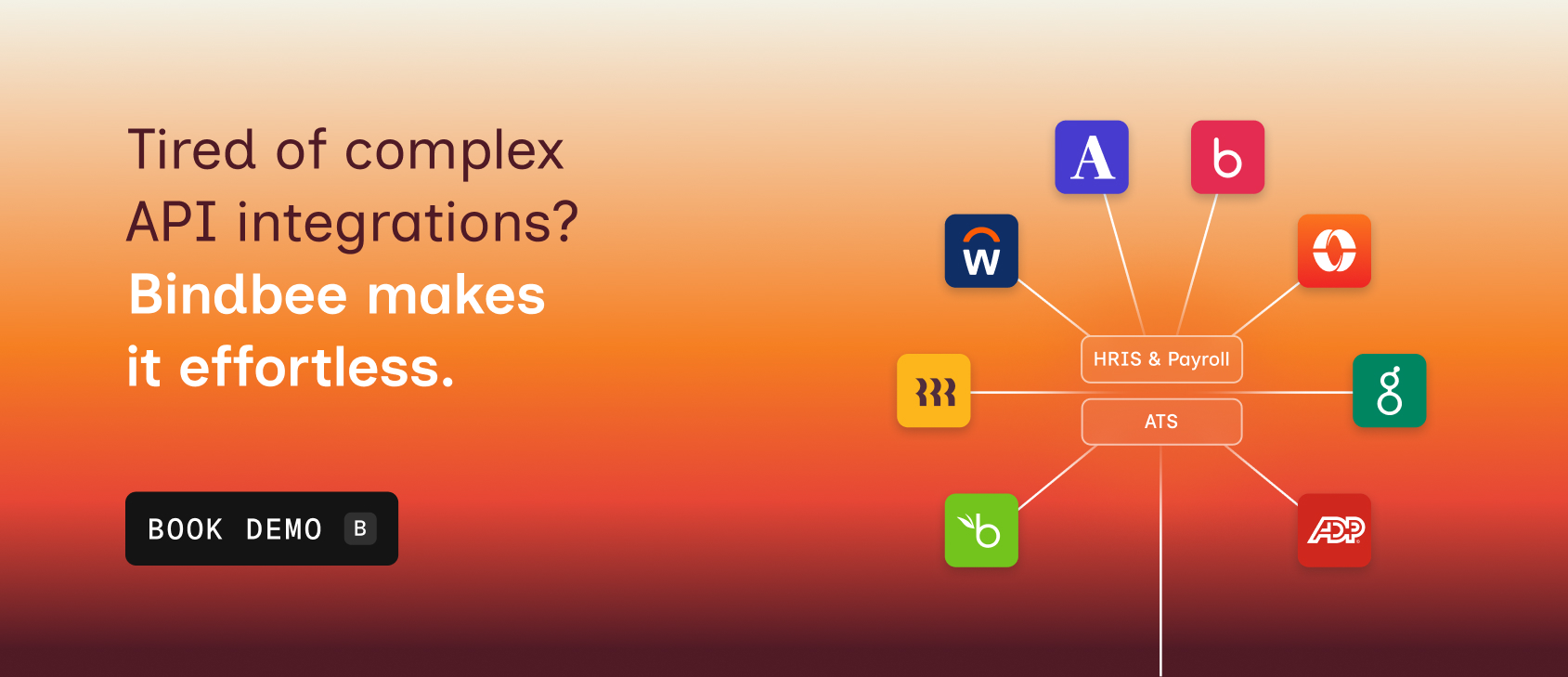
Bindbee replaces the entire in-house integration build with a unified API that covers 102+ HRIS, ATS, and payroll systems. Instead of paying to build and maintain each connector, you pay a fraction of that cost for access to all of them.
- Go live in weeks, not months
- Zero connector maintenance on your side
- 102+ systems covered from day one
- Engineering freed for core product work
Book a demo to see how Bindbee reduces your API integration cost.