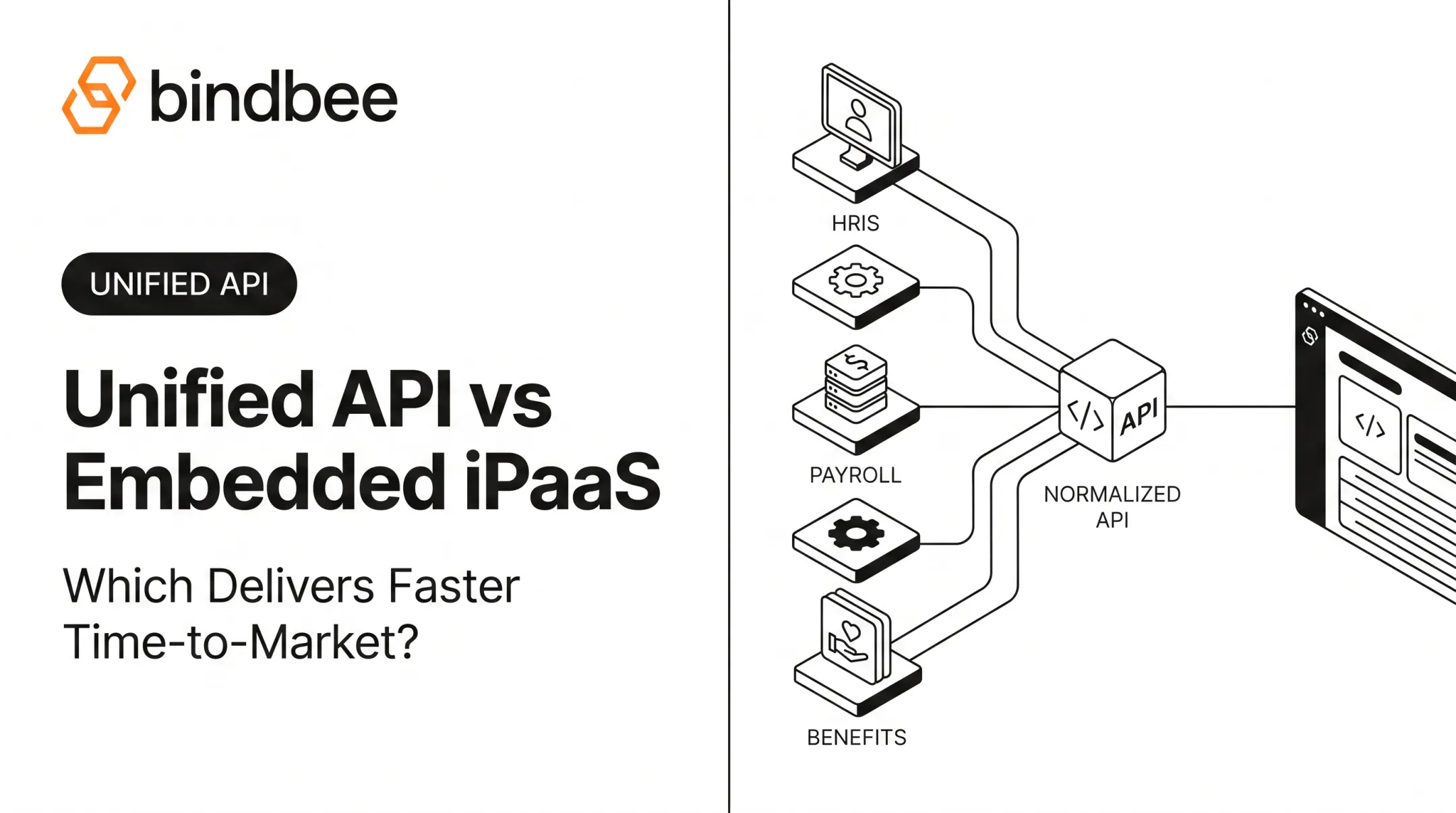

Two approaches dominate how software teams solve this: Unified APIs and Embedded iPaaS. The choice isn't cosmetic. It shapes engineering bandwidth, time-to-market, onboarding speed, and how much you'll spend maintaining integrations two years from now.
Integration capability increasingly shows up as a deciding factor in software buying decisions, which makes this an architecture choice with real revenue consequences. This article breaks down both models so HR Tech and benefits platforms can pick the right one.
Key Takeaways
- Unified APIs normalize data from 60+ HRIS, payroll, and benefits providers into one standardized schema
- Embedded iPaaS lets teams build complex, cross-category, customer-configurable automations in a visual workflow builder
- Speed and simplicity favor Unified APIs; flexibility for non-standard workflows favors Embedded iPaaS
- Benefits-specific data (eligibility, dependents, enrollment) often needs purpose-built models, not generic normalization
Unified API vs Embedded iPaaS: Quick Comparison
| Dimension | Unified API | Embedded iPaaS |
|---|---|---|
| Setup time | Hours to days once integrated | Weeks, per connector configuration |
| Maintenance | Provider manages upstream API changes | Internal team maintains workflows |
| Customization | Limited to normalized schema | High — custom connectors, per-customer workflows |
| Ideal for | Category-specific integrations at scale (HRIS, benefits, payroll) | Complex, multi-step, cross-category workflows |
| Technical skill | Standard REST API knowledge | Workflow builder + dev skills for custom logic |
Unified APIs trade flexibility for speed within one category. Embedded iPaaS trades speed for flexibility across many categories.
What Is a Unified API?
A Unified API is a single, standardized interface that aggregates many category-specific APIs — such as HRIS, payroll, and benefits carriers — into one normalized schema. Instead of building and maintaining a separate integration for Workday, ADP, BambooHR, Gusto, and 60 other systems, you build once against the unified layer. Core operational benefits:
- Faster onboarding for new employer connections
- Reduced engineering maintenance burden (the provider absorbs upstream API changes)
- Consistent data structure regardless of which HRIS a customer runs
Why Benefits-First Data Models Matter
Generic normalization works fine for basic employee records. It breaks down for benefits data, which involves relationships (dependents), time-bound events (coverage effective dates), and compliance logic (ACA hour thresholds). That's why Bindbee built distinct Employee Benefits, Employer Benefits, and Dependent Benefits models rather than folding everything into one generic schema. Employee Benefits captures plan name, coverage tier, and contributions. Dependent Benefits preserves relationship type, coverage dates, and eligibility. A benefits platform querying "who's covered" needs those structured relationships — not a flat field dump.

Use Cases of Unified APIs
That same structured data is what benefits platforms need in production. Unified APIs fit wherever eligibility, enrollment, or dependent data must sync from employer HRIS systems. Industries where this model dominates:
- Benefits administration platforms
- Third-party administrators (TPAs)
- Payroll platforms
- InsurTech and digital health platforms Real engineering impact:
- Upduo saved roughly 15 engineering hours per week (~$80,000 in annual maintenance costs)
- Cypherworx cut onboarding from 24 days to hours and saved over 400 engineering hours Industry results look similar: Bonusly (a Merge customer) reported that building to a Unified API took the same time as one internal integration (2–3 sprints) but unlocked dozens of HRIS integrations at once.
What Is Embedded iPaaS?
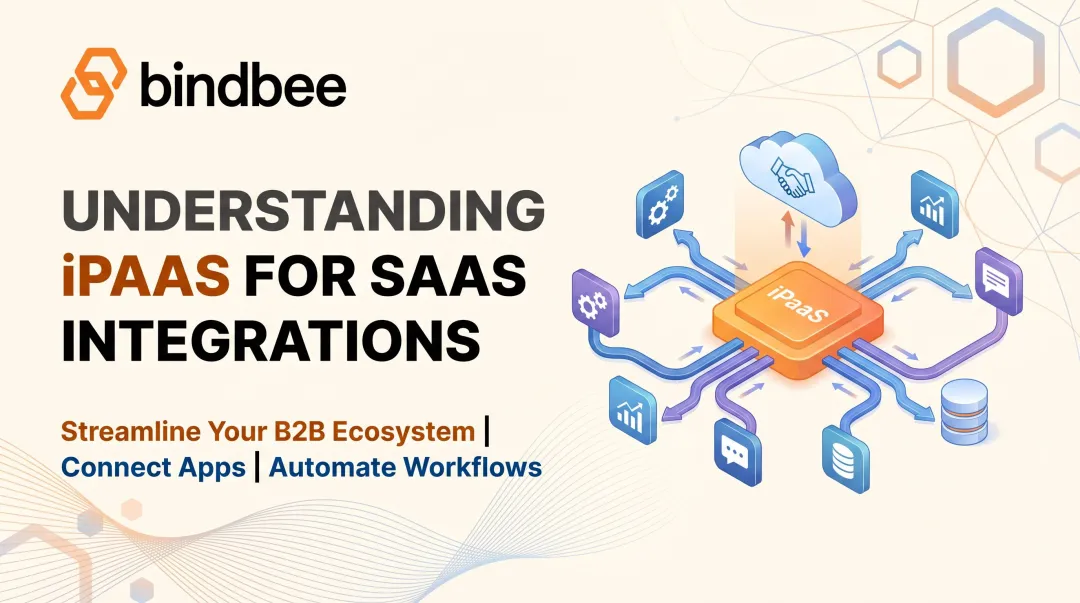
Embedded iPaaS is a workflow-based integration platform with a visual builder and pre-built connectors, embedded directly inside a SaaS product. Instead of normalizing data across one category, it lets users (or your team) build multi-step automations across completely unrelated apps.
Core benefits:
- Flexibility for complex workflows spanning CRM, finance, HR, and beyond
- End-user self-service configuration, no engineering ticket required for every workflow tweak
- Non-developer access so onboarding or support teams can build and manage workflows
Use Cases of Embedded iPaaS
Embedded iPaaS works best when a platform's integration needs sprawl beyond one vertical. Think a horizontal SaaS tool that needs to connect a customer's CRM, accounting software, and HR system into one custom automation chain.
Where it typically wins:
- Broad platforms serving customers with wildly different tech stacks
- Workflows that trigger actions across multiple app categories (e.g., "when an employee is terminated in the HRIS, remove their CRM seat and notify finance")
- Products where customers expect to build their own integrations without submitting feature requests
Workato's Bullhorn case study illustrates the tradeoff well: Bullhorn moved from delivering integrations in "hundreds of hours to tens of hours" once workflows were templated.
That's a real efficiency gain, but it's a single customer result—not a guaranteed baseline. Complex workflow builds still typically take weeks of configuration per connector, not hours.
Which Is Better for HR Tech and Benefits Platforms?
There's no universal winner. The right choice depends on four factors:
- Integration complexity — Do you need standardized data from many similar systems, or custom logic across different app categories?
- Real-time eligibility/enrollment needs — Benefits data with compliance implications (COBRA, ACA) needs purpose-built models, not generic mapping.
- Team size and skillset — Small engineering teams often can't maintain dozens of workflow configurations long-term.
- End-user configuration needs — Do your customers need to build their own automations, or do they just need clean, current employment data?

Choose a Unified API if:
- You need standardized, always-current HRIS/benefits/payroll data across dozens of systems
- Your team can't afford heavy ongoing engineering lift for integration maintenance
- Your core need is data accuracy and freshness, not workflow customization
Choose Embedded iPaaS if:
- Your customers need highly customized, multi-app workflows unique to each account
- You're building horizontal software that spans well beyond HR/benefits data
For benefits-first use cases, generic iPaaS connectors weren't built for waiting periods, ACA hour validation, benefit-class assignment, or COBRA qualifying events.
Bindbee's unified API handles that compliance-heavy logic natively, including state-specific rules and life-event detection for marriage, divorce, and dependent age-outs. Platforms get eligibility and enrollment rules without building a custom layer on a generic workflow tool.
Real-World Example: Choosing the Right Integration Approach
Healthee, a benefits tech platform, faced a familiar bottleneck. Every new employer meant weeks of back-and-forth just to collect census data. Building a custom HRIS integration for each employer took more than two months.
That repeated cycle, not a one-time integration project, was the trigger. Healthee needed a way to onboard employers without rebuilding connector logic every time a new HRIS showed up.
After adopting Bindbee's unified API:
- Employers connect their HRIS in minutes
- Healthee goes live with new employers the same day
- Custom connector cycles dropped from 2+ months to none
Phin, an employee-gifting platform with the same HRIS dependency, saw similar gains. After switching to Bindbee's unified API for real-time employee data across 60+ HR systems, it reported a 76% reduction in onboarding time for new customers and a 94% improvement in time-to-value.

The takeaway: Platforms with benefits-specific or employment-data-heavy needs tend to see faster ROI from a unified API built for that vertical, rather than a general-purpose integration tool retrofitted for HR data.
If your platform needs to connect to HRIS, payroll, and benefits systems without a multi-month build cycle, see how Bindbee's unified API works across 60+ HR and benefits systems.
Conclusion
Choose based on the job, not the category label. Unified APIs fit standardized, benefits-first HR data needs where speed and data accuracy matter most. Embedded iPaaS fits broad, highly customized cross-category workflows where end users must build their own automations.
For most HR Tech and benefits platforms, that points to a Unified API: faster employer onboarding, lower ongoing maintenance costs, and more engineering time on the core product—not integration plumbing.
Frequently Asked Questions
What are the 5 stages of API integration?
The typical lifecycle covers planning, authentication setup, data mapping and normalization, testing, and ongoing maintenance and monitoring. Each stage adds engineering time, which is exactly what unified APIs aim to compress.
What is a unified API and what is its purpose?
A unified API is a single, normalized interface connecting to multiple providers within a category, like HRIS or payroll systems. Its purpose is to simplify and accelerate integration development by letting teams build once instead of per-provider.
What is an embedded API?
An embedded API usually means embedded iPaaS or SDK-based components built into a SaaS product. End users can configure or trigger integrations without leaving the host platform.
What are the different types of iPaaS?
Two main types exist: traditional enterprise iPaaS for internal IT teams, and embedded iPaaS built into a vendor's product for its customers. Some platforms are workflow-based; others focus on data connectors.
What are the key differences between PaaS and iPaaS?
PaaS provides infrastructure for building and running applications, including servers, dev tools, and middleware. iPaaS is purpose-built middleware focused specifically on connecting systems and moving data between them.
How long does it take to set up integrations with a unified API versus embedded iPaaS?
Unified APIs often connect new systems in under a day once the core integration is live. Embedded iPaaS setup can take weeks, since each workflow needs individual configuration.