
Introduction
Building HRIS, payroll, and benefits integrations natively is expensive. A single production-grade Workday integration can cost $50,000–$100,000 in developer time and take 2–3 months to ship — before accounting for the ongoing maintenance burden across dozens of other systems your customers use. Unified API platforms like Unified.to emerged to solve exactly this problem, abstracting that fragmentation behind a single endpoint.
As the market has matured, "one API for everything" is no longer the only option. For HR Tech, Benefits Administration, and Insurtech companies specifically, it often isn't the right one either.
Generic unified API platforms tend to cover 80% of requirements well. The remaining 20% is where enterprise customers push back hardest:
- Benefits enrollment sync
- Dependent data management
- Life event webhooks
- HIPAA compliance posture
- Carrier system connectivity
That gap is driving teams to evaluate more specialized alternatives.
This guide covers the top 10 platforms, selected based on integration depth, compliance posture, setup speed, and production readiness for HR and benefits use cases.
Key Takeaways
- Unified.to covers 30 categories broadly but lacks the benefits-specific data models required for Benefits Admin and Insurtech use cases.
- The top alternatives differ in architecture (stateless vs. sync-based vs. self-hosted), domain depth, and pricing model.
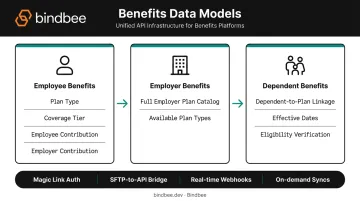
- Bindbee is the only benefits-first unified API with dedicated data models for Employee Benefits, Employer Benefits, and Dependent Benefits.
- SOC 2 Type II, HIPAA, and ISO 27001 compliance should be mandatory evaluation criteria — not nice-to-haves.
- Connector count is a poor selection criterion; data model depth and write support are what actually determine production fit.
What Is Unified.to and Why Are Teams Looking for Alternatives?
Unified.to is a stateless unified API platform covering 524 integrations across 30 categories, including 272 HR and directory integrations. Its passthrough architecture means customer data is never stored at rest on Unified.to's servers — a clean compliance posture. Pricing is consumption-based on API calls, not customer count.
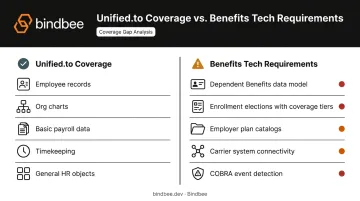
For general HR data workflows — syncing employee records, pulling org charts, reading basic payroll data — Unified.to performs well. Its HR and directory model covers 11 objects: Employee, Group, Location, Company, Time Off, Payslip, Benefit, Deduction, Bank Account, Timeshift, and Device — enough for general-purpose HR data access, but not benefits administration depth.
Where it falls short for Benefits Tech and HR Tech teams:
- No dedicated Employer Benefits or Dependent Benefits data models
- Benefits enrollment depth (coverage tiers, contribution amounts, dependent-to-plan linkage) is limited compared to purpose-built platforms
- Carrier system connectivity and SFTP-based legacy system support are not core to its design
- Teams building eligibility sync, census data generation, or COBRA event detection hit data model gaps quickly
The platforms below address those gaps with varying degrees of domain specialization — from general-purpose unified APIs to infrastructure built specifically for benefits and employment data workflows.
Top 10 Unified.to Alternatives for HR Tech and Benefits Platforms in 2026
Evaluation Criteria
All platforms below are assessed on five dimensions that directly affect engineering velocity and product reliability:
- Domain depth: HRIS, payroll, and benefits-specific data model coverage
- Compliance: SOC 2 Type II, ISO 27001, HIPAA, GDPR
- Connector breadth: total integrations and relevant system coverage
- Pricing model: predictability at scale
- Setup speed: time to first live employer connection
1. Bindbee
Bindbee is a unified API built exclusively for HR Tech, Benefits Administration, payroll, and carrier systems. It connects 60+ HRIS, payroll, benefits, and carrier platforms through a single API, purpose-built for Benefits Tech, Insurtech, TPAs, and Employee Engagement platforms.
Bindbee's benefits-first data architecture exposes three distinct models that generalist platforms don't offer in structured form:
- Employee Benefits: individual enrollment detail — plan type, coverage tier, employee and employer contribution amounts
- Employer Benefits: the full plan catalog an employer makes available, not just what employees elected
- Dependent Benefits: a relational model linking specific dependents to enrolled plans with effective dates
The Dependent Benefits model covers census data generation, eligibility verification, and dependent audit trails — use cases where normalized data is non-negotiable.
Additional platform capabilities include:
- Magic Link authentication — an embeddable SDK that reduces employer HRIS connection to minutes
- Real-time incremental syncs with outbound webhooks when data changes
- SFTP-to-API Bridge for legacy carrier and file-based systems
- On-demand syncs via API or dashboard
- Custom HRIS integrations built on request
Customers like Healthee reduced employer onboarding from 8–12 weeks down to 24–48 hours. Alma's enterprise clients now connect HR systems in minutes rather than weeks.
| Attribute | Details |
|---|---|
| Key Features | Benefits-first data models; 60+ integrations; SFTP-to-API Bridge; life event webhooks; Magic Link auth |
| Compliance | SOC 2 Type II, ISO 27001, HIPAA Compliant, GDPR Ready |
| Pricing | Contact Bindbee for pricing details |
2. Merge
Merge is a well-established unified API with strong HRIS and ATS coverage — 75 HRIS integrations and 60 ATS integrations among its 240+ total connectors. It uses a sync-based architecture that normalizes data into Common Models stored on Merge's infrastructure.
Strengths:
- Deep coverage of Workday, BambooHR, Greenhouse, and Lever
- Fast query response against cached data
- Well-documented Common Models with solid HRIS object coverage
Limitations for benefits use cases:
- Sync frequency ranges from near-real-time to daily or monthly — data freshness depends on tier
- Write operations are asynchronous
- Per-linked-account pricing ($650/month base + ~$65/account) scales steeply at volume
- Benefits-specific modeling — contribution amounts, dependent-to-plan linkage, employer plan catalogs — is more limited than purpose-built platforms
Merge holds SOC 2 Type II, ISO 27001, HIPAA, and GDPR certifications, making it a credible option for teams with standard HRIS and ATS sync requirements.
| Attribute | Details |
|---|---|
| Key Features | 240+ HRIS/ATS integrations; sync-based Common Models; webhooks for data changes |
| Compliance | SOC 2 Type II, ISO 27001, HIPAA, GDPR |
| Pricing | $650/mo base + ~$65/linked account (verify current pricing) |
3. Finch
Finch is an employment data API focused on HRIS and payroll connectivity, covering 250+ HRIS and payroll systems. It's widely used by HR Tech and benefits companies that need programmatic access to employer, employee, and payroll data.
Strengths:
- Strong payroll system depth across ADP, Gusto, Rippling, Workday, and others
- Deductions write support for retirement and medical benefit deduction changes
- Automated integration refresh every 24 hours (12 hours for deductions)
Limitations:
- Read-heavy by design; benefits data models are less specialized than benefits-first platforms
- Compliance certifications (SOC 2 Type 2, HIPAA, GDPR, CCPA) — verify current status before committing
- Usage-based pricing at approximately $65/month per connection (confirm on the live pricing page)
| Attribute | Details |
|---|---|
| Key Features | 250+ HRIS/payroll integrations; deductions write support; read-optimized employment data |
| Compliance | SOC 2 Type 2, HIPAA, GDPR, CCPA (verify current status) |
| Pricing | Usage-based; ~$65/mo per connection (verify current pricing) |
4. Kombo
Kombo is a European-founded unified HR API platform offering 250+ integrations across HRIS, ATS, payroll, assessment, and LMS systems. It holds SOC 2 Type 2, ISO 27001, HIPAA, and GDPR certifications.
Strengths:
- Strongest European HR system coverage on this list — Personio, DATEV, PayFit, SD Worx, Factorial — alongside major global platforms
- Fixed annual platform fee plus per-customer variable pricing eliminates API-call billing surprises
- Read and write operations across major HR systems
Limitations:
- US carrier system connectivity and benefits-specific data coverage are more limited than US-focused platforms
- Teams primarily serving US employer populations should verify connector depth before committing
| Attribute | Details |
|---|---|
| Key Features | 250+ HRIS/ATS/payroll integrations; European system depth; read/write support |
| Compliance | SOC 2 Type 2, ISO 27001, HIPAA, GDPR |
| Pricing | Annual platform fee + per-customer variable fee; tiered (Start, Scale, Enterprise) |
5. StackOne
StackOne is a unified API platform for HR Tech and workforce management, offering 430+ prebuilt connectors across HRIS, ATS, LMS, CRM, IAM, and messaging categories. Its Falcon engine operates as a real-time proxy — no customer data is persisted by default.
Strengths:
- Broad category coverage across 430+ connectors in a single API
- Real-time proxy execution with 26,000+ production-ready actions
- SOC 2 Type II, GDPR, HIPAA, and CCPA compliant
- Good fit for SaaS platforms needing HR data alongside LMS or IAM categories
Limitations:
- Benefits enrollment depth, dependent data models, and carrier connectivity are more limited than specialized platforms
- Teams with complex benefits workflows should verify data model coverage against their specific use cases
| Attribute | Details |
|---|---|
| Key Features | 430+ connectors; HRIS, ATS, LMS, CRM unified API; real-time proxy; no data storage |
| Compliance | SOC 2 Type II, GDPR, HIPAA, CCPA |
| Pricing | Starter free (1,000 calls/mo); ~$0.003/call; volume discounts on Core/Enterprise |
6. Apideck
Apideck connects to 200+ providers across accounting, HRIS, CRM, ATS, file storage, and ecommerce through a stateless passthrough architecture — data flows through without being persisted on Apideck's infrastructure.
Strengths:
- Passthrough architecture simplifies compliance scope — no data persisted on Apideck's servers
- Deepest accounting integration coverage on this list
- SOC 2 Type II and GDPR compliant
- Practical when integration needs span multiple categories (HRIS + accounting)
Limitations:
- HRIS is not the primary focus; benefits-specific data models and carrier connectivity are less developed
- Pricing starts at approximately $599/month for 25 consumers (confirm on the live pricing page)
| Attribute | Details |
|---|---|
| Key Features | 200+ integrations across HRIS, accounting, CRM, ATS; stateless passthrough; proxy API |
| Compliance | SOC 2 Type II, GDPR |
| Pricing | Per consumer from ~$599/mo; or API-call based (verify current pricing) |
7. Nango
Nango is an open-source integration infrastructure platform that handles OAuth flows, credential storage, token refresh, rate limiting, and request proxying. It's designed for engineering teams that need self-hosted deployment or deep customization.
Strengths:
- Full infrastructure control with self-hosted deployment — data never leaves your environment
- Open-source core is inspectable and modifiable
- Cloud tier is SOC 2 Type II certified, GDPR and HIPAA compliant; BAA available on request
Limitations:
- Not a prebuilt unified data model platform — data normalization is your team's responsibility
- Requires sustained DevOps investment proportional to integration complexity
- Best for engineering-heavy teams with self-hosting requirements, not teams shipping benefits integrations quickly
| Attribute | Details |
|---|---|
| Key Features | Self-hosted or cloud; OAuth/auth management; open-source; no built-in unified data models |
| Compliance | SOC 2 Type II, GDPR, HIPAA (cloud); self-hosted compliance is fully your responsibility |
| Pricing | Cloud from $50/mo; self-hosted free (open-source); Enterprise self-hosted: custom |
8. Knit API
Knit is a unified API platform focused on HR data connectivity, offering 150+ integrations across HRIS, payroll, and ATS systems. It holds ISO 27001, SOC 2 Type 2, and GDPR certifications and does not store end-user data on its servers.
Strengths:
- HR-focused with cleaner connector depth than broad generalist platforms
- Bidirectional read/write support across major HRIS systems
- Flexible pricing — per connected account or per API call/sync credit; Launch tier from ~$499/month for 10 connected accounts (verify current pricing)
Limitations:
- Benefits-specific data models, dependent data, and carrier system integrations are more limited than purpose-built platforms
- Connector count (150+) is smaller than Merge or Finch for HRIS-specific depth
| Attribute | Details |
|---|---|
| Key Features | 150+ HRIS/payroll/ATS integrations; read/write support; no end-user data storage |
| Compliance | ISO 27001, SOC 2 Type 2, GDPR |
| Pricing | From ~$499/mo for 10 accounts; or per API call (verify current pricing) |
9. Rippling Platform API
Rippling's developer API provides access to employee, payroll, benefits, and IT data for companies running on the Rippling platform. Developers can read and write data using API tokens or OAuth scopes.
Important distinction: This is not a multi-HRIS unified API. It only covers Rippling-managed workforces. Teams needing connectivity across multiple HRIS systems for their entire customer base will need a separate unified API layer in addition to Rippling.
Best fit: HR Tech or benefits platforms that serve a significant Rippling-native customer segment and need deep access to Rippling-specific data — not as a universal integration strategy.
| Attribute | Details |
|---|---|
| Key Features | Full HR, payroll, and benefits API for Rippling-managed employees; read/write via OAuth |
| Compliance | SOC 2 Type 2 (verify HIPAA status on current trust page) |
| Pricing | Contact Rippling for partner/API access pricing |
10. Gusto Embedded Payroll API
Gusto's embedded payroll API lets partners build in-app payroll functionality for companies running on Gusto — including programmatic payroll runs, employee onboarding, and access to payroll and benefits data.
Like Rippling, this is platform-specific, not a universal unified API. It does not provide normalized connectivity across multiple payroll or HRIS providers. Gusto notes it cannot support all partner use cases and requires commercial and security review before access.
Best fit: Benefits tech or compensation platforms with heavy SMB customer bases where Gusto has strong penetration, paired with a unified API for broader employer coverage.
| Attribute | Details |
|---|---|
| Key Features | Embedded payroll; payroll and benefits data API; SMB-focused; programmatic payroll runs |
| Compliance | Verify current SOC 2 and HIPAA status on Gusto's security page |
| Pricing | Contact Gusto for embedded partner pricing |
How We Chose These Platforms
Connector count is the most common — and most misleading — selection criterion. A platform with 400+ connectors that returns flat employee records without benefits enrollment data, dependent relationships, or coverage effective dates is less useful for a benefits platform than one with 60 connectors and a purpose-built benefits data model.
The criteria that actually matter:
- Data model depth — Does the platform expose enrollment elections, dependent-to-plan linkage, employer plan catalogs, and contribution amounts? Or just employee demographics and job data?
- Write support — Are write operations synchronous or asynchronous? Which objects support writes?
- Compliance posture — SOC 2 Type II and HIPAA are required for benefits and employment data — HHS has collected over $144 million in HIPAA penalties to date, and compliance gaps in your integration layer become your liability.
- Setup speed — A single production-grade HRIS integration can cost $50,000–$150,000 per year when you include build, QA, maintenance, support, and security. The faster a unified API gets you to first sync, the faster you recover that investment.
- Pricing model predictability — Per-linked-account pricing (like Merge's) compounds fast. Per-API-call pricing requires forecasting volume. Know which model matches your growth trajectory before signing.
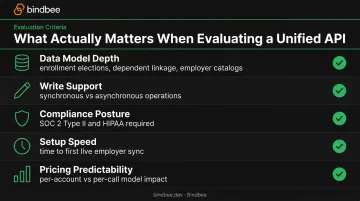
The platforms below are evaluated against these criteria — with particular weight on benefits data depth, since that's where most unified APIs fall short in practice.
Conclusion
Connector count is a distraction. The right unified API is the one whose data models, compliance coverage, and architecture actually match the domain your product operates in.
For HR Tech, Benefits Administration, and Insurtech companies, that means verifying three things before committing to any platform:
- Does it expose benefits-specific objects — enrollment elections, dependent coverage, employer plan catalogs?
- Is HIPAA compliance current and verified (not just listed as a checkbox)?
- Does real-time sync actually mean real-time, or is it daily batch with a marketing label?
If those three checks surface gaps, that's your signal. Starting with a benefits-first unified API avoids a costly rip-and-replace once your roadmap matures or an enterprise deal forces the issue. Bindbee connects 60+ HR, payroll, and benefits systems through a single API. Its data models are built specifically for the workflows Benefits Tech companies run — enrollment elections, dependent management, carrier connectivity, and COBRA event detection — not bolted on as afterthoughts.
Review Bindbee's documentation or request a demo to walk through the specific use cases your team needs covered.
Frequently Asked Questions
What is Unified.to and what are its limitations for HR and benefits use cases?
Unified.to is a stateless unified API covering 30 categories and 524 integrations. Its breadth across multiple domains means it lacks the benefits-specific data models — enrollment elections, dependent-to-plan linkage, employer plan catalogs — and the HIPAA depth and carrier system connectivity that Benefits Administration and HR Tech platforms specifically require.
What should Benefits Tech and HR Tech companies look for in a unified API platform?
Prioritize benefits-first data models (Employee Benefits, Employer Benefits, Dependent Benefits), HIPAA and SOC 2 Type II compliance, real-time eligibility sync, life event webhooks, and support for legacy carrier systems via SFTP bridging. Setup speed and pricing model predictability at customer scale are equally important selection criteria.
How does Bindbee differ from other unified API platforms like Merge or Finch?
Merge focuses on HRIS/ATS data and Finch on employment/payroll connectivity — both treat benefits as a secondary data category. Bindbee is the only platform with dedicated data models for Employee Benefits, Employer Benefits, and Dependent Benefits — purpose-built for Benefits Administration, Insurtech, and TPAs. It also ships with HIPAA compliance and SFTP-to-API bridging for legacy carrier systems.
How long does it take to go live with a unified API integration?
Native integrations typically take 4–8 weeks per connector. Unified API platforms compress this significantly — Bindbee reduces employer onboarding from 8–12 weeks to 24–48 hours, with employer HRIS connections completing in minutes via Magic Link authentication.
What compliance certifications should I require from a unified API platform handling benefits data?
Require SOC 2 Type II and current HIPAA compliance at minimum. ISO 27001 and GDPR readiness indicate broader security maturity. Always verify certifications are active — not lapsed — and confirm whether the platform persists customer data in its own infrastructure, as this directly expands your compliance audit scope.
Is a unified API better than building native integrations for HRIS and benefits systems?
For most HR Tech and Benefits platforms, yes. Native integrations demand ongoing maintenance with every system version change, authentication update, and API deprecation — across dozens of providers. A unified API eliminates that burden, freeing engineering teams to focus on core product development.