
Introduction
Benefits tech and HR Tech platforms evaluating integration infrastructure in 2026 face a question that looks simple on the surface: pick a unified API and move fast. The real decision is harder. Choosing the wrong platform carries real consequences. Shallow benefits enrollment data, extended employer onboarding cycles, and compliance gaps don't surface until months into implementation, by which point switching costs are significant.
The risk cuts both ways: teams that choose a horizontal platform for a benefits-specific use case often hit critical data model gaps, while teams that over-specify for vertical depth may sacrifice coverage across other SaaS categories they need.
This guide covers the criteria that matter most for making this call: connector breadth, data model depth, compliance posture, and onboarding speed.
Key Takeaways
- Horizontal unified APIs cover 13+ SaaS categories with 260+ connectors, built for AI agent workflows across CRM, IAM, learning, and collaboration tools
- Bindbee focuses exclusively on employment and benefits with 60+ connectors, including Benefits, Employer Benefits, and Dependent data models not found in horizontal platforms
- If your product needs action-based workflows spanning HRIS and many other enterprise tool categories, a horizontal platform fits
- Bindbee fits benefits tech, insurtech, and HR platforms requiring normalized enrollment data, dependent sync, and HIPAA compliance
- The core question: does your product live inside HR, or does it connect HR to everything else?
Platform Comparison: Horizontal vs. Vertical Unified APIs
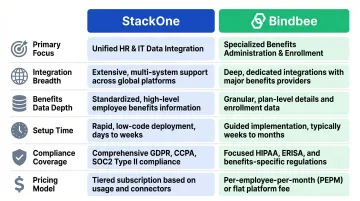
| Dimension | Horizontal Unified API | Bindbee |
|---|---|---|
| Primary Focus | Cross-category SaaS (HR, CRM, IAM, learning, collaboration, ERP, analytics) | Employment and benefits systems exclusively (HRIS, payroll, ATS, benefits, carriers) |
| Integration Breadth | 260+ connectors spanning 13+ SaaS categories | 60+ HRIS, payroll, benefits, and carrier systems |
| Benefits Data Depth | Benefits enrollment fields available in specific connectors (e.g., Oracle HCM); no unified benefits schema across all HRIS providers | Dedicated Employee Benefits, Employer Benefits, and Dependent Benefits models normalized across all 60+ connectors |
| Setup Time | Custom connectors vary by engagement; specific onboarding timelines not consistently published | Most customers live within 1 week; enterprise onboarding typically 2 weeks; sub-10-minute Magic Link authentication |
| Compliance Coverage | SOC 2 Type II, HIPAA, GDPR, CCPA | SOC 2 Type II, ISO 27001, GDPR Ready, HIPAA Compliant with BAA agreements available for Pro and Enterprise tiers |
| Pricing Model | Usage-based: varies by action call volume; Enterprise pricing custom | Flat per-connection pricing with unlimited API calls; $12,000 minimum annual commitment; no usage fees |
Primary Differentiators
AI Agent Infrastructure in Horizontal Platforms
Horizontal unified API platforms provide purpose-built tooling for agentic workflows: prompt injection protection, tool execution engines, and native support for MCP and Agent-to-Agent (A2A) protocols. Gartner projects 40% of enterprise applications will feature task-specific AI agents by end of 2026, up from less than 5% in 2025, making this AI infrastructure increasingly relevant to enterprise buyers with multi-category product needs.
Bindbee's Benefits-First Architecture
While horizontal platforms expose benefits-related fields within certain connectors, Bindbee treats Employee Benefits, Employer Benefits, and Dependent Benefits as distinct, normalized models across all supported systems. This includes plan selections, coverage tiers, effective dates, deduction codes, and dependent relationships, which are data structures that benefits administration platforms require to function but that horizontal APIs don't model consistently.
Pricing Predictability vs. Flexibility
Bindbee's per-connection model with unlimited API calls provides cost certainty for high-volume census sync workloads. Usage-based pricing in horizontal platforms offers a free entry tier and scales with usage, which may favor lower-volume or event-driven agent interactions but can make costs harder to predict for continuous sync workloads.
What is Bindbee?
Bindbee is a vertical unified API built exclusively for employment and benefits infrastructure. The platform normalizes data across 60+ HRIS, payroll, ATS, benefits, and carrier systems, including Workday, ADP Workforce Now, BambooHR, UKG, SAP SuccessFactors, and others, through a single API with benefits-first data models.
The primary differentiator is Bindbee's benefits-specific data architecture. Unlike horizontal APIs that expose generic employee fields, Bindbee surfaces Employee Benefits, Employer Benefits, and Dependent Benefits as distinct, structured objects across all connectors.
These models include plan selections, coverage elections, effective dates, contribution amounts, deduction codes, and dependent relationships, which are data that benefits administration platforms, insurtech products, and digital health applications depend on to operate.
Core Capabilities
- SFTP-to-API Bridge: Converts legacy HRIS and carrier systems that only export flat files (CSV, XML, fixed-width) into API-accessible JSON, removing a major friction point for benefits platforms connecting to older employer systems
- Incremental Syncs & Webhooks: Automatic syncs keep data current, with built-in webhooks for life events including new hires, terminations, and dependent changes
- Magic Link Authentication: Enables employer connections without requiring manual credential setup
- Deduction Intelligence: Maps pre-tax and post-tax deductions across payroll cycles without manual configuration
- Compliance Certifications: SOC 2 Type II, ISO 27001, GDPR Ready, and HIPAA Compliant, with Business Associate Agreements (BAA) available for Pro and Enterprise tiers
Use Cases of Bindbee
Bindbee serves benefits administration platforms, third-party administrators (TPAs), insurtech companies, and HR Tech products where the accuracy of enrollment data, dependent records, and qualifying life events directly affects product functionality.
Documented Customer Outcomes:
- Newfront (insurtech, San Francisco): Reduced integration time from 8-12 weeks to 48 hours, achieving 90% developer time reduction and $800,000+ annual savings
- Phin (HR Tech, New York): Cut onboarding from 2+ months to 48 hours, reporting 76% reduction in onboarding time and 94% optimization in Time-to-Value, saving $115,000+ annually
- Papershift (workforce management): Achieved 85% onboarding time reduction with $200,000+ annual savings
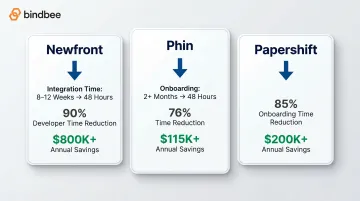
Across all three cases, the pattern is consistent: connecting to a new employer takes hours, not weeks, and the elimination of manual roster uploads removes a persistent source of enrollment errors.
How to Choose the Right Platform
Unified APIs all eliminate per-connector engineering builds, but they optimize for different integration strategies. The core decision framework is depth vs. breadth: horizontal platforms maximize cross-category SaaS coverage and agentic capabilities, while Bindbee maximizes vertical depth within employment and benefits data.
Choose a horizontal unified API if:
- Your product requires integrations across multiple unrelated SaaS categories (HRIS plus CRM plus IAM plus collaboration tools)
- AI agent workflows that take actions inside third-party systems are central to your roadmap
- Enterprise customers require broad system compatibility well beyond HR
- You need support for protocols like MCP or Agent-to-Agent alongside standard REST API
- Usage-based pricing aligns better with your cost structure than per-connection flat fees
Choose Bindbee if:
- Your product operates in benefits tech, insurtech, HR Tech, or digital health and depends on accurate benefits enrollment data
- Dependent records, carrier connections, or HIPAA-compliant data handling are operational requirements
- Normalized benefits data models, including Employee Benefits, Employer Benefits, and Dependent Benefits, must be consistent across all connectors, not siloed within specific systems
- Predictable per-connection pricing with unlimited API calls fits your high-volume census sync workloads
- Your integration requirements are concentrated within employment and benefits systems rather than distributed across many SaaS categories
The Benefits Data Gap
The clearest differentiator between horizontal and vertical platforms is benefits enrollment depth. Some horizontal connectors include Benefit Enrollments, Benefit Enrollment Dependents, and Benefit Enrollment Opportunities as action categories within specific HRIS providers, and these platforms reference "benefits eligibility data" in onboarding use cases. These benefits fields are connector-specific, not normalized across all HRIS providers as a unified schema.
Bindbee provides unified benefits models across all 60+ connectors. If your product requires COBRA event detection, dependent coverage sync, or benefits decision support, you need pre-modeled benefits objects that expose plan types, coverage tiers, and effective dates consistently. General-purpose unified APIs do not surface this by default.
If you're in benefits or HR Tech and evaluating whether Bindbee fits your integration architecture, book a Bindbee demo to see the benefits data models in action and confirm coverage for your specific use cases.
Conclusion
Horizontal and vertical unified APIs serve different integration priorities. Horizontal platforms deliver wide SaaS reach and AI-agent capabilities for products that need coverage across many tool categories. Bindbee delivers employment and benefits data depth for products where dependent sync, enrollment accuracy, and regulatory compliance are core operational requirements, not secondary features.
The right choice comes down to your integration surface area. If you need multi-category coverage across diverse tool types, a horizontal platform's breadth fits. If your product's outcomes depend directly on benefits data quality, Bindbee's vertical depth is the better foundation.
Frequently Asked Questions
What is the main difference between a horizontal unified API and Bindbee?
Horizontal unified APIs cover 13+ SaaS categories and are optimized for AI agent workflows and wide SaaS coverage. Bindbee is a vertical unified API purpose-built exclusively for employment and benefits data with dedicated Employee Benefits, Employer Benefits, and Dependent Benefits models not available in horizontal platforms.
Which platform is better for benefits administration?
Bindbee is purpose-built for benefits administration with distinct benefits enrollment data models, real-time dependent sync, and HIPAA compliance with BAA agreements. Horizontal platforms expose benefits-related fields within certain connectors but do not offer the normalized benefits-first schema across all HRIS systems that benefits platforms require.
Do horizontal unified APIs support benefits enrollment and dependent data?
Some horizontal platforms provide benefits-related fields in specific connectors like Oracle Fusion HCM, but these are not normalized into a unified schema across all HRIS providers. Bindbee treats benefits enrollment data as a first-class model across all 60+ connectors, making it the more reliable choice for platforms that depend on consistent benefits data.
How fast is Bindbee to set up?
Bindbee customers complete Magic Link authentication in under 10 minutes, with most going live within 1 week and enterprise onboarding finished in 2 weeks.
Which type of platform is more suitable for AI agent workflows?
Horizontal unified API platforms are the stronger fit for AI agent product use cases, with purpose-built tooling for prompt injection protection, tool execution, and native MCP and Agent-to-Agent protocol support. Bindbee is built for reliable, normalized data sync in benefits workflows, not agent-driven automation.
Does Bindbee offer HIPAA compliance?
Yes. Bindbee is HIPAA compliant. It holds SOC 2 Type II and ISO 27001 certifications and offers Business Associate Agreements (BAA) on Pro and Enterprise tiers.