
Introduction
API integration for SaaS insurance platforms is genuinely difficult, not because REST APIs are hard, but because the underlying data landscape is fragmented by design. Employee eligibility data sits across HRIS, payroll, carrier, and benefits systems that were built independently, use different schemas, and operate under strict compliance requirements including HIPAA and SOC 2.
The teams navigating this are product and engineering teams at InsureTech, benefits administration, and HR Tech companies. Generic REST API experience doesn't transfer cleanly here. Insurance-specific fields like coverage tiers, dependent relationships, and enrollment effective dates don't exist in standard HR data models, which means every integration requires domain knowledge alongside technical execution.
When integration is poorly planned, the consequences are concrete: stale eligibility data causing claim denials, missed termination events delaying COBRA notices, HIPAA compliance gaps surfacing during audits, and months of maintenance per connected system slowing every enterprise deal.
This guide covers the complete approach: prerequisites and data modeling, step-by-step implementation, testing strategies, and the specific failure modes that derail most teams before they reach production.
Key Takeaways
- Integrating APIs into a SaaS insurance platform means connecting HRIS, payroll, and carrier systems to keep eligibility and enrollment data synchronized
- Before building, map your benefits data model, confirm HIPAA/SOC 2 baselines, and choose between native builds or a unified API layer
- Implementation runs in order: authenticate → normalize → initial sync → incremental sync → webhook configuration
- Expect friction from inconsistent HRIS schemas, SFTP/EDI 834-only carriers, and compliance gaps that surface after launch
- Polling alone is insufficient. Insurance-critical events like terminations and QLEs require webhooks
API Integration for SaaS Insurance Platforms
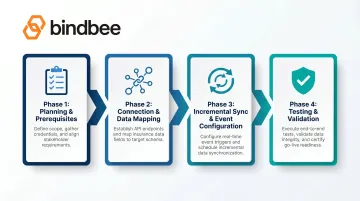
Integration for insurance SaaS follows four phases: planning and prerequisites → connection and data mapping → incremental sync and event configuration → testing and validation.
One important scope-setter before diving in: a single native integration typically requires 4–8 weeks of engineering time including requirements, development, testing, and deployment. Multiply that across dozens of employer systems. The average mid-size organization runs 8+ HR technology applications simultaneously, and the engineering math becomes unsustainable quickly.
Prerequisites and Requirements
Define your data model before writing code. For insurance use cases, generic HR data models will fail. Benefits platforms need three distinct models:
- Employee Benefits: plan elections, coverage tier (EE, EE+SP, FAM), contributions, effective dates, provider
- Employer Benefits: plan offerings available at the organizational level
- Dependent Benefits: dependent relationships, linked plan coverage, eligibility, dates of birth, and SSNs
These aren't fields bolted onto an employee record. They're first-class data entities that enrollment workflows, premium billing, and carrier submissions depend on. Bindbee's benefits-first data models are built around exactly this structure, which is why 50+ benefits platforms use it as their integration infrastructure.
Confirm your compliance baseline. Any platform handling insurance data must meet:
- HIPAA technical safeguards (45 CFR §164.312): TLS 1.2+ in transit, AES 128-bit minimum at rest, audit logging, and minimum necessary access scoping
- SOC 2 Type II: confirms design and operating effectiveness of security controls (audit period: 3–12 months)
- ISO 27001: requires a defined ISMS scope covering your SaaS infrastructure and operations
Require that any third-party integration provider you use already holds these certifications, so compliance is inherited, not rebuilt per integration.
Map your customer's systems before architecture decisions. Most mid-size employers run HRIS, payroll, and benefits systems from different vendors simultaneously. Document that fragmentation before choosing how to connect.
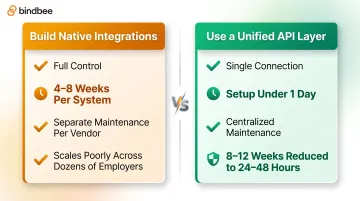
Build vs. buy. Building native integrations gives you full control but costs 4–8 weeks per system. A unified API layer like Bindbee, which normalizes 60+ HRIS and payroll systems through a single connection, can reduce setup to under a day. Healthee, for instance, cut integration deployment from 8–12 weeks to 24–48 hours after switching. This is an architectural decision, not a vendor preference. Weigh engineering bandwidth against scale goals honestly.
Key Integration Types and Data Models
REST APIs vs. file-based systems. Most modern HRIS and payroll platforms offer REST APIs. Most legacy insurance carriers and TPAs do not. They export data via SFTP file drops using EDI 834 (version 005010X220) or flat CSV. EDI remains the most commonly used technology in health insurance for managing enrollment and eligibility data.
Your architecture must handle both paradigms. An SFTP-to-API bridge that normalizes file-based exports into structured API responses eliminates the need to maintain separate file parsing infrastructure for each carrier. Bindbee's bridge handles CSV, XML, and fixed-width formats; its carrier integration layer also handles EDI 834 generation for outbound enrollment submissions.
A generic employee record captures name, job title, and start date, but not coverage effective dates, benefit plan elections, dependent SSNs, or enrollment status changes. Those fields drive carrier submissions, COBRA triggers, and QLE enrollment windows. Without them as first-class data entities, your application logic compensates with fragile custom field mappings per employer.
Real-time vs. batch sync. Insurance platforms need both:
| Sync Type | Use Case | Mechanism |
|---|---|---|
| Scheduled batch | Routine eligibility updates | Daily sync |
| Event-driven | New hires, terminations, QLEs | Webhooks |
Polling on a fixed schedule cannot replace webhooks for insurance-critical events. The lag introduced by polling causes missed enrollment windows, delayed COBRA notices, and stale eligibility data at the point of a claim.
How to Integrate APIs into Your SaaS Insurance Platform (Step-by-Step)
Data mapping and compliance validation are the phases most teams underestimate. Failures here create downstream problems that are expensive to trace and fix post-launch. Follow the sequence.
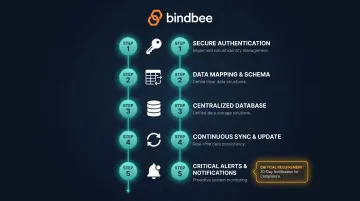
Step 1: Authentication and connection. Implement OAuth 2.0 or API key authentication with each source system. For multi-employer SaaS models, design a customer-facing authorization flow that lets employer admins authorize data connections without sharing credentials with your engineering team. Bindbee's Magic Link component handles this. The employer admin authenticates in under 5 minutes via an embeddable SDK, and initial data sync begins immediately.
Step 2: Data mapping and normalization. Map each source system's fields to your internal schema. This is the hardest phase. Date formats, status enumerations (is it "active," "A," or "1"?), and field names vary across every HRIS vendor.
Build a canonical mapping layer at the ingestion point rather than scattering normalization logic through application code. Bindbee delivers normalized data models out of the box, so platforms consuming its API receive consistent schemas regardless of source system.
Step 3: Initial historical data load. Pull existing employee, enrollment, and dependent records. Surface missing required fields explicitly, like dependent SSNs, coverage election dates, and effective dates, rather than silently skipping them. Incomplete eligibility data causes downstream claims and enrollment errors that are difficult to trace back to the source.
Step 4: Incremental sync configuration. Configure delta syncs that pull only changed records since the last run. Full refreshes don't scale at employer volumes.
Sync frequency should reflect the compliance stakes: eligibility checks may need near-hourly syncs given that monthly separation rates run at 3.4% across the US workforce, while enrollment updates can often run daily.
Step 5: Webhook configuration for life events. Configure event-driven notifications for:
- New hire: opens a benefits eligibility window
- Termination: triggers COBRA and coverage end
- Qualifying life event (QLE): opens a mid-year plan change window
Why webhooks matter here: COBRA requires employers to notify the plan administrator within 30 days of a qualifying event, and the administrator must notify the beneficiary within 14 days. A scheduled daily sync that runs at midnight will miss a termination processed at 9 AM for most of that day. Webhooks fire at the moment the event occurs in the source system.
Testing and Validating Your Insurance API Integration
Unvalidated integrations fail quietly. Eligibility data errors surface only when a claim is denied or an audit uncovers the gap, often months after go-live.
Functional testing. Validate end-to-end data flow for each core scenario:
- New hire enrollment: verify eligibility window opens correctly
- Mid-year plan change: verify QLE triggers and enrollment updates
- Dependent addition: verify dependent record links to correct coverage
- Termination: verify COBRA trigger fires and coverage end date is set
Compliance validation. Before any data reaches production:
- Confirm TLS 1.2+ enforcement on all API endpoints handling PHI
- Verify data access scopes are restricted to minimum necessary fields
- Confirm audit logs capture access and modification events in a HIPAA-reviewable format
Failure mode testing. Deliberately test:
- Source system unavailability: does your platform queue or fail gracefully?
- Malformed records: does the ingestion layer surface errors or silently corrupt data?
- Conflicting data across two systems for the same employee: which source wins, and is that documented?
Common API Integration Challenges and How to Fix Them
These problems surface in virtually every insurance SaaS integration project, and most are preventable if you know where to look.
Data Normalization Failures
Problem: Employee or benefits records arrive with inconsistent field values: different date formats, status codes, and field names for the same data concept.
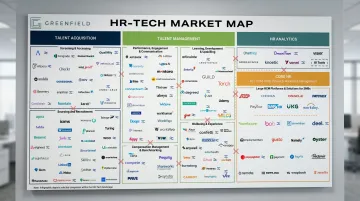
Why it happens: The top five HR tech vendors (Workday, SAP, Oracle, ADP, UKG) hold only about 35% of the market. The remaining 65% is a long tail of proprietary systems with no cross-vendor data standard. 40% of organizations cite integration as a major gap in their HRMS applications.
Fix: Define your canonical data model before connecting any source system. Enforce normalization at ingestion, not in application logic. Prioritize the HRIS systems your largest customers use first, then expand coverage.
Legacy Carrier and TPA Systems Without APIs
Problem: Many carriers only export via SFTP file drops (EDI 834 or flat CSV), making real-time API integration impossible without additional infrastructure.
Why it happens: Carrier core systems were built before REST APIs were standard. Migration is costly, so file-based export persists even when modern APIs exist elsewhere in the organization.
Fix: Build an SFTP ingestion pipeline that parses supported file formats and converts them to your canonical data model on a schedule. Alternatively, use an integration platform with a native SFTP-to-API bridge. This eliminates building and maintaining file parsing infrastructure in-house, which, across multiple carriers, compounds quickly.
Compliance Gaps Discovered Post-Launch
Problem: Integration is live, but a customer security review reveals unencrypted PII fields, over-broad data access scopes, or missing audit trails.
Why it happens: Compliance was treated as a post-build checklist rather than an architecture requirement.
Fix: Make compliance part of the Definition of Done for every integration sprint:
- Encrypt at the ingestion layer before data moves anywhere
- Scope API access at connection time, not retroactively
- Implement audit logging before data reaches production
Only use integration providers that already hold SOC 2 Type II, ISO 27001, and HIPAA certifications. Platforms building on Bindbee inherit these controls rather than rebuilding them. That cuts compliance overhead significantly at launch.
Best Practices for Insurance API Integration
1. Design for Multi-Employer, Multi-System Complexity from Day One
Insurance SaaS platforms serve many employer clients, each with different HRIS and payroll configurations. Employer-specific customization logic that creeps into application code compounds technical debt as your customer base grows.
Your integration layer should be employer-agnostic and system-agnostic. The employer's specific HRIS is an implementation detail, not a constraint on your architecture.
2. Prefer Webhooks Over Polling for Insurance-Critical Events
Fixed-schedule polling introduces lag that can cause missed enrollment windows, delayed COBRA notices, and stale eligibility at the point of a claim. Configure webhooks so your platform reacts immediately when a change occurs at the source.
3. Maintain Living Documentation of Your Data Contracts
For each integration, document:
- What data is pulled and from which source fields
- What transformations are applied
- What sync frequency is configured
- What error handling behavior is defined
This documentation is essential for debugging, onboarding new engineers, and demonstrating data governance to enterprise buyers and compliance auditors. Teams that skip it end up re-solving the same normalization problems every time a new employer connects, slowing onboarding and burning engineering cycles that belong on the core product.
Conclusion
Integration quality directly determines the reliability of eligibility data, the speed of employer onboarding, and the compliance posture of your entire insurance SaaS platform. Shortcuts taken during planning and data modeling don't stay hidden. They surface as claim denials, missed COBRA deadlines, and audit findings.
The right architectural decision depends on your team's engineering bandwidth and scale goals. Two paths exist:
- Build native integrations: Full control, but 4–8 weeks of engineering per system and ongoing maintenance overhead
- Use a unified API layer: Centralized normalization, compliance handling, and maintenance. Newfront, for example, cut integration deployment from 8–12 weeks to 48 hours and recovered 90% of the engineering time previously spent on integration work
At that ratio, the architectural choice stops being an engineering preference. It determines how many enterprise clients you can actually onboard in a quarter.
Whichever path you choose, the downstream compliance risks described above (claim denials, COBRA failures, audit exposure) scale directly with how well your integration infrastructure handles the unglamorous work: data normalization, eligibility rules, and carrier file generation. Build or buy accordingly.
Frequently Asked Questions
What is API integration in insurance?
API integration in insurance means connecting software systems, such as HRIS, payroll, and carrier platforms, so that employee eligibility, enrollment, and benefits data flows automatically between them. It eliminates manual exports, re-entry, and the eligibility lag that causes claim denials.
What APIs do SaaS insurance platforms typically need to integrate with?
The main categories are: HRIS systems (employee records and life events), payroll platforms (deduction data), benefits administration systems (enrollment and plan elections), and insurance carriers or TPAs (eligibility confirmation and claims). Most platforms need connections across all four simultaneously.
How long does it take to build API integrations for an insurance SaaS platform?
A single native integration typically takes 4–8 weeks of engineering time. Building across dozens of employer systems multiplies this significantly. Unified API platforms like Bindbee normalize multiple systems through a single connection, reducing initial setup to under a day. Most customers complete authentication in under 10 minutes.
What security certifications should insurance API integrations meet?
At minimum: SOC 2 Type II and ISO 27001. Platforms handling health data also need HIPAA compliance, covering TLS 1.2+ encryption in transit, AES 128-bit encryption at rest, and audit logging. HIPAA Business Associate Agreements (BAAs) must be in place with any third-party data processor.
What is the difference between a native API integration and a unified API?
A native integration connects directly to one specific system and requires a separate build per vendor. A unified API normalizes data from many source systems through a single connection, reducing build time and centralizing maintenance. When one HRIS vendor changes their schema, your entire integration layer doesn't need updating.
How do insurance SaaS platforms handle carriers that don't have APIs?
Legacy carriers typically export data via SFTP file drops using EDI 834 or CSV formats. Platforms handle this through file ingestion pipelines or an SFTP-to-API bridge, which converts file-based exports into structured API responses. That makes file-sourced data consumable through the same endpoints as direct API integrations.