
Introduction
SaaS companies face a quiet but expensive tension: customers expect integrations with their existing tools from day one, but building each connection natively consumes engineering resources your team can't spare.
A single native HRIS integration can take 4–8 weeks to build, then demand ongoing maintenance every time an upstream provider changes its API. Multiply that across dozens of systems and integration work starts crowding out actual product development.
The market response is hard to ignore. According to Grand View Research, the iPaaS market was valued at $12.9 billion in 2025 and is projected to reach $55.46 billion by 2033 — SaaS teams everywhere are already moving toward purpose-built solutions.
This guide covers 10 application integration tools selected for modern SaaS teams, what each one does well, and — critically — where each one falls short. Each tool is evaluated on use case fit, so you can quickly identify what belongs in your stack — and what doesn't.
Key Takeaways
- Application integration tools eliminate manual data entry by connecting software systems automatically.
- SaaS teams have two distinct needs: internal automation and customer-facing (product) integrations — most tools serve one better than the other.
- General-purpose iPaaS platforms suit broad enterprise automation; unified APIs ship faster for vertical SaaS product teams.
- Connector count matters less than data model quality and maintenance overhead.
- HR Tech, Benefits, and Payroll SaaS teams get integrations live in days — not quarters — with a vertical-specific unified API like Bindbee.
What Is Application Integration?
Application integration connects separate software systems so they can exchange data and trigger actions automatically — no manual exports, no CSV uploads, no copy-pasting between tools.
Three main approaches matter for SaaS teams:
- Point-to-point integrations — direct connections between two specific systems. Simple to build initially, painful to scale beyond a handful of connections.
- iPaaS (Integration Platform as a Service) — cloud-based platforms for building custom integration workflows across many apps. Broad use cases, low-to-no code, but general-purpose by design.
- Unified APIs — a single endpoint that normalizes data from many systems within a specific category (HRIS, payroll, CRM). Faster to implement for SaaS teams operating in a defined vertical.
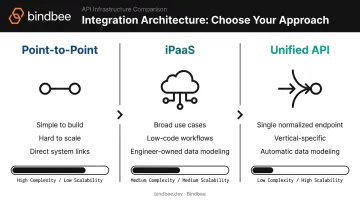
The practical difference: an iPaaS can technically connect any two systems, but your engineers own the data modeling for each one. A unified API handles normalization across every connected system automatically — that's a meaningful reduction in build time and ongoing maintenance.
Okta's 2024 research found that businesses deploy an average of 93 apps — SMBs alone average 58. At that scale, integration maintenance becomes a full-time engineering problem — which is why SaaS product teams increasingly treat integration infrastructure as a core architectural decision, not an afterthought.
10 Best Application Integration Tools for Modern SaaS
These tools were selected based on connector breadth, setup speed, maintenance burden, security posture, and suitability for SaaS product teams.
1. Bindbee
Bindbee is a unified API platform built specifically for HR Tech, Benefits Administration, Payroll, and Insurtech SaaS companies. One API endpoint covers 60+ HRIS, payroll, benefits, and carrier systems — including Workday, ADP Workforce Now, BambooHR, Rippling, Gusto, UKG, SAP SuccessFactors, and bswift.
What separates Bindbee from general-purpose tools is its benefits-first data model. Most iPaaS platforms expose a binary "enrolled/not enrolled" flag — that's not enough for benefits platforms.
Bindbee surfaces structured objects for Employee Benefits (plan name, coverage tier, contribution amounts, effective dates), Employer Benefits (the full plan catalog an employer offers), and Dependent Benefits (which specific plans cover each dependent). That level of specificity is what insurance brokerages like Newfront and AI-driven tools like Healthee actually need.
Key differentiators:
- End-user connection via Magic Link completes in minutes; full developer integration go-live in as little as 48 hours (vs. 4–8 weeks building natively)
- Zero maintenance — Bindbee absorbs all connector updates when upstream providers change their APIs
- Automatic incremental syncs with webhook notifications for sync completion and data changes
- SFTP-to-API bridge for legacy systems and carriers that only support file-based data exchange
- Custom fields support for edge-case data outside normalized schemas
- Compliance credentials: SOC 2 Type II, ISO 27001, HIPAA
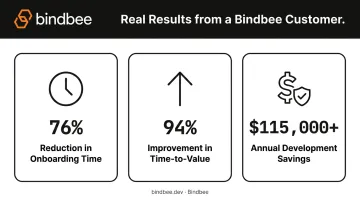
Customer Phin reported a 76% reduction in onboarding time, 94% improvement in time-to-value, and over $115,000 in annual development savings after switching to Bindbee.
| Category | Details |
|---|---|
| Best For | HR Tech, Benefits Administration, Payroll, and Insurtech SaaS companies |
| Key Features | Unified API for 60+ systems, benefits-first data models, Magic Link auth, webhooks, SFTP bridge, custom fields |
| Pricing | Contact Bindbee for pricing; setup in under one day |
2. MuleSoft Anypoint Platform
MuleSoft (a Salesforce product since its $6.5B acquisition in 2018) is an enterprise-grade API-led integration platform connecting applications, data, and devices across cloud and on-premises environments.
Its strengths are well-documented: deep API management and governance, a large connector library, and DataWeave — a powerful transformation language for complex data mapping. MuleSoft earns a 4.5/5 on G2, with reviewers consistently praising its API management capabilities.
The trade-offs are real. Licensing costs are high, the learning curve is steep, and implementation typically requires dedicated MuleSoft specialists. It's the right tool for large enterprises with complex IT landscapes — not for an early-stage SaaS team needing customer-facing integrations shipped fast.
| Category | Details |
|---|---|
| Best For | Large enterprises with complex, multi-system integration needs |
| Key Features | API design and management, pre-built connectors, hybrid deployment, DataWeave |
| Pricing | Enterprise pricing; contact MuleSoft for a quote |
3. Dell Boomi
Boomi is a cloud-native iPaaS platform (now PE-owned following its $4B sale from Dell in 2021) offering integration, API management, and master data management in one suite. Its drag-and-drop interface and 1,000+ pre-built connectors make it more accessible than MuleSoft for mid-market teams.
Boomi earns a 4.4/5 on G2. Its low-code designer is a genuine strength for organizations that need to connect cloud and on-premises systems without heavy coding. That said, costs escalate at volume, and complex transformations still require technical expertise — it's not the "no-code for everyone" experience the marketing sometimes implies.
| Category | Details |
|---|---|
| Best For | Mid-to-large enterprises with mixed cloud and on-premises environments |
| Key Features | Low-code integration designer, 1,000+ connectors, API management, master data hub |
| Pricing | Subscription-based; pricing tiers available on request |
4. Workato
Workato is an enterprise automation platform rated 4.7/5 on G2 — one of the higher scores in this category. It combines workflow automation with integration through "Recipes" (pre-built workflow templates) and 1,200+ connectors, with enterprise-grade security baked in: role-based access, encryption, and audit logs.
The limitation is cost. Workato's pricing is firmly enterprise-tier, and its consumption-based model means a team running high automation volume can see bills climb faster than expected.
| Category | Details |
|---|---|
| Best For | Enterprises requiring sophisticated workflow automation alongside app integration |
| Key Features | 1,200+ connectors, Recipes, enterprise-grade security, real-time automation |
| Pricing | Enterprise pricing; not ideal for budget-constrained startups |
5. SnapLogic
SnapLogic is an AI-assisted iPaaS using a visual, low-code interface and a library of "Snaps" — 1,000+ pre-built connectors for cloud apps, data sources, and APIs. Its Iris AI assistant recommends the next step in a pipeline as you build, cutting setup time on standard integration tasks.
SnapLogic earns 4.4/5 on G2 (399 reviews). Reviewers value the visual pipeline builder and connector breadth; the recurring critique is complexity when transformations get advanced. Strong for cloud data source integrations, less suitable for teams that need deep customization without a learning investment.
| Category | Details |
|---|---|
| Best For | Enterprises wanting AI-assisted pipeline building for cloud and data sources |
| Key Features | Visual pipeline designer, AI-assisted Snap recommendations, 1,000+ connectors, batch and real-time processing |
| Pricing | Contact SnapLogic for enterprise pricing |
6. Merge
Merge is a unified API platform for customer-facing product integrations, with eight categories: HRIS, ATS, CRM, Accounting, File Storage, Ticketing, Knowledge Base, and Chat — covering 240+ integrations. It earns 4.7/5 on G2 (253 reviews).
Merge's Common Models normalize data across integrations, and its Field Mapping feature lets you access custom fields your customers have configured in their source systems. An Integrations Management dashboard gives customer-facing teams visibility into integration health. Merge is a strong choice for SaaS companies needing broad multi-category product integrations — though its HRIS and benefits coverage is more general-purpose than Bindbee's domain-specific models.
Pricing: Launch tier is free for 3 production Linked Accounts; paid Launch is $650/month for up to 10 accounts.
| Category | Details |
|---|---|
| Best For | SaaS companies building multi-category customer-facing product integrations |
| Key Features | 8 unified API categories, Common Models, Field Mapping, Integrations Management, 240+ integrations |
| Pricing | Tiered; Launch free up to 3 accounts, paid from $650/month |
7. Celigo
Celigo is a cloud-based iPaaS targeting SMBs and mid-market companies, rated 4.6/5 on G2 (1,052 reviews). Its standout position is NetSuite — Celigo specializes in NetSuite integrations, with pre-built flows connecting NetSuite to Salesforce, Shopify, Amazon, HubSpot, and nearly 100 other systems.
For companies running NetSuite at the center of their operations, Celigo's pre-built templates and flow builder meaningfully reduce setup time. That NetSuite depth is the point: teams that don't need it will find more flexibility elsewhere.
| Category | Details |
|---|---|
| Best For | SMBs and mid-market companies automating data sync between business apps, especially NetSuite |
| Key Features | Pre-built integration templates, flow builder, error management, NetSuite-native integrations |
| Pricing | Subscription-based; tiered plans available |
8. Zapier
Zapier connects 9,000+ apps via "Zaps" — trigger-action workflows that require zero code. Trusted by 3M+ businesses, it's the go-to tool for non-technical teams automating simple, linear workflows between popular apps.
The constraints are well-known: costs scale quickly with task volume, complex multi-step workflows can be hard to troubleshoot, and enterprise security requirements (advanced audit logs, custom data retention) often aren't met. Zapier earns 4.5/5 on G2, with most satisfaction coming from SMB and startup users rather than product engineering teams.
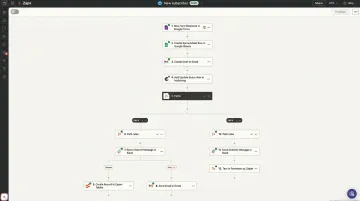
Pricing: Free tier available; paid plans start from $19.99/month.
| Category | Details |
|---|---|
| Best For | Non-technical SaaS teams automating simple workflows between popular apps |
| Key Features | 9,000+ app integrations, no-code Zap builder, multi-step Zaps, conditional logic |
| Pricing | Free tier; paid from $19.99/month |
9. Jitterbit
Jitterbit is a flexible integration and data platform with roots in open-source data integration (first released as open-source in 2008, per InfoWorld). It supports both cloud and on-premises deployment through private agents, earns 4.5/5 on G2 (622 reviews), and is particularly valued for customization depth.
Jitterbit suits organizations that need precise control over integration logic — custom transformations, complex routing, hybrid deployment behind corporate firewalls. Teams new to the platform consistently report a steeper ramp than with simpler alternatives — budget time for that learning curve.
| Category | Details |
|---|---|
| Best For | Businesses requiring extensive customization and control over integration processes |
| Key Features | Pre-built connectors, API manager, data transformation, cloud and on-premises deployment |
| Pricing | Contact Jitterbit for pricing |
10. Make (formerly Integromat)
Make is a visual, scenario-based automation platform with 3,000+ app integrations and a drag-and-drop canvas for building complex multi-path workflows. It's a more flexible and affordable alternative to Zapier — paid plans start from $12/month on a credit-based model.
Where Zapier optimizes for simplicity, Make optimizes for control. Multi-path routing, data filtering, and granular execution logs make it appealing to technically-minded SaaS teams. The trade-off is that users without any technical background will find Make's setup more demanding than Zapier's.
| Category | Details |
|---|---|
| Best For | SaaS teams and developers needing flexible, visual workflow automation at a competitive price |
| Key Features | Visual scenario builder, 3,000+ app connectors, multi-path routing, data filtering, webhooks |
| Pricing | Free tier (1,000 credits/month); paid from $12/month |
How We Chose These Application Integration Tools
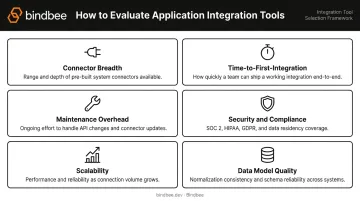
Selection focused on factors most relevant to modern SaaS product teams:
- Connector breadth — how many relevant pre-built integrations are available out of the box
- Time-to-first-integration — how quickly a developer can go from signup to production data
- Maintenance overhead — who handles connector updates when upstream systems change
- Security and compliance — SOC 2, ISO 27001, HIPAA certifications for data-sensitive verticals
- Scalability — whether the tool grows with your product without rearchitecting
- Data model quality — whether normalized models match your product's domain
The mistake most SaaS teams make: prioritizing raw connector count over data model quality. A tool with 500 connectors but no normalized schema still leaves your engineers doing field mapping, transformation, and maintenance work on every integration. That hidden work is where most integration timelines actually break down.
That data model gap hits hardest in domain-specific verticals. For SaaS companies in HR Tech, Benefits Administration, Payroll, or Insurtech, a general-purpose iPaaS is typically the wrong category of tool entirely. The data models don't fit, setup takes months rather than days, and every upstream API change becomes your engineering team's problem. Vertical-specific unified APIs exist precisely to eliminate that burden.
Conclusion
The best application integration tool depends entirely on what you're building and for whom.
Here's the short version:
- General-purpose iPaaS (MuleSoft, Boomi, Workato) — best for large enterprises with diverse, multi-system needs and dedicated integration teams
- No-code automation tools (Zapier, Make) — right for non-technical teams automating straightforward workflows between popular apps
- Vertical Unified APIs (Merge for multi-category SaaS, Bindbee for HR and benefits) — the right call when you need customer-facing product integrations in a defined domain, fast
Evaluate tools not just on features and sticker price, but on long-term maintenance costs, time-to-value, and whether the tool's data models actually match your product's domain.
If that domain is HR Tech, Benefits Administration, or Payroll SaaS, Bindbee is worth a close look. It's a vertical-specific alternative to general-purpose platforms — 60+ HRIS, payroll, and benefits integrations through a single API, with setup in under a day and no ongoing maintenance burden on your team. Explore Bindbee or request a demo to see how quickly you can move from zero integrations to production coverage.
Frequently Asked Questions
What is application integration?
Application integration is the process of connecting separate software systems so they can automatically exchange data and trigger actions — eliminating manual data entry, breaking down information silos, and enabling seamless workflows across your tech stack without human intervention.
What are examples of integration tools?
Examples span several categories: iPaaS platforms (MuleSoft, Dell Boomi, Workato), no-code automation tools (Zapier, Make), and unified API platforms (Bindbee for HR and benefits, Merge for multi-category SaaS integrations). The right type depends on whether you need internal automation or customer-facing product integrations.
What is the difference between iPaaS and a unified API?
iPaaS is a general-purpose cloud platform for building custom integration workflows between any apps. A unified API normalizes data from many systems within a specific category — like HRIS or payroll — into a single, consistent endpoint. For SaaS companies building within a defined vertical, unified APIs are faster to implement and require less ongoing maintenance.
What is the difference between application integration and data integration?
Application integration connects apps at a functional level for real-time or near-real-time data exchange and process automation. Data integration typically collects data from multiple sources in batch processes for analysis or reporting. The right approach depends on whether you need live operational data or historical analytical data — they serve different purposes and often work together.
How do I choose the right application integration tool for my SaaS?
Evaluate tools on:
- Breadth of relevant pre-built connectors
- Setup time and maintenance overhead
- Security certifications (SOC 2, ISO 27001, HIPAA)
- Scalability under your expected data volume
- Whether the data models match your product's domain
For SaaS companies with a defined integration category, vertical-specific unified APIs typically require less custom work and fewer ongoing resources than general-purpose platforms.
Which integration tool is best for HR Tech companies?
HR Tech, Benefits Administration, and Payroll SaaS companies benefit most from a unified API built specifically for employment data. Bindbee connects 60+ HRIS, payroll, and benefits systems through a single API, with benefits-first data models and compliance certifications (SOC 2 Type II, ISO 27001, HIPAA) included out of the box.