
The right platform reduces engineering overhead, gets you to market faster, and lets your data connections scale as you grow. This guide compares six leading API integration platforms by features, pricing, and best-fit use cases, so your team can make a confident call.
TL;DR
- API integration platforms connect systems through their APIs, cutting the custom-code burden on engineering teams
- The global iPaaS market grew 23.4% to $8.5 billion in 2024, driven by AI and no-code adoption
- We compare five platforms: Bindbee, Merge, Workato, MuleSoft, and Zapier
- General-purpose tools (Zapier, Workato) suit broad automation; vertical unified APIs (Bindbee) suit deep, category-specific data needs
- Pick based on connector depth in your vertical, security certifications, and total maintenance burden — not brand recognition
Overview of API Integration Platforms in the US Software Market
Building and maintaining separate point-to-point integrations for every external system drains engineering time. An API integration platform fixes that by letting your product connect to dozens or hundreds of systems through one interface.
The category is growing fast. Gartner reported the global iPaaS market grew 23.4% to $8.5 billion in 2024, citing AI and no-code/low-code tools as key drivers (Gartner, 2025).
The broader API management market, which includes gateways, lifecycle tools, and security, hit $7.68 billion in 2024 and is forecast to grow at a 17.1% CAGR through 2029 (MarketsandMarkets).
Not every platform fits every job. Below, we compare tools across three categories: vertical unified APIs, horizontal unified APIs, and general-purpose iPaaS, so you can match the right tool to your integration scope.
Top API Integration Platforms Compared
We evaluated each platform on connector breadth, implementation ease, security posture, pricing transparency, and niche specialization.
Bindbee
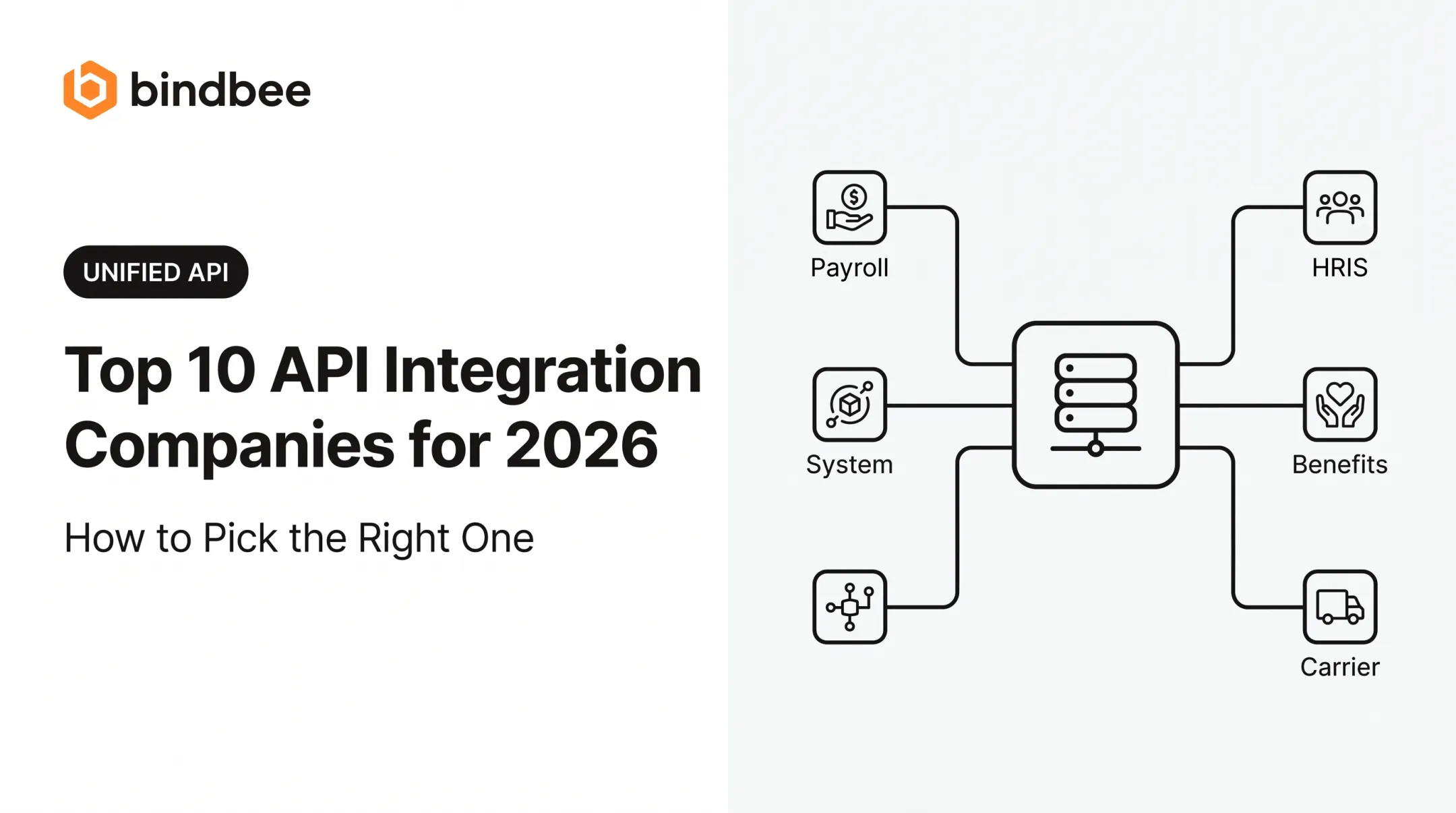
Bindbee is a unified API platform purpose-built for HR tech, benefits administration, and payroll integrations. It connects to 60+ HRIS, payroll, benefits, and carrier systems, including Workday, ADP, BambooHR, Gusto, and Rippling, through a single API. Standout capabilities:
- Benefits-first data models: separate Employee, Employer, and Dependent Benefits objects, not generic HR fields bolted on
- SFTP-to-API bridge: connects legacy systems that only export CSV, XML, or fixed-width files (ADP Workforce Now, Paylocity, Rippling, Sage HR)
- Life-event webhooks: new hires, terminations, and dependent changes
- Fast setup: live in under a day, versus 4-8 weeks for native integrations
- Compliance: SOC 2 Type II, ISO 27001, and HIPAA
Customer results: Newfront cut its HRIS integration timeline from 12 weeks to 48 hours. Alma deployed 60+ integrations instantly instead of building each one in 2-3 weeks.
Aspect Details Pricing Custom, per active connection; minimum annual commitment around $12,000 Key Features Unified API for HR/benefits systems, real-time eligibility sync, magic link authentication, custom fields Best For HR tech, benefits administration, payroll platforms, and insurtech building employee data integrations

Merge
Merge is a unified API covering HR, ATS, CRM, accounting, ticketing, and file storage, built for customer-facing product integrations across many categories at once. Its strength is breadth: a common data model spans hundreds of software categories, backed by an integration observability dashboard. Merge raised a $55 million Series B in 2022, bringing total funding to $75 million (TechCrunch). At the time, it reported serving over 2,500 companies.
| Aspect | Details |
|---|---|
| Pricing | 3 free production accounts; then $650/month for up to 10 linked accounts, plus $65 per additional account |
| Key Features | Common data models across categories, integration observability, real-time sync |
| Best For | B2B SaaS companies needing multi-category, customer-facing integrations |
Workato
Workato is an enterprise iPaaS built for end-to-end automation across cloud and on-prem applications. Its recipe-based automation engine handles complex, multi-step workflows that span departments. Workato says it's used by more than half of the Fortune 500. The company raised a $200 million Series E at a $5.7 billion valuation in 2021 (Business Wire). It reported over 11,000 customers at that time.
| Aspect | Details |
|---|---|
| Pricing | Custom enterprise pricing based on usage and connectors |
| Key Features | Recipe-based automation, pre-built connectors, real-time triggers |
| Best For | Large enterprises automating complex cross-departmental workflows |
MuleSoft Anypoint Platform
Salesforce-owned MuleSoft is built for teams that want to design, build, and manage APIs at scale, not just connect existing ones. Its Anypoint Studio is an Eclipse-based IDE for building and testing integrations locally before deployment. MuleSoft combines iPaaS with full API lifecycle management, and was named a Leader in Gartner's 2024 Magic Quadrant for API Management. Deep Salesforce ecosystem ties make it a natural fit for companies already running on that stack.
| Aspect | Details |
|---|---|
| Pricing | Available by request; typically enterprise-tier contracts |
| Key Features | API design/build/deploy in one platform, hundreds of connectors, hybrid deployment |
| Best For | Enterprises needing centralized API management with dedicated developer resources |
Zapier
Zapier is the no-code option: trigger-action workflows connecting over 10,000 apps, according to its app directory (Zapier). No engineering background required. Pricing (as of its current published rates): Free plan includes 100 tasks/month. Professional starts at $19.99/month billed annually. Team starts at $69/month annually. Enterprise is custom.
| Aspect | Details |
|---|---|
| Pricing | Free plan; Professional from $19.99/month; Team from $69/month; custom Enterprise |
| Key Features | 10,000+ app integrations, no-code builder, AI agent support |
| Best For | Small-to-mid-sized teams automating simple, internal workflows |

How We Chose the Best API Integration Platforms
The most common mistake teams make is picking a platform by brand recognition instead of matching it to their actual integration scope. A well-known enterprise iPaaS can be overkill — or worse, under-equipped — for a narrow, vertical-specific need.
We weighted platforms on:
- Security certifications — SOC 2, ISO 27001, and relevant compliance like HIPAA
- Connector depth in a specific vertical — not just total connector count
- Implementation time — proof-of-concept speed matters more than feature lists
- Total cost of ownership — subscription costs plus engineering labor and maintenance
No two platforms compete on identical terms. A horizontal tool like Merge and a vertical tool like Bindbee solve different problems, even when their marketing language overlaps.

Conclusion
There's no single "best" API integration platform. The right choice depends on whether you need broad, horizontal automation across many software categories, or deep, vertical-specific data models for a narrow use case.
Before committing, evaluate:
- Scalability as your integration volume grows
- Support for your specific data categories
- How much ongoing maintenance you'll own
For HR tech, benefits administration, and payroll platforms, Bindbee's unified API and benefits-first data models can cut integration build time. Phin, for example, reported a 76% reduction in customer onboarding time after adopting Bindbee.
Frequently Asked Questions
What is an API platform?
An API platform (or API management platform) lets teams design, publish, secure, and monitor their own APIs. This differs from an API integration platform, which connects existing systems together through their APIs.
What is the difference between an API integration platform and an iPaaS?
iPaaS is a broader category of cloud-based tools covering data integration, process automation, and orchestration. API integration platforms specifically focus on connecting systems via their APIs.
How much does an API integration platform cost?
Pricing ranges from free no-code tools to enterprise contracts costing tens of thousands annually. Cost depends on integration volume, connector depth, and support needs.
How long does it take to implement an API integration platform?
Implementation ranges from under a day for unified API platforms like Bindbee to several weeks for custom enterprise iPaaS rollouts, depending on complexity.
Can API integration platforms connect to legacy systems?
Yes. Select platforms offer legacy-specific bridges, such as SFTP-to-API conversion, to connect older systems that only export files instead of offering modern APIs.
What should I look for when choosing an API integration platform?
Prioritize connector coverage in your specific vertical, security certifications like SOC 2 and ISO 27001, ease of ongoing maintenance, and transparent pricing.