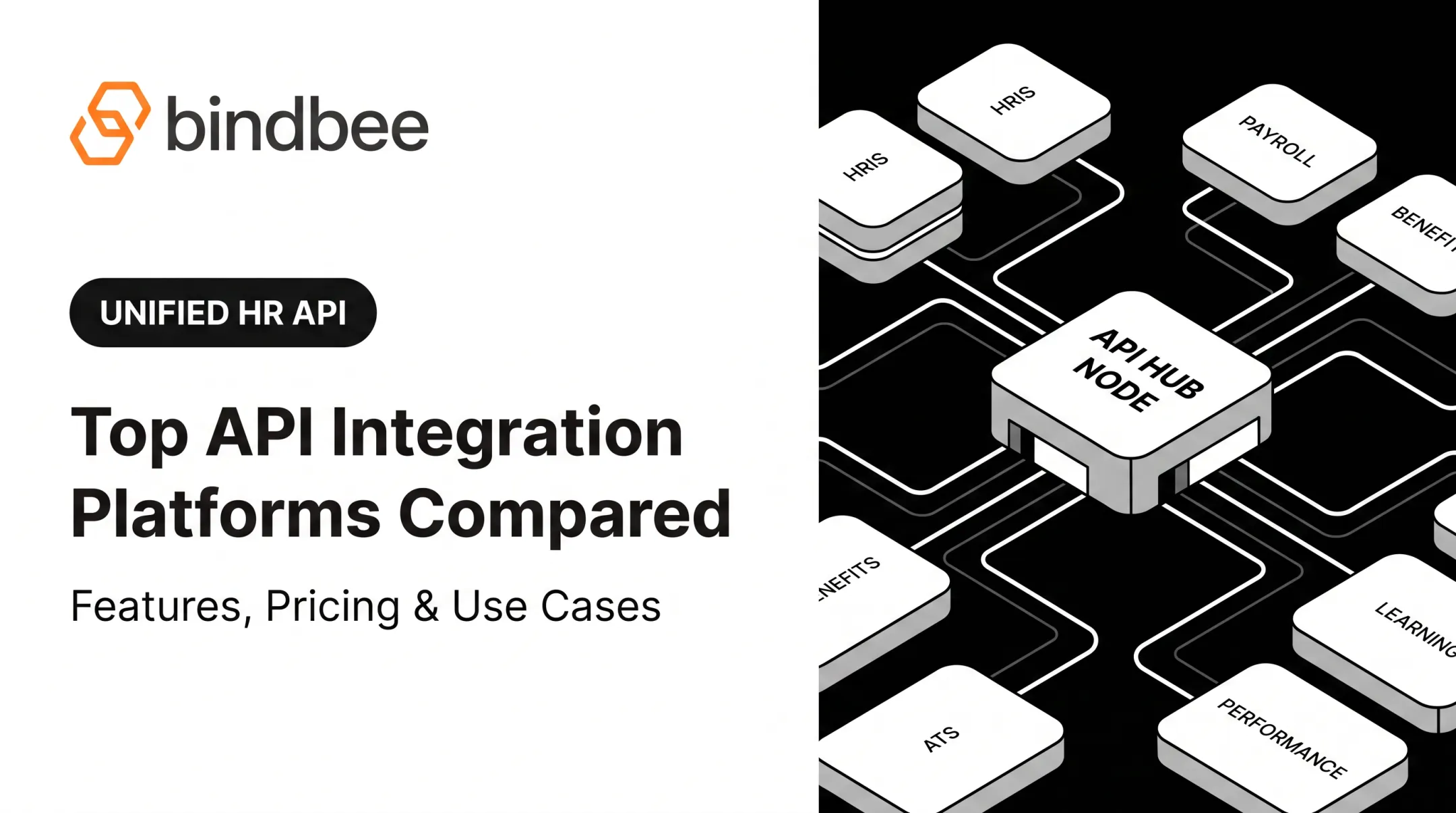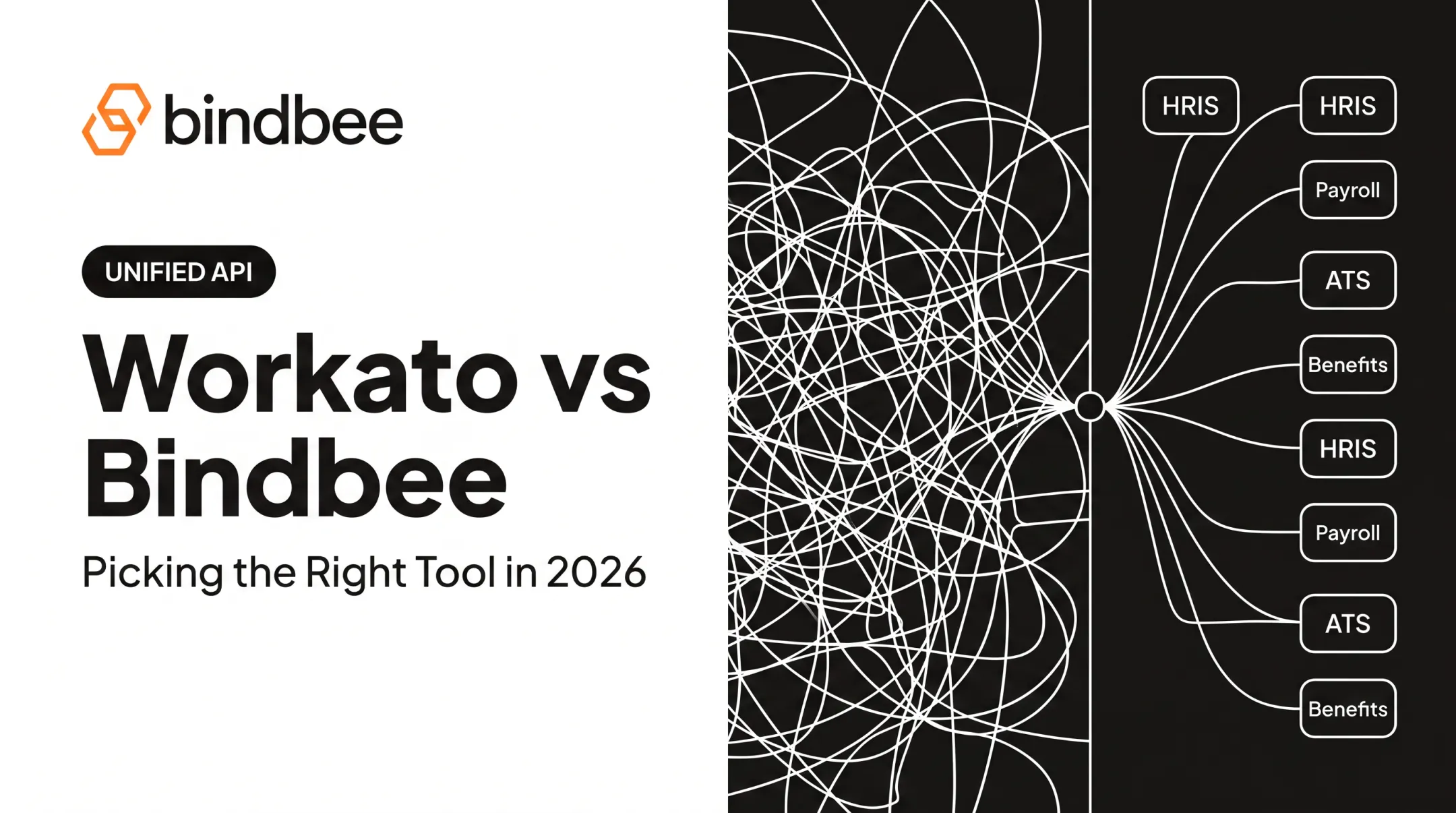

Pick the wrong partner, and you're looking at ballooning engineering overhead, slower time-to-market, and a maintenance burden that never really ends. This guide breaks down what to look for and ranks the top API integration companies for 2026.
TL;DR
- Outsource connector build and upkeep so your engineers stay on core product work
- Choose on vertical depth, data normalization, maintenance model, and compliance—not connector count alone
- Native builds take 4–5 weeks per integration, and often months for complex systems
- Shortlist for 2026: Bindbee, MuleSoft, Boomi, Workato, and Merge
- Vertical unified APIs beat general iPaaS tools for HR-specific data depth
What Is API Integration and Why It Matters
API integration connects two or more software systems so they can exchange data automatically, without manual exports or CSV uploads. Companies that specialize in this either sell a platform (unified API, iPaaS) or build custom connectors as a service.
The alternative is building in-house. That means one engineer (or a small team) learning every vendor's API quirks, authentication method, and rate limit, then maintaining that code forever.
Here's the real cost breakdown, according to Truto's 2026 engineering analysis:
- Five native HRIS integrations at six weeks each equals 30 engineer-weeks just for version one
- A unified API can save 70-80% of that engineering time
- Custom integration maintenance often eats 60-70% of total cost of ownership
That last point matters more than most teams realize going in. Building the integration is only half the job.
Every time a vendor pushes an API update, someone on your team has to notice, patch, and retest. That's the hidden tax that unified API platforms are built to eliminate.

So how do you separate a genuinely good integration partner from one that just has a long connector list? That's next.
What to Look For in an API Integration Company
Not every API integration company solves the same problem. Before you compare vendors, lock in the criteria that matter for HR, payroll, and benefits data.
Vertical Depth vs. Horizontal Breadth
General iPaaS tools connect to hundreds of apps but treat them all the same way. A vertical platform built for HR Tech models employee, dependent, and benefits data specifically. An "employee record" in Workday doesn't look anything like one in Gusto.
Normalization
Every HRIS vendor structures data differently. A strong integration partner absorbs that mess at the API layer, so your application code sees one clean schema instead of 60 different ones.
Maintenance Model
Ask directly: who owns the fix when ADP changes its API next quarter?
- In-house: your engineers monitor, patch, and retest every connector
- Managed partner: the vendor absorbs the change and ships you a stable API
Compliance
For HR, payroll, and benefits data, baseline requirements should include:
- SOC 2 Type II: independent audit of security controls over time
- HIPAA compliance: required if PHI is involved, with a signed BAA
- ISO 27001: formal information security management certification
- GDPR readiness: necessary if you touch EU employee data
Setup Time & Developer Experience
Native, single-vendor integrations typically take 4-5 weeks each, according to Kombo's 2026 unified API research. Complex enterprise systems can stretch into months.
Unified API platforms shorten that path by building and maintaining connectors once, then exposing a single interface across many providers.

Top 10 API Integration Companies for 2026
This list ranks providers by vertical depth, normalization quality, compliance posture, and market presence—not brand size alone.
1. Bindbee — Best for HR Tech and Benefits Platforms
Bindbee provides a unified API across 60+ HRIS, payroll, benefits, and carrier systems for HR Tech, benefits administration, InsurTech, and TPAs.
What sets it apart:
- Benefits-first models with distinct Employee, Employer, and Dependent Benefits objects
- SFTP-to-API bridge for legacy exporters like bswift and PlanSource
- Life-event webhooks for hires, terminations, dependent changes, and COBRA-qualifying hour cuts
- Zero-maintenance connectors—Bindbee absorbs upstream API changes so customer code stays stable
| Key Features | Setup Time | Compliance |
|---|---|---|
| Unified API, 60+ integrations, benefits-first models | Under 1 day vs. 4–8 weeks native | SOC 2 Type II, ISO 27001, HIPAA compliant, GDPR ready |
Newfront cut integration deployment from 8–12 weeks to 48 hours. Healthee employers now connect an HRIS the same day instead of waiting two-plus months.

2. MuleSoft (Salesforce)
MuleSoft is Salesforce’s enterprise iPaaS and API management platform, tightly tied to the Salesforce ecosystem.
- Strengths: Salesforce-native integration, Anypoint lifecycle management, Agentforce/MCP support
- Fit: Large enterprises with dedicated integration teams
- Watch out: Enterprise-tier pricing and steeper complexity
| Key Features | Best For | Pricing |
|---|---|---|
| API lifecycle management, Anypoint platform | Large enterprises | Enterprise-tier, high cost |
3. Boomi
Boomi is a low-code iPaaS with a broad connector library for ERP, CRM, and general business systems.
- Strengths: Gartner iPaaS Leader recognition, composable architecture, self-healing AI flows
- Fit: Cross-app business process integration
- Watch out: Shallower HR-specific data models
| Key Features | Best For | Limitation |
|---|---|---|
| Composable architecture, 1,000+ connectors | General business process integration | Shallow HR data depth |
4. Workato
Workato is a workflow automation platform with 1,000+ connectors aimed at cross-functional enterprise automation.
- Strengths: Agent Studio AI automation, strong enterprise adoption, Workato One platform
- Fit: Ops and IT teams automating work across many apps
- Watch out: Limited HR-specific object depth versus vertical platforms
| Key Features | Best For | Limitation |
|---|---|---|
| Workato One, Agent Studio | Cross-functional automation | Limited HR depth |
5. Finch
Finch is an employment data API weighted toward SMB payroll systems such as Gusto and QuickBooks.
- Strengths: Broad SMB payroll coverage across 250+ systems
- Fit: Products that primarily need small-business payroll data
- Watch out: Less depth on enterprise HRIS and ATS objects
| Key Features | Best For | Limitation |
|---|---|---|
| SMB payroll focus | Small business payroll data | Limited enterprise coverage |
6. Merge
Merge offers a unified API across HR, ATS, accounting, and CRM in one platform.
- Strengths: Multi-category coverage from a single integration surface
- Fit: Products that need several software categories, not HR alone
- Watch out: Less HR object depth than employment-data specialists
| Key Features | Best For | Limitation |
|---|---|---|
| Multi-category unified API | Products needing multiple integration categories | Less HR-specific depth |
7. Google Apigee
Apigee is Google’s general-purpose API management platform for app delivery, gateway control, and analytics.
- Strengths: Solid analytics, scalable API management, usage-based packaging
- Fit: Broad API program and gateway needs
- Watch out: Not specialized for complex on-prem or legacy HR integrations
| Key Features | Best For | Pricing |
|---|---|---|
| API management, analytics | Broad, general API needs | Competitive, usage-based |
8. Microsoft Power Automate
Power Automate is Microsoft’s enterprise low-code automation tool, built around Microsoft 365 and Dynamics.
- Strengths: Copilot-driven AI flows, multi-cloud orchestration, deep Microsoft graph connectivity
- Fit: Microsoft-centric enterprises
- Watch out: Weaker fit outside the Microsoft stack (ecosystem lock-in)
| Key Features | Best For | Limitation |
|---|---|---|
| Copilot AI flows, multi-cloud orchestration | Microsoft-centric enterprises | Ecosystem lock-in |
9. Zapier
Zapier is a no-code automation platform with 10,000+ app integrations, used mostly by SMBs and product-led teams.
- Strengths: Fast setup, flat pricing, huge app library, AI-enhanced workflows
- Fit: Lightweight SMB and PLG automation
- Watch out: Shallow enterprise-grade data models
| Key Features | Best For | Limitation |
|---|---|---|
| 10,000+ app library | SMB/product-led teams | Shallow enterprise data depth |
10. SnapLogic
SnapLogic is a cloud-native integration platform with generative AI (SnapGPT) and metadata-aware tooling.
- Strengths: SnapGPT, AgentCreator, metadata awareness, data governance controls
- Fit: Enterprises that want governed, AI-assisted integration
- Watch out: General-purpose rather than vertical-specific (limited HR/benefits depth)
| Key Features | Best For | Limitation |
|---|---|---|
| SnapGPT, metadata awareness | Enterprises needing data governance | Not vertical-specific |
How We Chose the Best API Integration Companies
The most common mistake teams make? Picking based on brand recognition or connector count alone, rather than vertical fit or maintenance model. A 1,000-connector catalog doesn't prove a vendor supports payroll deductions, benefit elections, or write-back operations.
We weighed each vendor on:
- Vertical depth — models your industry's data objects and workflows, not generic CRM-style fields
- Normalization quality — clean, consistent schema across source systems
- Compliance certifications — SOC 2 Type II, HIPAA, ISO 27001, and GDPR readiness
- Setup speed — days to first production sync, not weeks or months
- Total cost of ownership — subscription plus the engineering time you'd otherwise spend on maintenance
Miss on any of these and you pay later in delayed launches, maintenance drag, or sync failures that land on support.

Conclusion
The right API integration partner matches your vertical's needs and your team's operational goals. Before committing, evaluate setup time, data depth, and what ongoing maintenance actually looks like six months in.
For HR Tech, Benefits, and InsurTech platforms specifically, Bindbee's unified API offers one of the fastest paths to normalized, always-current employment data. Book a demo to see how it compares against your current integration approach.
Frequently Asked Questions
What is API integration?
API integration is the process of connecting two or more software systems through their APIs so they can exchange data and automate workflows. Instead of manual exports or spreadsheets, systems talk to each other directly.
What does an API integration company do?
These companies build and maintain the connectors, normalization layers, and infrastructure needed to link software systems. That means your team doesn't have to build and maintain that plumbing in-house.
How much do API integrations cost?
Custom builds run from a few thousand dollars for a simple connection to tens of thousands for enterprise-scale work, per OpenLegacy's 2024 vendor analysis. Unified API platforms usually use lower, predictable subscription pricing.
How long does it take to set up an API integration?
Custom-built integrations typically take 4–5 weeks per system, and longer for complex enterprise platforms. Unified API platforms often cut simple connections to under a day.
What's the difference between a unified API and a traditional iPaaS platform?
A unified API gives you one normalized, vertical-specific data model behind a single endpoint. Traditional iPaaS platforms offer broader, general-purpose workflow automation across many app categories, with less domain-specific structure.
Is API integration secure for sensitive data like HR and payroll?
Reputable providers maintain SOC 2 Type II reports, ISO 27001 certification, and HIPAA compliance to protect employment and benefits data. Always confirm a signed BAA if the workflow touches protected health information.