
An income verification API replaces much of that manual work by connecting directly to payroll systems, bank accounts, employer databases, or uploaded documents, then returning structured, consented data to the requesting application.
The operational pressure is real. Businesses need faster underwriting decisions, fewer manual touchpoints, and coverage for salaried, self-employed, contract, and gig workers alike. In July 2023, the Bureau of Labor Statistics counted 11.9 million independent contractors, or 7.4% of total US employment, in its BLS contingent employment report — a population that a wage-only verification path simply can't cover.
This guide breaks down what an income verification API actually is, how consented data flows through the system, how results get validated, and where human review still fits in.
Key Takeaways
- Income verification APIs pull permissioned data from payroll, bank, credit, or document sources and return it in structured form
- The typical workflow runs through consent, authentication, retrieval, normalization, validation, and delivery to a decisioning system
- No single source covers every applicant — payroll, bank data, and documents each verify different things
- Security, consent tracking, audit trails, and fair-lending controls matter as much as API speed
What Is an Income Verification API?
An income verification API is a software interface that lets an authorized application request, receive, and evaluate income-related data from one or more trusted sources, delivered in a structured, machine-readable format.
It exists to close an obvious gap: collecting paystubs, bank statements, tax forms, or employer confirmations by hand is slow, inconsistent across applicants, hard to audit, and prone to transcription errors. An API turns that scattered paperwork into a repeatable, traceable process.
That said, an API connection isn't a guarantee. It doesn't automatically confirm that an income figure is accurate, current, or sufficient for a specific lending, rental, or eligibility decision. The result depends entirely on which sources are available, what the applicant consented to share, and the validation rules the receiving business applies.
Types of Income Verification Data Sources
Different sources answer different questions, which is why most serious verification programs use more than one.
| Source Type | What It Establishes | Where It Falls Short |
|---|---|---|
| Payroll/employer-connected data | Employer, pay frequency, gross/net pay | May not cover gig or informal employers |
| Bank transaction data | Deposits received, income patterns | Doesn't confirm job title or employer identity |
| Document/OCR workflows | Figures present on submitted paystubs or W-2s | Extraction isn't the same as employer confirmation |
| Direct employer contact | Employer-confirmed status and pay | Slower; depends on employer responsiveness |
| Credit-derived estimates | Modeled annual wage income | An estimate, not an observed payroll record |
Source selection should follow the applicant, not the other way around. Payroll connectivity works well for traditional W-2 employees, but self-employed, contract, seasonal, and multi-income applicants typically need bank data, documents, or both.
Income verification and employment verification are related, not interchangeable. Employment status, employer identity, job tenure, and pay frequency matter, but they are not the same as gross or net earnings and income stability. A business can confirm someone is employed without fully verifying what they earn.
How Does an Income Verification API Work?
The process turns a user-authorized data request into a structured verification result that feeds an underwriting, rental, or eligibility workflow. It runs as a sequence rather than a single lookup.
Initiation and Consent
The business first identifies what it needs to verify, presents the applicant with a clear disclosure, and obtains explicit permission before requesting anything sensitive. This typically happens through:
- An embedded verification flow inside the business's own application
- A hosted connection screen operated by the data provider
- A secure link sent to the applicant
- An application-triggered API request after the applicant logs in
Whatever the method, consent scope, purpose, duration, and revocation rights need to be recorded. If a decision is ever questioned, the business must be able to show exactly why the data was accessed and what the applicant agreed to.
Source Connection and Authentication
Once consent is captured, the API connects to the relevant source (a payroll system, HRIS platform, bank, employer database, or document-upload channel) using credentials, OAuth-style authorization, or another secure method.
Authentication confirms the user has the authority to share the data. It does not, by itself, prove the income is sufficient, stable, or free of inconsistencies. Those are separate questions handled later in the process.
Connection failures happen. Expired credentials, unsupported employers, or financial institutions outside the provider's network can all stall this step, which is why fallback paths (document upload, manual confirmation) need to exist from the start.
Data Retrieval and Normalization
With a live connection, the provider retrieves relevant fields: employer name, employment status, pay frequency, gross or net pay, payment dates, year-to-date earnings, and historical income where it's available.
Raw data rarely arrives in a usable shape. One payroll system might label a field "annual salary," another "base comp," a third might report pay dates in a different format entirely. Normalization converts these varied formats, labels, and pay schedules into one consistent schema the receiving application can actually use.
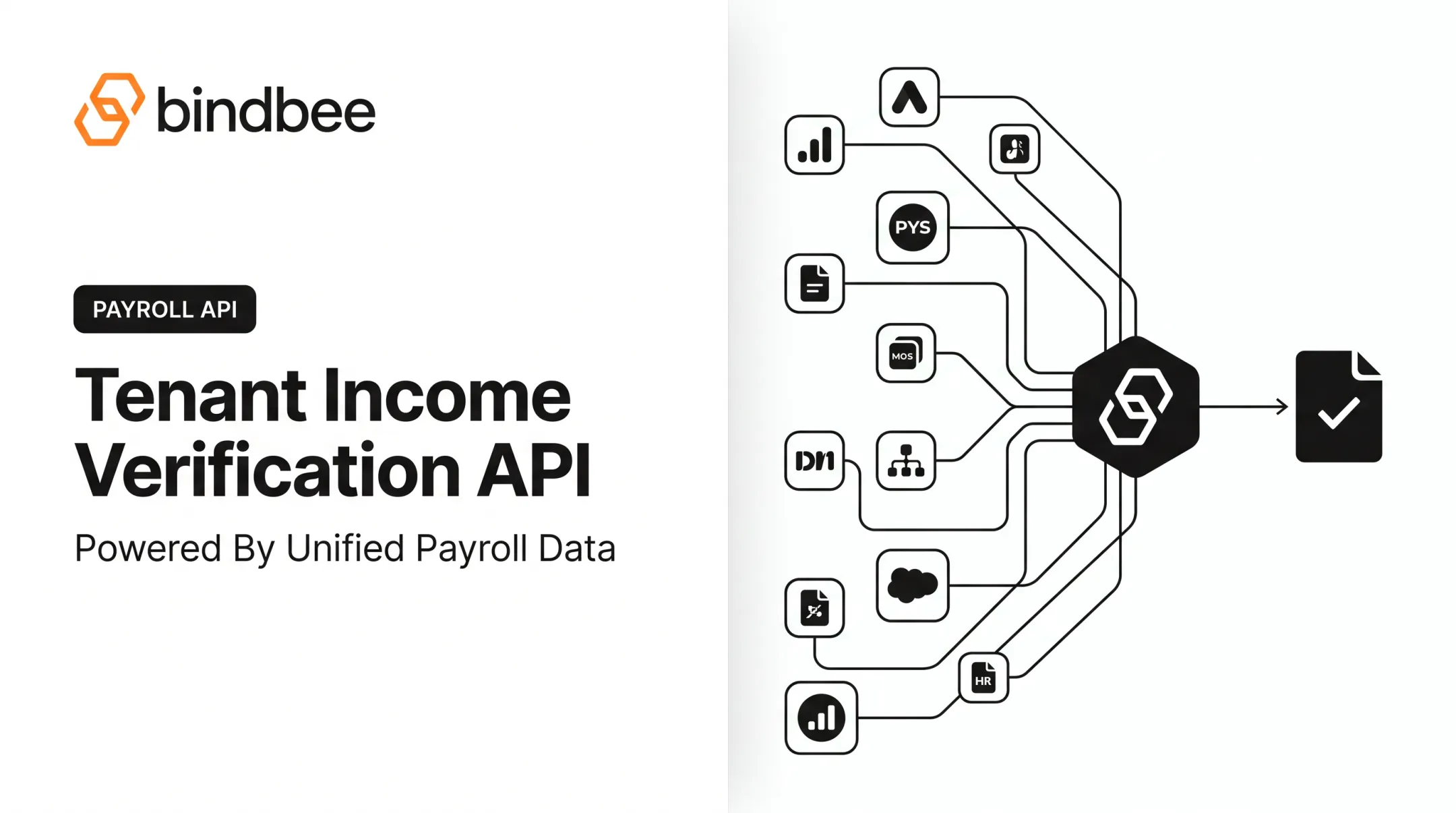
This is where unified data layers add real value. Bindbee, for example, normalizes employment data across 60+ HR systems, including Workday, ADP, BambooHR, Gusto, Rippling, and a long tail of regional platforms. A receiving application sees the same employee, compensation, and pay-frequency fields regardless of which payroll or HRIS system an employer runs.
Employment data alone still typically needs banking or document data for a complete income picture. HR systems confirm employment and pay rate, not necessarily total take-home earnings for someone with multiple income streams.
Validation, Reconciliation, and Exception Handling
Once data is normalized, verification logic checks it against the applicant's stated income. Does payment frequency make sense? Do payment dates align with a plausible pay schedule? Do multiple sources agree, or is there a material gap?
Additional checks commonly include:
- Employment status and identity matching
- Duplicate or conflicting records across sources
- Unusual or unexplained deposits
- Document inconsistencies from OCR extraction
- Stale or incomplete source data
Most providers apply confidence thresholds here. Clean results with sufficient supporting data can move forward automatically. Anything flagged (missing data, mismatches, low-confidence document extraction, or an unsupported income type) gets routed to a fallback process or human reviewer instead of being pushed through blind.

Output and Downstream Decisioning
The final response is structured, machine-readable data: verified fields, source details, timestamps, a status indicator, confidence or exception flags, and an audit reference where the provider supports one.
That output feeds into whatever system needs it: a loan-origination platform, property-management workflow, tenant-screening product, benefits eligibility engine, or internal rules engine.
One important caveat: the API response is not the approval decision. The receiving organization still applies its own affordability, eligibility, risk, and compliance rules on top of the verified data. The API supplies evidence; the business decides what to do with it.
Where Is Income Verification Used?
Income verification APIs show up across a surprisingly wide range of workflows, each with different stakes and rules.
Lenders and fintechs use verified income to support affordability analysis, underwriting, prequalification, and fraud controls, while keeping the verification step distinct from the broader credit decision. Adoption of digital verification is still uneven. In Fannie Mae's 2024 survey of recent homebuyers, only 30% said they were offered online bank-account verification and agreed to it, while 65% weren't offered it at all, according to Fannie Mae's 2024 survey.

That gap shows API-based verification is still rolling out unevenly across the mortgage industry, not a fully standardized practice yet.
Property managers and tenant-screening platforms use income and employment data to evaluate rental applications, but this falls squarely under consumer-reporting rules. If a report contributes to a denial or a higher deposit, the landlord must issue an adverse-action notice, according to FTC's landlord guidance. That notice must also disclose the applicant's right to dispute inaccurate information.
Beyond lending and housing, income and employment data support:
- Benefits administration eligibility checks (waiting periods, ACA hour validation)
- Payroll products and HR tech onboarding workflows
- Insurance underwriting
- Immigration-related income documentation
Choosing the Right Income Verification API
Not every provider covers every applicant type or use case, so evaluation criteria should map to the actual population being verified.
Coverage factors to check:
- Does it reach W-2 employees, small-employer workers, self-employed people, contractors, and gig workers?
- Can it handle applicants with multiple income streams?
Technical factors:
- Normalized schemas across sources
- Webhooks or real-time update notifications
- Sandbox testing, SDKs, and clear documentation
- Rate limits, error handling, and uptime commitments
Governance factors:
- Consent management and revocation support
- Encryption and access controls
- Data retention and deletion policies
- Audit logs and data lineage
- Vendor security certifications (SOC 2 Type II, ISO 27001)
- A defined process for disputes and adverse decisions
Companies building benefits or HR tech products on top of employment data face a related integration challenge: connecting reliably to dozens of underlying payroll and HRIS systems.
Bindbee's unified API addresses that layer specifically, giving platforms one normalized connection across 60+ systems instead of building and maintaining each integration separately. That infrastructure complements, rather than replaces, the income-verification sources above.

Conclusion
An income verification API is a data-orchestration and validation layer. It obtains permissioned information, standardizes it into a consistent format, checks it against defined rules, and returns a decision-ready result, not a final decision.
The strongest implementations combine multiple sources with clear fallback paths:
- Payroll data alone misses gig workers
- Bank data alone misses job title and employer identity
- Documents alone depend on extraction accuracy
Treating any single source as sufficient for every applicant is where verification programs tend to break down.
Choosing the right API ultimately comes down to coverage for your actual applicant population, data quality, security posture, integration effort, and how well it fits your specific use case, whether that's lending, rental screening, or benefits eligibility.
Frequently Asked Questions
How does automated income verification work?
The applicant gives consent, then the API connects to an authorized payroll, bank, employer, or document source. The system retrieves and normalizes the data, validates it against defined rules, and returns a structured result for downstream decisioning.
Can apartments truly verify your exact income?
Property platforms can verify reported income against available source data, but results depend on consent, source coverage, data freshness, and income type. A single source rarely establishes "exact" income for every applicant.
What data does an income verification API access?
Depending on the provider and user permission, it may access employment status, employer name, pay frequency, gross or net earnings, payment history, bank deposits, document fields, and verification timestamps.
Is income verification through an API secure?
Reputable providers rely on consented access, encryption, authentication, and least-privilege controls, along with audit logs and retention limits. Check a provider's security certifications, such as SOC 2 Type II or ISO 27001, before integrating.
Can an income verification API verify self-employed or gig-worker income?
Payroll connectivity alone usually doesn't cover these applicants. Effective workflows typically combine bank transaction analysis, tax forms, platform statements, document extraction, and manual review for non-traditional income.