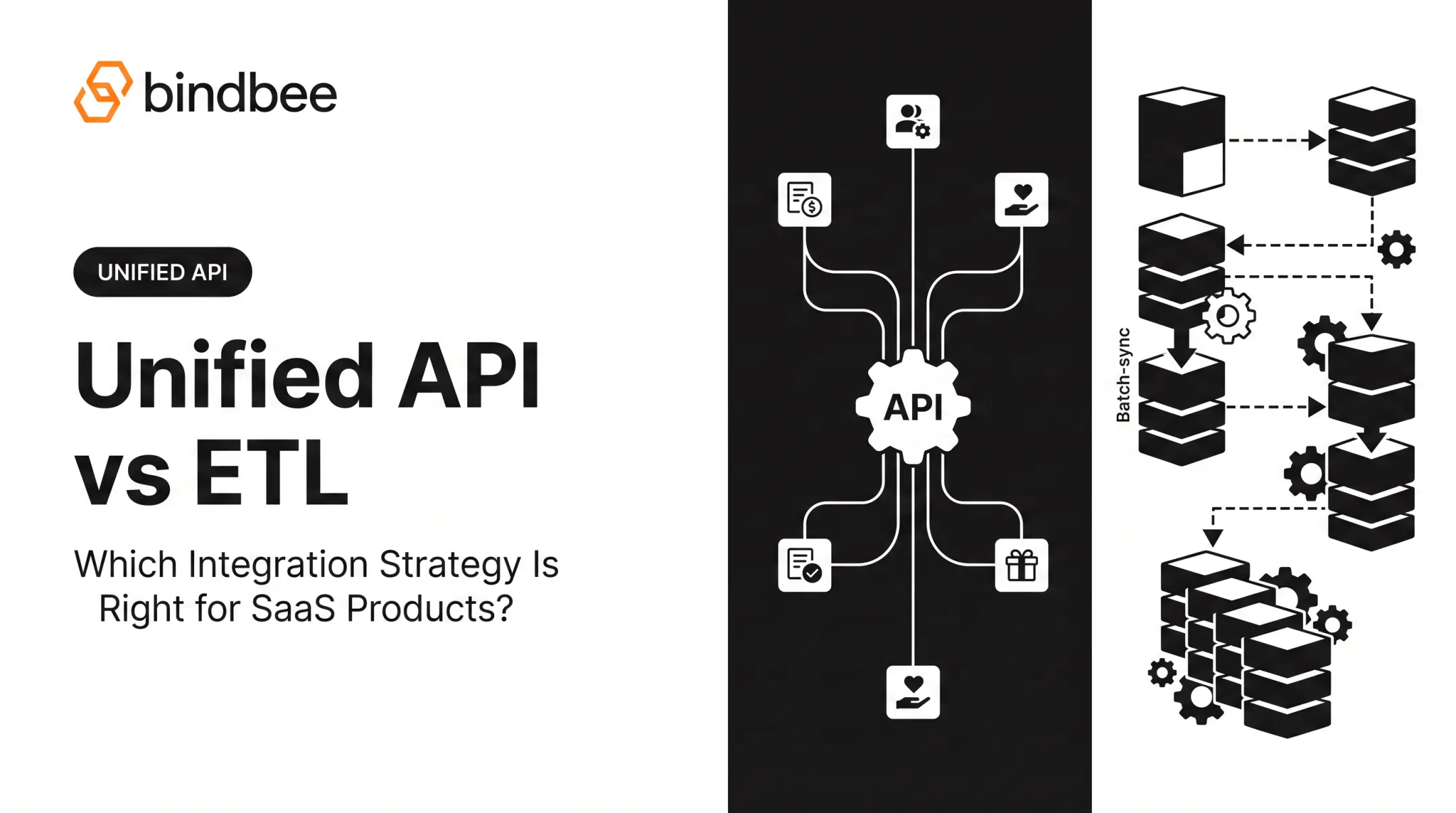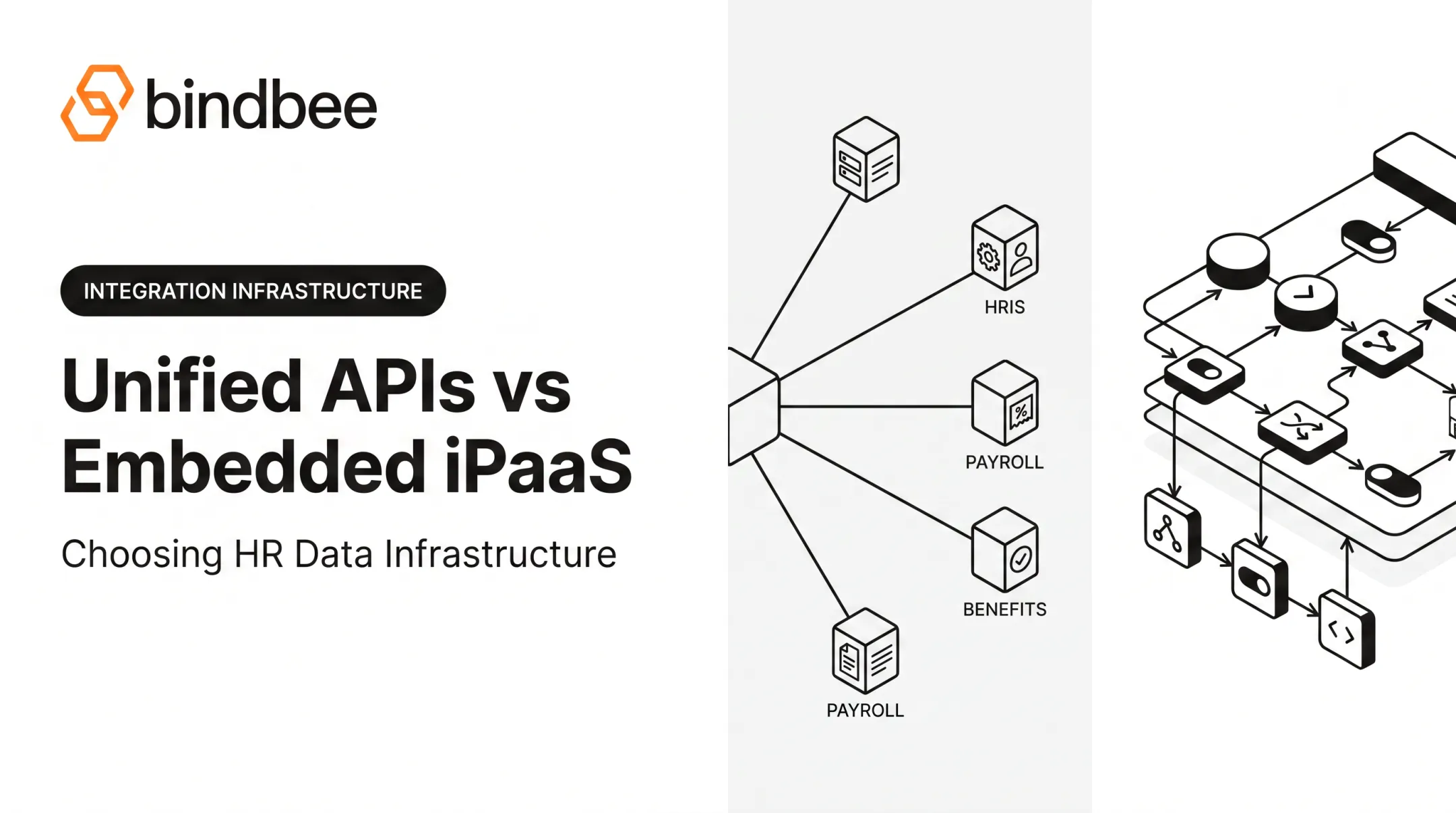

Many product teams struggle to pick the right architecture before it's too late. Gartner reports the iPaaS market grew 23.4% to $8.5 billion in 2024, proof that integration infrastructure spending is accelerating industry-wide. The decision affects engineering velocity, time-to-market, and maintenance cost for years.
This article breaks down middleware vs. unified API architecture, where each scales well, and how to decide which fits your growing SaaS product.
Key Takeaways
- Middleware orchestrates complex internal workflows but requires ongoing engineering investment as integrations grow
- Unified APIs normalize dozens of third-party systems behind one schema, slashing ongoing maintenance cost
- Middleware fits internal, multi-step enterprise workflows
- A unified API scales better when integrations are a customer-facing product feature
Middleware vs Unified API: Quick Comparison
| Factor | Middleware | Unified API |
|---|---|---|
| Architecture | Separate orchestration layer (ESB/iPaaS) routing and transforming data between systems | Single normalized schema abstracting multiple third-party APIs |
| Engineering effort to scale | Custom mapping/config per new integration | One consistent endpoint; provider adds new integrations |
| Maintenance overhead | Internal team owns connectors, auth, version changes | Vendor owns connector health, auth refreshes, schema updates |
| Time-to-market | Weeks per integration | Often under a day per new system |
| Best fit | Complex internal workflows across ERP, CRM, legacy systems | Customer-facing integrations at scale |
Those rows share one scaling pattern: every new connector you own multiplies mapping, auth, and version work.

Even middleware vendors acknowledge the gap versus building native. In Workato's Bullhorn case study, native integration work ran an estimated 100–200 engineering hours per connection, versus a few dozen hours on a hosted integration layer. One vendor example isn't a universal benchmark—but connector-by-connector building rarely scales cheaply either way.
What is Middleware?
Middleware is software that connects disparate applications so they can exchange data. IBM defines it as the "software glue" between systems in a distributed network. Common categories include:
- Enterprise Service Buses (ESBs): Legacy orchestration layers for large enterprise systems
- iPaaS platforms: App-to-app connectors (MuleSoft, Boomi, Workato) for automation and data movement
- Message-oriented middleware: Asynchronous transport tools (Kafka, RabbitMQ)
- API gateways: Traffic, authentication, and rate-limiting layers for APIs
Middleware's core strength is centralized orchestration. It handles protocol translation, transaction management, and multi-step workflows that span several systems at once.
Use Cases of Middleware
Middleware fits internal, back-office scenarios: syncing ERP and CRM data, bridging legacy mainframes with cloud apps, or coordinating multi-department workflows. Large enterprises with dozens of internal systems and centralized data governance needs are the classic buyers.
Gartner's 2025 analysis puts the global iPaaS market at $8.5 billion, up from $7.77 billion the prior year. That figure shows broad enterprise appetite for integration infrastructure, not B2B SaaS-specific demand.

What is a Unified API?
A unified API is a single interface that normalizes data models and authentication across dozens of third-party systems into one consistent schema. Instead of building separate connectors for Workday, ADP, BambooHR, and Gusto, a product team calls one endpoint and gets standardized employee, payroll, or benefits data back.
Core benefits for SaaS growth:
- Faster customer onboarding since new connections don't require new code
- Reduced engineering bandwidth spent on connector maintenance
- Consistent data models regardless of the underlying source system
Unified APIs come in two flavors: general-purpose (covering many categories loosely) and category-specific (built deep for one domain, like HR/payroll or accounting). The category-specific ones tend to embed domain logic the general-purpose versions skip.
Use Cases of Unified API
For benefits administration platforms, HR tech, and insurtech companies, integration breadth is a core product feature customers expect on day one—not a backend nice-to-have.
That demand is why category-specific unified APIs go deeper than generic HR fields. Bindbee is a unified API for employment data with benefits-first data models. It separates benefits into three distinct models:
- Employee Benefits: enrollment records, coverage tiers, contributions, effective dates
- Employer Benefits: plan configuration, provider details, benefit categories
- Dependent Benefits: dependent enrollments, linked plans, eligibility details
That split matters for platforms running real enrollment workflows, not just reading generic employee records.

Employee-gifting platform Phin is one example: after connecting through Bindbee instead of building native HRIS integrations one by one, it reported a 76% reduction in onboarding time and 94% faster time-to-value.
Middleware vs Unified API: Which Scales Better?
The right answer depends on four factors:
- Number of third-party systems you need to connect
- Whether integrations are internal or customer-facing
- Engineering team size relative to integration backlog
- Compliance requirements tied to the data you're moving Those four factors usually point to one of three outcomes:
- Middleware wins when you're orchestrating a handful of internal systems with complex, multi-step logic. You need custom workflows a normalized schema can't anticipate.
- A unified API wins when integrations are a core, customer-facing feature that must scale across dozens of external systems. Paragon's guide on build-versus-buy makes the point directly: three-year maintenance cost, not first-build difficulty, is the deciding factor.
- A hybrid model wins when you need both—middleware for internal orchestration, a unified API for external connections. The failure mode is scaling middleware to dozens of customer-facing integrations. That path usually means rebuilding connector logic system by system. Each new HRIS or payroll provider needs its own mapping, auth handling, and version-drift monitoring. Unified APIs are built to absorb that scale. The provider owns connector upkeep across the full catalog, so your team doesn't. Many SaaS teams run both on purpose. Middleware handles internal orchestration; a unified API covers external, customer-facing connections. For teams that need depth inside the stack and breadth outside it, that split is often the right architecture.
Real-World Example: Scaling Integrations in Benefits Tech
Bindbee customers like Newfront, Healthee, Alma, and ThrivePass hit the same wall: engineering teams burned weeks on native integrations while customer onboarding stalled.
- Newfront needed employee rosters, benefits data, and dependent info from client HRIS platforms. Each enterprise integration took 8-12 weeks before adopting a unified API.
- Healthee spent more than two months per custom integration, connecting to 50+ employer HRIS systems.
- Alma needed 60+ HRIS and ATS integrations for immigration services, with each custom connection taking 2-3 weeks.
- ThrivePass relied on manual payroll exports for HSA/FSA eligibility, creating six-week audit cycles.
After shifting to a unified API model, these companies replaced multi-week native builds with under a day per system. Newfront's staff engineer reported that work formerly requiring six engineers for six months took one engineer one week.

Bindbee's Phin case study puts hard numbers on the same pattern: a 76% reduction in onboarding time and a 94% improvement in time-to-value.
When integration breadth becomes a bottleneck to product growth, a unified API architecture scales more predictably than expanding a middleware layer system by system.
If your engineering team is stuck maintaining connectors instead of shipping product, Bindbee's unified API removes that maintenance burden.
Conclusion
There's no universal winner. Middleware fits internal, complex enterprise orchestration where flexibility matters more than speed. Unified APIs fit B2B SaaS products that must scale customer-facing integrations quickly, without growing engineering headcount proportionally.
What actually shows which approach scales better for your business:
- Engineering bandwidth saved
- Faster customer onboarding
- Lower maintenance cost over three years
Not just how fast you ship the first connector.
Frequently Asked Questions
What is API middleware?
API middleware refers to tools like API gateways and management platforms that sit between clients and APIs, handling authentication, rate limiting, and traffic management. It's distinct from full integration middleware, which connects backend systems to each other.
What are the top 5 middleware technologies?
Common options span message brokers (Kafka, RabbitMQ) for async transport, iPaaS platforms (MuleSoft, Workato, Boomi) for orchestration, and API gateways for traffic management. Each solves a different layer of the integration stack.
Can a unified API replace middleware entirely?
No. A unified API replaces the need to build and maintain individual third-party connectors, but it doesn't handle internal orchestration tasks like multi-step workflows. Many teams run both together.
How does a unified API reduce engineering costs compared to middleware?
The vendor owns connector maintenance, auth refreshes, and schema updates. Bindbee, for example, manages OAuth token refreshes and provider API changes across 60+ systems so customers don't have to.
Is middleware still relevant for modern B2B SaaS companies?
Yes, for internal, complex workflows spanning legacy and enterprise systems. Unified APIs now cover most customer-facing integrations, but middleware still handles the internal orchestration it was built for.
How long does it typically take to add a new integration with each approach?
Middleware-based integrations typically take weeks, depending on complexity. Unified APIs like Bindbee often connect new systems in under a day, since the schema and connector are already built.