
iPaaS tools connect these systems, automate data flows, and cut the engineering hours teams spend babysitting custom integrations. This matters especially in HR tech and benefits administration, where employee data touches payroll, carriers, and compliance systems simultaneously. The market reflects this urgency: Gartner reports the iPaaS market grew 23.4% to $8.5 billion in 2024, and Grand View Research projects the global market will reach $55.46 billion by 2033.
Key Takeaways
- iPaaS connects cloud apps and automates workflows without heavy custom coding
- Market growth is accelerating at 23.4% year-over-year as of 2024
- Judge platforms on connector breadth, governance, and pricing transparency, not brand name
- Five platforms dominate: MuleSoft, Boomi, Workato, SnapLogic, and Celigo
- For HR tech and benefits, vertical-specific unified APIs often beat general iPaaS on time-to-value
Overview of iPaaS in the US Market
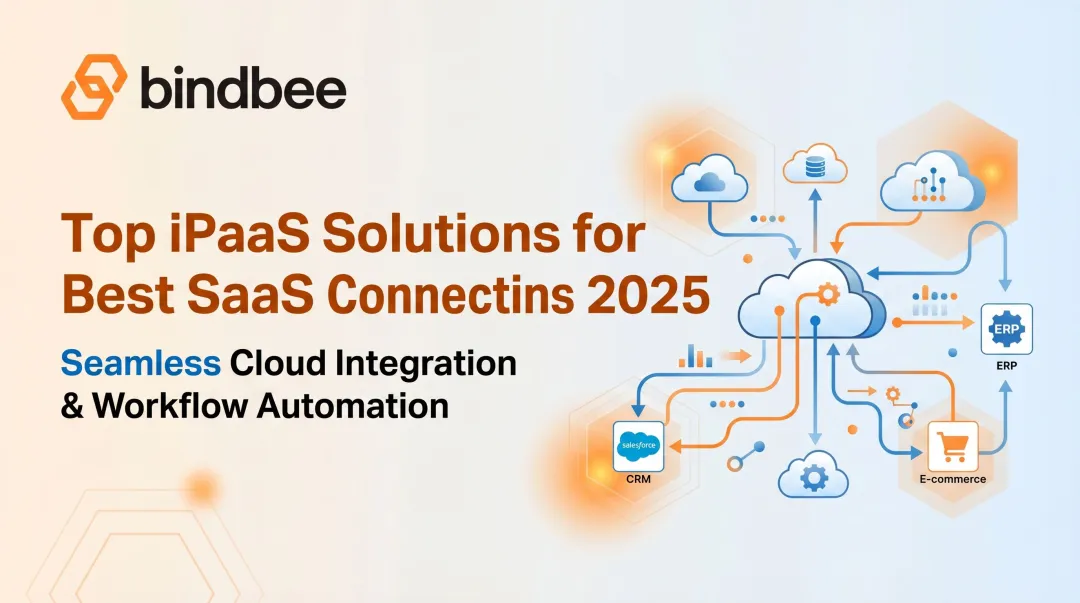
iPaaS is cloud software that connects applications, systems, and data sources, letting them exchange information automatically instead of relying on manual exports or one-off scripts.
SaaS sprawl is the real driver here. Okta's 2025 Businesses at Work report found the average organization now runs 101 apps — a number that's climbed steadily for a decade.
Every new app is another potential data silo. iPaaS platforms exist to stop that sprawl from turning into chaos.
Below, we break down five leading platforms, what each does best, and how to evaluate them for your stack.
Top iPaaS Tools for US Businesses
Selection criteria matter more than logos. Evaluate each platform on:
- Connector breadth across the systems you actually run
- Ease of use for non-engineers
- Scalability under production load
- Governance and access controls
- Transparent, predictable pricing
MuleSoft Anypoint Platform
Salesforce completed its acquisition of MuleSoft in 2018, and it remains a primary option for large enterprises running API-led integration strategies. MuleSoft treats APIs as reusable products, not one-off connections.
Its standout feature is Agent Fabric, announced in September 2025, which adds Agent Registry, Agent Broker, Agent Governance, and Agent Visualizer for orchestrating AI agents across systems. Paired with a large connector library, it fits organizations with dedicated integration teams.
| Best For | Key Features | Pricing Model |
|---|---|---|
| Large enterprises with API governance needs | Agent Fabric, API lifecycle management, extensive connector library | Usage-based packages tied to Mule components, flows, and throughput |

Boomi
Boomi split from Dell in 2021 and has since repositioned around "data activation" rather than plain integration. Its heritage is hybrid: connecting on-premise legacy systems to modern cloud apps.
The distributed Atom runtime lets you deploy integration logic close to your data. Boomi's newer Agentstudio (launched March 2025) includes Agent Designer, Agent Control Tower, Agent Garden, and a managed MCP service for connecting AI tools.
| Best For | Key Features | Pricing Model |
|---|---|---|
| Hybrid cloud/on-prem environments | Distributed Atom runtime, Agentstudio, managed MCP service | Pay-as-you-go from $99/month plus usage, or subscription tiers |
Workato
Workato built its reputation on being usable by business teams, not just engineers. Its recipe-based model lets non-technical users assemble automations visually.
Workato pairs its large connector count with Agent Studio and Guardrails, giving teams a way to build AI-driven automations without losing governance control. It's often the pick for companies scaling automation across departments rather than just IT.
| Best For | Key Features | Pricing Model |
|---|---|---|
| Business-led automation at scale | Recipe-based low-code builder, Agent Studio, Guardrails | Platform fee plus usage-based scaling |
SnapLogic
SnapLogic leans on visual pipeline building and AI assistance. Its SnapGPT assistant, announced in 2023, translates plain-language requests into working pipelines — a time-saver for teams without deep integration expertise.
Pricing is a differentiator here too. SnapLogic offers predictable, package-based pricing rather than consumption-based billing, which simplifies budgeting.
| Best For | Key Features | Pricing Model |
|---|---|---|
| Teams wanting AI-assisted, predictable-cost integration | SnapGPT, visual pipeline builder, marketplace of pre-built Snaps | Package-based (Essential, Professional, Enterprise), unlimited pipelines |
Celigo
Celigo positions itself as an intelligent automation platform spanning integrations, APIs, EDI, and AI workflows. Its Integration Apps (formerly called PIPs) are prebuilt, fully managed connections for common app pairs.
Celigo earns strong customer satisfaction scores. Its exception management auto-resolves many workflow errors before they need human attention.
| Best For | Key Features | Pricing Model |
|---|---|---|
| Mid-market teams needing managed, prebuilt integrations | Integration Apps, exception management, EDI support | Flat-rate pricing by endpoints and flows, no overage fees |

Core iPaaS Features to Evaluate
iPaaS platforms vary widely in depth and fit. Evaluate these fundamentals:
- Pre-built connectors for common apps (Salesforce, NetSuite, ERPs) that cut custom development time
- Low-code/no-code data mapping so business users can build workflows without pulling engineers off other work
- Real-time and batch processing so you can match sync patterns to each workflow
- Monitoring dashboards and alerting for failed jobs, latency, and data drift
- Compliance certifications (SOC 2, GDPR, HIPAA) if you handle sensitive employee or benefits data
Why HR Tech and Benefits Need More Than Generic Connectors
Here's where general-purpose iPaaS tools often fall short: they treat HR and benefits data like any other object, mapping generic fields rather than understanding what a "dependent" or "waiting period" actually means in a benefits context.
A specialized unified API like Bindbee complements or replaces general iPaaS in this vertical. It normalizes data across 60+ HRIS, payroll, and benefits systems with benefits-first models (Employee Benefits, Employer Benefits, and Dependent Benefits) instead of flattening everything into generic HR fields.
Bindbee also supports:
- SFTP-to-API bridging for legacy systems that only export flat files
- Webhook-based life event detection for new hires, terminations, and dependent changes
- Eligibility intelligence covering waiting periods, ACA hour validation, and state-specific rules
- Carrier connectivity, including EDI 834 generation and member ID sync (currently in beta)
Bindbee holds SOC 2 Type II and ISO 27001, and is HIPAA-compliant and GDPR-ready. That matches the compliance bar of general iPaaS tools above, with data models built for benefits from the start.

How We Chose the Best iPaaS Tools
The biggest mistake teams make is picking a platform based on connector count alone. A huge connector library means little if governance is weak or support is slow when something breaks in production.
We weighed each platform against four criteria:
- Scalability under real transaction volumes, not demo conditions
- Customer support ratings and responsiveness during incidents
- Real-world case studies, not just vendor claims
- Total cost of ownership, including maintenance, not just license fees
Independent analyst coverage also shaped the shortlist. That included Gartner's Magic Quadrant for iPaaS and Forrester's Wave assessment of 15 iPaaS offerings.
Conclusion
There's no single "best" iPaaS — the right choice depends on your team's technical skill set, deployment model, and how much you'll scale over the next few years. Pick based on fit, not brand recognition.
Before committing enterprise-wide, pilot a platform against your highest-priority integration. See how it performs under real conditions before rolling it out further.
For companies building HR tech, benefits administration, or payroll products specifically, a purpose-built unified API can beat a general iPaaS on speed. Bindbee customers have seen concrete results:
- Healthee cut integration deployment from 8-12 weeks to 24-48 hours
- ThrivePass reduced onboarding from six weeks to under one week
- Phin saw a 76% reduction in customer onboarding time
Newfront, Alma, and Clever Benefits are among the 50+ benefits platforms running on Bindbee’s benefits-first infrastructure instead of generic connectors.

Frequently Asked Questions
What is iPaaS software?
iPaaS is cloud-based software that connects applications and automates data flows between them without requiring heavy custom coding. It replaces one-off scripts and manual data transfers with managed, reusable integrations.
Can you give me an example of an iPaaS?
Leading examples include MuleSoft (API governance), Boomi (hybrid on-prem/cloud connectivity), Workato (business-user automation), and Celigo (prebuilt Integration Apps).
What is the difference between iPaaS and API management tools?
iPaaS focuses on executing integrations and automating data flow between systems. API management focuses on securing, documenting, and governing APIs across their lifecycle. They're related but not interchangeable.
How much does an iPaaS platform typically cost?
Pricing models vary by vendor: task-based, connection-based, or endpoint/flow-based. Costs depend on usage volume, number of connections, and whether you need premium connectors or enterprise support tiers.
Do small businesses need an iPaaS, or is it only for enterprises?
Lighter-weight, no-code iPaaS options exist for smaller teams with simpler needs. Enterprise-grade platforms like MuleSoft or Boomi suit organizations with complex, high-volume integration requirements.
Can iPaaS integrate with legacy on-premise systems?
Yes. Most modern iPaaS platforms support hybrid integration through dedicated connectors and hybrid runtimes—such as Boomi's Atom architecture—that bridge on-premises systems with cloud applications.