
According to HR.com's 2025 State of HR Technology and Integrations survey, 62% of HR teams use two to four paid HR solutions from different vendors, but only 39% say those systems are usefully integrated. A striking 81% say poor integration limits their ability to hit HR goals.
For benefits platforms, this isn't just inconvenient. Broken syncs mean stale eligibility data, missed dependent updates, and compliance risk. This guide covers the core principles, build/test/maintain practices, and when a unified API beats building in-house.
Key Takeaways
- Understand the source system's API and data model before writing a single line of integration code
- Automate testing continuously in CI/CD, not just before launch
- Treat documentation, monitoring, and versioning as first-class work, not post-launch cleanup
- Accurate real-time eligibility and dependent data directly affect compliance and employee experience
- Unified APIs cut integration setup from weeks to hours and remove ongoing maintenance work
Key Principles of Integration
Data Normalization
Every HRIS names things differently. One system calls it "dependent_relationship," another calls it "relation_type." Without normalization, your product has to handle dozens of schemas instead of one.
This matters most for benefits data. Coverage elections, dependent relationships, and effective dates need a single consistent schema regardless of source system, or your enrollment logic breaks silently.
Security and Compliance
Employee and benefits data is sensitive. Foundational standards to evaluate:
- SOC 2 Type II — ongoing controls assurance over time, not a point-in-time check
- ISO 27001 — requirements for an information security management system
- GDPR — applies when processing personal data of EU individuals
- HIPAA — applies selectively; scope depends on the specific data and transaction, not every employment record
Reliability and Freshness
Eligibility data moves through real-time or batch workflows. CAQH CORE's Eligibility & Benefits Infrastructure Rule calls for real-time responses within 20 seconds for 90% of transactions in a given month, plus standardized batch processing.
Stale data creates real risk. A dependent added mid-month but not synced for days can mean incorrect coverage, denied claims, or compliance exposure.
Scalability
Integrations need to survive growth: more customers, more API calls, more edge cases. Design with:
- Internal rate-limit tracking per connection
- Horizontal scaling for sync jobs
- Queue-based retry systems instead of synchronous blocking calls
Interoperability
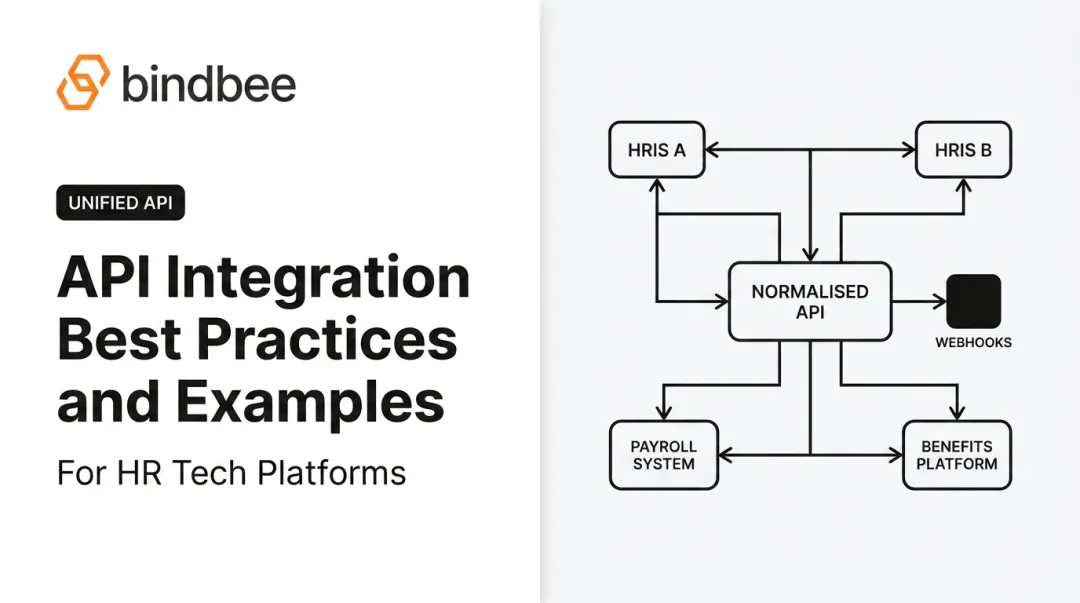
Freshness also depends on how systems talk to each other. Webhooks and event-driven updates push changes when a new hire starts, someone terminates, or a life event changes coverage, so downstream systems stay current without waiting for the next batch pull.
Put together, the bar looks like this:
- Normalize data into one consistent schema
- Secure it against recognized compliance standards
- Sync reliably, in real time where it matters
- Scale without breaking under growth
- Connect systems through webhooks and events, not just polling

Best Practices for Building Integrations
Research Before You Build
Before writing code, understand:
- Authentication method (OAuth vs API key)
- Data model and available fields
- Rate limits and quotas
- API type (REST vs GraphQL)
Skipping this step is the number one cause of integrations that need to be rebuilt three months in.
Authentication and Token Management
OAuth is preferred over static API keys. RFC 6749 defines the standard framework, and OWASP recommends the Authorization Code flow with PKCE over older implicit grants.
The catch: OAuth means managing token storage, refresh cycles, and expiration across dozens of providers — each with its own quirks.
Prefer delegated authorization so your product never stores customer credentials. Bindbee’s Magic Link authentication component lets customers authorize their HRIS or payroll account directly, often in under 5 minutes, without the integrating company touching tokens or secrets.
Error Handling and Rate Limits
Build resilient retry logic for network failures, downtime, and malformed responses. RFC 6585 defines the 429 status code for rate limiting, and providers often include a Retry-After header — but quotas vary by vendor. Gusto, for example, allows 200 requests per minute per OAuth grant.
Practical approach:
- Track usage against known quotas internally
- Implement exponential backoff on 429 responses
- Queue non-urgent syncs to smooth traffic spikes

Legacy Systems Without Modern APIs
Not every HR system exposes a modern API. Some still only export flat files, so resilience planning has to cover SFTP-to-API patterns: pull CSV, XML, or fixed-width drops and convert them into the same schema as API-based data.
Validate and normalize those files into one JSON model shared with your REST connectors. Bindbee’s SFTP-to-API Bridge follows that pattern so downstream apps do not need separate logic for legacy sources.
Custom Fields and Non-Standard Configurations
Customers customize their HR systems constantly. If your integration only maps default fields, it breaks the moment someone adds a custom benefit class or field.
A stable pattern keeps the normalized schema separate from provider-specific extras:
- Store unknowns in a
custom_fieldsobject - Preserve original provider field names
- Configure mappings at the connector and organization level
Best Practices for Integration Testing
Testing integrations is harder than testing regular software. You're dealing with asynchronous webhooks, third-party downtime you can't control, and data sensitive enough that mistakes have real consequences.
Build Realistic Sandbox Environments
Start by matching that complexity in staging. Use environments with test data that reflects reality:
- Employees with multiple dependents
- Mid-year benefit changes
- Terminations and rehires
- Coverage tier switches
Vendors like ADP and BambooHR provide sandbox accounts specifically for this kind of testing.
Automate in CI/CD
Every code change should trigger integration tests automatically, not only pre-release runs. That catches regressions the moment they land—mapping bugs, auth failures, or broken webhook handlers—instead of weeks later in production.
Schedule Recurring Tests Independent of Deploys
Source APIs change on their own schedule, not yours. Recurring automated tests catch upstream breaks (a renamed field, deprecated endpoint, or altered eligibility payload) before customers see bad enrollments or failed syncs.
Validate Schema and Business Logic
- Check for null values and duplicate records
- Validate schema structure on every sync
- Confirm eligibility dates and coverage elections calculate correctly, not just that data "arrived"
Maintaining and Scaling Integrations
The habits that keep one connection healthy are the same ones that decide whether the fiftieth stays manageable.
Documentation That Actually Helps
Good documentation covers:
- Why the integration exists and what it powers
- Authentication setup and token refresh steps
- Rate limits and quota behavior
- Rollback or replacement plans if the connector fails
Proactive Monitoring
Don't wait for customers to report broken syncs. Set up alerting for:
- Sync failures and retry exhaustion
- Data anomalies (sudden drops in record counts)
- Webhook delivery issues
Bindbee's dashboards track connection and sync status in real time, surface failures automatically, and support retries. Engineering teams often catch problems before a customer notices anything's wrong.

Plan for Versioning and Deprecation
APIs change constantly. Gusto, for instance, supports date-based versions for at least 12 months before a six-month deprecation window begins. BambooHR and ADP publish similar changelogs.
Regularly upgrade to supported versions rather than letting deprecated endpoints pile up as technical debt. That discipline is what lets connector coverage grow without maintenance growing at the same pace.
Build vs Buy: When a Unified API Makes Sense
Building one native HRIS integration typically takes 4-8 weeks of engineering time. Multiply that across 60+ systems your customers might use, and you're looking at a team dedicated entirely to integration maintenance instead of core product.
That's the hidden cost: it's not just the initial build. It's ongoing work every time a provider changes their API, deprecates a field, or adds a new auth requirement.
How a Unified API Changes the Math
Bindbee normalizes data across 60+ HR, payroll, ATS, and benefits systems through benefits-first data models: Employee Benefits, Employer Benefits, and Dependent Benefits. Those models cover concepts generic HRIS mapping tends to miss, including dependent relationships, coverage tiers, and eligibility windows.
Real customer outcomes:
| Company | Before | After |
|---|---|---|
| Newfront | 8-12 weeks per integration | 48 hours |
| Healthee | 2+ months for custom integrations | Same-day go-live |
| ThrivePass | 6-week onboarding/audit cycles | Under 1 week |
Phin, another Bindbee customer, reported a 76% reduction in onboarding time and a 94% improvement in time-to-value after switching from native integrations to Bindbee's unified API. The team went live in 48 hours instead of 10+ weeks.

What to Evaluate in a Partner
If you're comparing unified API providers, check for:
- Compliance credentials: SOC 2 Type II, ISO 27001, HIPAA readiness
- Webhook coverage for life events (new hires, terminations, dependent changes)
- Legacy system support via file-based bridges, not just modern REST APIs
- Custom field handling that holds up when customers use non-standard configurations
Bindbee holds SOC 2 Type II and ISO 27001 certifications and supports webhook-driven updates for terminations, hours reductions, and dependent changes. Those events are what trigger COBRA notices and coverage changes in benefits platforms.
Frequently Asked Questions
What are the key principles of integration?
The core principles are data normalization, security and compliance, reliability through real-time or batch syncing, scalability, and interoperability via webhooks. Together they determine whether an integration stays reliable as you grow.
What are the best practices for integration testing?
Use realistic sandbox environments with edge cases like multiple dependents, automate testing in CI/CD for every code change, and run recurring scheduled tests to catch upstream API changes independently of your deploy cycle.
How long does it typically take to build a single API integration in-house?
Native integrations typically take 4-8 weeks of engineering time per system. Unified API alternatives can reduce this to under a day for the same connectivity.
What's the difference between building integrations in-house and using a unified API?
Building in-house means your engineering team owns authentication, error handling, testing, and ongoing maintenance for every source system. A unified API outsources that normalization and upkeep, so your team maintains one integration instead of dozens.
How do you keep integrations from breaking when a source API changes?
Monitor vendor changelogs, avoid dependency on deprecated endpoints, and set up automated alerts for sync failures. Scheduling recurring tests independent of your deploy cycle also catches silent upstream changes early.
Why is real-time data sync important for benefits and HR integrations?
Stale eligibility or dependent data can lead to incorrect coverage, denied claims, or missed compliance deadlines like COBRA notices. Real-time sync ensures downstream systems reflect life events such as hires, terminations, and dependent changes as they happen.