

Voluntary vs mandatory payroll deductions
Summarise the blog with AI
Last verified: 2026-11-03
Key takeaways
- A deduction is mandatory when a statute or legal order requires it and voluntary when the employee's election starts it, so the test is the legal authority behind it, not the payee or the tax treatment.
- An auto-enrolled 401(k) deferral is voluntary, because the employee can affirmatively opt out by following the procedures in the employer's notice.
- Employee FICA is 7.65% in both 2026 and 2027, and the Social Security taxable maximum moves from $184,500 (2026) to $192,300 (2027), per the Social Security Administration.
- Disposable earnings for garnishment subtract only legally required deductions, so voluntary deductions, 401(k) deferrals included, stay in the base.
- The Department of Labor caps an ordinary garnishment at the lesser of 25% of weekly disposable earnings or the amount above $217.50, and caps support orders at 50% or 60%, plus 5 points when payments are more than 12 weeks in arrears.
- Tax treatment is a separate axis: a traditional 401(k) deferral is excluded from income-tax withholding but still owes Social Security and Medicare, and a Roth deferral owes both.
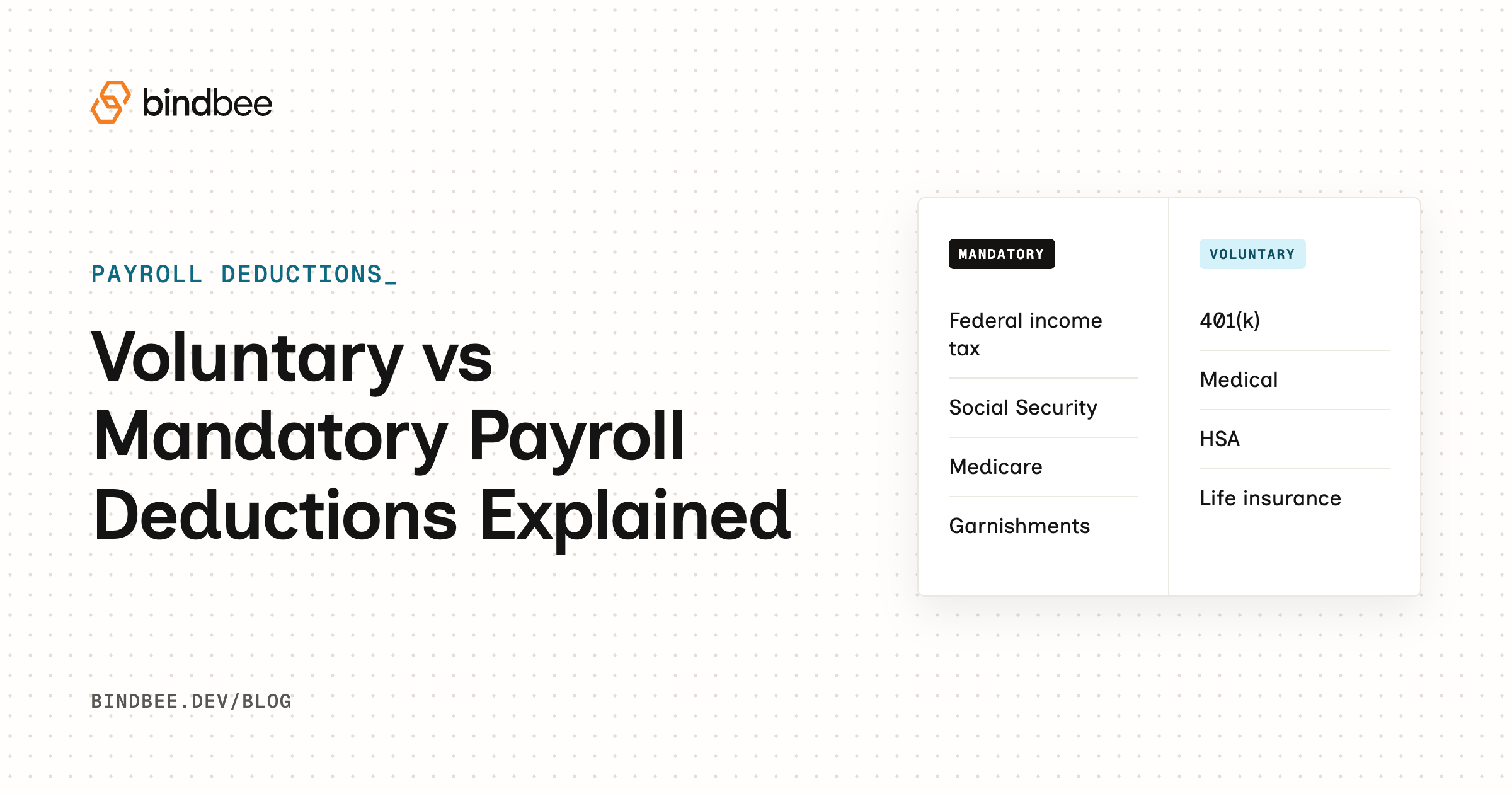
A payroll deduction is mandatory when a statute or a legal order requires it, and voluntary when the employee's election or authorization starts it. That is one question. How the deduction is taxed is a second, and the two answers are independent.
Confusing them has a price. The category decides whether you need the employee's consent and whether the deduction shrinks the pay a garnishment is measured against. A separate rule decides which wages stay taxable.
The most universal mandatory deduction is FICA, which takes 7.65% of an employee's wages in both 2026 and 2027: 6.2% Social Security up to the taxable maximum plus 1.45% Medicare on all earnings, according to the Social Security Administration. That is the employee's share only.
This page gives you the test that sorts a deduction, the federal figures for 2026 and 2027, the point where garnishment makes a wrong classification cost money, and one table with both axes side by side. It is written for the people who define deductions and send them into client payrolls.
How to tell which category a deduction belongs to
Ask what legal authority stands behind the deduction. If a statute or a legal order requires the employer to take it, it is mandatory and the employee cannot opt out. If it exists because the employee elected or authorized it, it is voluntary, whatever it is called.
The payee does not decide it: child support and union dues both go to a third party, and they sit in different categories. Tax treatment does not decide it either, and gets its own section below.
Mandatory when the authority is:
- a statute, as with income tax withholding, Social Security and Medicare
- a garnishment order, as with a creditor's garnishment
- a support order, as with child support
Voluntary when the authority is:
- an election, as with a retirement deferral or a health premium
- an authorization, as with union dues or a charitable gift
- an agreement, as with a voluntary wage assignment to a creditor
Automatic enrollment is the case that breaks intuition. The deferral begins without the employee doing anything, which feels like a mandate. The IRS says otherwise: an employee can affirmatively elect not to have the contributions deducted, by following the procedures in the employer's notice. A deduction the employee can stop is voluntary, however it started. The plan sets the rate, and that does not change the class.
Authorization is also not the only limit on a deduction. Deductions for items primarily for the employer's benefit or convenience, such as tools, required uniforms, cash-register shortages or damage to employer property, may not push pay below the federal minimum wage of $7.25 an hour or cut into overtime owed, according to the Department of Labor's wage-deduction fact sheet. Having the employee reimburse the employer in cash does not avoid that. The floor applies to this class of deduction only, not to every voluntary one.
State rules can be stricter and they vary; this page covers federal rules only.
Sorting is the easy half. The mandatory bucket still needs its numbers, and one of them changed between 2026 and 2027.
The federal mandatory set and its 2026 and 2027 limits
Federal law requires income tax withholding, Social Security and Medicare. Within FICA, only the Social Security portion has a wage cap: the taxable maximum is $184,500 for 2026 wages and $192,300 for 2027 wages, per the Social Security Administration's October 2026 release. Medicare has no wage limit.
| Deduction | Authority | 2026 wage cap | 2027 wage cap | Note |
|---|---|---|---|---|
| Federal income tax withholding | Statute | n/a | n/a | Amount set by earnings and Form W-4; no flat rate |
| Social Security | Statute (FICA) | $184,500 | $192,300 | 6.2% employee share, on earnings up to the cap |
| Medicare | Statute (FICA) | No limit | No limit | 1.45% on all earnings |
| Additional Medicare | Statute | Starts above $200,000 | Starts above $200,000 | 0.9% withheld on wages above $200,000 in the calendar year, whatever the employee's filing status; no employer match; not included in the 7.65% |
| State and local income tax | State or local law | Varies | Varies | Rules differ by jurisdiction |
| Garnishment and support orders | Legal order | n/a | n/a | Limited by percentage, not wage base; see next section |
The Additional Medicare row is the one that slips through. It has applied since January 2013, and because the 7.65% does not include it, a flat-rate FICA setting will miss it for anyone above the threshold. The trigger is what this employer has paid the employee in the calendar year; the higher joint-filer threshold applies to the employee's own tax return, not to what payroll withholds. Medicare is withheld on top of federal income tax, not as part of it.
Treat the wage base as data that changes every October, when SSA announces the next year's figure. Any figure older than these two, including the 2025 figure of $176,100, is no longer current.
The last row of the table behaves differently from the rest. A garnishment is mandatory, but how much it takes depends on which of the other deductions count.
Garnishment is where the category changes the math
A garnishment takes a percentage of disposable earnings, and disposable earnings subtract only the deductions the law requires. Voluntary deductions, a 401(k) deferral among them, stay in the base.
Per the Department of Labor's Fact Sheet #30, the required set is federal, state and local taxes, the employee's share of Social Security and Medicare, and any retirement contribution required by law. Union dues, health and life insurance, charitable contributions, savings bonds, voluntary wage assignments and retirement contributions not required by law are not subtracted.
The federal caps, by order type:
| Order type | Cap on disposable earnings |
|---|---|
| Ordinary garnishment | The lesser of 25% of weekly disposable earnings or the amount above 30 times the federal minimum wage |
| Support order, worker supports another spouse or child | Up to 50%, or 55% when payments are more than 12 weeks in arrears |
| Support order, worker supports no other spouse or child | Up to 60%, or 65% when payments are more than 12 weeks in arrears |
| Defaulted federal debt, collected by a federal agency | Up to 15% |
At the $7.25 minimum wage, 30 times is $217.50 a week. Nothing is garnishable at or below $217.50, only the excess between $217.50 and $290 is, and 25% applies at $290 or more. The CCPA limits do not apply to bankruptcy court orders or federal and state tax debts, and states can be more protective, so a state order may cap lower.
Here is the calculation for a worker earning $1,000 a week under an ordinary garnishment. Weekly deductions are $120 federal income tax withholding, $30 state income tax, $76.50 employee FICA, a $60 401(k) deferral and $10 in union dues.
- Federal tax, state tax and FICA are required deductions; the deferral and the dues are voluntary.
- Subtracting only the required ones, $1,000 minus $120, $30 and $76.50 leaves $773.50 in disposable earnings.
- The two limits are 25% of $773.50, which is $193.38, and the amount above $217.50, which is $556.00.
- The lesser applies, so the employer withholds $193.38 for the garnishment.
Subtract the deferral and the dues as well and the base falls to $703.50 and the cap to $175.88, which is $17.50 a week below what the law allows. Swap in a child-support order for a worker supporting another child and the same $773.50 base allows up to 50%, or $386.75.
The fact sheet draws one more line at the edge. A garnishment does not include a voluntary wage assignment, where an employee agrees the employer may turn over specified earnings to a creditor. The employee's agreement is the authority, so it sorts as voluntary, and it is one of the items that stays in the disposable-earnings base.
Taxes did the reducing in that example, which can make the category look like a tax question. The next section separates the two. For how the same deductions come out of a full paycheck, from setup to W-2, see payroll deductions: types, tax treatment and data flow.
The second axis: how a deduction is taxed
The tax rule for the specific arrangement decides how a deduction is taxed, and the category does not predict it. "Voluntary" never implies "pre-tax." Pre-tax is a statement about income-tax wages only, and Social Security and Medicare wages follow their own treatment.
The table puts both axes together. The middle column is the category from the first section; the right two are the tax outcome.
| Deduction | Mandatory or voluntary | Federal income-tax withholding | Social Security and Medicare wages |
|---|---|---|---|
| Federal income tax withholding | Mandatory | Not applicable | Not applicable |
| FICA | Mandatory | Not applicable | Not applicable |
| Child support order | Mandatory | Included | Included |
| Creditor garnishment | Mandatory | Included | Included |
| Traditional 401(k) deferral | Voluntary | Excluded | Included |
| Roth 401(k) deferral | Voluntary | Included | Included |
| Section 125 health premium | Voluntary | Generally excluded | Generally excluded |
| Union dues or charitable gift | Voluntary | Included | Included |
The rows marked Included have no exclusion to claim. Federal wages cover all pay unless a specific rule excludes it, and the excluded benefits are the ones IRS Publication 15-B lists. Child support, a creditor garnishment, union dues and a charitable gift are not among them, so they come out of pay after tax. For the W-2 box each pre-tax deduction reduces, see pre-tax vs post-tax deductions.
Take the $60 deferral from the garnishment example. According to the IRS, a pre-tax elective deferral is excluded from federal income-tax withholding but is still Social Security and Medicare wages, so for a worker under the wage base the 7.65% still applies, $4.59 on that $60. Designate it Roth and it is included in both. Employer matching and nonelective contributions are subject to neither.
A health premium paid by salary reduction under a written Section 125 cafeteria plan is, in the IRS's treatment, generally excluded from federal income-tax wages and from Social Security and Medicare wages.
Read the table by column. A traditional deferral and a Roth deferral are both voluntary and are taxed differently; a Section 125 premium is voluntary and escapes both taxes. Nothing in the category column predicts the two columns beside it, so a deduction record needs both.
What has to carry the classification into payroll
A deduction record has to carry the plan it belongs to, the employee amount and the employer amount, and the payroll deduction code it posts against, with that code set up to apply the right tax treatment from the table above. Lose any of the three in transit and the classification goes with it.
The two amounts matter because an employee's deferral and an employer's match are taxed differently, so one blended figure cannot be right for both. The code matters because nothing in a dollar amount says which treatment it needs. This is the work of mapping a client's plans to payroll deduction codes: the plan says voluntary pre-tax premium, the client's payroll has a code configured some way, and the two have to agree.
None of the rules above is Bindbee's; the IRS, SSA and DOL pages linked here are the authority on each one. A team can get every classification right on paper and still lose it at the seam, because the code lives in someone else's payroll system.
Bindbee makes the payroll side of that seam readable. Each deduction line it reads from a payroll run carries the employee amount and the company amount separately, plus the payroll code it posted to. Codes are typed EARNING, DEDUCTION or TAX, with a sub_type such as GARNISHMENT, FICA, FIT, RETIREMENT or HEALTH, so a withholding can be sorted into the mandatory or voluntary bucket without parsing its name. Where the client's payroll system populates it, an employer benefit carries the ID of the deduction code it posts to. Whether that code carries the right tax setup is still something to confirm in each client's payroll.
On the benefits side, Bindbee reads four models: the plan catalog, each enrollment (tier, employee and company contribution, effective date), dependent coverage and per-person insured amounts. All four are read-only. A benefits deduction (an ICHRA allowance, an HSA contribution, a voluntary premium) can be written to payroll through the employee payroll run endpoint, where the integration supports it. Per-integration support is published in Bindbee's Model Availability Matrix, with each model marked Available, Beta or not available, so you can check a client's payroll system before you promise the write.
Ask two questions of every deduction: what authority is behind it, and how is it taxed. Answer both when the plan is defined and keep the answers attached through the transfer, and consent, disposable earnings and taxable wages all come out right.
If your product creates the deduction, the payroll deduction writeback use case shows how the amount reaches payroll against its deduction code, across the 110+ HRIS, payroll, ATS and benefits systems Bindbee connects to. Book a demo to check your clients' payroll systems. We build the integrations. You build the product.