
Payroll deductions: types, federal tax treatment and data flow
Summarise the blog with AI
Last verified: 2026-11-03
Key takeaways
- "Pre-tax" has to be read one tax at a time: a traditional 401(k) deferral is excluded from Box 1 but still included in Boxes 3 and 5 of the W-2, so it lowers income-tax wages and not Social Security or Medicare wages.
- Qualified Section 125 benefits are generally exempt from income-tax withholding, Social Security, Medicare and FUTA, but adoption assistance and group-term life above $50,000 still carry Social Security and Medicare.
- Caps stop deductions mid-year, and each runs on its own calendar: IRS Publication 15-B sets the dependent care exclusion at $7,500 per year from 2026, up from $5,000.
- Garnishment limits are computed on disposable earnings, so voluntary deductions are not subtracted and disposable earnings are not take-home pay.
- The IRS says to keep employment-tax records at least four years after filing the fourth-quarter return for the year.
- A deduction's tax treatment is fixed when its payroll code is set up, so the benefits-to-payroll handoff has to carry the code, an amount within the cap and the right pay period, and confirm that the code's tax setup matches the plan.
"Pre-tax" is not a status a deduction has. It describes one tax, and a payroll system tracks three.
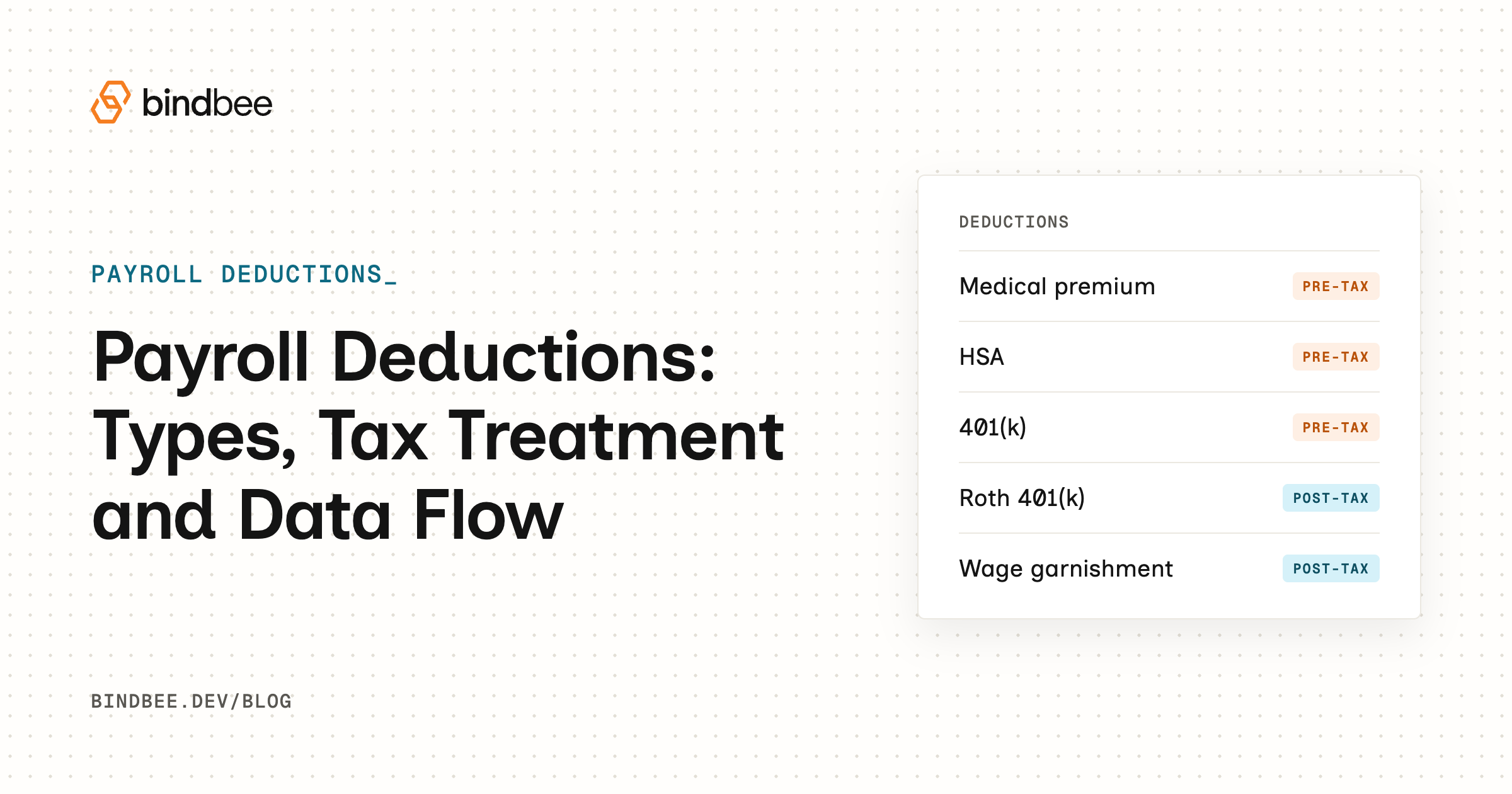
Payroll deductions are amounts withheld from gross pay, and they sort on two axes: mandatory or voluntary, and pre-tax or post-tax. Net pay is gross pay, minus pre-tax deductions, minus tax withholding, minus post-tax deductions and garnishments.
The second axis is where integrations go wrong. A traditional 401(k) deferral leaves income-tax wages but stays in Social Security wages. A health FSA contribution leaves income-tax, Social Security and Medicare wages alike. A garnishment leaves none of them. Collapse the first two into a single "pre-tax" flag and either withholding or the W-2 comes out wrong.
The employer sits at the center of all of this. The IRS says employers withhold federal income tax and the employee share of Social Security and Medicare from wages, and pay the employer share themselves. FUTA is paid only by the employer, from its own funds, and is never withheld from employees. A deduction starts as an effective-dated election or order and ends as deposits, a W-2 and retained records.
This page is written for the product or engineering lead whose product sends deduction amounts into customers' payroll systems.
How each deduction is treated for federal tax and the W-2
Take Maria, an employee at one of your customers, paid weekly. She puts $50 a week into a health FSA and $75 a week into a traditional 401(k). Both are pre-tax, yet they affect her W-2 differently: the FSA lowers Box 1, Box 3 and Box 5, while the 401(k) deferral lowers only Box 1. The IRS retirement plan FAQ is explicit that Boxes 3 and 5 include all employee pre-tax, after-tax and Roth contributions, so a deferral never leaves Social Security or Medicare wages. Which W-2 boxes each pre-tax deduction reduces has its own worked example.
The FSA behaves differently because of the cafeteria plan rules. Under IRS Publication 15-B (2026), qualified benefits under a Section 125 cafeteria plan are generally exempt from income-tax withholding, Social Security, Medicare and FUTA. Two named exceptions break the pattern: adoption assistance is subject to Social Security and Medicare, and so is group-term life coverage above $50,000. Neither requires income-tax withholding.
In the table, mandatory means required by law or by an order, which in practice means garnishments. Employer-provided means an amount the employer supplies and payroll has to report, not something the employee elects. Everything else is voluntary. Each wage base gets its own column because that is how a payroll code is built.
| Deduction | Mandatory or voluntary | Income-tax wages | Social Security wages | Medicare wages | W-2 wage boxes affected |
|---|---|---|---|---|---|
| Traditional 401(k) or 403(b) deferral | Voluntary | Excluded | Included | Included | Box 1 lower; Boxes 3 and 5 unchanged; separate Box 12 code |
| Roth 401(k) or 403(b) deferral | Voluntary | Included | Included | Included | None; separate Box 12 code |
| Section 125 health premium | Voluntary | Excluded | Excluded | Excluded | Boxes 1, 3 and 5 lower |
| HSA contribution through a cafeteria plan (qualified individual) | Voluntary | Excluded | Excluded | Excluded | Boxes 1, 3 and 5 lower |
| Health FSA | Voluntary | Excluded | Excluded | Excluded | Boxes 1, 3 and 5 lower |
| Dependent care assistance and qualified transportation, up to each limit | Voluntary | Excluded | Excluded | Excluded | Boxes 1, 3 and 5 lower |
| Adoption assistance, up to the annual limit ($17,670 for 2026) | Employer-provided | Excluded | Included | Included | In Boxes 3 and 5, not Box 1; Box 12 code T |
| Group-term life coverage above $50,000 (imputed cost) | Employer-provided | Included; withholding not required | Included | Included | In Boxes 1, 3 and 5; Box 12 code C |
| Union dues, charitable contributions, loan or advance repayments | Voluntary | Included | Included | Included | None |
| Garnishment | Mandatory | Included | Included | Included | None |
Two FUTA notes apply to the table. Adoption assistance is subject to FUTA, and group-term life coverage above $50,000 is not.
One more line belongs on the map. Employer match and nonelective contributions are not employee deductions, and the IRS says they are not subject to FICA or income-tax withholding.
Treatment tells payroll what to withhold. It says nothing about where a deduction must stop.
Annual caps and thresholds that stop a deduction mid-year
A deduction that is taxed correctly can still be wrong by October. Social Security tax applies only up to a wage base, so for a high earner it stops partway through the year. SSA's 2026 wage base is $184,500 for 2026 wages, and the OASDI rate is 6.2% each for employee and employer.
Medicare works the other way round. It has no ceiling (SSA lists Medicare taxable earnings as "No Limit"), but the IRS says employers must withhold an additional 0.9% on wages above $200,000 in a calendar year, with no employer match. That threshold is a statutory figure and is not indexed.
Deductions have ceilings too. Maria's $2,600 annual FSA election sits under the health FSA cap, but payroll has to stop the deduction at the cap whatever the benefits system keeps sending. The table gives each limit with its period, because the period is what differs.
| Cap or threshold | 2026 amount | Period | Source | What payroll does when it is reached |
|---|---|---|---|---|
| Social Security wage base | $184,500 | 2026 wages | SSA | Stops Social Security tax on wages above the base, both shares |
| Additional Medicare Tax | 0.9% above $200,000 | Calendar year; not indexed | IRS | Starts withholding the extra 0.9%; no employer match |
| Health FSA salary reduction | $3,400 | Plan years beginning in 2026 | IRS Publication 15-B (2026) | Stops salary reduction at the cap |
| Dependent care assistance exclusion | $7,500 | Per year from 2026; was $5,000 | IRS Publication 15-B (2026); P.L. 119-21 | Excludes only up to the cap |
| Transit and commuter vehicle; parking | $340 | Per month in 2026, for transit and commuter vehicle benefits and for qualified parking | IRS Publication 15-B (2026) | Excludes only up to the monthly limit |
| 401(k), 403(b) or 457(b) elective deferral | $24,500, plus catch-up for eligible employees | Calendar year | IRS Notice 2025-67 | Stops deferrals at the cap |
| HSA contribution | $4,400 self-only; $8,750 family | Calendar year, by coverage tier | IRS Rev. Proc. 2025-19 | Stops contributions at the limit for the employee's tier |
The dependent care row resolves a conflict you will meet in practice. Sources that still show $5,000 are quoting the figure from before 2026. The exclusion is $7,500 per year from 2026.
These limits do not move together. SSA sets the next year's wage base each October, effective January 1. The health FSA cap attaches to plan years beginning in 2026, so a plan year that starts in July runs on the 2026 figure through the following June. The dependent care exclusion is set by statute and the $200,000 threshold is fixed, so neither is indexed. Some 2027 figures are already set (the Social Security wage base is $192,300 and the HSA self-only limit is $4,500), while the 2027 health FSA, transit and 401(k) limits had not been announced when this page was last verified.
Caps constrain what a voluntary deduction may take. Garnishments are the mandatory kind, and their limit is computed on a base that ignores the voluntary deductions entirely.
Disposable earnings and what can legally come out of a paycheck
DOL Fact Sheet #30 defines disposable earnings as the earnings left after legally required deductions: federal, state and local taxes, and the employee share of Social Security and Medicare. Take-home pay is a different number: what remains after every deduction, voluntary ones included.
Deductions not required by law are not subtracted when computing disposable earnings. That covers voluntary wage assignments, union dues, health and life insurance, charitable contributions, savings bonds and repayment of payroll advances. Retirement contributions are not subtracted either, unless the law requires them. Tax treatment and garnishment status are independent: a pre-tax FSA and post-tax union dues both stay in disposable earnings.
Back to Maria. Assume her weekly earnings after taxes and her Social Security and Medicare share come to $400. Her $50 FSA and $75 401(k) deductions come out of her pay but not out of that $400, so her take-home is $275 while her disposable earnings stay $400.
The federal cap for an ordinary garnishment is the lesser of 25% of disposable earnings or the amount by which weekly disposable earnings exceed 30 times the $7.25 federal minimum wage. For Maria that is the lesser of $100 and $182.50, so $100. A payroll that mistook her $275 take-home for disposable earnings would cap the order at $57.50 instead, the amount above $217.50.
| Weekly disposable earnings | Maximum ordinary garnishment |
|---|---|
| $217.50 or less | Nothing may be garnished |
| Over $217.50 but under $290 | Only the amount above $217.50 |
| $290 or more | 25% of disposable earnings |
The $217.50 is 30 times $7.25, and $290 is where the two limits cross: 25% of $290 is $72.50, and so is $290 minus $217.50. The thresholds move only if Congress changes the federal minimum wage.
Three rules sit outside the ordinary cap, according to Fact Sheet #30:
- Support orders may take up to 50% of disposable earnings if the worker supports another spouse or child, and 60% if not, plus 5% more when payments are over 12 weeks in arrears.
- Federal agencies may garnish up to 15% for defaulted debts owed to the United States.
- Bankruptcy court orders and federal or state tax debts fall outside the Title III limits.
States can set their own garnishment rules, which this page does not cover. The voluntary vs mandatory deductions guide works a second garnishment example and shows why a deduction's category changes the base.
A separate limit applies to deductions the employer takes for its own items. DOL Fact Sheet #16 says deductions for things like required uniforms, cash shortages or vehicle repairs may not reduce wages below the $7.25 federal minimum wage or cut into required overtime. They may be prorated over paydays if each workweek still meets the floor.
Payroll applies every limit in this section at calculation time, using what the deduction's code says about it. A code that misstates a deduction's status carries that error into every pay period until someone corrects it.
How a deduction moves from election to W-2 and stored record
A deduction is an effective-dated record that passes through five stages, and the benefits platform owns only the first. Each later stage belongs to the customer's payroll or to the employer.
- Setup. An election from the benefits platform, an HR change or a withholding order arrives with an effective date and is mapped to a deduction code that carries its tax treatment. The benefits platform owns the election; the customer's payroll team owns the code.
- Calculation and approval. Payroll applies the code's treatment, the caps and the garnishment limits to each period's earnings, and the payroll administrator approves the run. Owner: the customer's payroll.
- Net pay, liabilities and remittances. The run produces net pay, tax liabilities and payments to payees such as carriers, and the employer deposits withheld taxes on the IRS deposit schedule. Owner: the employer.
- Accounting and reporting. The run posts accounting entries, and withheld amounts roll up into the quarterly Form 941 and the annual W-2. Owner: the employer.
- Reconciliation and retention. Payroll and benefits records are compared, and employment-tax records are stored. Owner: payroll and benefits teams for reconciliation, the employer for retention.
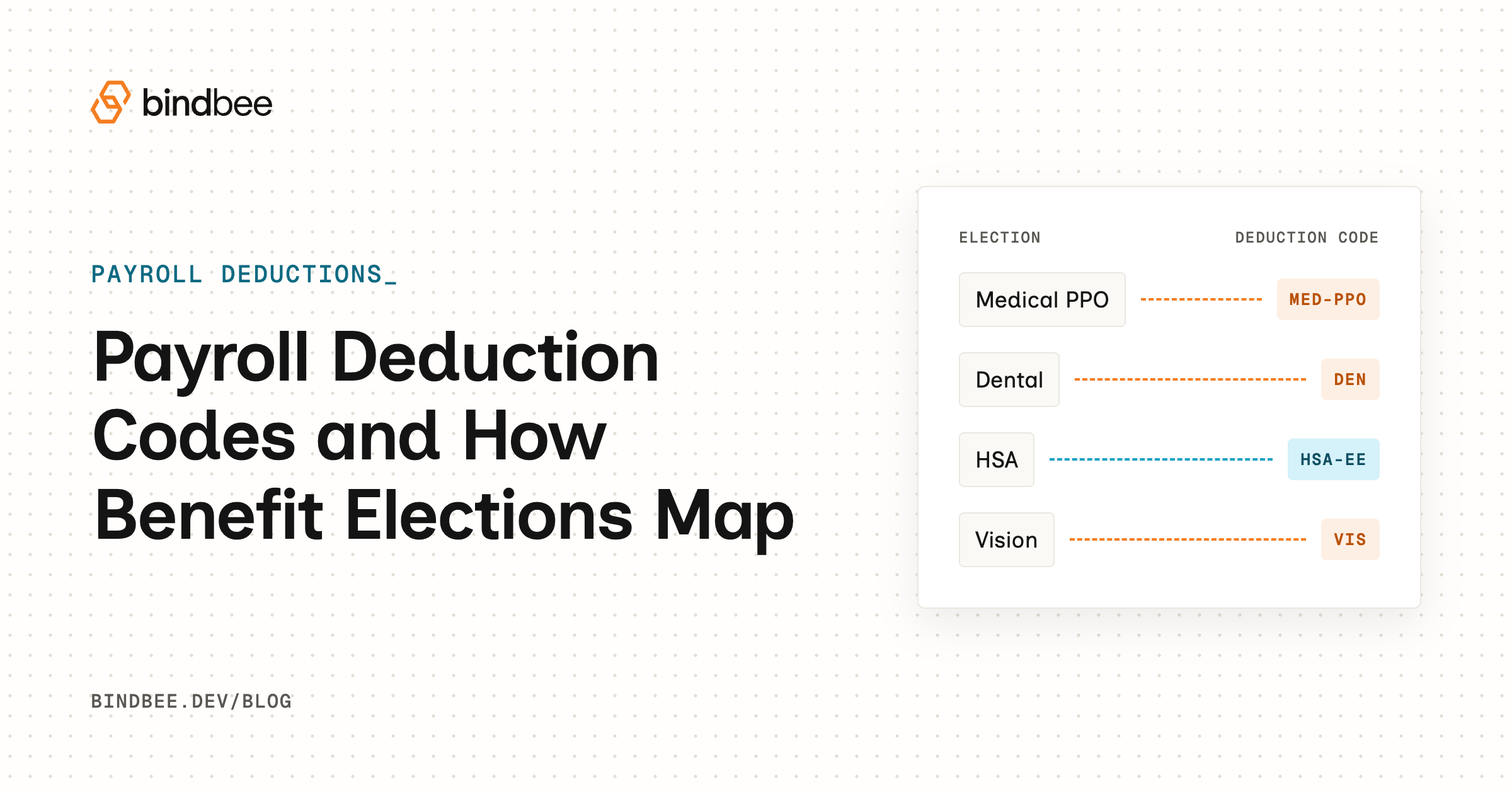
Stage 1 sets the treatment that every later stage applies. If Maria's FSA is coded as post-tax, calculation runs without error, and her Boxes 1, 3 and 5 come out $2,600 too high for the year. Calculation runs the code as configured, and nothing in that stage compares it with the plan. How benefits elections reach payroll setup is where that mapping is decided, and how to map each election to a deduction code covers the spec and the tests.
Stage 5 is the first place the mismatch can surface, which is what reconciliation between benefits and payroll exists to do. Retention is the rule people misremember. The IRS says to keep all employment-tax records for at least four years after filing the fourth-quarter return for the year, so the clock on 2026 records starts when the 2026 fourth-quarter return is filed. Certain 2021 sick and family leave and employee retention credit wage records are the exception, at six years.
Where deduction data crosses from the benefits system into payroll
Three things travel with every deduction from your product into a customer's payroll:
- The deduction code the amount posts to, matching that customer's setup.
- The amount, within whichever cap applies to it.
- The effective date, which sets the pay period where the amount starts.
A fourth has to be confirmed, not sent: that the code's tax setup in the customer's payroll matches the treatment in the table above. Payroll applies whatever the code says.
How those three arrive depends on the approach, and each approach hides its variation in a different place:
| Approach | How the deduction reaches payroll | What varies by payroll system |
|---|---|---|
| Deduction file | The benefits system produces a file in the layout the payroll system imports | File layout, code names, who runs the import and when |
| Direct payroll-vendor API | The benefits platform integrates with each vendor's own API | Authentication, endpoints, field names, whether deductions can be written at all |
| Unified API | One API with a single schema reads payroll codes and posts deductions across payroll systems where the integration supports it | Which integrations and models support a write |
Whichever route you choose, the hard part is the same. Each customer's payroll has its own codes, so a product that sends "FSA, $50" still has to land it on the code that carries the right treatment. Mapping that by hand for each customer is work that remains even for a team doing everything else right. Mapping benefit elections to deduction codes walks through that spec field by field.
Bindbee's API is one example of the unified approach. It reads benefits as four models: the plan catalog, each enrollment, dependent coverage, and per-person insured amounts. All four are read-only, and enrollment changes happen in the source system. Payroll codes are readable too, typed EARNING, DEDUCTION or TAX with a sub_type such as RETIREMENT, HEALTH or GARNISHMENT. Where the customer's payroll system populates it, an employer benefit carries the ID of its deduction code, so you can read which code a plan posts to on that connection.
On the write side, a benefits deduction (an ICHRA allowance, an HSA contribution or a voluntary premium) can be written to payroll as a line item on the employee payroll run, where the integration supports that write. Reads and writes go through the same API, and write support varies by model and integration. Per-integration support is published in the Model Availability Matrix, which marks each model Available, Beta or not available.
The effective date has an unhappy path. Payroll systems close periods, and a deduction written after a period closes can land in the next open one; the customer's cutoff is not exposed through the API. Treat a late change as an adjustment in the following period, and read the run back to confirm the period it landed in.
A Production connector syncs every 24 hours by default, adjustable per connection on request. A write reaches the source system straight away, but it shows up in reads only after the next sync, so design any reconciliation cadence with that default in view.
Bindbee does not calculate withholding, run payroll or set a deduction's tax treatment; the customer's payroll applies all three from how the code is configured. Deduction writes are also not available on every integration, so before relying on one, check three things per payroll system:
- Whether the integration supports a deduction write, per the matrix.
- Whether the customer's payroll has a deduction code for the benefit, and which one.
- Whether that code's tax treatment matches the table on this page.
Enrollment and pay data are sensitive where they leave the benefits system. Bindbee is SOC 2 Type II, ISO 27001, HIPAA and GDPR compliant, and offers a standard Business Associate Agreement.
The unit of work is the deduction code: its treatment, its cap, its garnishment status, its effective date and its owner. A field-level spec that records those five for every code your product posts to is what keeps "pre-tax" from meaning three different things in three different systems.
To find out which of your customers' payroll systems accept deduction writes, start from the coverage list: Bindbee connects to 110+ HRIS, payroll, ATS and benefits systems through one API. We build the integrations. You build the product. Book a demo and we will check your customers' payroll systems against it.
FAQ
Does a pre-tax deduction lower Social Security tax?
It depends on the deduction. A Section 125 premium, a cafeteria-plan health FSA or HSA contribution, and qualified dependent care or transit benefits lower Social Security and Medicare wages as well as income-tax wages. A traditional 401(k) or 403(b) deferral lowers only income-tax wages, so Social Security and Medicare tax still apply to it.
What happens if a deduction write lands after payroll closes?
The payroll system can apply it to the next open period instead of the one you intended. The customer's cutoff is usually not visible through an API, so read the run back after the write, and treat a late change as an adjustment in the following period rather than a correction to a closed one.
Who sets a deduction's tax treatment, the benefits platform or payroll?
Payroll. The treatment lives in how the customer's payroll has configured the deduction code, and every run applies it from there. The benefits platform decides which code an election posts to, so its job is to confirm that the code's setup matches the plan before the first deduction runs.