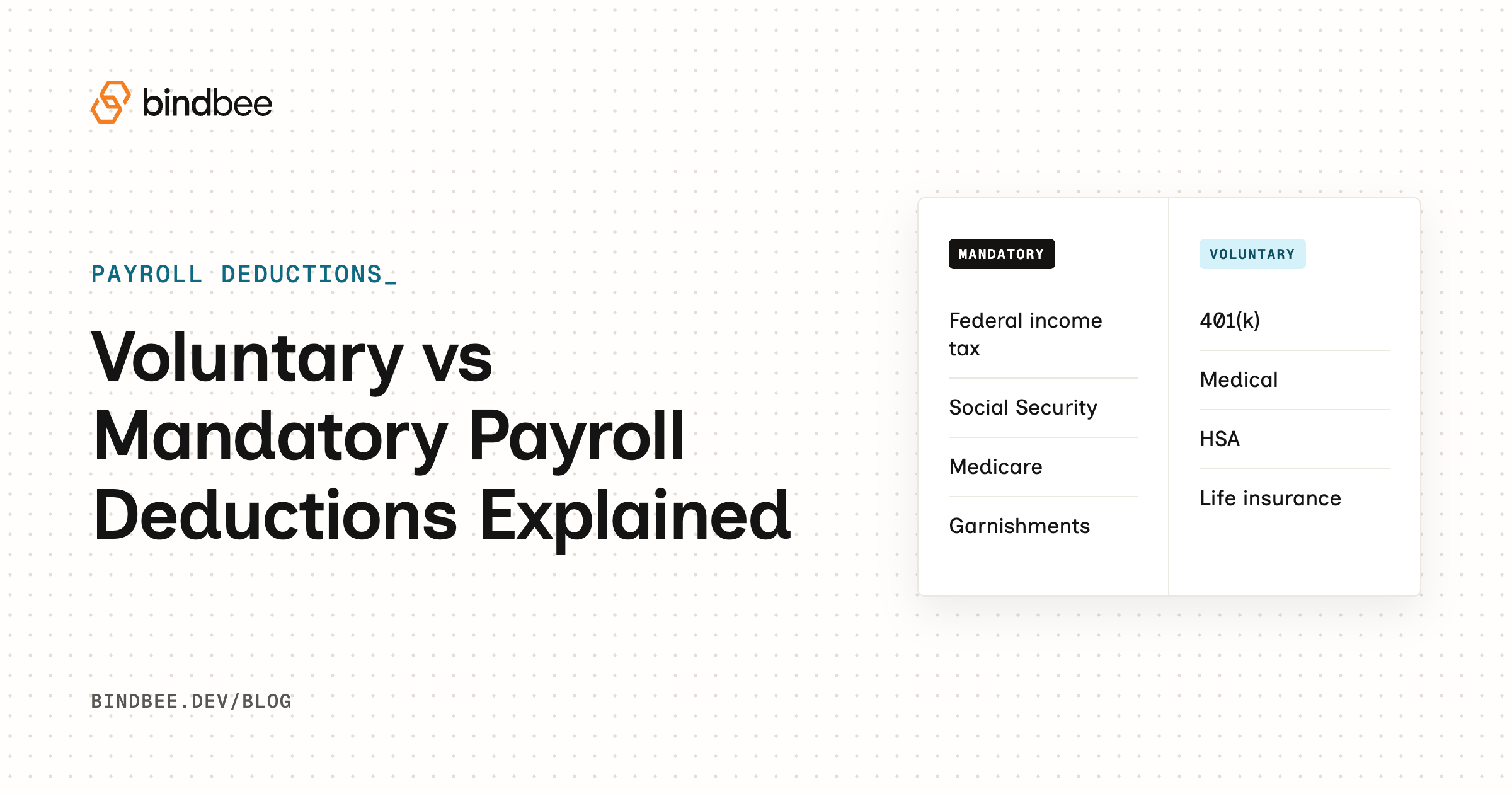

Pre-tax vs post-tax deductions

Summarise the blog with AI
Last verified: 2026-11-03
Key takeaways
- "Pre-tax" is not one treatment. A deduction can reduce federal income-tax wages, Social Security wages and Medicare wages independently, so the question is which of W-2 box 1, box 3 and box 5 it reduces.
- Under IRS rules for Section 125 cafeteria plans, qualifying health coverage, health FSA and HSA deductions are generally excluded from all three wage bases.
- A traditional 401(k), 403(b) or 457(b) deferral leaves box 1 and stays in boxes 3 and 5, so it saves income tax but not Social Security or Medicare tax.
- A designated Roth contribution is after-tax and remains in boxes 1, 3 and 5, while an employer Roth match is generally not subject to Social Security or Medicare withholding and is reported on Form 1099-R.
- In an illustration at a hypothetical 22% income-tax rate (not a withholding estimate, with wages below the Social Security wage base and $200,000), a $100 deduction costs $70.35, $78.00 or $100.00 of take-home pay, depending on which bases it reduces.
- Comparing box 1 against boxes 3 and 5 on a W-2 shows which wage bases a deduction reduced, which points to whether it was treated as an elective deferral or a Section 125 reduction.
Calling a deduction "pre-tax" settles almost nothing. Federal payroll runs on three wage bases: income-tax wages (W-2 box 1), Social Security wages (box 3) and Medicare wages (box 5). Section 125 deductions generally reduce all three, traditional 401(k)-type deferrals reduce only box 1, and Roth and other after-tax deductions reduce none. That is why a pre-tax deduction costs less than its face amount, and why some cost less than others.
The IRS retirement plan FAQs draw the line plainly. Box 1 wages exclude pre-tax contributions made under a salary-reduction agreement, while boxes 3 and 5 include all employee pre-tax, after-tax and designated Roth contributions. IRS Topic No. 424 adds that some 401(k) plans let employees make after-tax contributions as designated Roth contributions. The Section 125 treatment comes from IRS rules for Section 125 cafeteria plans.
| Deduction type | Federal income-tax wages, box 1 | Social Security wages, box 3 | Medicare wages, box 5 |
|---|---|---|---|
| Health, dental or vision premium through a Section 125 cafeteria plan | Generally excluded | Generally excluded | Generally excluded |
| Health FSA contribution through a Section 125 cafeteria plan | Generally excluded | Generally excluded | Generally excluded |
| HSA contribution through a Section 125 cafeteria plan | Generally excluded | Generally excluded | Generally excluded |
| Traditional 401(k), 403(b) or 457(b) deferral | Excluded | Included | Included |
| Designated Roth contribution | Included | Included | Included |
| Other after-tax deduction | Included | Included | Included |
"Excluded" means the amount comes out of that wage base. Employer contributions follow a different rule and get their own table below.
What each wage base is taxed at, and what $100 costs
Each wage base feeds one tax: box 1 feeds federal income-tax withholding, box 3 feeds Social Security tax and box 5 feeds Medicare tax. A deduction saves exactly the taxes attached to the bases it reduces, nothing more.
The employee shares, per IRS Publication 15 (2026), are Social Security tax of 6.2% on wages up to the annual wage base and Medicare tax of 1.45% with no cap. An Additional Medicare Tax of 0.9% is withheld on an employee's wages above $200,000 in a calendar year. The take-home cost of a deduction follows directly: the amount, minus the amount times the combined rate of every tax whose wage base it reduces.
Take one scenario. An employee puts $100 of a single paycheck toward each type of deduction, at a hypothetical income-tax rate of 22%. That rate is for illustration only and is not a withholding estimate, and the example assumes wages below the Social Security wage base and below $200,000.
| Deduction type | Taxes it avoids | Take-home reduction per $100 |
|---|---|---|
| Section 125 premium | Income tax, Social Security and Medicare (22% + 6.2% + 1.45% = 29.65%) | $70.35 |
| Traditional 401(k) deferral | Income tax only (22%) | $78.00 |
| Roth or other after-tax deduction | None | $100.00 |
The gap between the first two rows is $7.65, which is exactly the combined Social Security and Medicare rate. An illustration that applies only an income-tax rate cannot tell those two rows apart, and that is the difference a customer notices on a stub.
The Section 125 saving also has a ceiling. Social Security tax applies only up to an annual wage base, $184,500 for 2026 and $192,300 for 2027, which SSA resets each October (see the 2026 and 2027 federal payroll figures). Once an employee's year-to-date wages pass it, no more 6.2% is withheld, so a Section 125 deduction stops saving it for the rest of that year. For our employee in December, the cost of the premium rises from $70.35 to $76.55, because the income-tax and Medicare savings continue.
This page covers federal income tax, Social Security and Medicare only. Each state defines its own income-tax wages, and none of that is stated here.
Everything so far assumes the employee's own money moving through payroll. The employer's contribution sits on the same retirement statement and follows different rules.
Roth and employer contributions: where the pattern breaks
The deciding variable here is whose money it is, not whether it is pre-tax or Roth. Employee deferrals, traditional or Roth, stay in boxes 3 and 5. Employer matching and nonelective contributions, pre-tax or Roth, are generally not subject to Social Security or Medicare withholding, and neither is subject to federal income-tax withholding.
| Contribution | Who makes it | Federal income-tax withholding | Social Security / Medicare | Where reported |
|---|---|---|---|---|
| Employee designated Roth | Employee | Included in box 1 (after-tax) | Included in boxes 3 and 5 | W-2 boxes 1, 3 and 5, with a box 12 code for designated Roth |
| Employer pre-tax match or nonelective | Employer | Not subject to withholding | Not subject to FICA | Not covered here |
| Employer Roth match or nonelective | Employer | Not subject to withholding | Generally not subject to withholding | Form 1099-R, code G in box 7 |
| Roth SEP or SIMPLE salary reduction | Employee, by salary reduction | Subject to withholding | Subject to FICA | Not covered here |
The IRS's SECURE 2.0 Form W-2 guidance, published in August 2024, says employer designated-Roth matching and nonelective contributions are reported on Form 1099-R rather than as wages. The treatment applies to contributions made after December 29, 2022. Per the IRS, employer pre-tax matching and nonelective contributions are likewise not subject to FICA or federal income-tax withholding.
Picture an employee who defers $100 as Roth while the employer adds a $50 Roth match. The $100 sits in boxes 1, 3 and 5. The $50 appears in none of them and turns up on a 1099-R with code G in box 7.
The exception is narrow. Roth SEP and SIMPLE salary-reduction contributions get no such treatment. They are subject to income-tax withholding, FICA and FUTA, because they come out of the employee's pay. For support, the practical consequence is blunt: someone searching a W-2 for an employer Roth match will find nothing, and the answer is on a different form.
How to read a stub and a W-2 for the treatment
A stub shows the arithmetic and the W-2 shows the result, and comparing the two tells you which treatment payroll actually applied. A mis-coded deduction rarely announces itself. It shows up as wage totals that do not match each other.
The arithmetic runs in six steps, and a stub lists them in this order:
- Gross pay, total earnings before any deduction, is where every wage base starts.
- Pre-tax deductions come out next: Section 125 premiums, cafeteria-plan FSA and HSA contributions, and traditional deferrals.
- Taxable wages are then set for each tax, and income-tax, Social Security and Medicare wages diverge when the deductions in step 2 differ in kind.
- Taxes are withheld on the step 3 figures.
- Roth deferrals and other after-tax deductions come out of what remains.
- What is left is net pay.
Where a stub breaks taxable wages out per tax, step 3 is where a mis-coded deduction shows first. The W-2 repeats the same comparison once a year. Check these, with the IRS retirement plan FAQs as the reference:
- Box 1 below boxes 3 and 5 points to an elective deferral such as a traditional 401(k).
- Boxes 3 and 5 both below gross wages point to Section 125 reductions, or another excluded benefit such as qualified transit or dependent care, provided the employee is below the Social Security wage base.
- All three boxes at gross wages mean no pre-tax deduction reduced them.
- Box 12 codes distinguish elective deferrals from designated Roth contributions by plan type.
- Box 13's retirement-plan checkbox is checked for active participants, so it confirms participation, not treatment.
The signals stack. An employee with both a medical premium and a 401(k) deferral shows box 1 lowest, with boxes 3 and 5 equal to each other and below gross. Box 3 stops tracking gross once wages pass the Social Security wage base, so read it with the year's wages in mind.
Consider a customer whose W-2 shows boxes 3 and 5 below gross, though the only deduction they say they elected was a 401(k) deferral. Assume wages under the Social Security wage base and no other reductions: a deferral alone leaves both boxes at gross, so the W-2 and the election disagree. The likely candidate is a deduction that reduced all three bases, the Section 125 pattern, but the W-2 cannot name it. To confirm, read the year's stubs for the deduction lines that actually ran, and check what each was coded as in payroll.
The reverse needs the same care. A customer elected a cafeteria-plan premium, and box 1 is below gross while boxes 3 and 5 equal gross, with wages under the Social Security wage base. That is the pattern a deferral leaves, so a premium coded as a deferral is the first thing to check. Boxes 3 and 5 at gross cannot say so alone, since an after-tax deduction leaves them there too. It takes box 1 to tell the two apart.
Box 12 is an information item: per IRS Topic No. 424, employers report elective deferrals there, and deferrals still count as wages for FUTA.
Every one of these checks works backward from a W-2 that already exists. The cheaper fix sits upstream, on the line that carried the deduction into payroll.
What has to travel with a deduction sent to payroll
A benefits platform gets an election into a customer's payroll one of three ways: a direct payroll API, a file export, or a unified API. On every route the election has to become a deduction line on a deduction code, and the treatment from the table above is whatever the customer's payroll configuration attached to that code. Paylocity's developer documentation states it directly: the taxability of an earning or deduction code is determined by its assigned detType, which also decides how the W-2 boxes are generated. The mapping from election to code is the point of control.
Take an employee who elects a $100 HSA contribution through a cafeteria plan. If it lands on a code configured as Section 125, the take-home cost is $70.35 at the illustrative rate from the worked example above. If it lands on a code configured as after-tax, the same election costs the full $100, all three wage bases stay at gross, and the mistake surfaces later as a W-2 complaint.
Getting that deduction line and its code into each customer's payroll without building a separate connection per system is the integration problem. Bindbee's API can write a benefits deduction, such as an ICHRA allowance, an HSA contribution or a voluntary premium, to payroll as a line item on the employee payroll run endpoint, where the integration supports it. A worked example of writing a deduction line into one payroll system shows what that looks like in practice.
Payroll codes are readable too, typed EARNING, DEDUCTION or TAX. Where the customer's payroll system populates it, an employer benefit carries the ID of the deduction code it posts to, so you can see which code a plan uses on that connection. Which code belongs to which plan stays the customer's decision, so confirm it with them, and map each election to its code before the first write. Bindbee reads and writes the code; it does not set or check the code's tax treatment, which stays in the customer's payroll configuration.
On the benefits side, Bindbee reads four models: the plan catalog, each enrollment, dependent coverage and per-person insured amounts. All four are read-only, so enrollment changes happen in the source system.
Whether this works on your customers' payroll systems depends on the integration and the model. Reads and writes go through the same API, write support varies by model and integration, and Bindbee publishes per-integration support (Available, Beta or not available) in its Model Availability Matrix. Bindbee is SOC 2 Type II, ISO 27001, HIPAA and GDPR compliant.
If you are mapping elections to deduction codes for customers, the payroll deduction writeback use case shows the write path across the 110+ HRIS, payroll, ATS and benefits systems Bindbee connects to. Book a demo and we will check it against the payroll systems your customers run. We build the integrations. You build the product.
FAQ
Is a 401(k) deferral taxed for Social Security?
Yes. A traditional 401(k), 403(b) or 457(b) deferral is excluded from federal income-tax wages (W-2 box 1) but stays in Social Security and Medicare wages (boxes 3 and 5), so the 7.65% employee share still applies to it, up to the Social Security wage base for the 6.2% part.
Why doesn't my employer Roth match show on my W-2?
Employer designated-Roth matching and nonelective contributions are reported on Form 1099-R, with code G in box 7, not as W-2 wages. They are generally not subject to income-tax, Social Security or Medicare withholding. An employee's own Roth deferral, by contrast, stays in W-2 boxes 1, 3 and 5.