
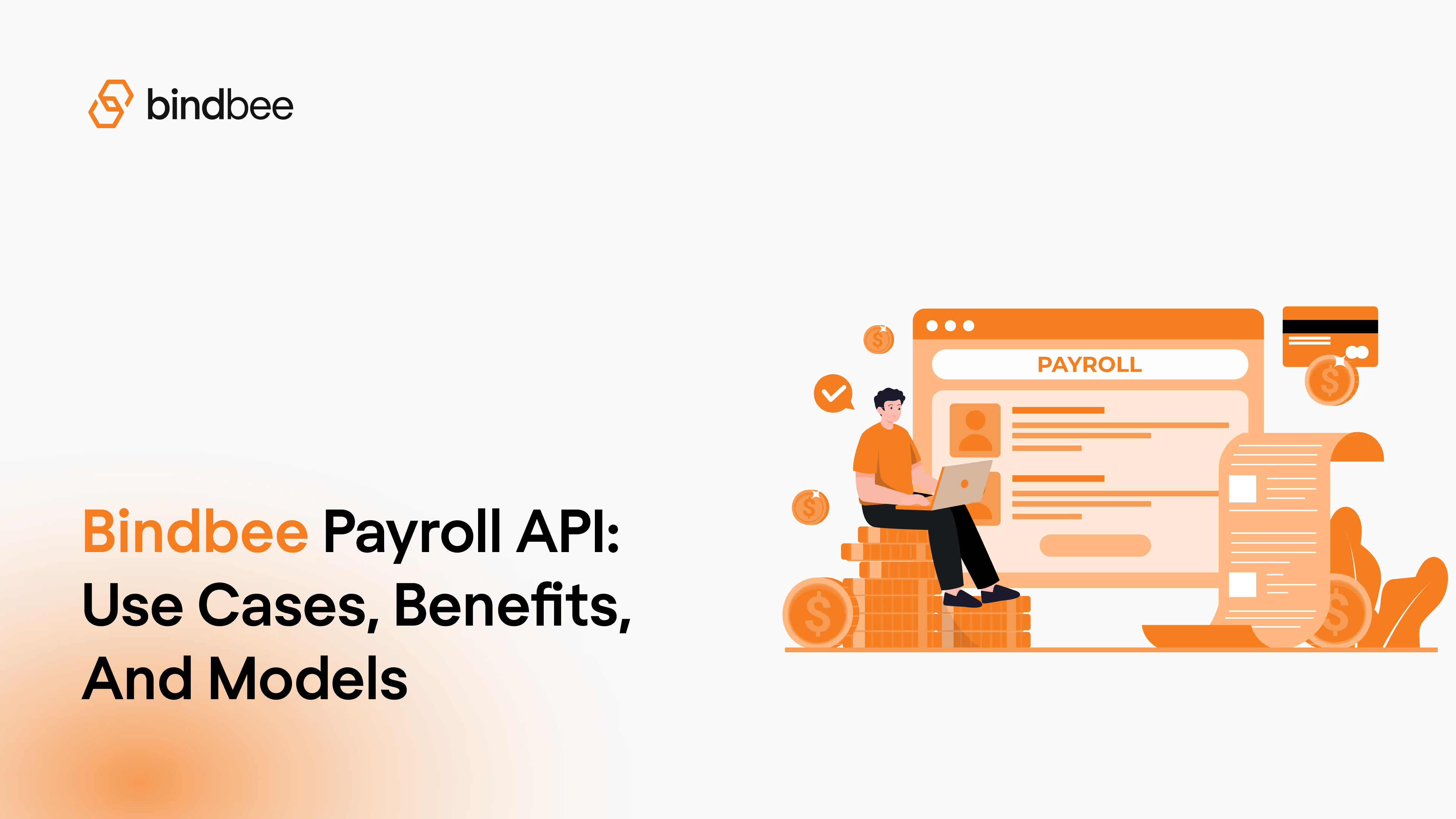
Bindbee Payroll API: Use Cases, Benefits, and Models
Summarise the blog with AI

Payroll integrations tend to break at the worst possible moment. A late-stage enterprise deal where the prospect asks about ADP support. An onboarding call where the customer realizes their HRIS isn't connected yet. A Friday afternoon when compensation data hasn't synced before payroll runs. Most of these failures aren't technical disasters. They're the result of building integrations one at a time, without a unified layer underneath. Each new HRIS requires a new connector. Each API change requires a maintenance cycle. Each new customer adds another configuration to manage. This piece is about what a payroll API actually looks like when it's built to handle this at scale, what use cases it enables, and how the data model underneath determines whether you can actually build on it.
What Is a Payroll API?
A payroll API is an interface that allows your product to exchange payroll-related data with external HR and payroll systems. In practice, this means accessing compensation records, pay schedules, deductions, earnings, contributions, and payroll run history from systems like ADP, Gusto, Paychex, Rippling, or any of the dozens of platforms your customers use.
The challenge isn't accessing one payroll system. It's building a data layer that works consistently across all of them.
The Real Use Cases
The value of a payroll API depends almost entirely on what you're building. Here are the use cases where it actually matters:
Benefits Deductions and Contributions
Benefits platforms need to write deduction amounts back to payroll. If an employee enrolls in a new health plan, that change has to reach the payroll system before the next run. A payroll API with write support handles this automatically instead of relying on manual exports or HR admin intervention.
401(k) and Retirement Platforms
Retirement platforms need contribution rates, compensation figures, and payroll run data to calculate deferrals correctly. They also need to push contribution changes back when employees adjust their elections. Without real-time sync, contribution errors compound over time.
Compensation Analytics
HR analytics tools that surface compensation benchmarks, pay equity gaps, or total rewards data need clean, normalized compensation records from across the organization. That means pulling salary, bonus, equity, and benefits cost data from payroll systems and mapping it to a consistent schema.
Workforce Financial Planning
Finance tools that model headcount costs need payroll data at the employee level. What does this role actually cost including taxes, benefits, and equity? That requires payroll API access with enough depth to pull loaded compensation, not just base salary.
Employer Onboarding
When a new employer joins your platform, you need their employee roster, compensation structure, and current deduction setup immediately. A payroll API with embedded authentication flows lets you pull that data in minutes rather than waiting days for a manual data export.
The Data Model Is What Actually Matters
Most payroll APIs fail not because they can't connect, but because the data they return is inconsistent. ADP structures payroll differently than Gusto. Rippling's compensation model doesn't map directly to Paychex. If you're normalizing this yourself, you're doing the hard work that a unified payroll API should be handling for you.
Here's what a well-structured payroll data model looks like:
Employee
Core identity: employee ID, name, employment type, start date, department, location. This is the anchor everything else maps to.
Employment
Job title, employment status, manager relationship, work location. Tracks the structure of how someone fits into the organization.
Compensation
Pay rate, pay period, pay type (salary vs hourly), effective date. Includes historical records so you can track changes over time.
Payroll Run
Pay date, period start/end, gross pay, net pay, taxes withheld. Run-level data that tells you when people were paid and what was included.
Deductions
Benefit deductions, retirement contributions, garnishments. Each with type, amount, frequency, and effective dates.
Earnings
Regular pay, overtime, bonuses, commissions. Broken out by type so you can calculate total compensation accurately.
Read vs. Write: Why Both Matter
Most HR integrations only support read access. That's enough for analytics and reporting use cases, but it's not enough for benefits platforms, retirement providers, or any product that needs to push data back into payroll.
Write support matters for:
- Updating deduction amounts when benefits elections change
- Pushing 401(k) contribution rate changes
- Writing new hire data when onboarding triggers downstream payroll setup
- Syncing compensation changes from HR to payroll
If your product needs to complete any of these workflows, you need a payroll API that supports bidirectional sync, not just reads.
How Bindbee Handles Payroll Integrations
Bindbee is a unified API built for HR Tech and benefits companies. Instead of building separate connectors for each payroll system, you connect once to Bindbee and get normalized access to payroll, compensation, and deduction data across 65+ HRIS and payroll platforms.
What that means in practice:
- One consistent schema across ADP, Gusto, Paychex, Rippling, and 60+ other systems
- Read and write support for deductions, contributions, and compensation records
- Real-time webhooks when payroll data changes
- Embedded auth flows so employers can connect their payroll system in minutes
- SOC 2, HIPAA, and ISO 27001 compliance for payroll-grade data security

Book a demo to see how Bindbee's payroll API can accelerate your integration roadmap.