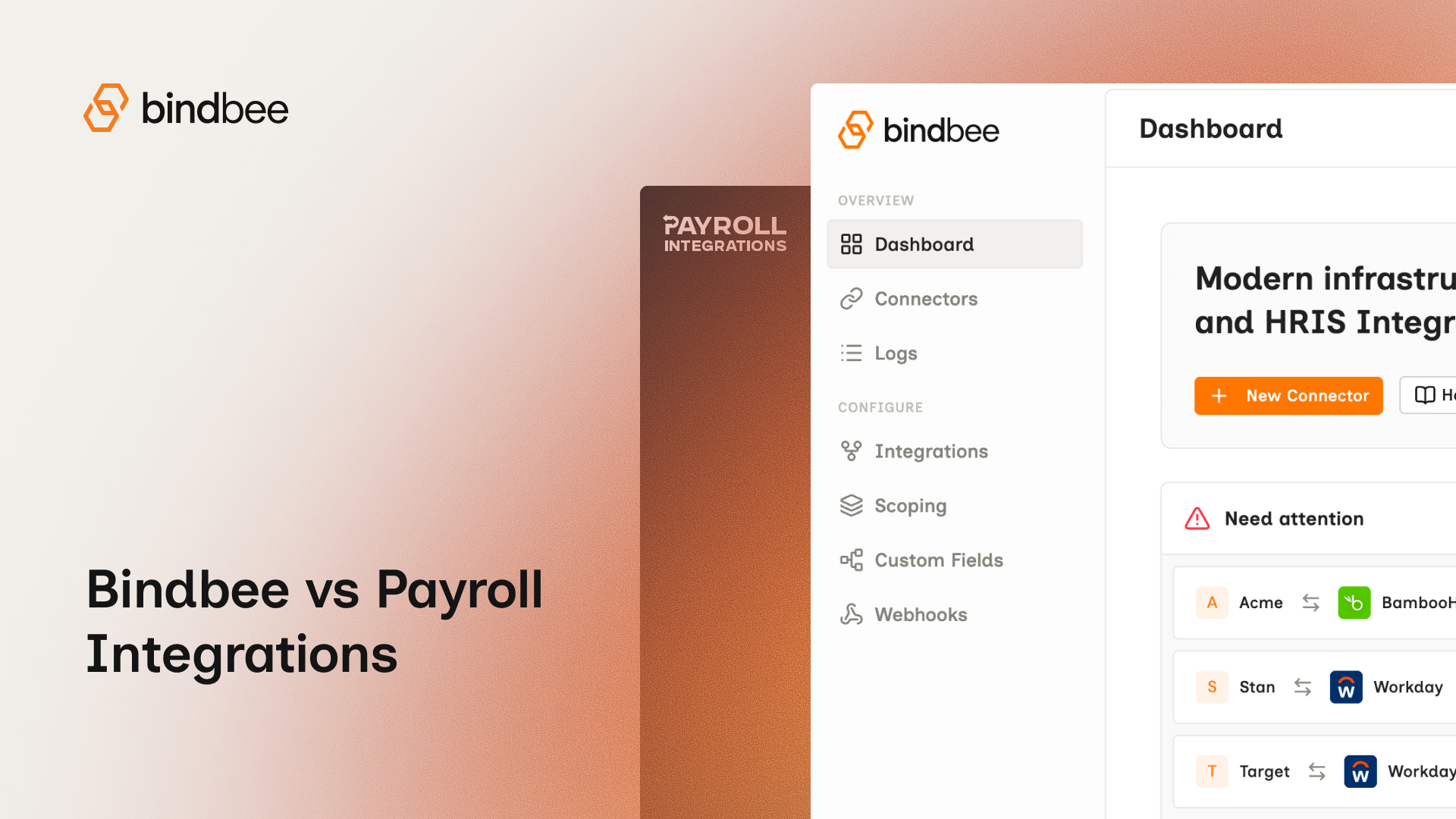

11 Common Integration Challenges and How to Overcome Them
Summarise the blog with AI
Last verified: 2026-11-20
Integration challenges are universal in HR Tech, but teams that anticipate them ship faster and maintain more reliable systems. Your customers' HRIS, payroll and benefits systems belong to other vendors. You don't choose their schema, their auth, their rate limits or their release schedule, so every fix has to hold once per connection and keep holding after the vendor ships a change.
Here are the 11 most common integration challenges, why each one happens, and how to overcome it.
Key takeaways
- Most integration problems are structural, so a retry won't fix them. Only timeouts, throttling and brief outages clear on a second attempt. Schema gaps, expired credentials and missing endpoints come back every time.
- Normalize at the edge. Translate each vendor into one data model you own, so vendor-specific logic stops before it reaches your product code.
- Alert on sync failures as well as connection failures. A broken sync leaves your last copy readable, so nothing on your read path tells you the data stopped arriving.
- Writes need more care than reads. Check write support per model and integration, build each request from the connector's own schema, and attach an idempotency key so a retried write can't create a second record.
- State how fresh your data is. A synced copy trails its source, so decide how far behind it may fall and tell your customers.
- Every fix recurs per connected system. Decide which of the 11 you will own and which you will hand to an integration provider.
Integration failures come in two kinds. Microsoft's Azure Architecture Center defines a transient fault as a momentary loss of connectivity, a temporary unavailability of a service, or a timeout when a service is busy. These typically self-correct if the action is repeated after a suitable delay. Everything else is structural: the data means something different, the endpoint isn't there, the credential is wrong. Retrying a structural failure returns the same failure, faster.
1. Schema Inconsistency Across Systems
Every HRIS structures employee data differently. Workday's worker record doesn't map directly to BambooHR's employee object, and deduction type codes vary by payroll vendor. Without normalization, your application code branches per vendor, and every new system adds another branch.
Benefits data shows how far apart systems can be. Suppose one vendor stores plan, tier and cost on the employee record, a second keeps the plan catalog apart from each enrollment, and a third tracks dependents and insured amounts in their own records. "Coverage" is one word for four different things, and a field-for-field copy puts each in the wrong place.
How to overcome it: put a translation layer between the vendors and your product. Microsoft's Azure Architecture Center documents the pattern as the anti-corruption layer: a facade or adapter that translates between subsystems that don't share semantics, first described by Eric Evans in Domain-Driven Design. It can run as a component inside your application or as an independent service, and either way it adds latency.
That placement is the build-or-adopt line. Adapters inside your app mean writing and maintaining one per vendor. A separate shared-model service concentrates the work in one place, and a unified API is a pre-built version of it.
Bindbee's API covers 40+ unified data models across HRIS, payroll, ATS, LMS and benefits. For benefits it reads the four things from the example above as four models: the plan catalog, each enrollment, dependent coverage and per-person insured amounts. When an upstream field has no place in the model, Bindbee's Custom Fields map any field already in the payload Bindbee receives onto a unified model through a JMESPath expression, per integration or per connector.
2. Authentication Complexity
Different systems use different auth flows: OAuth 2.0, API keys, SAML and certificate-based auth. Each comes with its own lifecycle. Access tokens expire and need refreshing, an admin rotates a key, a password changes, or someone narrows the integration user's permissions. Managing that across dozens of systems and hundreds of customer connections is significant overhead.
The hardest part is that a credential failure is structural. Retrying with a dead token returns the same error until a person at the customer reconnects.
How to overcome it:
- Let customers authorize through a guided, hosted flow, so you never collect or store their credentials by hand.
- Keep token refresh and rotation inside the integration layer, so your product code never handles a raw credential.
- Treat "this connection needs relinking" as its own alert, separate from ordinary sync errors, and route it to someone who can contact the customer.
Bindbee handles each of these. Customers authorize through a hosted Magic Link or an Embedded SDK, and their credentials never pass through your product. Bindbee reaches each system through its own API (OAuth, API key, token or certificate) or a customer-run SFTP export, never screen scraping. Your own calls carry two headers, your API key and the connector token for that customer:
When a customer's credentials stop working, the connector moves to RELINK_NEEDED and Bindbee's connector.relink_needed webhook fires once. connector.relinked follows when the customer reconnects. That one event is the signal to act on, because it means your customer has to do something.
3. API Rate Limits
HRIS and payroll APIs enforce rate limits that slow sync operations or block them outright at scale. The load is uneven in HR: a new customer's first backfill, a hiring wave or open enrollment can multiply the number of calls in a week. Without rate limit handling, those high-volume syncs fail exactly when customers are watching.
How to overcome it:
- When a vendor returns
429 Too Many Requests, wait as long as itsRetry-Afterheader asks, and count the wait against your retry cap. - Read each vendor's limits on their own terms, since vendors signal throttling in different ways.
- Queue sync work and throttle it per connection, so one customer's backfill can't eat the allowance another customer's sync needs.
Bindbee applies the per-connection rule at its own API: 200 requests per minute per connector, so one customer's traffic can't exhaust another's. That limit is Bindbee's own, and the source system's limits still apply behind it.
4. Silent Integration Failures
The most dangerous integration failure is the one you don't know about. A deduction that stops syncing, a new hire that doesn't get provisioned, a termination that doesn't trigger offboarding. Every API call can succeed while data is still missing, because a permission scope was narrowed or a sync job failed.
Failed syncs are quiet by nature. Bindbee's documentation puts it this way: after a failed sync, previously synced data stays readable, so the failure means your copy is stale, not missing. A broken connector does not announce itself on your reads, and has to be watched separately.
How to overcome it: monitor sync outcomes, not just connections.
- Alert on every failed sync, and alert harder on a connection that needs relinking. Bindbee sends
connector.sync.started,connector.sync.completedandconnector.sync.failedwebhooks, and the failed event carries anerrorobject with the failure time and a summary. - Compare record counts against what the customer sees in their own system, so a narrowed permission scope shows up as a number that doesn't match.
- Make one customer's sync traceable end to end. OpenTelemetry maintains several official propagators, and its default uses the headers specified by the W3C Trace Context specification, so a request keeps one identity across your API, queue and workers.
Your trace still ends where the vendor's system begins. Say a customer reports that a coverage change never reached their payroll system. Your trace shows the job, the worker and the outbound call. Then it stops. So log a connection ID and a sync ID on every call that crosses the vendor boundary, with the response you got back. Bindbee puts both on every webhook: a connector object and a sync object with its sync_id.
Keep personal data out of that telemetry. The Azure Architecture Center advises removing personal data before using data for performance monitoring or debugging. In HR integrations it carries weight: a payload logged for debugging is an employee record sitting in your logs.
5. API Version Changes
HRIS vendors change their APIs on their own schedule. A field is renamed or dropped, a new required field appears, an old version is retired. Without active monitoring and a fast response, a vendor update breaks your connector, often as a silent failure from the previous challenge.
How to overcome it:
- Parse tolerantly. The Apache Avro specification says that if the reader's schema has a field with a default value and the writer's schema lacks that field, the reader uses the default. Apply the same rule to vendor payloads: a dropped field gets your default, and a new field you don't recognize shouldn't fail the record.
- Keep the raw payload next to your mapped record, so a mapping fix can be re-applied to what you already hold. Bindbee returns the upstream payload as
raw_datawhen you ask for it withinclude_raw_data=true, which is also how you check how a value was normalized. - Hand the connector upkeep to someone whose job it is. With a managed integration layer, the provider absorbs vendor-side API changes. Bindbee maintains each of its connectors, so a vendor's API change is Bindbee's work, not your engineering team's.
6. Write-Back Complexity
Pushing data back to payroll or HRIS systems is harder than reading from them. Different systems have different write endpoints, validation requirements and error response formats. What one system needs to create an employee differs from another, and can differ by tenant within the same system.
Writes also fail in ways reads don't. Bindbee's documentation calls them business failures: an insufficient leave balance, a closed payroll period, a mandatory custom field. The useful message is the source system's own.
How to overcome it:
- Check write support per model and integration. Working reads say nothing about writes. Bindbee's unified API accepts writes on four HRIS models: Employee, Employee Payroll Run, Time Off and Timesheet Entry. Support for each varies by integration and is published in Bindbee's Model Availability Matrix.
- Build each request from the connector's own schema. Bindbee's Meta endpoints return the request body a connector expects for one write operation, with field requirements, types and accepted values, so you don't hardcode a body that only fits one system.
- Normalize errors into one shape. IETF RFC 9457 (July 2023, obsoleting RFC 7807) defines a problem detail, a machine-readable error format in JSON or XML, so your retry and alerting logic reads one format for every vendor.
- Make retried writes safe. A write that times out can still reach the provider, and retrying it blind can create a second record in your customer's system.
Step 4 needs the API's help. Bindbee's four HRIS create endpoints accept an X-Idempotency-Key header. Send the same key with the same body and Bindbee returns the saved result without writing to the provider again. Derive the key from your own record, so every retry reuses it:
One more thing to plan for: your own write isn't readable back straight away. It lands in the source system, but Bindbee's reads answer from the last completed sync, so the new record appears in a GET once the next sync picks it up.
7. Missing Data and Endpoints in the Vendor API
Sometimes the data arrives in the wrong shape. Sometimes it doesn't exist at all. The vendor decides which models its API exposes, which writes it allows and what an error looks like. Before designing around a missing capability, find out whether it's missing, then pick the least bad way around it.
A file export is a dependable route for many payroll and benefits systems, and its freshness follows its schedule: a customer exporting nightly gives you data up to a day old. The trade-offs between an API and a file export decide which one a given customer gets.
8. Timeouts and Transient Outages
Some failures really do clear on a second try: a timeout, a 503 from a busy service, a brief outage on a system you don't run. Retry these, and only these, inside three limits: a count, a delay and a final action. Put a circuit breaker behind the retries so a vendor that is down isn't hammered by your own jobs.
A retry policy that survives someone else's API has six parts:
- Classify: retry timeouts, brief outages and busy-service responses. The Azure Architecture Center advises against retrying most 4xx client errors, because the request is wrong and sending it again gets the same answer.
- Cap: set a maximum retry count so the loop always ends.
- Back off with jitter: space attempts with increasing, randomized delays, which reduces load and stops many clients retrying in synchronized spikes.
- Wait out throttling: honor the vendor's
Retry-Aftersignal (challenge 3). - Repeat safely: only repeat writes that carry an idempotency key (challenge 6).
- Define the final action: after the last attempt, park the item, alert, and mark the connection as failing, so nothing is dropped silently.
Steps 1 to 4 fit in a few lines:
A retry policy bounds one call. It says nothing about the hundredth call to a vendor that has been down for an hour. The circuit breaker covers that: it fails fast rather than calling a failing dependency, and a Half-Open state lets a limited number of requests test whether the dependency has recovered. Keep one breaker per connection, so one customer's vendor outage doesn't stall everyone else's syncs.
9. Credential Security Across Customer Systems
An integration that holds your customers' access to other systems is a standing credential store, and the security baseline covers it. NIST SP 800-228, Guidelines for API Protection for Cloud-Native Systems (updated March 2026), recommends an organizational inventory of internal and external APIs (REC-API-4.2), so the APIs you call are in scope as well as the ones you expose.
Broken authentication, which the OWASP API Security Top 10 (2023) lists, permits credential stuffing, weak passwords, unvalidated tokens and weakly stored passwords, and can lead to account takeover. NIST's REC-API-11 answers with robust authentication and correct processing of credentials, including protection against credential stuffing and brute force.
How to overcome it:
- Inventory every external API you call and every customer connection you hold, so none goes unreviewed.
- Authenticate and process credentials robustly, as REC-API-11 describes.
- Keep customer credentials out of your product altogether, by authorizing through a flow that never routes them through it.
The first two are discipline you keep up. The third is a design choice, and Bindbee makes it with its hosted Magic Link and Embedded SDK. Bindbee is also SOC 2 Type II compliant and ISO 27001 certified, with data encrypted in transit (TLS 1.2+) and at rest (AES-256). If a review is coming, here is what counterparties ask for in a vendor security review.
10. Stale Data Between Syncs
Between syncs, your copy trails the source. The Azure Architecture Center describes event-driven designs as accepting eventual consistency as a deliberate trade-off, and "deliberate" is the useful word: decide how far behind your copy may fall, then state it to your customers.
Bindbee states its contract. A Production connector syncs every 24 hours by default, adjustable per connection on request. Webhooks v2 send a created and an updated event per data model, with event IDs, per-connector sequence numbers and Standard Webhooks signatures. Data events follow the sync, so they report what the last sync found.
The ID and the sequence number are what make a handler safe to retry and safe to reorder:
Events alone won't settle everything, which is why change detection needs reconciliation as well as events.
11. Partial Failures in Multistep Writes
Some changes span more than one system. Suppose a change must update your database, then a customer's payroll system, and the second call fails after the first committed. There's no atomic transaction across the two to roll back.
How to overcome it: use a compensating transaction, which undoes the completed step. The Azure Architecture Center attaches three caveats: a compensation can itself fail, it needn't undo steps in exact reverse order, and it doesn't necessarily restore the original state. So log compensations like any other write, give them their own retries and alerts, and make the order of steps explicit in code rather than leaving it to chance.
How Bindbee Addresses These Challenges
Each of the 11 challenges recurs for every system you connect, so ownership is the decision that outlasts the build. A new customer on a new vendor reopens schemas, auth, limits, writes, credentials, tracing and drift, none of them under your control.
You have two ways to carry that. Build and maintain an adapter, a retry policy, a credential store and a drift check per vendor, or adopt a provider that carries the per-connection work. Adopting doesn't make the challenges disappear. It moves who handles them, and your own retry policy and tracing stay yours either way.
Bindbee handles schema normalization, hosted authorization, rate limiting, sync monitoring webhooks, connector maintenance and write-back across 110+ HRIS, payroll, ATS and benefits systems, through one API. Most customers are live within a week, and 100+ customers, including Newfront, Healthee and Papershift, run their integrations on it.
Whichever way you go, use these questions to review your own build or any provider's:
- Where does vendor-specific translation live, and what happens to a field the model lacks?
- How do customers authorize, and how will you know when a connection needs relinking?
- Is there a per-connection request budget, and does the client honor
Retry-After? - Will a failed sync raise an alert even though old data is still readable?
- Who absorbs a vendor's API change, and is the raw payload kept?
- Which models accept writes for this integration, and are retried writes idempotent?
- Can you see per-integration coverage, and what is the fallback when the API lacks a model?
- Is retry bounded, with backoff, jitter and a circuit breaker?
- Does an inventory list every external API, and where do customer credentials live?
- Is freshness stated, and are event handlers safe to retry and reorder?
- How are partial failures in multistep writes compensated and logged?
If you're weighing the choice, build in-house or outsource lays out the decision. We build the integrations, you build the product.
FAQ
What are the most common data integration challenges?
The most common are schema inconsistency between systems, authentication and credential upkeep, API rate limits, silent sync failures, vendor API changes and the extra difficulty of writing data back. In HR, payroll and benefits integrations, missing endpoints, stale data between syncs and partial failures in multistep writes round out the list.
Why do HRIS integrations break after go-live?
Because the vendor keeps changing things you don't control: a field is renamed or dropped, a token expires, an admin narrows permissions, a rate limit tightens. Each of those is a structural failure, so a retry won't fix it. Plan for drift with tolerant parsing and kept raw payloads, and for relinks with an alert when a connection needs one.
Should I retry a 429 from a payroll API?
Yes, but on the vendor's schedule: wait as long as its Retry-After header asks, and count the wait against your retry cap. A 429 means the vendor wants less traffic, so retrying on your own backoff schedule works against it.
How do I stop duplicate employees when a write times out?
Send an idempotency key derived from your own record, and reuse it on every retry of that write. On Bindbee's employee, payroll-run, time-off and timesheet create endpoints, the same X-Idempotency-Key with the same body returns the saved result without a second write to the provider. Passthrough requests don't accept the header, so guard those yourself.
Book a demo to see how Bindbee overcomes common integration challenges.