
HSA catch-up contributions for 2026 and 2027: employer and payroll rules
Summarise the blog with AI
Last verified: 2026-11-09
Key takeaways
- The age-55 catch-up is $1,000 added to one annual limit, so for 2027 an eligible employee's limit is $5,500 self-only and $10,000 family, with no separate account or bucket.
- Payroll's deduction cap is the limit including catch-up minus employer contributions, and the employee's own pretax cafeteria-plan deferrals count as employer money.
- Outside a cafeteria plan, an employer catch-up paid only to employees 55 and older fails comparability, which carries an excise tax of 35% of the employer's aggregate HSA contributions for the year.
- Through a sec. 125 cafeteria plan, comparability does not apply and the sec. 125 nondiscrimination rules govern instead.
- HSA payroll elections can change prospectively without a qualifying event, because they are an exception to cafeteria-plan irrevocability.
- Contribution eligibility ends at Medicare entitlement, not at age 65, and the catch-up is reported inside the Box 12 code W total.
The over-55 HSA catch-up looks like the simplest rule in payroll: 55 or older, $1,000 more. It is also where deduction caps quietly go wrong.
The catch-up raises a limit, and employer contributions draw on that same limit. The funding route decides whether an employer-paid catch-up is lawful, election timing governs when contributions can start, and Medicare entitlement decides when they must stop.
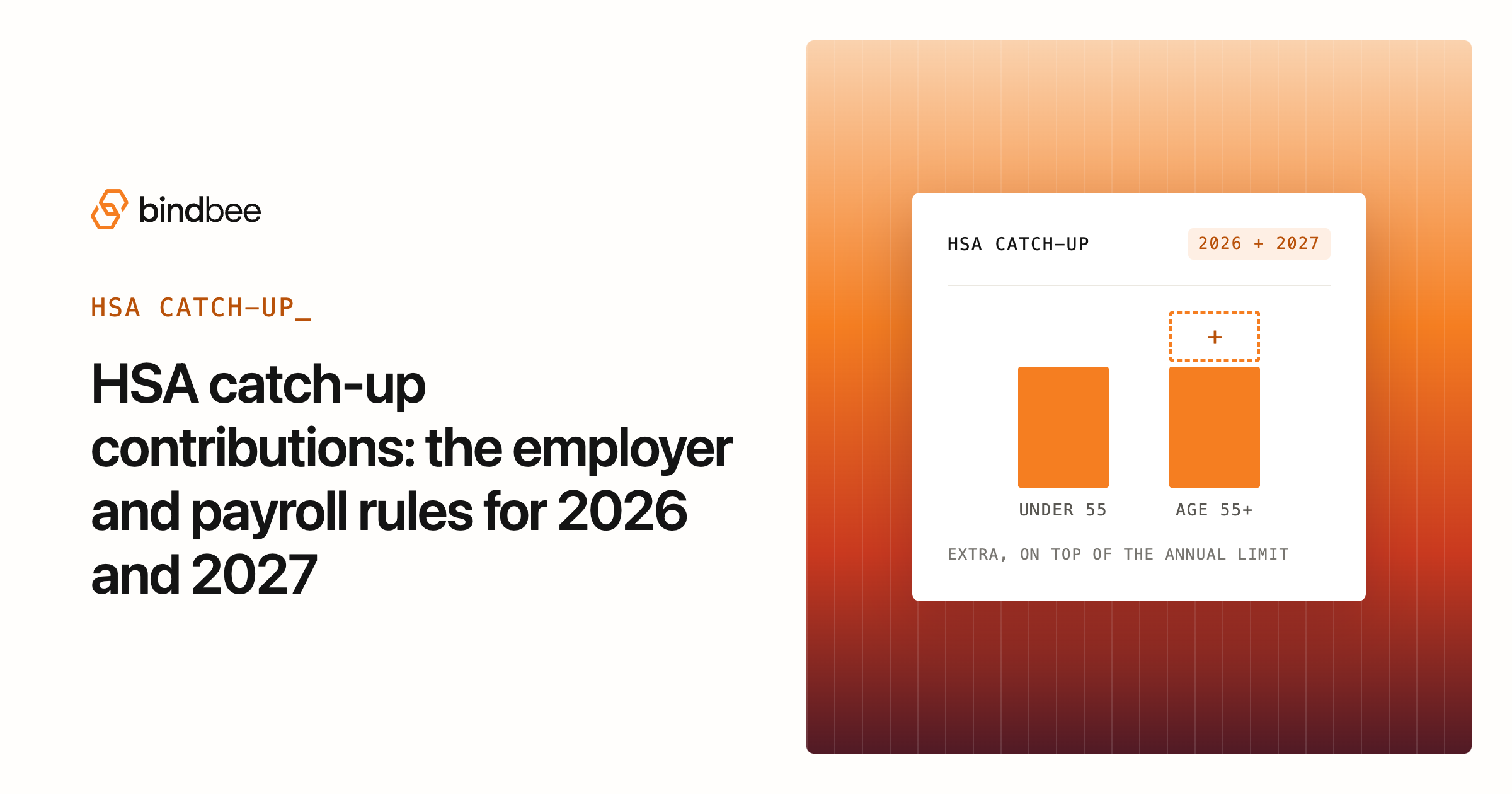
The rule itself is short. Under IRC 223(b)(3), a person who is 55 or older by the end of the tax year and otherwise HSA-eligible may contribute an additional $1,000, which raises that person's one annual limit. Rev. Proc. 2025-19 sets the 2026 base at $4,400 self-only and $8,750 family coverage, so with the catch-up the 2026 limit is $5,400 self-only and $9,750 family.
Which 2027 limit applies, and how spouses split it
For 2027, Rev. Proc. 2026-24 (IRB 2026-25) sets the base HSA limit at $4,500 self-only and $9,000 family. Each eligible employee who will be 55 or older by year-end adds $1,000. Load these values by coverage tier:
| Coverage tier | 2027 base limit | 2027 limit with catch-up |
|---|---|---|
| Self-only | $4,500 | $5,500 |
| Family | $9,000 | $10,000 |
Take Maria, 57, on self-only HDHP coverage at a 40-person company. She loads at $5,500 for 2027. For the other 2027 limits employers configure, see 2027 HSA and FSA contribution limits for employers.
The age test is a year-end test. An employee who turns 55 in November qualifies for that year's catch-up, provided they are otherwise eligible all year, so payroll does not prorate by birth month.
Households are the one place the catch-up does not follow the family limit. Each spouse who is 55 or older must make their catch-up to their own HSA, while the family limit itself is divided between the spouses by agreement, or equally if they have none (IRC 223(b)(5); Pub 969). Two eligible spouses aged 55 and over on family coverage can therefore reach $10,750 combined for 2026: $8,750 plus two $1,000 catch-ups. For 2027 the same arithmetic gives $11,000: $9,000 plus two $1,000 catch-ups.
That gives payroll a limit, but not yet a deduction cap.
How much payroll can still deduct
The cap is the applicable limit including catch-up, minus employer contributions, minus any other contributions the employee has disclosed. The basis is IRC 223(b)(4)(B) and Pub 969, which reduce the amount the taxpayer or anyone else can contribute by the employer's excludable contributions, including those made through a cafeteria plan. The sequence below is the calculation payroll applies on that basis, run per employee:
- Set the limit: pick the coverage tier, then add $1,000 if the employee will be 55 or older by year-end.
- Subtract employer funding: remove every dollar the company contributes or plans to contribute for the year.
- Subtract deferrals already taken: the employee's own pretax cafeteria-plan contributions count as employer contributions, so year-to-date withholding comes off the limit.
- Subtract disclosed contributions: take off anything the employee reports contributing outside payroll. The remainder is the most payroll can still deduct this year.
Maria's employer seeds $1,200 and she has disclosed nothing else, so payroll can deduct $4,300 across the year. A cap set at base plus $1,000 would let withholding reach $5,500. With the employer's $1,200, that puts $6,700 into an account with a $5,500 limit.
The catch-up raises the ceiling for everyone's money, including the employee's. That raises the employer's question: can the company put the catch-up in itself?
Whether the employer can fund the catch-up
The funding route decides which test an employer catch-up has to pass. Say the company wants to give every employee 55 or older an extra $1,000, outside the cafeteria plan. Under 26 CFR 54.4980G-4 Q&A-10 and Q&A-11, additional employer contributions made only to employees eligible for the IRC 223(b)(3) catch-up do not satisfy comparability.
Comparability means that, for each month, contributions are the same amount or the same percentage of the HDHP deductible for eligible employees with the same category of coverage on the first day of that month (Q&A-1(a)). A rule keyed to age cannot meet that definition.
| Funding route | Rule that applies | Catch-up-only contribution allowed? | Test or consequence |
|---|---|---|---|
| Employer contribution outside a cafeteria plan | Comparability, 26 CFR 54.4980G-4 | No, it fails comparability | Same amount or percentage of the HDHP deductible, monthly, within a coverage category; failure triggers the excise tax |
| Contribution through a sec. 125 cafeteria plan | Sec. 125 nondiscrimination rules, 26 CFR 54.4980G-5 Q&A-1 | Comparability does not apply; the sec. 125 tests decide | Eligibility, contributions and benefits, and key-employee concentration |
Failing comparability triggers an excise tax of 35% of the employer's aggregate HSA contributions for the year (IRC 4980G; Pub 969). The base is every HSA dollar the employer contributed, not the amount that missed. A catch-up-only program at a company that seeds all its HSAs is priced against the whole pool.
The cafeteria route escapes comparability but not testing. The sec. 125 tests look at highly compensated participants and key employees. Pub 15-B (2026) defines them by role, with a separate key-employee test (an officer paid over $235,000, a 5% owner, or a 1% owner paid over $150,000), and no flat pay threshold applies. Plan-document drafting and test methods are outside this page.
Changing an HSA election mid-year
An employee can start, stop or change an HSA payroll election during the year without a qualifying event, provided the change applies prospectively. Cafeteria-plan elections are generally irrevocable once the plan year begins, yet HSA elections can change during the year. Both are true: one is the general rule and the other is the HSA exception.
The general rule: a cafeteria-plan election is irrevocable once the plan year begins, unless a qualifying life event permits a change.
The exception: Notice 2004-50 allows HSA salary-reduction elections to be started, stopped or changed prospectively during the year. The 2007 proposed cafeteria-plan regulations, Prop. Treas. Reg. 1.125-2, add that the plan must allow changes at least monthly. The notice supplies the prospective rule and the proposed regulations supply the monthly one.
If Maria asks in September to raise her deduction, payroll applies the new amount to later pay, never to pay already run, and the remainder from the capacity calculation stays the ceiling. Because the monthly language sits in proposed regulations, check for final sec. 125 rules before hard-coding it.
Elections let the catch-up start at nearly any point. Something else forces it to stop.
When catch-up eligibility ends
Catch-up eligibility ends with HSA contribution eligibility, and that ends from the first month the employee is entitled to Medicare. Publication 969 (2025) is explicit that reaching 65 alone does not end it.
A stop rule keyed to the 65th birthday therefore cuts off contributions for employees who are 65 but not entitled to Medicare. Payroll needs the entitlement date, which a date of birth cannot supply.
Medicare entitlement can be retroactive, so the zero limit can start in a month that has already passed. Contributions for those months become excess, and the employee corrects them through the custodian. See employer HSA contributions for the worked case.
A partial year of eligibility can also change that year's limit. Publication 969's contribution-limit rules govern that case, and this page does not work the proration. The last-month rule and its testing period are covered in the employer HSA contributions guide.
How the catch-up appears on the W-2
Employer contributions, including those made through a cafeteria plan, are reported on Form W-2 at Box 12, code W, according to the 2026 General Instructions for Forms W-2 and W-3. The catch-up is part of that total.
The counting rule from the capacity calculation returns here. Maria's $1,200 from her employer and, if she defers the full $4,300, $4,300 in pretax deferrals report as one code W figure of $5,500, and the catch-up dollars are already inside it.
What data payroll needs, and how it gets there
Every rule above assumed payroll already holds five inputs:
- Date of birth, for the year-end age test.
- Coverage tier, for the limit and the comparability category.
- Employer contributions, for the capacity calculation and the comparability test.
- The employee's election, for the amount and the date it takes effect.
- The Medicare entitlement date, for the month contributions stop.
A team that gets every rule right still depends on tier, contributions and election arriving from systems it does not own, and on the deduction landing in a payroll it does not run. That dependency is where an integration layer comes in.
Bindbee reads benefits as four models: the plan catalog, each enrollment, dependent coverage and per-person insured amounts. An enrollment carries tier, employee contribution and company contribution, which is the benefits side of those inputs. Date of birth and Medicare entitlement come from your own records.
Once the cap and election are right, the deduction has to reach the customer's payroll. Bindbee can write a benefits deduction, including an HSA contribution, to payroll through the employee payroll run endpoint, where the integration supports it. The payroll deduction write-back use case is the product surface for it, and Bindbee's guide to payroll and benefits integration best practices covers how elections and deductions connect.
Two limits are worth planning around. A Production connector syncs every 24 hours by default, adjustable per connection on request, with webhooks on every sync, so a mid-month election change is picked up at the next sync. Support also varies by integration: the Model Availability Matrix marks each model Available, Beta or not available for each one.
Maria's catch-up is a single raised limit, and employer money, funding route, election timing and Medicare date each act on it. A payroll that carries all five inputs applies them. One that carries only her birthday adds $1,000 and stops there. If you are configuring this for your customers' payroll systems, book a technical walkthrough and check per-integration support for reading HSA enrollments and writing the HSA deduction.
FAQ
Can an employer fund the HSA catch-up only for employees 55 and older?
Outside a cafeteria plan, no. A contribution made only to employees eligible for the catch-up fails comparability (26 CFR 54.4980G-4 Q&A-10 and Q&A-11), and the excise tax is 35% of the employer's aggregate HSA contributions for the year. Through a sec. 125 cafeteria plan, comparability does not apply and the sec. 125 nondiscrimination rules decide.
Does the HSA catch-up end when an employee turns 65?
No. Contribution eligibility, catch-up included, ends from the first month the employee is entitled to Medicare, and entitlement can be retroactive. Payroll needs the entitlement date, which a date of birth cannot supply.
Can an employee change an HSA payroll deduction mid-year?
Yes, prospectively and without a qualifying event. Notice 2004-50 allows HSA salary-reduction elections to be started, stopped or changed during the year, and proposed regulations would require the plan to allow changes at least monthly.
Where does the catch-up appear on the W-2?
Inside the Box 12 code W total. There is no separate code for the catch-up. Code W holds employer contributions and employee contributions made through a cafeteria plan, per the 2026 General Instructions for Forms W-2 and W-3.
The HSA catch-up has not changed: it is $1,000 in 2026 and 2027, fixed in IRC 223(b)(3) and not adjusted for inflation.