

Top 10 API Integration Companies for 2026 & How to Pick the Right One

Summarise the blog with AI
Choosing the right API integration company isn't just a technical decision. It determines how fast you can go to market, how much engineering overhead you absorb, and whether your product can scale to serve enterprise customers without rebuilding your integration layer every year.
This guide covers what to look for and the top API integration companies for 2026.
What to Look For in an API Integration Company
Vertical Depth vs. Horizontal Breadth
General-purpose integration platforms connect to hundreds of apps across CRM, ERP, HR, and finance. Vertical-specific platforms focus deeply on one category, such as HR and payroll, with normalized data models and write-back support that general platforms don't provide.
For HR Tech, vertical depth matters more. A partner that connects to 500 apps but returns shallow employee data isn't useful if your product needs compensation history, deductions, or dependent records.
Normalization
Does the platform normalize data across systems, or do you handle schema differences yourself? The best integration companies handle normalization at the API layer so your application code stays clean regardless of which system your customer uses.
Maintenance Model
When a vendor updates their API, who handles it? With in-house integrations, your team does. With the right integration partner, they do. This is one of the biggest long-term cost differentiators.
Compliance
HR and payroll data is sensitive. SOC 2 Type II, HIPAA, and ISO 27001 are baseline requirements for enterprise customers. Confirm compliance posture before committing.
Top API Integration Companies for 2026
1. Bindbee — Best for HR Tech and Benefits Platforms
Bindbee offers a Unified API for 110+ HRIS, Payroll, ATS, and Benefits systems, helping teams ship integrations at one-tenth the cost of custom builds. Deep coverage across 110+ HR and payroll tools with quick setup, 1,00,000+ employee data syncs daily, and purpose-built HR data models for deductions, dependents, compensation, and time-off. SOC 2, HIPAA, ISO 27001 certified.
2. MuleSoft
Enterprise iPaaS leader with broad connectivity and API management. High cost and complexity. Best for large enterprises with dedicated integration teams.
3. Boomi
Low-code iPaaS with strong enterprise connector library. Good for general business process integration across ERP and CRM. Less depth for HR-specific data.
4. Workato
Workflow automation platform with broad app coverage. Good for cross-functional automation. Limited HR data depth.
5. Finch
Employment data API focused on SMB payroll systems. Strong for Gusto, QuickBooks Payroll. Less coverage for enterprise HRIS and ATS.
6. Merge
Unified API covering HR, ATS, accounting, and CRM. Broader vertical coverage, less depth in HR-specific objects.
The Bottom Line
For HR Tech and benefits companies specifically, the integration partner that matters most is the one that provides the deepest, most normalized employment data across the HRIS and payroll systems your customers actually use. That's where purpose-built platforms like Bindbee provide the most value.
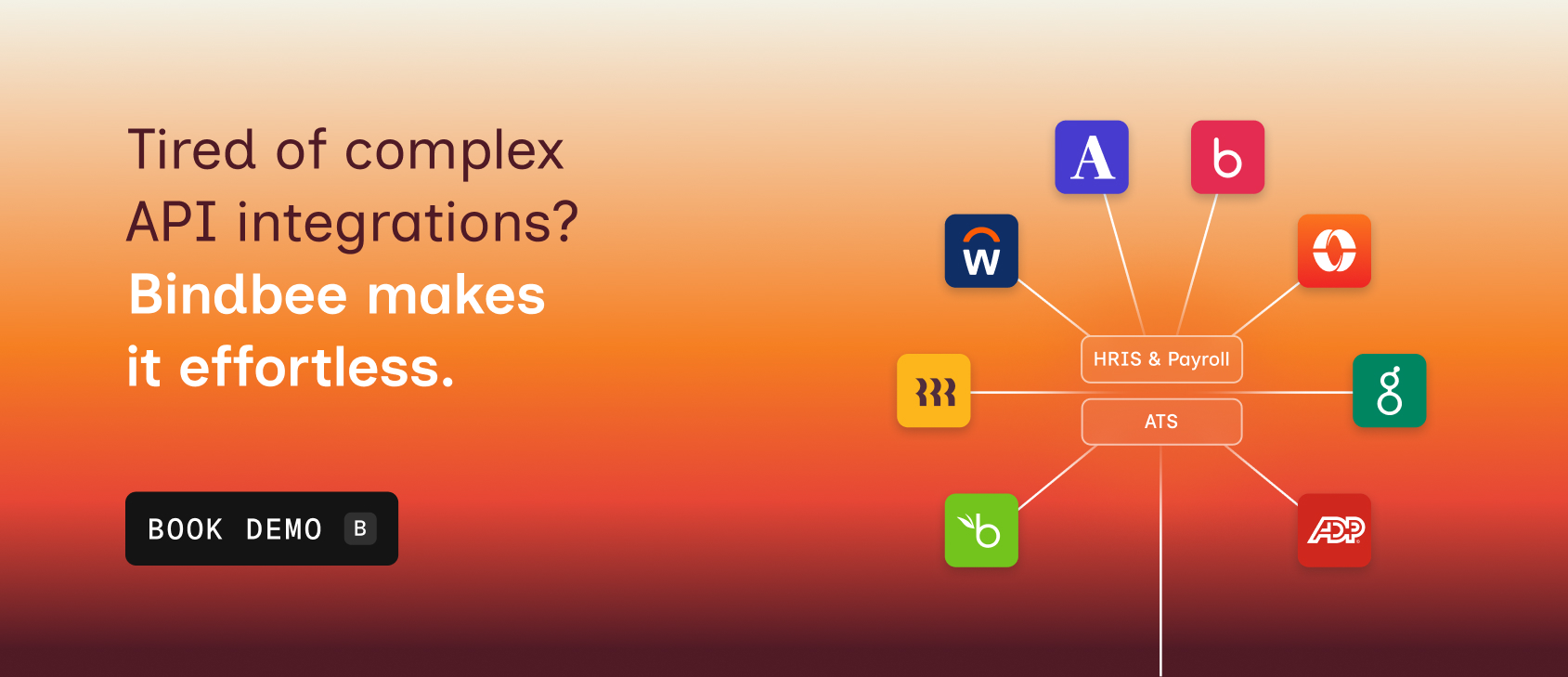
Book a demo to see how Bindbee compares as an API integration company for HR Tech.