

Understanding Bidirectional Synchronization and Its Benefits
Summarise the blog with AI
Your HR Tech or benefits platform depends on clean, reliable data flowing between systems, but that’s rarely what happens in practice. Gartner estimates poor data quality costs organizations an average of $12.9 million a year, which is why sync issues can become expensive fast.
Your HRIS updates an employee record, but your benefits platform may not reflect it, leaving teams reconciling mismatches before payroll or enrollment deadlines. Engineering ends up patching fixes, product timelines slip, and sales teams struggle when integrations fail. The more systems you connect, the more fragile your data becomes.
Bidirectional synchronization fixes this at the root. Instead of pushing data in one direction and hoping it stays consistent, you create a system where updates flow both ways automatically and stay aligned across platforms. Updates in one system flow instantly to another without manual steps. This reduces errors, removes reconciliation work, and gives your product the reliability enterprise buyers expect.
This blog breaks down how bidirectional synchronization works, where it fits, and why it’s becoming essential for any product that depends on real-time, accurate data.
At a Glance:
- Bidirectional synchronization ensures data moves smoothly in both directions between systems, keeping all platforms up to date automatically.
- It is widely used in HRIS, payroll, benefits, ATS, LMS, and CRM systems to maintain consistent, accurate data across workflows.
- Core benefits include real-time data accuracy, reduced manual reconciliation, faster operations, better customer experience, and lower engineering overhead.
- Successful implementation relies on APIs, event-driven updates, standardized data mapping, conflict resolution, error handling, and continuous monitoring.
- Best practices focus on defining data ownership, using standardized models, prioritizing critical workflows, monitoring continuously, and planning for scalable integrations.
What is Bidirectional Synchronization?
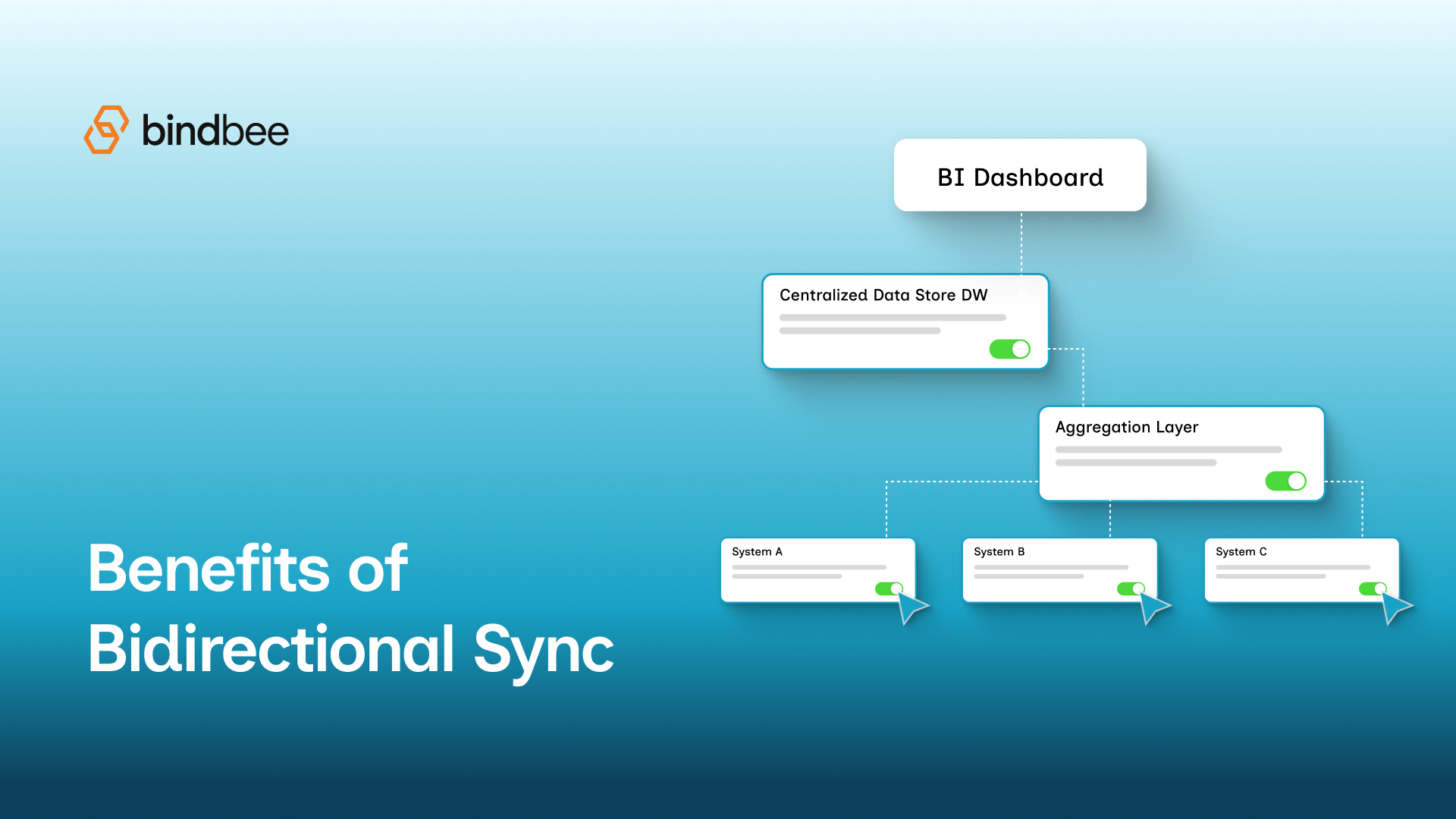
Bidirectional synchronization (often called “bi-directional sync”) is a data integration method where information flows in both directions between systems, ensuring that updates made in one system are automatically reflected in the other, and vice versa.
Unlike one-way sync, where data moves from System A to System B, bidirectional sync creates a feedback loop. If an employee’s salary changes in your HRIS, that update flows to your payroll system. If a correction happens in payroll, it flows back to HRIS and stays aligned across the employee record.
Common Use Cases of Bidirectional Synchronization
Bidirectional synchronization is most valuable in systems where data changes frequently and needs to remain consistent across multiple platforms without manual intervention.
Here’s where it shows up most often:
1. HRIS ↔ Benefits Platforms: Employee eligibility, dependents, and payroll deductions need to stay aligned. If an employee updates their dependents in one system, that change must reflect everywhere instantly.
2. Payroll ↔ 401(k) Systems: Contribution changes, salary updates, and employment status must sync both ways. Delays here directly impact compliance and employee trust.
3. HRIS ↔ LMS Platforms: When an employee joins, leaves, or gets promoted, access to training platforms should update automatically. Manual updates don’t scale.
4. ATS ↔ HRIS Systems: Once a candidate is hired, their data needs to move into the HR system, and any updates should reflect across both systems.
5. CRM ↔ Support Tools (General SaaS Example): Customer updates in sales tools must reflect in support systems, and vice versa, to avoid fragmented customer experiences.
Also Read: What Is Two-Way Sync? How It Keeps Your Data Accurate Across Systems
Key Benefits of Bidirectional Synchronization

Bidirectional synchronization isn’t just a technical improvement; it directly impacts revenue, payroll reliability, and engineering efficiency. The real value shows up in how smoothly your product operates at scale.
Here’s what changes when you implement it correctly.
1. Real-Time Data Accuracy Across Systems
When data updates instantly across systems, you eliminate inconsistencies at the source. Both systems always reflect the latest state, regardless of where the change originated.
- Ensures all systems reflect up-to-date employee, payroll, or benefits data
- Eliminates mismatched records across HRIS, payroll, and benefits tools
- Creates a single, reliable view of data without centralizing everything
In practice, this means your product doesn’t rely on outdated snapshots. If compensation changes in payroll, your benefits platform sees it immediately, no lag, no confusion.
2. Reduced Manual Reconciliation
Without bidirectional sync, your ops team becomes responsible for fixing mismatches, re-entering data, and chasing errors.
- Removes the need for duplicate data entry across systems
- Reduces human errors caused by manual updates
- Frees up ops teams from repetitive correction work
Instead of reacting to data issues, your systems resolve them automatically. That shift alone can reclaim hours of operational effort every week.
3. Faster Operations and Decision-Making
When systems stay in sync, workflows don’t stall waiting for data to catch up. Everything moves at the speed of your updates.
- Accelerates onboarding, payroll processing, and benefits enrollment
- Enables teams to act on real-time data instead of delayed reports
- Reduces bottlenecks caused by data dependencies across tools
For example, if employee status updates instantly, downstream systems—like payroll or LMS- don’t need manual triggers. Decisions happen faster because the data is already correct.
4. Better Customer Experience
Your customers don’t see your integrations, but they feel the impact when they break.
- Eliminates delays in benefits activation or payroll updates
- Reduces support tickets caused by inconsistent data
- Provides a smooth and reliable product experience
When systems stay aligned, your product feels predictable. Users don’t have to question whether the data is correct—it just works.
5. Lower Engineering Overhead
Every one-way integration adds maintenance overhead. Multiply that across systems, and your engineering team spends more time fixing than building.
- Reduces the need for custom sync logic and patchwork fixes
- Minimizes ongoing maintenance as APIs evolve
- Simplifies integration architecture at scale
Instead of managing multiple fragile pipelines, you maintain a consistent, two-way data flow. That directly translates into fewer bugs, fewer escalations, and more time for core product work.
6. Improved Compliance and Reliability
In HR and benefits systems, outdated data isn’t just an inconvenience; it’s a compliance risk.
- Helps you keep payroll deductions accurate
- Maintains audit-ready, consistent records across systems
- Reduces the risk of errors that lead to regulatory issues
Reliable synchronization helps you maintain data integrity, which is critical for your compliance workflows and reporting.

How Bidirectional Synchronization Works
Bidirectional synchronization relies on APIs, event-driven architecture, and conflict resolution mechanisms to ensure data flows smoothly and accurately between systems in real time.
Let’s break down its working process
1. APIs as the Foundation
Each system exposes APIs that allow data to be read and written.
Bidirectional sync uses:
- Read operations to fetch updates
- Write operations to push changes
Both systems must support reliable API interactions for this to work.
2. Event-Driven Updates (Webhooks)
Instead of constantly polling for changes, modern systems use webhooks.
Example:
- Employee record updated in HRIS
- HRIS triggers a webhook
- Connected system receives an update instantly
This allows systems to update in near real-time
3. Data Mapping and Normalization
Different systems structure data differently.
For example:
- One system stores “full_name.”
- Another splits into “first_name” and “last_name”
Bidirectional sync requires:
- Mapping fields between systems
- Normalizing data into a consistent format
This is where many integrations fail.
4. Conflict Detection and Resolution
What happens if the same data changes in both systems at the same time?
This is where conflict resolution rules come in:
- Last write wins
- Source-of-truth prioritization
- Timestamp-based decisions
Without clear rules, systems overwrite each other unpredictably.
5. Retry Logic and Error Handling
APIs fail. Networks drop. Systems go down.
A robust bidirectional sync system includes:
- Automatic retries
- Logging and monitoring
- Alerting for failures
This ensures consistency even when things break.
6. Continuous Monitoring
Synchronization isn’t a one-time setup.
You need:
- Real-time monitoring
- Error tracking
- Performance insights
Without this, issues go unnoticed until customers report them.
In practice, effective bidirectional sync isn’t just about moving data. It’s about managing state across systems reliably.
Also Read: What Is Real-Time Data Synchronization and Why It Matters
Challenges of Implementing Bidirectional Sync
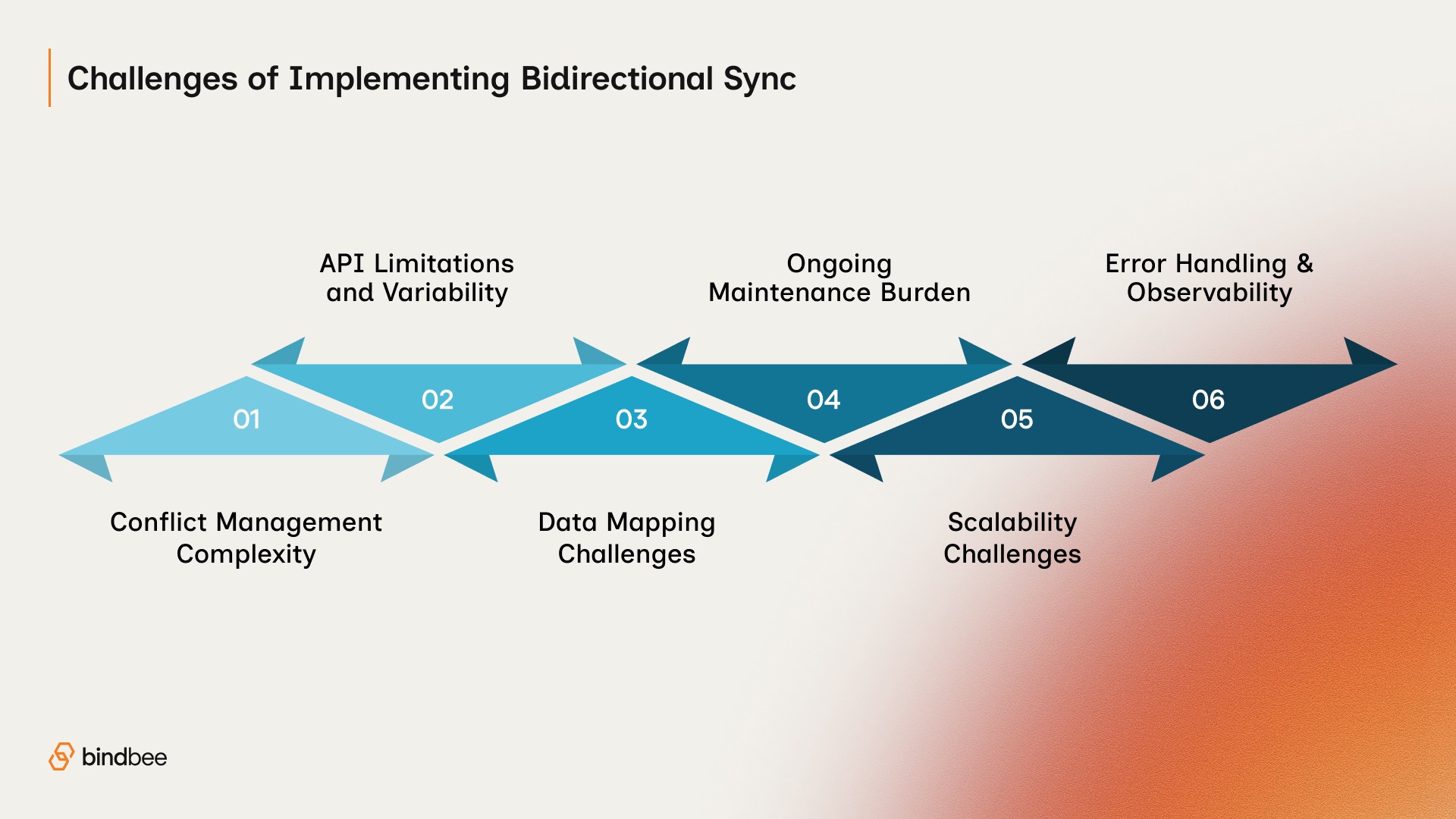
While bidirectional synchronization delivers clear benefits, implementing it in-house is complex and resource-intensive. Most teams underestimate the ongoing effort required.
Here’s where things get difficult.
- Conflict Management Complexity: When you handle simultaneous updates across systems, it isn’t straightforward. If you don’t resolve conflicts properly, you could face data corruption or inconsistencies.
- API Limitations and Variability: Every HRIS, payroll, or ATS system has different API capabilities. Some support real-time updates; others rely on batch processing. Managing these differences adds complexity.
- Data Mapping Issues: Each system defines data differently. You must align these schemas carefully and update them constantly as APIs evolve.
- Ongoing Maintenance Burden: APIs change frequently. You must continuously update mappings, handle edge cases, and fix breaking changes.
- Scalability Challenges: Adding more integrations increases complexity exponentially. What works for two systems can become difficult for you to manage across 10, 20, or 50 systems.
- Error Handling and Observability: Without proper monitoring, failures go unnoticed. You risk silent data inconsistencies that only surface when customers report issues.

Best Practices for Effective Bidirectional Sync
To make bidirectional synchronization reliable, you need more than just API connections. Following a structured approach helps you scale effectively, maintain accuracy, and manage long-term maintenance.
- Define Clear Data Ownership Rules: Even with bidirectional sync, you shouldn’t give all systems equal authority. Decide which system owns which data fields to prevent conflicts.
- Use Standardized Data Models: Normalize data across systems wherever possible to reduce mapping complexity and keep consistency high.
- Implement Robust Error Handling: Build retry mechanisms, fallback logic, and alerts. Don’t assume APIs will always work as expected.
- Prioritize Real-Time Sync Where It Matters: Not all data needs real-time updates. Focus on critical workflows that matter to you, such as payroll, benefits, and lifecycle events.
- Monitor Continuously: Set up dashboards and alerts so you can quickly catch sync failures. Visibility helps you maintain trust in your system.
- Plan for Scalability: Design your architecture to handle additional integrations without major rework. What works for 3 systems may break at 30, so plan ahead.
How Bindbee Simplifies Bidirectional Data Synchronization
Building and maintaining bidirectional synchronization across multiple HR systems is resource-intensive. Bindbee removes this burden by offering a unified API with prebuilt integrations and built-in synchronization capabilities.
Here’s how we can assist you:
- Integrate once, access 65+ HR systems: You connect to a single unified API and instantly support dozens of HRIS, payroll, ATS, and benefits platforms, removing the need to build and maintain individual integrations.
- Real-time bidirectional sync built in: Changes in any connected system are reflected across others instantly using webhooks and event-driven architecture, keeping data consistent without delays.
- Standardized HR data models: Bindbee normalizes employee data, compensation, PTO, dependents, and more into a consistent schema, eliminating repeated data mapping across systems.
- Prebuilt integrations reduce engineering effort: What typically takes weeks to build is already production-ready, allowing your team to deploy integrations quickly and focus on core product development.
- Monitoring, logging, and error handling included: Every sync is tracked with built-in observability, retries, and alerts, so issues are identified and resolved before they impact customers.
- Ongoing maintenance handled for you: Bindbee manages API changes, version updates, and edge cases across all integrations, removing the long-term maintenance burden from your team.
- Scales without added complexity: Whether you’re supporting a few integrations or dozens, the same infrastructure scales without requiring rework or architectural changes.
- Compliance-ready infrastructure: Built for U.S. HR and benefits workflows, Bindbee supports secure data handling with SOC 2, HIPAA, and GDPR readiness.
- Faster onboarding and improved sales velocity: With integrations already in place, you can onboard customers in minutes instead of weeks—and avoid losing deals due to missing integrations.
Instead of managing bidirectional sync as a complex engineering problem, Bindbee lets you treat it as a solved layer.
Conclusion
Disconnected systems create operational friction. Your teams spend time fixing data instead of using it. Your customers experience delays that shouldn’t exist.
Bidirectional synchronization fixes this by ensuring your HR, payroll, benefits, and LMS systems stay aligned in real time. It improves accuracy, removes manual work, and enables faster, more reliable operations. That said, implementing bidirectional sync at scale isn’t simple. It requires careful handling of data mapping, conflict resolution, monitoring, and ongoing maintenance. That’s why most teams don’t build this from scratch anymore.
Bindbee gives you a way to implement bidirectional synchronization without rebuilding everything from scratch. Instead of managing multiple integrations and constant updates, you get a unified layer that keeps your data flowing accurately across systems.
If your integrations are slowing down your roadmap or costing you deals, it’s worth seeing how this works in practice. Book a demo with Bindbee and see how quickly you can make your data actually stay in sync.
FAQs
1. What technologies commonly support bidirectional synchronization?
Bidirectional synchronization commonly relies on APIs, webhooks, middleware platforms, and database replication tools. Integration platforms like iPaaS, ESBs, and synchronization-specific software help automate data exchange across systems, ensuring changes in one system are reflected in the other in real time or near real time.
2. What security considerations apply to bidirectional synchronization?
Key security considerations include data encryption in transit and at rest, access controls, authentication protocols (OAuth, SAML), and audit logging. Ensuring compliance with regulations like GDPR or HIPAA, monitoring for anomalies, and securing API endpoints are crucial to prevent unauthorized access and data breaches during synchronization.
3. Can bidirectional synchronization integrate with cloud and on-premise systems?
Yes. Bidirectional synchronization can connect cloud-based applications with on-premise systems using APIs, secure VPNs, or integration platforms. Middleware or hybrid solutions enable seamless data flow between environments, allowing consistent, real-time updates across all systems, regardless of deployment location.
4. What metrics should be monitored in bidirectional synchronization setups?
Monitor data transfer success rates, latency, error or conflict rates, system performance, and data integrity checks. Tracking these metrics helps identify synchronization issues, optimize performance, and ensure accurate, up-to-date information flows between systems without disruptions or data loss.
5. What future trends are emerging in bidirectional synchronization technology?
Future trends include AI-driven conflict resolution, real-time analytics, improved API-based integrations, and enhanced automation for multi-system synchronization. Increased adoption of hybrid and cloud-native architectures, low-code integration tools, and enhanced security protocols are also shaping the evolution of bidirectional synchronization solutions.