
Product that suits modern B2B Tech companies

Book Demo
B
BACK
B

Trends in iPaaS for 2026: Key Insights and Future Predictions
Integration Strategy
May 13, 2026
Summarise the blog with AI
Open in ChatGPT
Ask questions about this page
Open in Claude
Ask questions about this page

Every new integration you ship slows you down more than it should. Weeks are spent connecting to one HRIS or payroll system, only to fix it again as APIs change. Your roadmap slips, engineering bandwidth drains, and sales keep hearing, “Do you integrate with our system?” If the answer is no or not yet, you lose the deal. Even worse, managing multiple SaaS apps and data flows across customers creates inconsistencies that are hard to control at scale.

That’s why iPaaS is no longer optional for you. Instead of building and maintaining each integration in-house, you can connect once and access multiple systems through a unified layer. That means faster onboarding, fewer errors, and more time for your team to focus on product innovation instead of integration upkeep. In fact, the adoption of iPaaS solutions is surging, with the global market expected to reach USD 71.35 billion by 2030, growing at a CAGR of 32.3% 

As iPaaS continues to evolve, the focus is moving toward deeper data models, real-time syncing, and reliability that meets enterprise expectations without draining your resources. This blog explores the top iPaaS trends for 2026, future market predictions, and adoption challenges.

Key Takeaways:

  • iPaaS helps you replace slow, custom integrations with a unified platform that improves data consistency, speeds up onboarding, and reduces engineering effort
  • Key iPaaS trends in 2026 include low-code tools, AI-driven automation, real-time data syncing, API-first models, and stronger multi-cloud connectivity.
  • Future iPaaS will focus on invisible integrations, smarter data insights, standardized ecosystems, and more flexible pricing and automation models.
  • Adoption comes with challenges such as legacy system complexity, data quality issues, scalability, and change management, which require careful planning to maximize value.

What is iPaaS and Why It Matters?

Integration Platform as a Service (iPaaS) is a cloud‑native integration platform that connects applications, data, and processes across disparate systems — especially in hybrid and multi‑cloud environments. It orchestrates data flows between your SaaS apps, legacy systems, and external partners without requiring extensive custom engineering. 

For HR Tech and benefits companies specifically, iPaaS removes the bottleneck of building one-off HRIS, payroll, and ATS integrations, freeing your engineering team to focus on your core product.

Here’s why it matters:

  • Reduces integration time: Instead of spending 4–6 weeks per integration, you can connect multiple systems through a single API and go live faster.
  • Improves data consistency: Standardized schemas keep employee, payroll, and benefits data aligned across connected systems.
  • Supports real-time decisions: Continuous syncing gives you up-to-date data, which is critical for payroll accuracy and benefits management.
  • Minimizes workflow errors: Automated validation and monitoring help prevent issues such as incorrect payroll deductions or outdated employee records.
  • Speeds up customer onboarding: Prebuilt integrations let you onboard new customers quickly without waiting weeks for custom development.
  • Strengthens compliance and security: Centralized integration management helps you efficiently meet SOC 2, HIPAA, and other regulations.
  • Prevents lost sales opportunities: When integrations are already available, your sales team doesn’t lose deals due to missing connections.

Also Read: 9 Key Benefits of iPaaS and How HR Tech Teams Use It

Emerging iPaaS Trends in 2026

Emerging iPaaS Trends in 2026

The iPaaS landscape in 2026 reflects both evolving enterprise needs and technological innovation. Below, we’ll break down the key trends that are reshaping how you approach integration:

1. Low-Code / No-Code Integration Tools

You can now move integration beyond engineering teams. Low-code and no-code tools let your product and operations teams set up workflows without writing extensive code.

Instead of waiting weeks for engineering bandwidth, your team can build and modify integrations faster—often in hours or days. This directly impacts how quickly you onboard customers or launch new features.

  • Reduce dependency on engineering for routine integration tasks
  • Speed up deployment cycles and experimentation
  • Enable ops teams to manage workflows directly
  • Cut development time significantly (often by weeks)

That said, the real shift isn’t just about speed; it’s about ownership. Integration becomes a shared responsibility across your product, ops, and engineering teams.

2. AI-Driven Integration

AI is turning integration from a manual process into an intelligent system that can manage itself. It’s not just about assisting; it’s about actively managing workflows.

Modern iPaaS platforms use AI to handle mapping, detect anomalies, and even predict failures before they happen. This reduces the firefighting your engineering team has to handle.

  • Automated data mapping across systems
  • Real-time error detection and resolution
  • Predictive insights for integration failures
  • Workflow optimization without manual intervention

As AI becomes embedded into integration platforms, you spend less time fixing pipelines and more time adding product value.

3. Real-Time Data Sync and Event-Driven Architecture

Batch processing is quickly becoming a bottleneck. Businesses now expect data to move instantly across systems.

Event-driven architectures make every change, whether it's a new hire, a payroll deduction update, a benefits enrollment, or a dependent status change, trigger immediate updates across connected platforms.

  • Instant syncing of employee and payroll data
  • Reduced lag between systems
  • Better user experience with up-to-date information
  • Improved accuracy in time-sensitive workflows

For benefits and 401(k) platforms especially, real-time sync isn't a nice-to-have — delayed data means contribution errors and compliance risk.

4. Multi-Cloud and Hybrid Connectivity

Your systems don’t live in one place anymore, and neither should your integrations.

With companies using multiple cloud providers and legacy systems, iPaaS platforms are evolving to support consistent connectivity across all environments.

  • Connect SaaS apps, on-prem systems, and multiple clouds
  • Avoid data silos across fragmented infrastructure
  • Support enterprise-level scalability and flexibility
  • Ensure consistent data flow across environments

In fact, most organizations now operate in hybrid or multi-cloud setups, making centralized integration a necessity—not a nice-to-have.

5. API-Centered Integration Models

APIs are no longer just connectors; they’re the foundation of modern integration strategies.

iPaaS platforms are increasingly built around API-first architectures, allowing you to standardize how your systems communicate and scale integrations predictably.

  • Treat APIs as reusable building blocks
  • Enable faster integration across multiple platforms
  • Simplify versioning and lifecycle management
  • Improve scalability with standardized interfaces

This shift helps you avoid one-off integrations that break every time a vendor changes their API.

6. Prebuilt HR-Specific Connectors

Generic connectors weren't built for HR complexity. When your platform needs to sync PTO balances, payroll deductions, dependent eligibility, or compensation data, a one-size-fits-all connector will cut corners that your customers will notice.

You can rely on prebuilt, domain-specific integrations that handle real-world complexity out of the box.

  • Faster go-to-market with ready integrations
  • Built-in support for HR-specific data models, roster, org, PTO, compensation, dependents, and benefits deductions
  • Reduced engineering effort for customization
  • Higher reliability compared to custom builds

For example, HR-focused platforms need deeper data models (like PTO, compensation, dependents). This is where providers like Bindbee stand out, with prebuilt integrations designed specifically for HR ecosystems.

7. Enhanced Compliance and Security

As integration expands, so does risk. Security and compliance are now central, not secondary, to iPaaS adoption.

Handling sensitive employee data, payroll figures, health benefits, and dependent records means your integrations need to meet strict regulatory standards from day one.

  • Built-in compliance (SOC 2, HIPAA, GDPR readiness)
  • End-to-end data encryption
  • Audit trails and monitoring
  • Secure API governance

Over half of enterprises still cite security as a major concern, which is why modern iPaaS platforms are prioritizing compliance-first architectures.

Book A Demo

Also Read:  Top 10 iPaaS Tools and How to Choose the Right One

Future Predictions for iPaaS in 2026

Future Predictions for iPaaS in 2026

Looking ahead, iPaaS is expected to become even more intelligent, automated, and embedded in business operations. If you adopt forward-looking strategies, you’ll gain a competitive edge.

  • Integration Becomes Invisible: The future of iPaaS points toward invisible integration, platforms handle data flows automatically while you focus on building better HR and benefits products. Your customers won't ask about integrations because they'll just work.
  • AI-Driven Insights Beyond Integration: iPaaS platforms won’t just move data, they’ll analyze it for you. Predictive insights, anomaly detection, and workflow optimization will help HR Tech and benefits SaaS make smarter operational decisions.
  • Standardization Across HR and Benefits Ecosystems: By 2026, expect pressure toward standard schemas across HRIS, ATS, and payroll platforms. This simplifies vendor onboarding, reduces custom development, and improves system compatibility.
  • Shift to Outcome-Based Pricing Models: Instead of charging per connector or per volume, iPaaS providers may adopt subscription or outcome-based pricing, aligning your costs with the value your business actually gains.
  • Expansion of Low-Code Automation: Low-code platforms will become more advanced, letting non-technical users create complex workflows, triggers, and approval chains across integrated systems.
  • Stronger Role of Compliance and Risk Monitoring: With HIPAA, SOC 2, and evolving state-level data privacy laws, HR and benefits platforms will need built-in compliance dashboards, automated audit reports, and real-time error alerts as standard, not add-ons.

Challenges in iPaaS Adoption

Despite the rapid growth of the iPaaS market, adoption isn’t always smooth. There are practical and strategic hurdles that teams must navigate:

  • Complex Legacy Systems: Many HRIS and payroll platforms, like ADP, UKG, or older on-prem systems, have fragmented APIs or inconsistent data models. Normalizing data before integration takes extra work and slows go-live timelines.
  • Data Quality and Consistency: Poor data hygiene can cause synchronization errors. Regular monitoring and validation help avoid problems.
  • Scalability Concerns: As your organization grows, integration platforms must handle higher transaction volumes without slowing down or failing.
  • Change Management: Teams need training and governance to use new integrations effectively and maintain them over time.
  • Cost vs. ROI: While iPaaS speeds up integration, you must weigh subscription costs against engineering time saved and revenue opportunities.

Recognizing these challenges helps you plan better and maximize your ROI.

Book A Demo

How Bindbee Can Streamline iPaaS Adoption

Bindbee offers a unified API and prebuilt integrations that reduce complexity, save engineering resources, and accelerate time-to-value for HR Tech and benefits SaaS companies.

Here’s how we can help you:

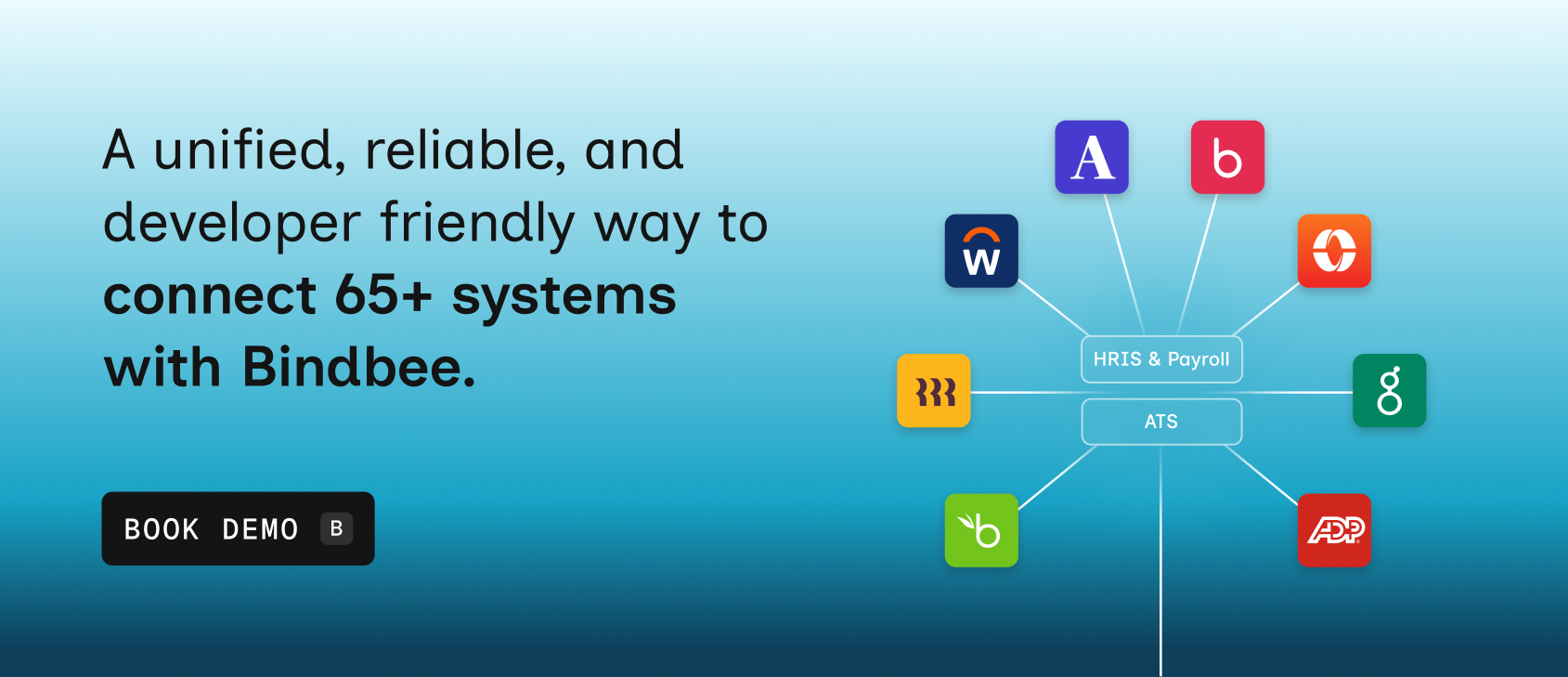
  • Unified API: Connect once to access 65+ HRIS, payroll, and ATS systems without building separate integrations for each vendor.
  • Deep data models: Standardized access to 27+ HR objects like employees, PTO, compensation, dependents, and payroll data across systems.
  • Real-time sync: Event-driven architecture ensures instant updates for hires, exits, payroll changes, and lifecycle events.
  • Data normalization: Automatically standardizes fragmented HR data so your product logic stays consistent across all integrations.
  • Faster deployment: Replace weeks of engineering work with implementation timelines measured in days.
  • Quick onboarding: Enable employers to connect their HR systems in minutes using simple, low-friction authentication flows.
  • Built-in monitoring: Centralized logs, retries, and error handling reduce debugging time and improve reliability.
  • Lower engineering load: Product and ops teams can manage integrations without constant developer involvement.
  • Scalable growth: Add new systems or customers without rebuilding pipelines, Bindbee handles ongoing maintenance.
  • Compliance-ready: SOC 2, Type II, HIPAA, ISO 27001, and GDPR-aligned infrastructure keeps sensitive HR and payroll data secure and audit-ready. 

By integrating Bindbee, companies can adopt modern iPaaS solutions confidently, stay compliant, and focus on growth and innovation rather than maintenance.

Conclusion

The iPaaS landscape in 2026 is poised for significant transformation. AI-driven automation, multi-cloud support, low-code accessibility, real-time syncing, and compliance-focused solutions will define the next generation of integration platforms. 

Adopting modern iPaaS approaches, utilizing automation and intelligence, and partnering with platforms designed for depth, like Bindbee, can give your organization the agility it needs to stay ahead.

Book a demo with Bindbee to see how you can accelerate integrations, reduce engineering overhead, and stay ahead in a connected, data-driven world.

FAQs

1. How do sustainability goals affect iPaaS platform choices? 

Sustainability goals push enterprises to choose iPaaS platforms that optimize resource usage, reduce redundant data processing, and support energy-efficient cloud infrastructure. Vendors offering carbon tracking, efficient API orchestration, and serverless architectures become preferred, as organizations align integration strategies with ESG targets and environmentally responsible operations.

2. What metrics should enterprises track for iPaaS performance?

Enterprises should track metrics like API response time, data latency, uptime, error rates, throughput, and integration deployment speed. Business-focused KPIs such as time-to-market, cost per integration, and system reliability are equally critical to evaluate how effectively the iPaaS platform supports operational efficiency and scalability.

3. How is blockchain integration emerging in iPaaS?

Blockchain integration in iPaaS is emerging to enhance data integrity, transparency, and security across distributed systems. It enables tamper-proof transaction logs, secure data sharing between partners, and improved auditability, particularly in industries requiring trust and compliance, such as finance, supply chain, and healthcare ecosystems.

4. What ROI can enterprises expect from iPaaS investments by 2026?

By 2026, enterprises can expect ROI through faster integration delivery, reduced development and maintenance costs, and improved operational agility. iPaaS minimizes manual effort, accelerates time-to-market, and enhances data consistency, resulting in better decision-making, higher productivity, and long-term cost savings across digital initiatives.

5. Which industries will see the most iPaaS growth in 2026?

Industries such as healthcare, financial services, retail, e-commerce, and manufacturing will see the most iPaaS growth. These sectors rely heavily on real-time data exchange, system interoperability, and scalable integrations to support digital transformation, regulatory compliance, and increasingly complex customer and partner ecosystems.

Om Anand
CEO
Bindbee
VIEW AUTHOR
BLOG_

Related blogs