

8 Business Benefits Of Integration You Risk Ignoring This Quarter
.avif)
Summarise the blog with AI
Benefits integration is how your benefits platform stays accurate, scalable, and operationally essential to your employer clients. When done well, enrollment changes reach payroll automatically, eligibility updates flow in real time, and your product becomes embedded in the workflows that run every pay cycle.
Why Benefits Integration Drives Business Success
Benefits integration isn't just a technical feature. It's a revenue and retention lever.
Employers choose benefits platforms that integrate with their existing HRIS and payroll systems. Platforms that require manual data exports, CSV uploads, or IT-assisted configuration create friction that stalls sales and frustrates administrators.
Platforms with seamless, automated integration become operationally essential. They're harder to rip out and replace because they're embedded in day-to-day payroll and HR workflows.
Key Integration Flows for Benefits Platforms
Enrollment to Payroll
Benefits deductions need to sync to payroll automatically after enrollment. This is the most operationally critical flow and the one most likely to generate customer support tickets when it fails.
HRIS to Benefits
Employee roster, eligibility status, and dependent records need to flow from the employer's HRIS to your benefits platform in real time. Stale data means ineligible employees get enrolled or eligible employees miss enrollment windows.
Life Events
Qualifying life events (marriage, birth, divorce) trigger special enrollment periods. Webhook-based notification from the HRIS lets your platform surface these events immediately so employees can make timely elections.
The Scale Challenge
The benefits integration problem compounds with your customer count. Each new employer client may use a different HRIS and payroll system. Without a unified integration layer, every new customer is a potential new connector build.
Bindbee supports faster, scalable integrations with 102+ HR and payroll tools, freeing engineering bandwidth and improving data accuracy. It covers all major HRIS and payroll systems and manages 100,000+ employee syncs daily.
How Bindbee Powers Benefits Integration
Bindbee provides a unified API covering 102+ HRIS and payroll systems with the data models benefits platforms need: employees, dependents, deductions, compensation, and time-off. One integration replaces per-vendor connector builds.
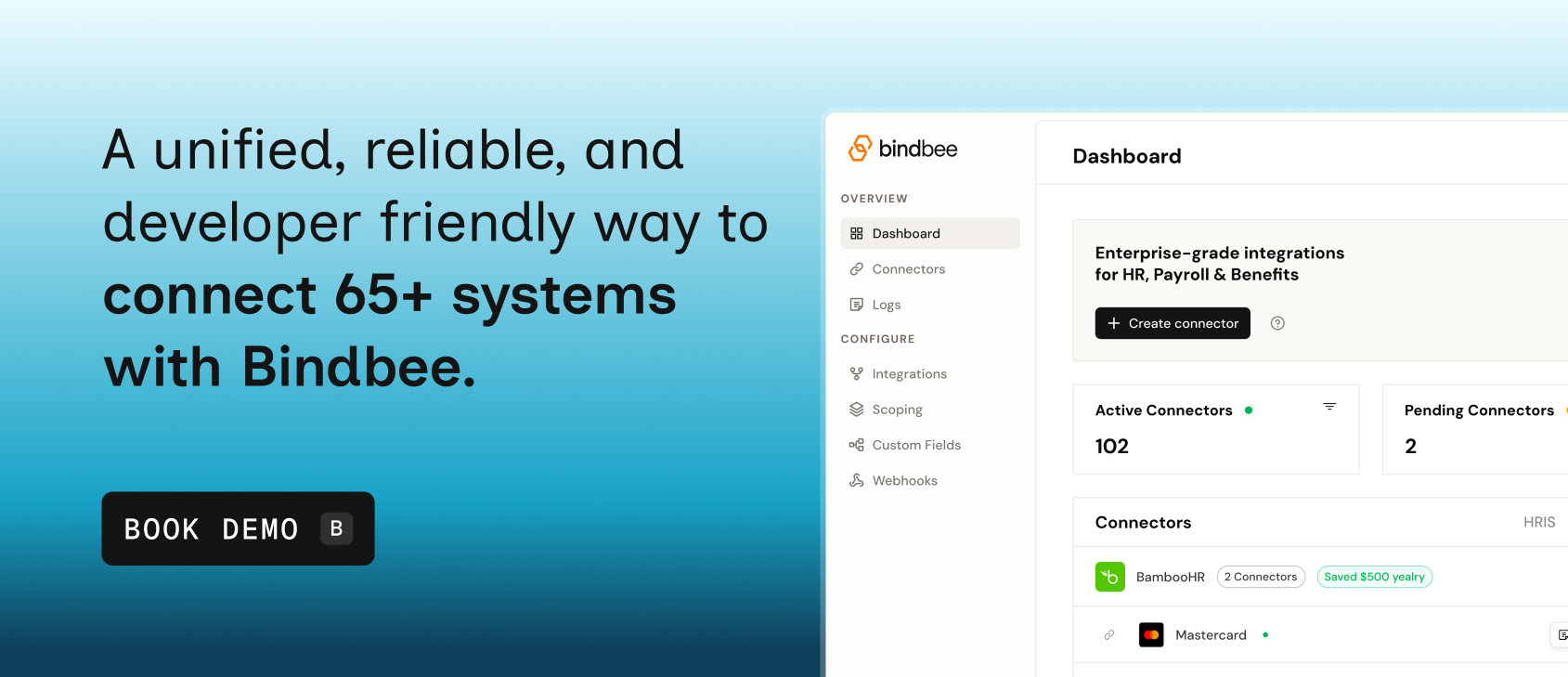
Book a demo to see how Bindbee powers benefits integration across 102+ systems.