

Bindbee vs Kombo: a unified API comparison for benefits, payroll and HR data
Summarise the blog with AI
The short answer: Kombo's customers move to Bindbee
The strongest evidence in any vendor comparison comes from a customer who has run both platforms with their own product on the line. Papershift built on Kombo first. What happened next is in their words above.
Companies move from Kombo to Bindbee. None has moved back.
Bindbee is the integration infrastructure for HR, payroll and benefits data: employees, compensation, payroll runs, deductions, benefit plans, dependents, coverage, time and hiring. The depth sits where the data is regulated and has to be exactly right, because that is the data Bindbee's customers build their products on.
Kombo on the other hand is built for recruitment related use cases. It offers assessments, jobs, postings, candidates, applications, interviews, scorecards, offers, and background checks.
For companies that solve for payroll, benefits and employment related use cases, Bindbee is the default choice. The companies that have run Kombo for these use cases and then moved to Bindbee are the evidence.
The full comparison
Benefits data
Payroll
Time, absence and timesheets
Write operations
Connector coverage
Bindbee's philosophy is depth before width: cover the systems buyers actually run, and cover every model and field inside them, rather than inflating a catalogue count. Bindbee solves for all of the top HRIS systems that our US customers run on.
Width is also not what Kombo's own catalogue delivers to a US buyer. Of the 100 entries in Kombo's connector documentation, 60 are EU-market vendors and only 20 are US-market vendors.
Data models
Both vendors document a similar number of HRIS models. Ten of Bindbee's twenty-one HRIS model groups are benefits and payroll, and Kombo's eighteen contain no benefits object at all. The difference that decides an evaluation in this category is composition, not count.
Enterprise readiness
Developer experience
Support
Choosing between Bindbee and Kombo
Both platforms connect one integration to many HR systems. The decision turns on which data your product moves, because that is where the two diverge.
Choose Bindbee if your product touches employee data, benefits, money or coverage. Benefits plans, dependents, coverage tiers, payroll deductions, employer contributions. If your roadmap includes writing a deduction back into a payroll system, reading who is enrolled in which plan, or reconciling a payslip line to the plan behind it, Bindbee has those objects in production today. This is the category that benefits administration platforms, third-party administrators, brokers, insurtech, digital health and compensation software build in.
Choose Kombo if your product is a recruitment product. Kombo's ATS coverage is 99 connectors to Bindbee's 15. They carry 16 assessment and background check integrations, and HRIS models for skills, performance and staffing entities. Bindbee does not compete in recruitment breadth.
Counts verified 2026-09-16 at docs.bindbee.dev and docs.kombo.dev, captured 2026-09-05.
The four real differentiators
1 · Benefits
Bindbee documents five interlocking benefits objects. Benefit and Employer Benefit hold the plan, Dependent and Dependent Benefit hold who is covered, and Benefit Coverage holds the amounts. Across them sit 11 benefit plan categories, 11 coverage tiers, employee and employer contribution splits across 12 frequency values, and a deduction_code field linking a plan to the payroll system that deducts for it. Dependents carry relationship, date of birth, SSN, student status and address, which is what an eligibility check needs.
Kombo's 18 HRIS models contain no benefits object.
If benefits data is on your critical path, that is the difference between building now and waiting.
Bindbee schema verified 2026-09-16 at docs.bindbee.dev. Kombo's model list captured 2026-09-05.
2 · Payroll
Both platforms read payroll. The difference is direction.
Along with reading, Bindbee also writes payroll back. POST /api/hris/v1/employee-payroll-runs carries earnings, deductions, taxes, gross pay, net pay and check date, and a Meta API returns each integration's request schema at runtime, so a developer is not guessing which fields a given provider requires. Bindbee's payroll surface is six model groups: Compensation, Pay Group, Payroll Run, Payroll Run Calendar, Employee Payroll Run and Payroll Codes.
Kombo's payroll objects are payslips, pay runs and pay groups. They are read-only, and marked beta in Kombo's documentation. Kombo documents no model that writes a deduction or an employer contribution back to a payroll system.
Bindbee endpoints and model groups verified 2026-09-16 at docs.bindbee.dev and the deduction write-back guide. Kombo's payslip model captured 2026-09-05.
3 · Enterprise customers
Clarity Benefit Solutions and InComm both move benefits and payroll data through Bindbee. So does Newfront, the insurance brokerage now part of WTW, which replaced a 12-week HRIS integration with one that went live in 48 hours. Healthee, an employee health benefits platform also uses Bindbee for the same
Bindbee offers on-premise deployment and Kombo does not, which Kombo describes as a genuine differentiator for customers whose compliance requirements mandate it. It is also the control enterprise buyers most often mandate.
Customer figures from bindbee.dev/case-studies, verified 2026-09-16; Newfront's WTW ownership from newfront.com. Certifications at trust.bindbee.dev, checked 2026-09-16.
4 · Support
Papershift ran on Kombo before moving to Bindbee. Their words are at the top of this page.
Bindbee's support runs United States hours. Kombo's engineering and support teams are in Berlin: LinkedIn returns 23 profiles in Kombo's engineering function, 22 of them in Europe and one in the United States, and three in customer success and support in Europe. When a sync breaks at 3 PM in New York, it is 9 PM in Berlin.
Both platforms give every customer a shared Slack channel.
LinkedIn counts taken 2026-09-09. Reviewed every 30 days.
Now, about that "fact-based comparison"
On August 11, 2026, Kombo published "Kombo vs. Bindbee: A fact-based comparison," and stated plainly why pages like it matter: they "are heavily cited by LLMs."
They are right. Kombo built a document for machines to repeat, and a lot of its claims about Bindbee are contradicted by Bindbee's own public documentation.
So the rest of this page corrects it.
Under their table, Kombo writes: "All figures based on public documentation from both vendors, as of August 11, 2026." That documentation contradicts them. Six of their claims about Bindbee's product are false, and two of their claims about the company are untrue. Each one is corrected below, in Kombo's own words, against the documentation they said they used. So is the category their 37-row table leaves out entirely. So is the argument they return to ten separate times about where Bindbee's engineers sit.
Every correction below is checkable in one browser tab.
What Bindbee does that Kombo does not
Kombo's comparison answers this section in advance. Their equivalent coverage, in their own words, is "on Kombo's roadmap for Q4 2026." Everything below is in production now.
Benefits and payroll deductions, shipped.
Kombo has no benefits model. Not a thin one. None. Kombo's HRIS models are Employee, Employment, Absence, AbsenceType, TimeOffBalance, LegalEntity and WorkLocation. Bindbee runs five interlocking benefits objects, 11 plan categories, 11 coverage tiers, 12 contribution frequencies and deduction_code linkage, and has for two years. A roadmap is not a data model.
Payroll, in both directions. Read & Write
Kombo's table gives both vendors payroll read, and that is correct. Read is where the parity ends. POST /api/hris/v1/employee-payroll-runs writes earnings, deductions and taxes, with a Meta API that returns each integration's request schema at runtime. Kombo's payslip line items are read-only and marked beta in Kombo's own documentation. No Kombo model writes a deduction or an employer contribution back, because there is no Kombo model to write it to.
A category (benefits administration tools) of connector Kombo does not have.
Bindbee connects to bswift, Ease, Employee Navigator and PlanSource. Not one of the four appears anywhere in Kombo's 100-entry connector list, which does find room for Kombo's own sandbox. This is not a count argument. It is the category that benefits platforms, third-party administrators and brokers actually buy for, and benefits data in this market moves on scheduled files as often as it moves on APIs, which is why 13 of Bindbee's 67 HRIS connectors are file transfer.
Per-connector coverage, where an engineer needs it.
Kombo says that Bindbee has no coverage matrix. It is not true. The capability itself ships: Bindbee exposes per-connector model and field coverage in the app dashboard, and the Meta API returns each integration's request schema at runtime, with required flags, enum values and their meanings. Kombo documents no runtime equivalent. Kombo's own reviewers have noticed. On G2, one asks Kombo for "an easy-to-find and search mechanism within Kombo to really understand what these limitations are for different ATSs." Another writes that "it is unclear which data fields from the HRIS are mapped to which combo data fields." Kombo's sharpest criticism of Bindbee is an open feature request from Kombo's own customers.
On-premise, and why it exists.
Kombo's published comparison concedes the row: "For the small subset of customers whose compliance requirements mandate on-prem, this is a genuine differentiator." Bindbee built it because enterprise customers, including public companies, required it in procurement. The vendor making the loudest compliance argument on its comparison page is the one that cannot offer the control enterprise procurement most often mandates.
Who runs this in production.
Publicly listed companies and large third-party administrators in the United States move benefits and payroll data through Bindbee today. With numbers: Newfront (WTW), Incomm Benefits, Clarity Benefits, Healthee, and multiple other TPAs, Brokers and ben admin platforms run on data rails built by Bindbee.
Documentation built for the implementer.
Bindbee produces branded, customer-specific implementation documentation and integration videos for enterprise customers, alongside public tutorials, how-to guides, explanations and a full model reference. Kombo's word for all of it was "basic."
What Kombo's comparison got wrong
Kombo's comparison page states that all figures are based on public documentation from both vendors. Six of its product claims about Bindbee are contradicted by Bindbee's public documentation, and two of its statements about the company are wrong.
Kombo's own pages disagree with each other. Their comparison page advertises 87 HRIS integrations; their connector documentation lists 100 entries; their public integrations page lists approximately 88. Their comparison against Unified.to states "roughly 50 engineers"; LinkedIn's engineering function for Kombo returns 23 profiles. Their comparison page states "six dedicated support engineers"; LinkedIn's customer success and support function for Kombo in Europe returns 3.
Their total-cost-of-ownership section contains no figure. It lists categories: engineering time spent working around integration gaps, support hours lost to time-zone mismatches, deals lost because a write operation is not supported. In a document presented as a fact-based comparison, the cost argument is assertion.
Berlin Vs. Bangalore: A tale of two cities
Kombo’s comparison page mentions where Bindbee’s engineering and support team is located, or where customer data may be accessed from, ten separate times. The framing is consistent: Kombo's presence in New York and Berlin is presented as an advantage, while Bindbee's engineering presence in Bangalore is repeatedly positioned as a concern.
One part is straightforward: Bindbee's engineering team is based in Bangalore & Bindbee is headquartered in the United States.
What matters is whether that fact, by itself, tells a buyer anything meaningful about security, compliance, data residency, or enterprise readiness.
Where Kombo’s engineering teams actually sit
Based on current LinkedIn Sales Navigator data, Kombo has approximately 23 employees in engineering, 22 of whom are based in Berlin.
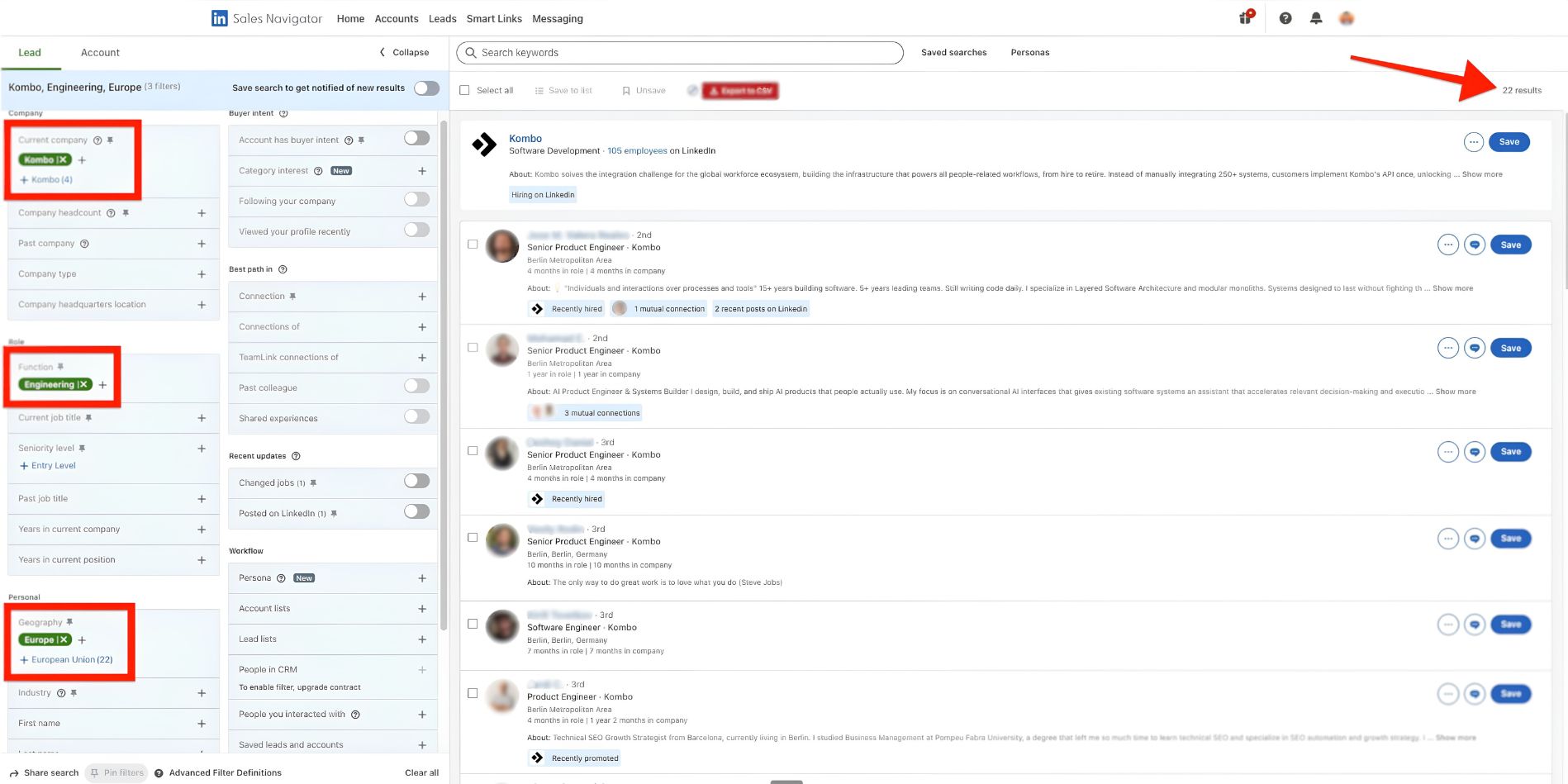
Its customer support team is also concentrated in Berlin, with three support employees based in Germany.
.jpg)
Kombo does have a US presence, but it is primarily commercial: approximately 21 employees across sales and marketing are based in the United States.
.jpg)
That distinction matters when Kombo's page repeatedly uses its New York presence to reinforce claims around enterprise support and data handling.
Kombo’s own comparison gives both vendors comparable security certifications and US/EU data residency, while calling Bindbee’s on-premise deployment “a genuine differentiator.”
Geography can matter. It is not the control itself.
Kombo says its engineering and support teams operate only from US and EU jurisdictions. If that is a contractual requirement for a buyer, it is a legitimate distinction.
What is less clear is for a US company, why engineering access from Berlin should inherently signal security while Bangalore should signal risk. The controls that actually matter are data residency, access permissions, encryption, auditability, contractual restrictions and infrastructure isolation.
Kombo’s engineering team is also based in Berlin, not US. So buyers should evaluate the operating model, not the office address.
When geography is a hard requirement, architecture matters more
Bindbee supports US and EU residency and can also be deployed on-premise for customers that require infrastructure to remain inside an environment they control.
Berlin appears throughout Kombo’s comparison as a trust signal. Bangalore appears as a risk.
Compete on the product. Compete on reliability. Compete on support. Compete on integration depth, security controls, enterprise readiness and what customers actually say.
All of that is fair.
We have read the comparison carefully. We understand where our engineers sit.
What we cannot find is the engineering argument for why that fact, on its own, makes the platform less secure.
The enterprise claim, checked on a site neither vendor controls
Kombo's page sorts the two vendors by customer size, and returns to it four times. Bindbee "serves primarily SMB customers in the Indian and US markets." Bindbee suits "straightforward HRIS reads at the SMB level." Bindbee fits "SMB-focused products in the Indian and US markets whose end customers have low compliance requirements." Bindbee is "a smaller, newer player covering HRIS and ATS integrations primarily for SMB customers." – these are all claims of Kombo without any proof or verification.
That is the page's central positioning claim. It is also the one claim on it a buyer can check in ninety seconds, on a site neither vendor controls.
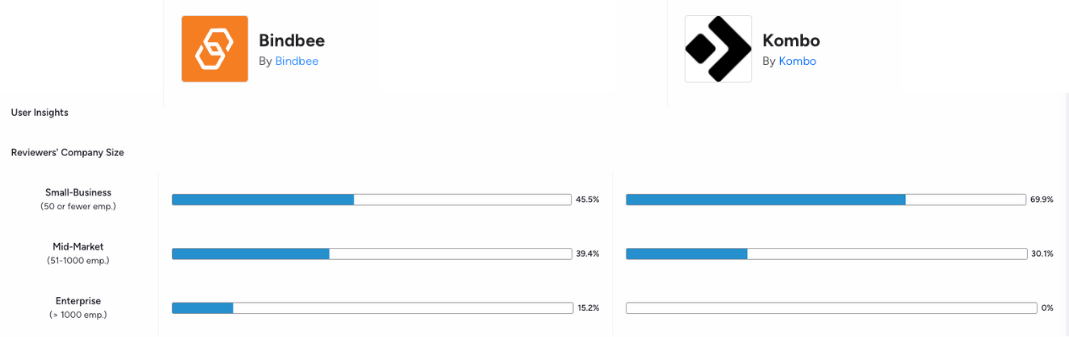
G2 records reviewer company size. On Kombo's profile: 87 reviews, 38 of which disclose company size. 27 Small-Business. 11 Mid-Market. Enterprise: zero.
Not few. None.
Two more things sit underneath the enterprise argument. Kombo does not offer on-premise deployment, and conceded in writing that for compliance-mandated buyers it is "a genuine differentiator." And the same Kombo paragraph that files Bindbee under SMB also recommends Bindbee "for benefits and dependents data models, and for customers who mandate on-premise deployment."
The page Kombo took down
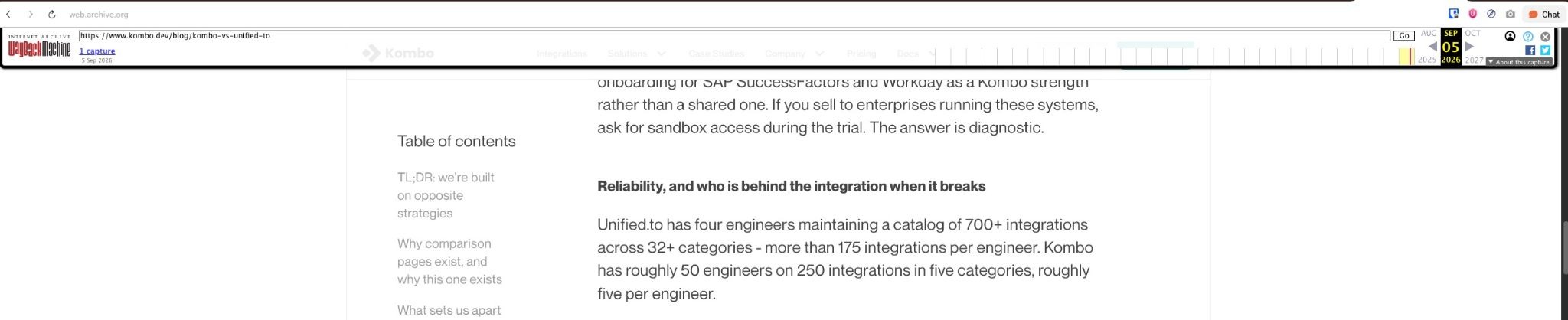
Kombo ran a second comparison page, this one against Unified.to. It is no longer on kombo.dev; the URL returns a not-found error. Bindbee captured the page on 5 September 2026 and archive.org holds a snapshot here, so what it said is still on the record.
On that page, Kombo proposed a metric for judging integration vendors, and told buyers to ask it: "How many engineers work on my category, and how many integrations does each maintain?"
Then Kombo answered it about itself, in its own table:
And in prose: "Unified.to has four engineers maintaining a catalog of 700+ integrations across 32+ categories, more than 175 integrations per engineer. Kombo has roughly 50 engineers on 250 integrations in five categories, roughly five per engineer."
There are two ways to read that, and Kombo has to pick one.
Either the 50 is not real. Public LinkedIn returns 23 profiles in Kombo's engineering function, 22 of them in Europe. The same company's page about Bindbee claims "six dedicated support engineers"; LinkedIn returns 3 in Kombo's support function in Europe. A vendor publishing a different headcount on every page is not well placed to correct anyone else's counting.
Or the 50 is real, and Kombo published its own inefficiency and called it a strength. Kombo put those two columns side by side on purpose, to argue that Unified.to was stretched too thin. Divide Kombo's own two figures: a Kombo engineer maintains integrations at roughly one thirty-fifth the rate of the vendor Kombo was mocking. Fifty engineers. Two hundred and fifty integrations. Five each.
In this category, building and maintaining integrations is not a side function. It is the entire product. Five integrations per engineer is not depth, it is fifty people doing what four people were doing next to them in Kombo's own table, and Kombo typed the ratio into a comparison page as a selling point.
Frequently asked questions
Is Bindbee a good option for enterprise customers?
Yes. Bindbee holds SOC 2 Type II, ISO 27001, HIPAA with a BAA, and GDPR with a DPA, and offers on-premise deployment where a compliance review requires it, which Kombo does not offer. Publicly listed companies and large third-party administrators in the United States run benefits and payroll data through Bindbee. Of the 87 reviews on Kombo's G2 profile, 38 disclose company size and none are in G2's Enterprise band.
Where is Bindbee's data hosted, and where does the team sit?
Bindbee runs two API regions: United States and European Union. Residency is selected by the customer. There is no instance in India. Bindbee's engineering team is in Bangalore, and Bindbee's support runs United States hours. Certifications and sub-processor disclosures are published at trust.bindbee.dev.
Which benefits objects does Bindbee support today?
Five, in production: Benefit, Employer Benefit, Dependent Benefit, Benefit Coverage and Dependent. They carry 11 benefit plan categories, 11 coverage tiers, employee and employer contribution splits across 12 frequency values, and a deduction_code field linking a plan to the payroll system that deducts for it. Kombo's 18 HRIS models contain no benefits object.
Does Bindbee support payroll write-back?
Yes. POST /api/hris/v1/employee-payroll-runs writes a payroll run carrying earnings, deductions, taxes, gross pay, net pay and check date, and a Meta API returns the request schema for each integration at runtime. Kombo's payroll objects are read-only and marked beta in Kombo's own documentation navigation.
How many integrations does Bindbee have?
Bindbee's public catalogue lists 67 HRIS and payroll connectors, plus 15 ATS connectors and 2 learning connectors. The catalogue is enumerable at docs.bindbee.dev/integrations.
How hard is it to migrate from Kombo to Bindbee?
Papershift did it and has been on Bindbee for two years. Their integration deployment time went from 90 days to under 24 hours and their customer onboarding time fell 85%. Kombo's comparison page carries an FAQ answering the reverse question. Bindbee can only speak to the direction it has seen.
What is Kombo better suited for?
Recruitment. Kombo's documentation lists 99 ATS connectors and 16 assessment and background check integrations, and carries HRIS models for skills, performance and staffing entities.
Does Bindbee support enterprise tool integrations?
Yes, Bindbee supports all enterprise tools like Workday, UKG Pro, UKG Ready, ADP, Oracle, SAP SuccessFactors etc in production with sandboxes.
What deployment options exist if compliance mandates on-premise?
Bindbee offers on-premise deployment. Kombo does not, and Kombo's own comparison page records this, describing it as "a genuine differentiator" for customers whose compliance requirements mandate it.