

What Are the Main Types of HR Technology?
.avif)
Summarise the blog with AI
Tired of every new client using a different HR system, leaving your team scrambling to build custom integrations for each one?
You're not alone. For HR Tech and benefits platforms, the proliferation of HR software categories means your product has to work with an increasingly fragmented landscape. Understanding what's in that landscape — and how the pieces connect — is the first step to building integrations that scale.
The HR Tech Stack: A Quick Map
HR technology broadly covers the systems companies use to manage their workforce. But within that, there are distinct categories with different data, different APIs, and different integration requirements.
HRIS (Human Resource Information Systems)
The core record of employee data. HRIS platforms manage employee profiles, org structure, job history, compensation, and time-off. Examples: Workday, BambooHR, Rippling, UKG, ADP Workforce Now.
For most HR Tech products, the HRIS is the primary data source. Getting clean, normalized employee data from these systems is what unlocks benefits enrollment, payroll deductions, and compliance workflows.
Payroll Systems
Manage compensation processing, tax calculations, and payment execution. Sometimes bundled with HRIS (Rippling, Gusto), sometimes standalone (ADP Run, Paychex, Paylocity).
Integration use cases: syncing deduction amounts, pulling payroll run data, writing compensation changes back after approval.
ATS (Applicant Tracking Systems)
Manage the hiring pipeline from job posting through offer. Examples: Greenhouse, Lever, Ashby, Workable.
Integration use cases: triggering onboarding workflows when a candidate is hired, syncing new hire data into the HRIS.
Benefits Administration Platforms
Manage employee benefits elections, carrier connections, and open enrollment. Examples: Employee Navigator, Ease, bswift, PlanSource.
Integration use cases: syncing enrollment changes to payroll for deduction updates, pulling eligibility data from the HRIS.
Learning Management Systems (LMS)
Manage employee training, certifications, and development. Examples: Cornerstone, Docebo, Workday Learning.
Integration use cases: syncing employee rosters from HRIS, triggering training assignments based on job changes.
Performance Management
Handle goal-setting, reviews, and feedback cycles. Often embedded in broader HCM suites but also standalone (Lattice, Leapsome, Culture Amp).
Time and Attendance
Track hours worked, schedules, and leave balances. Examples: Deputy, When I Work, UKG Dimensions.
Integration use cases: syncing time data to payroll, pulling leave balances into benefits platforms.
Why Category Awareness Matters for Integration
Different HR categories expose different data and have different API designs. A benefits platform connecting to an HRIS needs employee records and compensation data. Connecting to a payroll system needs deduction write-back capability. Connecting to an ATS needs hire events.
Treating all HR integrations as the same problem leads to shallow connectors that miss the data your product actually needs.
How Bindbee Covers the HR Tech Landscape
Bindbee is a unified API built specifically for HR Tech and benefits platforms. It covers HRIS, payroll, and ATS systems through a single normalized API, handling the schema differences and API complexity so your team doesn't have to.
Instead of building separate integrations per category and per vendor, you connect once to Bindbee and instantly unlock coverage across 102+ HR and payroll platforms, all with deep, normalized employment data models built for benefits, insurance, and payroll use cases.
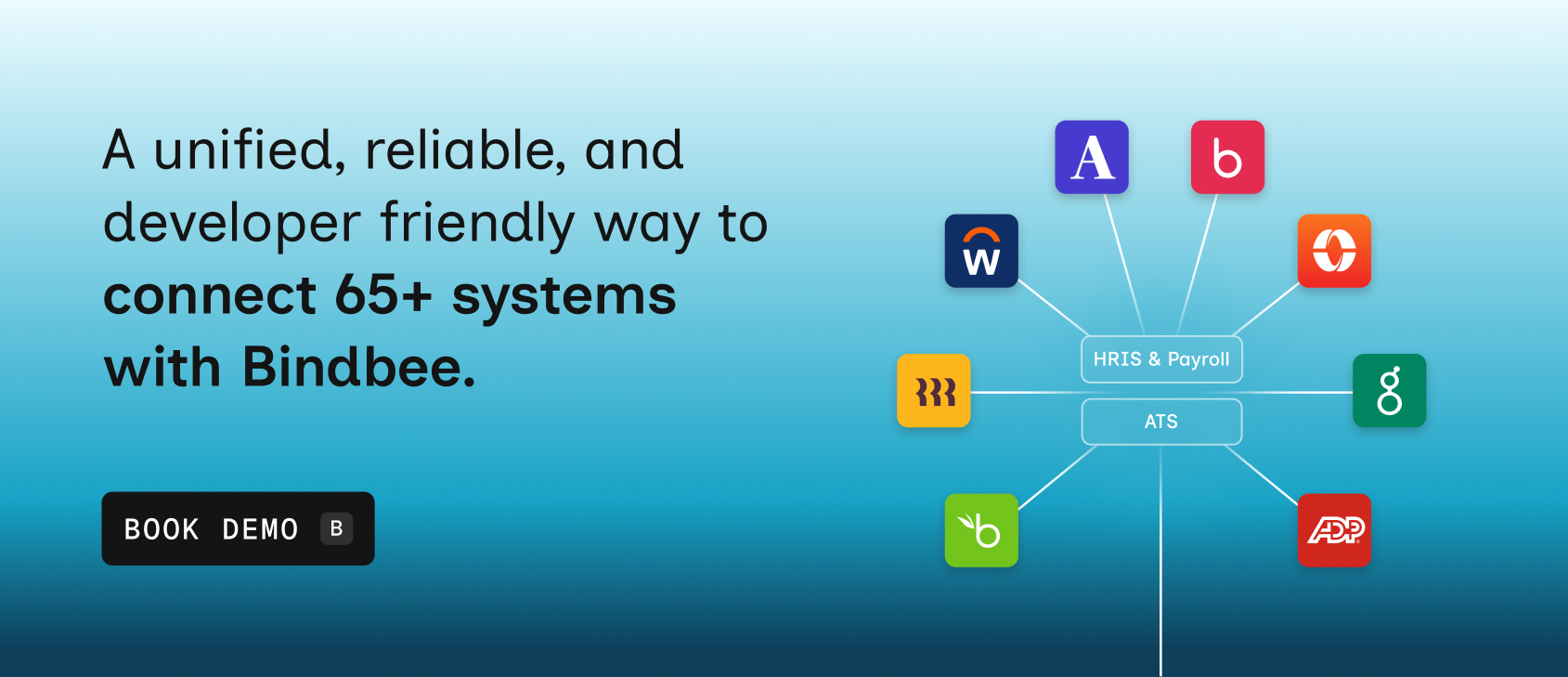
Book a demo to see how Bindbee covers HRIS, payroll, and ATS integrations through one API.