

Data Integration vs Application Integration: What to Use, When, and Why
.avif)
Summarise the blog with AI
Data integration and application integration are related concepts that get conflated frequently. Understanding the difference matters when you're evaluating integration infrastructure for an HR Tech or benefits platform, because the approach you choose determines what problems you can solve and what you'll be maintaining long-term.
Data Integration
Data integration focuses on combining, transforming, and normalizing data from multiple sources into a unified, queryable form. The output is typically a data store, data warehouse, or data lake where the combined dataset can be accessed for analytics, reporting, or machine learning.
Key characteristics: batch or scheduled processing, focus on historical accuracy and completeness, optimized for read-heavy analytical workloads, often involves ETL pipelines.
HR Tech use cases: compensation benchmarking across employers, workforce analytics, aggregating payroll run history for reporting.
Application Integration
Application integration connects live systems so they can exchange data in real time and coordinate workflows. The focus is operational accuracy — making sure the right data reaches the right system at the right time to support active business processes.
Key characteristics: real-time or near-real-time, event-driven, bidirectional, focused on workflow accuracy and operational reliability.
HR Tech use cases: syncing new hire data from HRIS to benefits platform, pushing deduction changes to payroll, triggering offboarding workflows on termination.
Where They Overlap
Most HR Tech platforms need both. Application integration keeps operational data current — enrollment changes reach payroll, new hires get provisioned. Data integration provides the historical view — compensation trends, benefits utilization, workforce cost analysis.
The integration layer underneath both needs to handle schema normalization across HRIS and payroll systems, which is why platforms like Bindbee that normalize employment data at the API layer simplify both use cases.
How Bindbee Fits
Bindbee focuses on application integration — connecting your product to 102+ HRIS, ATS, and payroll platforms in real time with normalized data models. This provides the foundation for both operational workflows and data integration use cases, since the normalized data flowing through Bindbee can feed both real-time operations and analytical pipelines.
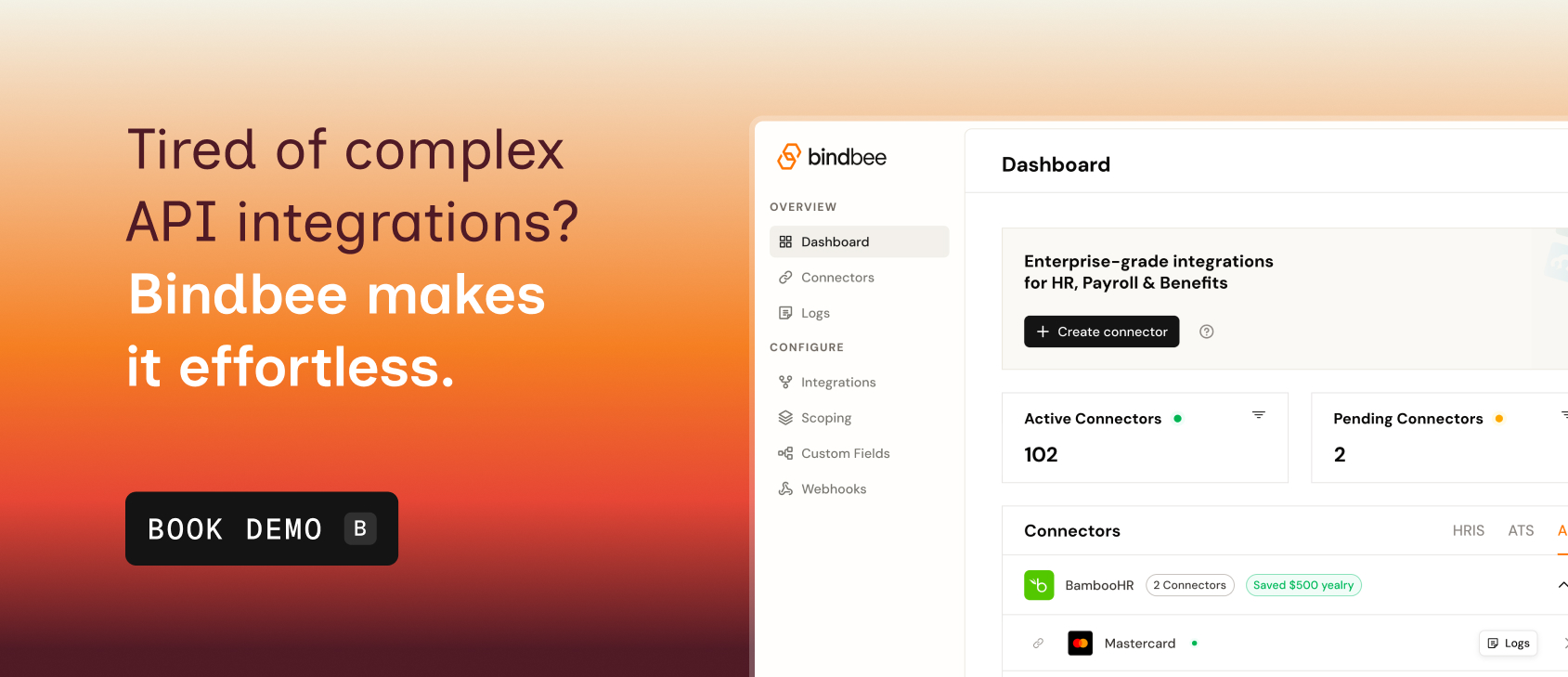
Book a demo to see how Bindbee supports both application and data integration for HR Tech.