

Top 8 API Use Cases for Modern SaaS Team
.avif)
Summarise the blog with AI
iPaaS for benefits covers a broad range of integration use cases, from syncing enrollment data to payroll to connecting carrier feeds to HR systems. The key use cases where iPaaS or unified API platforms deliver the most value for benefits teams are well-defined, and getting them right determines whether your benefits platform operates efficiently at scale.
Key Benefits iPaaS Use Cases
1. Enrollment Data Sync to Payroll
The most operationally critical integration for benefits platforms. When an employee enrolls in a health plan, dental, or vision coverage, the corresponding deduction amount needs to reach payroll before the next run. Delays or errors here result in incorrect paychecks, which creates immediate customer support escalations.
A benefits iPaaS layer handles this with write-back support to 102+ payroll systems, eliminating the manual export-import cycle.
2. Employee Roster Sync from HRIS
Your benefits platform needs a current, accurate employee roster to present the right plans to eligible employees. This requires real-time or near-real-time sync from the employer's HRIS — including new hires, terminations, and status changes.
Without this, enrollment windows open for ineligible employees, or eligible employees don't receive timely enrollment prompts.
3. Dependent Eligibility Management
Dependent records (spouse, children) and their eligibility status live in the HRIS but drive benefits coverage decisions. A benefits iPaaS layer pulls dependent data from each connected HRIS in a normalized format so your platform can evaluate eligibility consistently regardless of which system the employer uses.
4. Life Event Processing
Qualifying life events (marriage, birth, divorce) trigger a special enrollment period. These events need to surface in your benefits platform quickly so the employee can make elections within the allowed window. Webhook-based integration from the HRIS enables near-real-time event processing.
5. Open Enrollment Automation
During open enrollment, your platform needs to pull the current employee roster, apply eligibility rules, present plan options, capture elections, and push deduction updates back to payroll — all reliably within a compressed time window. An integration layer that handles the HRIS pull and payroll write-back automatically reduces the risk of errors during this high-stakes period.
6. Carrier Feed Management
Benefits data needs to flow from your platform to insurance carriers, typically via flat file or EDI. Integrating with carriers through a standardized layer rather than one-off file formats reduces maintenance overhead and improves accuracy.
How Bindbee Addresses Benefits iPaaS Use Cases
Bindbee provides a unified API covering 102+ HRIS and payroll systems with the data models needed for benefits use cases: employees, dependents, deductions, and time-off. Bidirectional sync, real-time webhooks, and embedded auth flows let your benefits platform stay current without manual intervention.
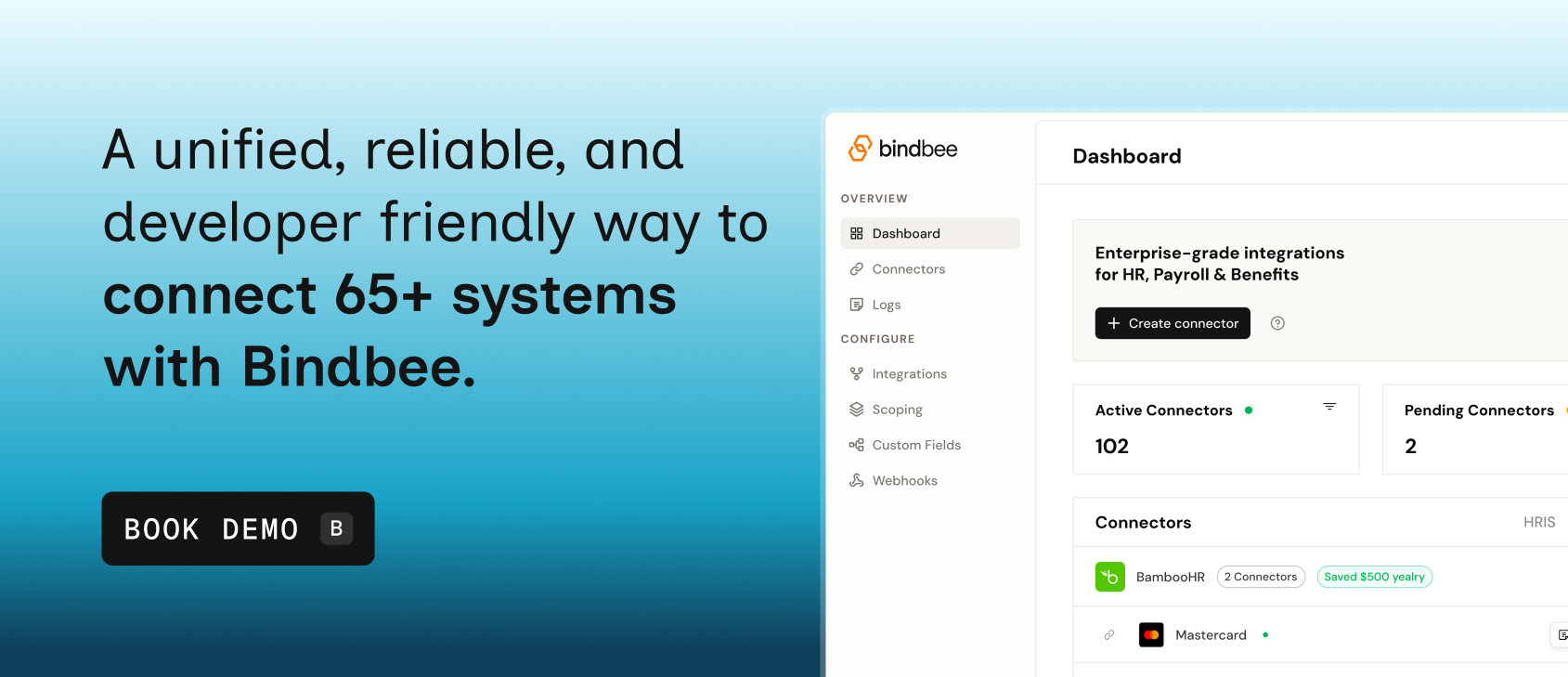
Book a demo to see how Bindbee supports benefits integration use cases.